






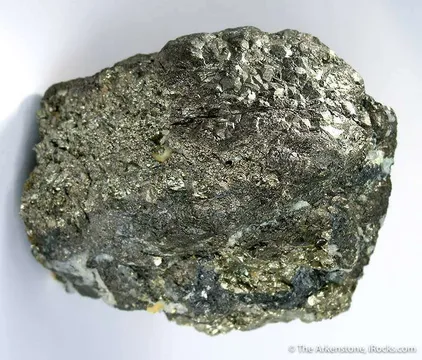
Steward Mine, USA — classic Butte locality; enargite, pyrite, bornite, and copper-sulfosalts, with mine-labels and sharp terminations prized by collectors.
Key facts
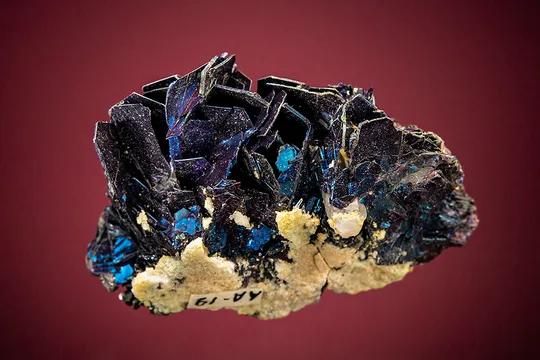
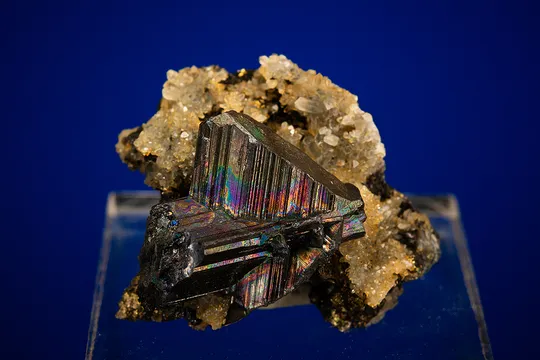
The Steward Mine is one of the classic underground mines of Butte, Montana’s “Richest Hill on Earth,” and for collectors it belongs to the sulfide side of Butte’s fame: enargite, pyrite, bornite, chalcocite, digenite, covellite, tennantite, and rarer copper-sulfosalt species rather than the bright oxidized copper carbonates that dominate many Western mining camps. Its significance is inseparable from Butte’s porphyry-to-lode hydrothermal system. The mine worked a major member of the Steward fault-vein system, where older quartz-pyrite veins were reopened, shattered, dragged, and locally re-cemented by later copper-silver sulfides. That structural history is exactly why good Steward specimens often have the slightly violent look prized by Butte collectors: brassy pyrite sparkling across dark copper sulfides, sharp steel-gray enargite prisms protruding from quartz-pyrite gangue, and occasional rare species appearing in seams and microcrystal coatings from deep levels.
Regional View
Country View
Historically, Steward was not a peripheral prospect but a serious Butte producer associated first with William A. Clark’s Original Consolidated Mining Company and later the Anaconda Copper Mining Company. It stood on the west side of the Butte hill, north of Woolman Street between North Main and Wyoming Streets, in a dense mining landscape where shafts, hoist houses, rail connections, and ore bins occupied city blocks above thousands of feet of underground workings. The mine’s surviving headframe and hoist buildings remain part of the Butte-Anaconda historic landscape, while the underground workings are closed and flooded as part of the Butte mine-water system.

Photo: James St. John via Wikimedia Commons
The best Steward pieces are old-time Butte specimens with mine-specific labels. They tend to reward close viewing more than casual display: the collector looks for crisp enargite terminations rather than massive black ore, bright pyrite sprinkled on crystal faces rather than dull granular sulfide, and old associations such as enargite-pyrite-quartz, bornite-pyrite-quartz, digenite-chalcocite-pyrite, purple fluorite with rhodochrosite, and rare betekhtinite needles in copper-sulfide matrix. In the Butte cabinet, Steward specimens occupy the attractive middle ground between the legendary covellite and chalcocite pieces of the district and the rarer, more research-driven sulfosalts that serious collectors chase by old label and level notation.
Search for specimens: View all specimens from Steward Mine, USA
The Steward Mine is in the Butte Mining District, Silver Bow County, Montana, within the great polymetallic vein and porphyry copper-molybdenum system developed in and around the Butte Quartz Monzonite of the Boulder Batholith. In modern genetic terms, Butte records deep pre-Main Stage porphyry Cu-Mo mineralization overprinted by Main Stage Ag-Zn-Cu lodes, with later high-sulfidation copper lodes rich in minerals such as enargite, chalcocite, covellite, digenite, bornite, and pyrite. Steward belongs to the lode-mining story: a structurally complex, steeply dipping vein system rather than a simple open pit or replacement blanket.
Classic USGS work treated the Steward system as a set of mineralized fault veins that cut and reopened older quartz-pyrite veins. The named Steward fault vein is the most important member of that system. In the western part of the copper area, the Steward, No. 6, and Blue Jay fault veins formed a group of south-dipping fractures; the Steward lode was developed from the west end of the Gagnon eastward toward the Nipper property. The mine’s characteristic ore came where older quartz-pyrite vein filling was cracked, brecciated, dragged into fault matter, and then mineralized by later sulfide-bearing solutions. This produced a mixture of solid quartz-pyrite ore, clay gouge, crushed granite, ore balls, bornite, enargite, chalcocite, sphalerite, galena, barite, and local calcite.
The old geological descriptions are unusually vivid. On the 700-foot level the Acquisition vein was described as a roughly 15-foot-wide body of dry, solid quartz and pyrite, irregularly enriched by bornite. Pyrite occurred in nearly solid bands a foot or more thick, and vuggy footwall streaks carried bunches of bornite two to six inches thick. Between the 700- and 900-foot levels, the Steward vein contained a peculiar arkose or sandstone-like filling, formed where the strike fault opened fissures and allowed material from above to wash down and settle in near-horizontal layers. Elsewhere this gave way to fault breccia and conglomerate made of crushed granite, clay, rounded ore fragments, and fragments of older quartz-pyrite vein.
The important copper mineralization strengthened downward. Bornite increased and enargite appeared in quantity at about the 900-foot level and below. Where the older vein was only cracked, chalcocite and bornite enriched those cracks; where it was strongly brecciated, the stopes could show eight to ten feet of ore consisting of clay, crushed rock, ore balls, secondary chalcopyrite, bornite, and enargite. The Steward vein could be narrow or enormous depending on structure: in places only a few feet wide, but in deeper workings the fault zone was reported as 50 to 75 feet between limiting fractures, with an average workable width of roughly 25 feet below the 1,100-foot level.
Mining history at Steward spans the long underground era of Butte. Historic district records place the mine within William Clark’s Original Consolidated Mining Company from 1885 until acquisition by the Anaconda Copper Mining Company in 1910. In 1897, the Steward shaft had reached 600 feet, with six men underground, three men on surface, and two hoist engineers. The older workings included an inclined shaft near the Nipper; later, the West Steward shaft became the principal working shaft after deeper ore bodies were found. By 1912, USGS accounts described the West Steward shaft as 1,800 feet deep. Later records show the mine becoming much deeper: by 1920 the shaft had reached more than 3,600 feet, and later summaries give a final depth near 4,400 feet before underground operations ended in the 1970s, with limited experimental mining continuing afterward.
For collectors, the mine’s production history matters because the specimens are not from a single small pocket or tourist dig. They came from decades of industrial underground work, from ore shoots, raises, level development, and high-sulfidation sulfide zones that were being mined for copper, silver, and associated metals. The specimen record includes classic enargite-pyrite pieces, pyrite-rich quartz ore, bornite with pyrite and quartz, digenite-chalcocite slabs with pyrite, betekhtinite from the 3,800-foot level, hinsdalite with enargite, chalcocite plates on quartz, purple fluorite with quartz needles and rhodochrosite, and rare silver-bismuth-copper sulfosalts documented in mineralogical reports.
The Steward site today is a historic mineyard, not a collecting locality. The headframe, hoist house, auxiliary hoist house, and associated structures survive in Butte’s historic mining landscape, but the underground is closed, hazardous, and part of the monitored Butte mine-flooding system. Collecting underground material is not a present-day field option; Steward specimens on the market are old mine material, collection pieces, dealer discoveries, or inherited Butte lots. For that reason, an old handwritten or typed Steward label, especially one giving a level or a former Butte collector, adds real value.
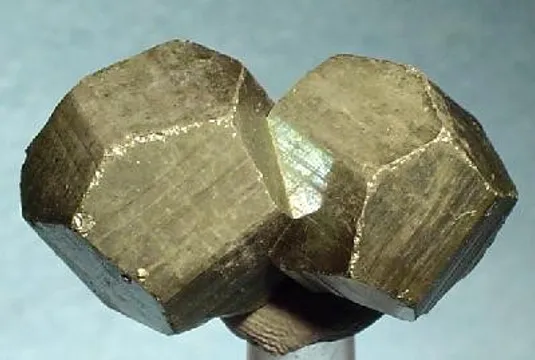
Steward Mine pyrite is not merely accessory brassy dust; it is one of the structural and aesthetic constants of the locality, occurring as massive quartz-pyrite ore, banded pyrite-rich streaks, drusy coatings, and bright small crystals associated with enargite, chalcocite-digenite, bornite, quartz, and rare sulfosalts. The old ore descriptions record nearly solid pyrite bands a foot or more thick in the quartz-pyrite vein material, while collector specimens show a more cabinet-friendly expression: glittering yellow pyrite decorating dark enargite prisms, pyrite on quartz with bluish-gray digenite-chalcocite, and pyrite forming sparkling matrices for rarer copper sulfides. The best pyrite-bearing Steward specimens are those in which the pyrite is fresh, bright, and textural—crystals or drusy crusts that frame the darker sulfides—rather than dull granular ore with no crystal definition.
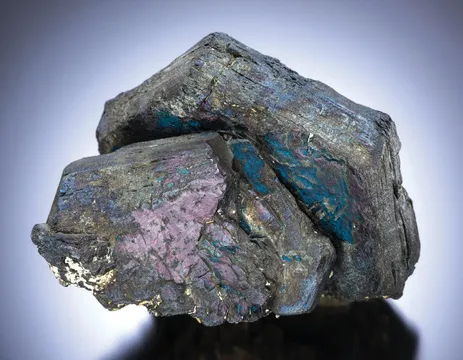
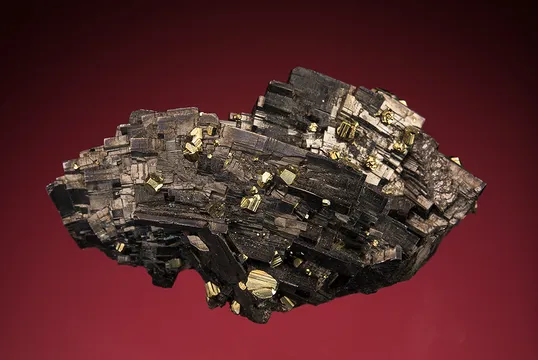
Steward enargite is classic Butte high-sulfidation copper mineralization: dark steel-gray to blackish metallic crystals and masses in a quartz-pyrite copper-sulfide gangue, commonly accompanied by pyrite and locally by bornite, chalcopyrite, chalcocite, hinsdalite, and quartz. Good specimens show sharp prismatic enargite crystals rather than massive arsenic-copper ore; one well-known old-style Steward example has sharp crystals to about 2.5 cm, with bright little pyrites decorating the enargite surfaces and only a small amount of matrix. Enargite became important in the deeper Steward ore, appearing in quantity around the 900-foot level and below, and the finest collector pieces preserve that deep-lode character: metallic, angular, three-dimensional clusters with crisp terminations, clean contrast against pyrite or quartz, and minimal bruising on the projecting crystals.
Beyond pyrite and enargite, Steward is documented for a compact but rich Butte suite: bornite, chalcocite, digenite, covellite, chalcopyrite, galena, sphalerite, tennantite, tetrahedrite-group minerals, calcite, barite, fluorite, quartz, rhodochrosite, siderite, dolomite, ankerite, muscovite-sericite, hübnerite, scheelite, native silver, stromeyerite, uraninite, and rare sulfosalts including aikinite, wittichenite, betekhtinite, and colusite. Colusite is especially important in a district context: Butte’s recognized type-locality mineral is colusite, named for the Colusa locality, and Steward is one of the Butte mines from which colusite has been recorded. Betekhtinite is a particularly desirable Steward rarity, known from needle-like charcoal-gray crystals in chalcocite-digenite matrix from the 3,800-foot level; hinsdalite with iridescent enargite and purple fluorite with rhodochrosite are also locality pieces that advanced Butte collectors notice immediately.
The chief authenticity issue with Steward specimens is locality precision. Many Butte sulfides circulated for decades under labels that read only “Butte, Montana,” and some mine names were applied later from memory, dealer stock, or district habit. A Steward label is strongest when it is old, specific, and internally plausible—ideally with the mine name spelled Steward or the historically common Stewart variant, an association typical of the mine, a former Butte or Anaconda collector, and, best of all, a level notation such as the documented deep-level betekhtinite material. Specimens labeled simply “Butte” should not be upgraded to Steward without supporting evidence.
No well-documented Steward-specific fake industry is apparent in the published and collection literature, but misidentification is easy in this district. Massive chalcocite, digenite, bornite, covellite, and enargite can be visually deceptive, especially when tarnished, intergrown, or present as sooty black coatings on quartz-pyrite ore. Claims such as “digenite,” “chalcocite,” “covellite after enargite,” or rare sulfosalt species deserve caution unless the piece is from a trusted old collection or has analytical support. Fine colusite, betekhtinite, wittichenite, aikinite, and stromeyerite should be treated as analytical or provenance-dependent minerals, not sight identifications for ordinary market purposes.
Condition is a serious consideration. Steward enargite crystals are brittle and often stand proud of the matrix; look closely for bruised terminations, repaired clusters, and rubbed edges. Pyrite can dull or tarnish but should not be crumbly; avoid pieces with active sulfide decay, powdery efflorescence, or acid odor. Butte copper sulfide slabs may have natural sootiness, iridescence, or uneven surfaces, but fresh breaks and sawed backs should be disclosed. Enargite contains arsenic, and many Butte sulfide ores contain other potentially toxic metals; collectors should wash hands after handling, avoid inhaling dust, and never trim, grind, or acid-clean such material without proper controls.
Market availability is modest but steady by old-camp standards. Steward is not as common on the specimen market as broad “Butte” material, and it is less frequently seen than pieces from the most famous Butte names such as Leonard, East Colusa, or Mountain Con. Good enargite-pyrite miniatures, attractive pyrite-rich sulfide specimens, and old bornite or chalcocite-digenite pieces appear occasionally. The rare species—especially well-labeled betekhtinite, colusite, wittichenite, and unusual fluorite-rhodochrosite associations—are much scarcer and are best regarded as specialist Butte-suite material.
On January 15, 1960, Raymond Lasmanis was working in the Steward Mine, running a slusher in the 3091 raise on the 3,000-foot level after a blast, when his headlamp caught the flash of tiny crystals. He collected four specimens with 2-mm crystals that looked to him like scheelite. The identification was later confirmed by Dr. John Guilbert of the Anaconda Geological Research Laboratory as the first known scheelite from Butte. Lasmanis gave two of the specimens to the Anaconda Reference Mineral Collection and, in exchange, was offered his choice from a group of small colusite crystals on enargite that Bob Ingersol had collected on the 3,200-foot level of the Leonard Mine.
The same account ends with one of those hardrock-mining moments that sounds almost invented until one remembers Butte’s combination of gallows humor, machinery, and vertical depth. Later, in the middle of a day shift at the Steward, Lasmanis was told to report to the shaft station and be hoisted to surface. The skip was empty except for him. It rose so fast that he later called it the “ride of my life,” and when it reached the surface it missed the sheets and shot up into the headframe. He thought he was going to die. It turned out the hoistman knew it was Lasmanis’s last shift and had given him a farewell ride. At the office he was thanked for the scheelite discovery, handed airplane tickets, and promoted to work on an induced-polarization geophysical study in the Escalante Desert of southwestern Utah.
Another Steward story survives not in a mineral cabinet but in the night skyline of Butte. In October 2005, about 150 people gathered for a headframe-lighting ceremony, including roughly 50 retired workers who had worked underground at the Steward and nearby Mountain Con. The illuminated headframes are more than civic decoration; in Butte they are vertical memorials to the mines beneath the streets. Steward’s lit steel frame marks a mine that was simultaneously an ore producer, a workplace, a specimen source, and, today, a visible remnant of the underground city below the city.
Weed, W. H. (1912). Geology and Ore Deposits of the Butte District, Montana. U.S. Geological Survey Professional Paper 74. The foundational detailed geological treatment of Butte’s veins, with an extended description of the Steward fault vein, ore bodies, levels, fault breccias, pyrite-quartz ore, bornite, enargite, sphalerite, galena, barite, and structural relations.
Guilbert, J. M., and Zeihen, L. G. (1964). The Mineralogy of the Butte District, Montana. Montana Bureau of Mines and Geology Open-File Report 268. Important district mineralogy reference documenting rare and common Butte species; Steward entries include aikinite, ankerite, apatite, barite, betekhtinite, colusite, dolomite, fluorite, hübnerite, muscovite, native silver, rhodochrosite, scheelite, sericite, stromeyerite, uraninite, and wittichenite.
Landon, R. E., and Mogilnor, A. H. (1933). “Colusite, a New Mineral of the Sphalerite Group.” American Mineralogist, 18, 528–533. Original formal description of colusite, Butte’s famous type-locality mineral; Steward is a recorded Butte occurrence of the species, although the type locality is the East Colusa locality.
Zachariasen, W. H. (1933). “X-Ray Examination of Colusite.” American Mineralogist, 18, 534–537. Early crystallographic work on colusite from Butte, useful background for understanding why colusite is not a casual sight-identification mineral.
Rusk, B. G., Reed, M. H., Dilles, J. H., and others. “Two-event lode-ore deposition at Butte, USA: 40Ar/39Ar and U-Pb documentation of Ag-Au-polymetallic lodes overprinted by younger stockwork Cu-Mo ores and penecontemporaneous Cu lodes.” U.S. Geological Survey publication page. Modern geochronologic and genetic framework for Butte’s porphyry and lode events, including the high-sulfidation copper lodes relevant to enargite-pyrite assemblages.
Reed, M. H., Rusk, B. G., and Palandri, J. (2013). “The Butte Magmatic-Hydrothermal System: One Fluid Yields All Alteration and Veins.” Economic Geology, 108, 1379–1396. Technical study of the Butte hydrothermal system, including high-sulfur assemblages with pyrite, enargite, covellite, and digenite.
Lasmanis, R. (2005). Letter in The Mineralogical Record, vol. 36, no. 4, July–August 2005. First-person account of finding scheelite crystals in the Steward Mine on January 15, 1960, and of the subsequent confirmation by Dr. John Guilbert.
Historic American Engineering Record. Butte Mineyards, Stewart Mine, Intersection of Main & Woolman Streets, Butte, Silver Bow County, MT. HAER MT-36-C. Library of Congress. Archival documentation of the Steward/Stewart mineyard, with photographs, captions, and historical notes on its association with William A. Clark and the Anaconda Copper Mining Company.
National Park Service. Butte-Anaconda Historic District National Historic Landmark nomination. Historic-district documentation covering the Steward Mine’s ownership history, location, surviving structures, and role in Butte’s mining landscape.
Butte Mineyards, Stewart Mine, Intersection of Main & Woolman Streets, Butte, Silver Bow County, MT — Historic American Engineering Record / Library of Congress — A 23-photograph HAER record with data pages and captions documenting the headframe, hoist houses, machinery, and mineyard.
Category: Steward Mine — Wikimedia Commons — A media gallery containing HAER images and modern photographs of the Steward Mine headframe and associated structures.
HISTORIC AMERICAN ENGINEERING RECORD: Butte Mineyards, Stewart Mine — Library of Congress caption pages — Caption pages identifying individual views of the Steward headframe, hoists, discharge chute, shaft collar, and machinery.
Steward Mine locality page — Mindat — The central locality page for Steward Mine mineral listings, gallery entries, coordinates, and collector-photo references.
Steward Mine gallery — Mindat — Useful for seeing documented specimen associations such as enargite-pyrite, betekhtinite in chalcocite-digenite matrix, hinsdalite with enargite, chalcocite, fluorite, and covellite-pyrite pieces.
Steward Mine — Western Mining History — Concise mining-database entry identifying Steward as a copper-silver-gold mine in Silver Bow County and listing Anaconda as owner.
Geology and Ore Deposits of the Butte District, Montana — Mountain Man Mining Library — Searchable presentation of the classic USGS Professional Paper 74 text, including the detailed Steward Mine and Steward fault-vein descriptions.
Geology and Ore Deposits of the Butte District, Montana — USGS PDF — The original USGS report in PDF form, indispensable for serious study of Butte vein structure and ore mineralization.
Butte, Montana – The Richest Hill on Earth — Dakota Matrix Minerals — Collector-oriented overview of Butte mineral specimens, including chalcocite, colusite, galena, and district context.
The Mineralogy of the Butte District, Montana — MBMG Open-File Report 268 — Important mineralogical reference for Butte’s documented species and rare-mineral occurrences.
Current Site Status — Silver Bow Creek/Butte Area, U.S. EPA — Current environmental and mine-flooding context for Butte, including the Berkeley Pit and flooded underground mine workings.
Butte Mine Flooding — Montana Bureau of Mines and Geology — MBMG’s overview of long-term water-level and water-quality monitoring in the Butte mine-flooding system.
Steward Mine headframe photograph — Wikimedia Commons — Modern image of the surviving Steward headframe with useful caption information and licensing.
.jpg)