Pingtouling Mine, China - Guangdong oxidized lead-zinc locality famed for orange mimetite crystals and scorodite, a prized collecting site.
Key facts
Pingtouling is a small mine with an outsized reputation: a lead-zinc deposit in northwestern Guangdong that, for a brief interval at the beginning of the twenty-first century, rewrote expectations for Chinese mimetite. The mine lies in Liannan Yao Autonomous County, Qingyuan, and is also encountered on specimen labels as the Dashuihu Mine, a local name referring to the flooded old workings. Mineralogically it is a skarn-type lead-zinc system with a strongly developed oxidized gossan, the kind of iron-rich weathering zone where galena, sphalerite and arsenic-bearing minerals can be transformed into brilliant secondary arsenates and sulfates.
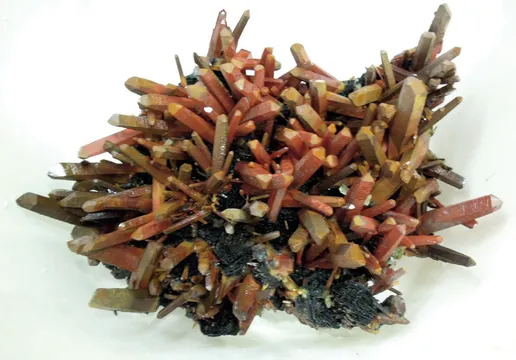
For collectors, Pingtouling means orange mimetite: lustrous, gemmy to translucent hexagonal crystals, usually bright honey-orange to yellow-orange, perched on rusty brown limonite and goethite-rich matrix. The best pieces have real sculptural presence rather than merely a coating of color—open vugs, sparkling crystal carpets, and airy stepped or barrel-like crystals that catch light from every angle. When these specimens first reached the international market in early 2003, they were initially surrounded by locality confusion, but they were soon recognized as a distinctive Guangdong occurrence and became one of the signature Chinese mineral finds of the modern collecting era.
Regional View
Country View
The locality is also important because the mimetite was not an isolated curiosity. Later in 2003, a very small number of fine scorodite specimens were recognized from the same mine—sharp, lustrous blue-green to greenish crystals on gossan, with associated anglesite, arseniosiderite and beudantite. That second discovery confirmed Pingtouling as an unusually productive oxidized arsenic-rich lead-zinc environment, even though the great specimen-producing episode appears to have been short-lived.

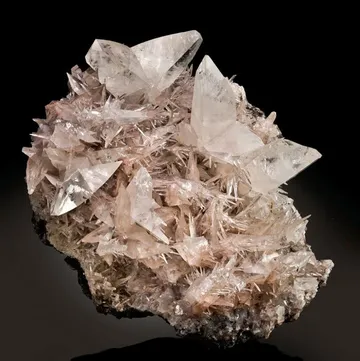
Photo: Wikimedia Commons

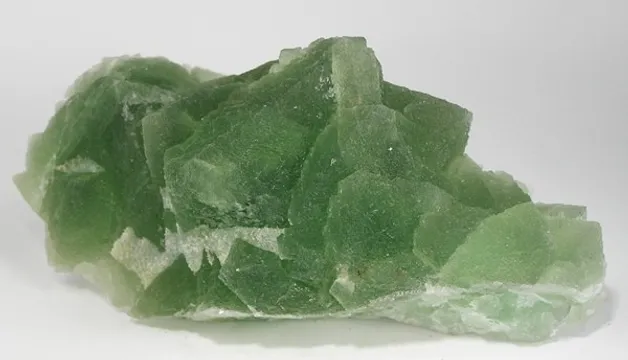
Photo: Wikimedia Commons
Search for specimens: View all specimens from Pingtouling Mine, China
Pingtouling Mine is the Pingtouling lead-zinc mine of Liannan Yao Autonomous County, Qingyuan, Guangdong Province, China, with the Chinese locality name 坪头岭铅锌矿. Modern specimen literature places it in northwestern Guangdong, and official county and municipal documents tie the mine to Zhaigang Town. The frequently seen alternate name “Dashuihu” is not a separate mineral locality in the collector sense; it refers to the old flooded workings and has been used locally for the abandoned mine area.
The deposit is described in collector and locality references as a skarn-type lead-zinc deposit and, more broadly, as a hydrothermal polymetallic system hosted in granite. The collectable minerals came from the oxidized zone: a limonitic to goethitic gossan developed above or around primary sulfide mineralization. In that setting, primary galena and sphalerite supplied lead and zinc, while arsenic-rich fluids or arsenic-bearing primary minerals supplied the chemistry that produced mimetite and scorodite during supergene alteration. The matrix on classic specimens is therefore not incidental; the rusty, earthy gossan is the actual weathered ore environment that made the specimens possible.
Mining at Pingtouling reportedly began in 1967. The old workings later flooded, and the locality passed through a period in which it was essentially known locally as a water-filled abandoned mine. Specimen accounts state that the mine was reopened by a private owner in 1999, and the major collector episode followed only a few years later. The first world-class mimetite specimens reached the mineral market in January 2003. Several thousand mimetite specimens were reportedly recovered, ranging from thumbnail and miniature pieces to cabinet specimens, with the finest examples carrying sharp yellow-orange crystals to more than 2 cm. By late 2003, a small but important scorodite pocket had also been encountered.
Official Chinese mining documents show that Pingtouling did not simply disappear after the specimen boom. Qingyuan mineral-resource planning materials list an integrated mining-right block for Liannan Yucheng Mining’s Zhaigang Town Pingtouling lead-zinc mine, combining several old lead-zinc workings in the Laohuchong and Pingtouling area into a single block of about 0.7044 km². A 2021 county emergency-management notice addressed to Liannan Yucheng Mining describes a Pingtouling lead-zinc-copper underground mining reconstruction project with a planned 30,000-ton-per-year capacity for the X XVII orebody, and records that the second work area was ordered to stop construction after safety inspections and incomplete rectification. Provincial safety-risk listings later continued to treat the Pingtouling workings as regulated underground noncoal mine areas under Qingyuan supervision.
For collectors, that modern regulatory history matters chiefly for access. Pingtouling is not a casual field-collecting site. It is an underground mine area with documented flooding, karst subsidence and regulatory safety concerns; any collecting without explicit permission from the landholder and mining-right holder should be considered unsafe and inappropriate. The supply available to collectors today is overwhelmingly from the 2002–2003 mimetite finds, plus the much scarcer scorodite material and a few later or redistributed specimens. No large, steady stream of new mimetite pockets comparable to the original discovery has been documented.
The classic pockets produced mimetite on limonite and goethite-rich gossan, sometimes with calcite noted in association. Better pieces show freestanding crystal sprays or dense drusy blankets rather than dull crusts. The later scorodite material came as cavity linings in earthy brown gossan, with crystals reported to 1 cm and only a small number of specimens saved. Those scorodites, and the accessory anglesite, arseniosiderite and beudantite noted with them, help complete the picture of Pingtouling as a compact but chemically lively oxidized lead-zinc-arsenic system.
Pingtouling mimetite is most admired as bright yellow-orange to deep honey-orange hexagonal crystals on rusty gossan, typically forming sparkling druses, stepped barrel-like crystals, and intergrown clusters on limonite or goethite matrix; many market specimens show crystals in the few-millimeter to 1 cm range, while the best documented pieces reached more than 2 cm and elevated the find to world-class status. The finest examples are sharply crystallized, lustrous, translucent to gemmy, and arranged with open relief on matrix, not merely as a flat sugary coating. Ordinary pieces tend to be dense but less transparent, more contacted, or visually crowded by iron oxide; superior ones have saturated color, clean crystal faces, strong sparkle, and the unmistakable contrast of orange mimetite against dark brown gossan from the 2002–2003 discovery period.
Beyond mimetite, Pingtouling has a short but interesting mineral list. Primary ore minerals include galena and sphalerite, while the oxidized assemblage includes anglesite, scorodite, arseniosiderite and beudantite; native lead and native zinc are also recorded, both notable rarities in any lead-zinc oxidation environment. No type-locality mineral species are known from Pingtouling, but the locality’s scorodite deserves special attention: only a small number of attractive specimens were saved from the 2003 pocket, with sharp blue-green to green crystals lining gossan cavities and, in some reported examples, small pyrite crystals on the matrix.
The main collecting issue with Pingtouling is locality discipline. Early Chinese mimetite specimens from this find circulated under confusing labels, including Hunan, Guangxi and Guangdong, and some were erroneously tied to Hezhou or Bapu in Guangxi. “Dashuihu Mine” is acceptable as an alternate or historical name when paired with Pingtouling, Liannan County, Qingyuan, Guangdong; by itself it is less precise. Labels reading “Bapu,” “Hezhou,” or vague “Guangxi” for the classic orange material should be treated as legacy misattributions unless supported by later corrected documentation.
No well-documented treatment or manufactured-fake problem is specifically associated with Pingtouling mimetite in the major sources, but the usual caution for highly desirable Chinese secondary minerals applies: examine crystal continuity into the matrix, look for glue at attachment points, and be wary of unusually isolated “perfect” crystals on unrelated-looking limonite. Because mimetite is a dense lead arsenate chloride, even small specimens feel heavy for their size; feather-light or resinous-looking pieces deserve closer inspection.
Condition is a real market separator. Pingtouling mimetite commonly occurs as brittle, exposed crystals on friable gossan. Edge chipping, bruised terminations, contacted crystal tips and crumbly matrix are common, especially on larger plates. Good specimens tolerate minor peripheral damage if the display face is bright and intact, but top examples should show undulled luster, sharp terminations, and little fresh breakage across the main crystal field. Iron staining is normal and usually part of the matrix character, not a defect.
Handle these specimens as lead- and arsenic-bearing minerals: keep them dry, avoid acids and ultrasonic cleaning, do not generate dust, wash hands after handling, and do not store loose fragments where children or pets can access them. The gossan matrix can shed grains, so a fitted box or acrylic base is often kinder than repeated bare handling. Pingtouling mimetite remains available on the collector market, but truly fine, damage-light, gemmy orange matrix pieces are finite and increasingly treated as modern classics. Pingtouling scorodite is much rarer; when a credible example appears, documentation and condition are both crucial.
The first story of Pingtouling is a story of confusion. When the orange mimetite hit the 2003 mineral market, it did not arrive with the tidy locality data collectors now expect. Specimens were passed around under broad or shifting Chinese province names—Hunan, Guangxi, Guangdong—and the material became famous before its mine was firmly pinned down. That uncertainty only sharpened the excitement: analyses in China, the United States and Germany confirmed that the brilliant orange crystals were indeed mimetite, while dealers and collectors tried to trace the actual source. Liu Guanghua later described buying a large lot of the specimens in Changsha in April 2003 while still not knowing the exact locality. The true source was eventually fixed as Pingtouling, near Liannan in Guangdong, not the Guangxi localities that had become attached to some early labels.
The second story belongs to scorodite, and it has the feel of a near miss. In November 2003, after the mimetite had already made the mine famous, a major pocket of crystallized scorodite was encountered at Pingtouling. According to the account relayed by Martin Jensen to Thomas P. Moore, an entire ore car full of crystallized scorodite was removed, but the value of the material was recognized only at the last moment before the car went to the crusher. Only about thirty specimens were saved. Jensen brought those thirty pieces to the United States, and John Veevaert obtained about eight of them. The surviving pieces showed sharp, mirror-faced, lightly striated, highly lustrous crystals to 1 cm, with a striking color shift from blue-green to purple-blue between indoor and outdoor light. In collector terms, the pocket was large; the saved population was tiny.

Photo: Wikimedia Commons