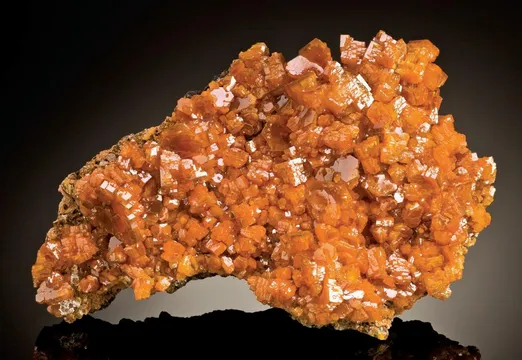
Guangdong, China — a mineral-rich locality noted for fluorite-quartz veins, green-to-purple octahedral fluorites, and notable copper and topaz finds at Shilu,…
Key facts
Guangdong is best understood by collectors not as a single mine locality but as a mineral-rich province on the southeastern edge of South China, where the Cathaysia Block, the Nanling metallogenic belt, and the coastal Yanshanian granite-volcanic province overlap. That setting produced a remarkable spread of specimen environments: fluorite-quartz veins in northern and eastern Guangdong, copper-iron skarn and oxidized copper zones at Shilu, polymetallic and tungsten systems such as Dabaoshan and Lianhuashan, uranium fields around northern Guangdong, and the scientifically important Yushui Cu-polymetallic deposit near Meizhou. The province has yielded handsome cabinet specimens as well as microscope-only type minerals, which is precisely why “Guangdong” appears on both dealer labels and modern mineralogical papers.
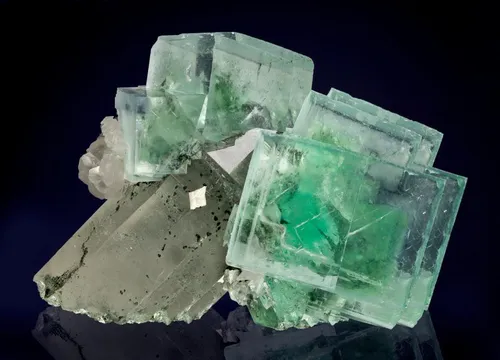
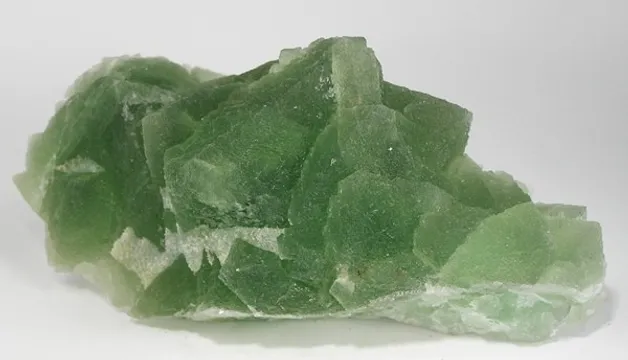
For the display collector, Guangdong is most immediately associated with fluorite and quartz. The best fluorites are transparent to translucent octahedra and modified crystals in green, purple, and occasionally violet-edged color zoning, commonly perched on quartz or separated from quartz-rich matrix. The strongest pieces have glassy interiors, crisp octahedral geometry, and enough matrix or association to anchor the specimen; ordinary examples tend to be isolated, contacted, cleaved, or etched to the point that their geological context is lost. Guangdong quartz is less abundant in the market but can be highly distinctive: plates and clusters with secondary growths, drusy matrices carrying fluorite, and locally strange colored overgrowths on earlier crystals.
Regional View
Country View
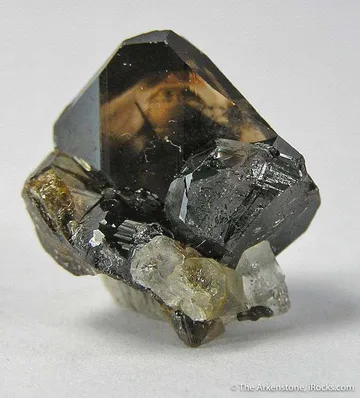
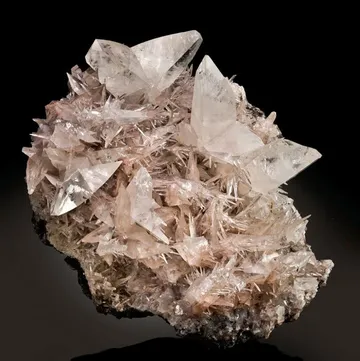
The specimen record is broader than fluorite. Shilu, in Yangchun County, is known for oxidized copper minerals, especially malachite and azurite; Lianhuashan has produced sprays of gemmy colorless topaz on light porphyry matrix; and Yushui has become one of China’s most productive modern type-locality sites for obscure V-HREE and phosphate species. Guangdong’s collector identity therefore has two faces: attractive Chinese display minerals from a handful of modern finds, and a fast-growing research record from complex polymetallic ores.

Photo: Wikimedia Commons

Photo: Wikimedia Commons
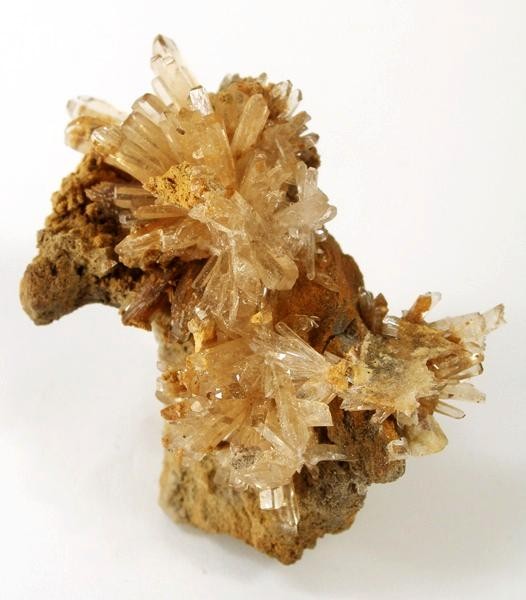
Photo: Wikimedia Commons
Search for specimens: View all specimens from Guangdong, China
Guangdong occupies the southeastern Chinese mainland, with mineral districts distributed from the Nanling highlands of northern Guangdong to the Meizhou-Heyuan area in the east and Yangjiang-Yangchun region in the southwest. Geologically, its collector minerals sit within the larger South China story: Neoproterozoic assembly of the Yangtze and Cathaysia blocks, repeated Paleozoic to Mesozoic deformation, and widespread Jurassic-Cretaceous magmatism that drove W-Sn-Mo-Cu-Pb-Zn-U-F mineralization. In practical specimen terms, that means Guangdong is not one style of deposit but a province of overlapping systems: skarn, porphyry, stratiform sulfide, vein, oxidation-zone, granite-related, fluorite-quartz, and rare-earth-bearing polymetallic environments.
The fluorite specimens most familiar to collectors are tied especially to the Ruyuan fluorite mine in Ruyuan County, Shaoguan. Dealer and database records place notable Ruyuan fluorite on the market in the early 2000s, with sharp green octahedra and fluorite on quartz specimens specifically documented around 2002 and 2005. The Ruyuan material is a fluorite-quartz association: green octahedral fluorite, sometimes with violet edges or deep color zoning, on white or drusy quartz matrix. Some Ruyuan fluorites were removed from quartz-rich matrix by hydrofluoric acid etching, a fact that matters greatly to collectors because it affects surface texture, residual contacts, and the degree to which a specimen still reads as natural matrix material rather than a liberated crystal group.
The Zhongdong fluorite deposit in Wuhua County, Meizhou, is a useful geological analogue for Guangdong fluorite mineralization. Work on Zhongdong describes a high-temperature hydrothermal fluorite-quartz deposit with multistage mineralization, vertical zoning, and CaF2 variation both along strike and down dip. The controlling factors identified there—stratigraphic lithology, structure, and magmatic rocks—fit the broader Guangdong pattern in which fluorite is commonly related to faults, intrusive activity, and quartz-bearing hydrothermal systems rather than to simple open-cavity Alpine-style growth.
Dabaoshan, about 40 km north of Shaoguan, is one of the province’s most significant polymetallic deposits. It was discovered in the 1950s through gossan and later proved to contain Fe, Cu, Pb, Zn, Mo, W, and sulfur resources. Its mineralization includes porphyry-type Mo(W), skarn-type Mo-W along and near granodioritic porphyry contacts, stratiform Cu-Pb-Zn bodies, siderite orebodies, and gossan formed during weathering. The published ore assemblage includes chalcopyrite, pyrite, galena, sphalerite, molybdenite, and siderite, with quartz-sulfide and quartz-molybdenite veins recording hydrothermal temperatures in the hundreds of degrees Celsius. Dabaoshan is important for the geological framework of Guangdong, though it is not chiefly a modern cabinet-specimen fluorite locality.
The Shilu Cu-Fe mine in Yangchun County, Yangjiang, represents a very different collecting style. Its ore bodies are largely oxidized, and malachite is recorded as a principal ore mineral. The mine’s oxidation zone produced malachite and azurite specimens that collectors compare with major copper-oxidation localities worldwide: fibrous to botryoidal malachite, silky chatoyant “velvet” surfaces, stalactitic or stalagmitic forms, and azurite crystals locally altered toward malachite. Market records place fine Shilu malachites in older and modern circulation, with specimens labeled around 1995 and additional material described from late-2019 finds.
The Yushui Cu-polymetallic deposit, northeast of Meizhou, is arguably the province’s most important modern research locality. It contains a Late Paleozoic stratiform ore body with VMS-type characteristics and a later Middle-Late Jurassic vein-type overprint. Published work describes stratiform and stockwork ore in the footwall, minor vein ore in hanging-wall dolomite along joints and faults, and a vein assemblage including chalcopyrite, bornite, galena, sphalerite, tetrahedrite, furutobeite, xenotime, and bastnäsite. The copper grade has been reported as averaging about 3.5% Cu and locally reaching very high-grade ore. For collectors, most Yushui type minerals are microscopic rather than display specimens, but the locality has become essential because several newly described rare minerals come from its bedded or massive polymetallic ore.
Mining access today should be treated as restricted unless a collector has explicit permission through legal channels. Guangdong’s major localities are mines, exploration areas, or industrial deposits, not public fee-collecting sites. Most specimens reaching collectors have come through mine workers, dealers, old stock, or modern Chinese specimen networks. Labels therefore matter: “Guangdong Province” alone is often too broad for high-level collecting. A specimen labeled Ruyuan fluorite mine, Shilu mine, Lianhuashan W deposit, Dabaoshan mine, or Yushui Cu mine carries far more interpretive value than a generic provincial label, especially when accompanied by an older dealer card, collection tag, or documented sale history.
Guangdong fluorite is most prized from the Ruyuan fluorite mine, where collectors seek translucent to transparent green octahedra on quartz, with documented crystals ranging from modest miniature size to large cabinet crystals over 7 cm across on matrix; the best pieces show sharp octahedral form, bright grass-green to deep green color, occasional violet edging, and contrast against white quartz or drusy quartz matrix. Separate Guangdong finds also produced purple, glass-clear modified octahedral fluorites with bevels, stepped triangular growth features, and crystals around 3 to 5.5 cm on plates up to cabinet size. Good Guangdong fluorite is judged by transparency through the crystal, undamaged edges, strong luster, intact octahedral geometry, and believable matrix; ordinary pieces are often contacted at the base or perimeter, cleaved, acid-etched out of quartz, or reduced to attractive but geologically context-poor loose crystals.
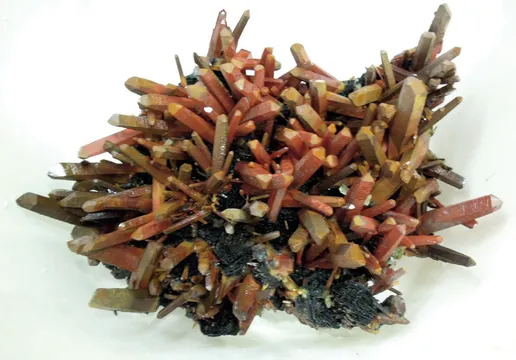
Quartz from Guangdong is most familiar as the matrix and companion mineral for Ruyuan fluorite, where small white to colorless quartz crystals provide the visual base for green octahedral fluorite and help distinguish stronger specimens from loose, etched fluorite groups. Guangdong also produced unusual quartz clusters in which colored secondary quartz growths overlap or drape earlier normal quartz crystals; one documented cabinet specimen measured 16.6 x 10.8 x 6.1 cm and was described as coming from a one-time find not commonly repeated in the market. The best Guangdong quartz specimens are locality-specific rather than generic: crisp drusy matrices with fluorite attached, sculptural clusters with secondary overgrowths, or quartz that preserves the sequence of growth instead of being merely massive gangue.
Other Guangdong minerals give the province unusual depth. Shilu is notable for malachite and azurite, especially fibrous, botryoidal, stalactitic, and chatoyant malachite from oxidized Cu-Fe ore. Lianhuashan has produced radial sprays of colorless to iron-stained topaz on porphyry matrix. Yushui is a type locality for several rare species, including jingwenite-(Y), yuchuanite-(Y), wenlanzhangite-(Y), nigelcookite, plumbojohntomaite, and meizhouite; these are not cabinet minerals but they are highly important to mineralogy because they document vanadium, heavy rare earth elements, phosphate, and redox-sensitive assemblages in the Yushui polymetallic system. Dabaoshan contributes the classic sulfide and polymetallic suite of pyrite, chalcopyrite, galena, sphalerite, molybdenite, and siderite in a porphyry-skarn-stratiform setting.
Guangdong labels require discipline. Because the province is large and mineralogically varied, a specimen labeled only “Guangdong, China” should be considered incomplete unless it has a distinctive habit, an old provenance, or supporting documentation. Ruyuan fluorite, Shilu malachite, and Lianhuashan topaz are materially different collecting categories; collapsing them all into “Guangdong” weakens both scientific and market value.
The most important treatment issue for Guangdong fluorite is acid preparation. Ruyuan fluorites have been documented as commonly etched out of quartz using hydrofluoric acid. Acid-prepared pieces may still be legitimate locality specimens, but collectors should inspect for unnaturally clean separation surfaces, matte or sugary quartz remnants, etched recesses, and a lack of natural attachment. Strong pieces retain convincing matrix or at least honest, visible contacts. Loose green octahedra can be beautiful, but they should be priced and described differently from intact fluorite-on-quartz specimens.
Condition is a central concern. Guangdong fluorite commonly shows edge wear, cleavage, bruised corners, and contact damage from extraction in tight quartz-rich cavities. Large modified purple fluorites from provincial finds are especially known with heavy peripheral contacts; a complete display face with only minor internal cleavage is much better than a superficially large but shattered cluster. On Ruyuan material, look closely at octahedral tips and along octahedral edges under strong side light.
Quartz condition varies by habit. Drusy quartz matrices can be bruised or acid-muted, while the unusual secondary-growth Guangdong quartz clusters can lose the delicate overgrowths that make them distinctive. For quartz specimens, avoid pieces whose interest depends on a single fragile overgrowth that is already abraded or broken.
Shilu malachite demands a different eye. The silky, fibrous, chatoyant surfaces that make these specimens desirable are also easily dulled by handling, dust, oils, or abrasion. Avoid rubbing the surface; handle by matrix or base, and keep loose fibers away from food, drink, and children. Azurite from Guangdong can show natural alteration toward malachite, which may be attractive when it creates green accents, but dull, powdery, or unstable surfaces should be evaluated cautiously.
Fluorescence is not a reliable blanket identifier for Guangdong fluorite. At least one Ruyuan specimen has been described with unusual red fluorescence under both longwave and shortwave UV, but that should be treated as specimen-specific rather than diagnostic for the locality. As with many Chinese fluorites, color, habit, matrix, and provenance are more useful than UV response alone.
Market availability is uneven. Ruyuan fluorite appears periodically but the best older green octahedral specimens have become harder to replace, especially sharp matrix pieces with minimal damage. Generic Guangdong fluorite is more available than well-provenanced Ruyuan material. Shilu malachite remains seen in the trade in a range from affordable small pieces to high-end cabinet specimens with exceptional velvet luster and form. Yushui type-locality species are scientifically important but not normally available as aesthetic display specimens.
One of the memorable Guangdong fluorite moments entered the collector record at Denver before March 2010, when a new find of unusually large, glass-clear purple fluorites appeared. The standout specimen was a 17 x 10.5 x 7 cm plate of modified octahedra with individual crystals to 5 cm. It was not just size that caught attention: the crystals had the look of cut glass, with bevels, repeated triangular growth forms, stepped faces, and enough transparency to make the interior color glow rather than sit flat on the surface.
The same find also showed the harsh reality of mining fluorite from tight cavities. Nearly every specimen had heavy contacts around the perimeter, not because the pocket was mishandled after the fact but because that was how the pieces had to be removed. The best examples were not flawless in the abstract; they were exceptional because the damage was pushed to the edges while the display face remained alive with large, transparent purple crystals. That distinction matters for Guangdong: perfection is rare, and the knowledgeable collector asks where the damage is, not merely whether some exists.
Ruyuan’s green fluorites tell a quieter market story. Specimens documented around 2002 and 2005 show big, sharp octahedra on quartz, in some cases with main crystals over 7 cm across. Later descriptions note that the material came out in modest numbers for only a short time and then largely disappeared from the market. As a result, an undamaged, well-composed Ruyuan fluorite-on-quartz specimen has moved from “recent Chinese fluorite” into the more serious category of a finite modern classic.
The Shilu malachite story is about texture as much as color. The finest pieces are not simply green; they are silky, banded, fibrous, and sculptural. One documented Shilu specimen from the 2022 Tucson Virtual presentation measured 16.5 x 8.5 x 6.8 cm, with the largest stalagmitic malachite growth measuring 12.8 x 3 cm. That is the kind of concrete scale that explains why collectors compare Shilu with great malachite districts: the material can be architectural, not merely botryoidal.
Chen Shao-qing. “Mineralization characteristics and ore-controlling factors of the Zhongdong fluorite deposit in Wuhua County, Guangdong Province.” East China Geology, 2016. A focused study of the Zhongdong fluorite-quartz deposit, emphasizing multistage mineralization, vertical zoning, CaF2 variation, and structural-magmatic controls.
Chen, G., Chen, M., Ke, C., and Tang, Y. “Paleozoic VMS-type stratiform mineralization overprinted by Mesozoic vein-type mineralization in the Yushui copper deposit, eastern Guangdong, South China.” Ore Geology Reviews 158, 105498, 2023. Open-access paper establishing the dual stratiform VMS and Jurassic vein overprint model for Yushui.
Mao, J., et al. “U-Pb and Re-Os geochronology and geodynamic setting of the Dabaoshan polymetallic deposit, northern Guangdong Province, South China.” Ore Geology Reviews 43, 40–49, 2011. Key geochronological and geological reference for Dabaoshan’s Fe-Cu-Pb-Zn-Mo-W-S polymetallic system.
Yao, W., Liu, P., Li, G., Sun, N., Yang, W., Jiang, C., Du, W., Zhang, C., Song, W., Cook, N.J., and Mao, J. “Yuchuanite-(Y), Y2(CO3)3·H2O, a new hydrous yttrium carbonate mineral from the Yushui Cu deposit, South China.” American Mineralogist 109(3), 599–605, 2024. Type-mineral description for yuchuanite-(Y), occurring in bedded/massive Yushui ore with bornite, chalcopyrite, galena, sphalerite, bastnäsite-(Y), xenotime-(Y), anhydrite, and quartz.
Liu, P., Gu, X., Zhang, W., Hu, H., Chen, X., Song, W., Wang, X., Yu, M., and Cook, N.J. “Jingwenite-(Y), IMA 2021-070.” CNMNC Newsletter 64, European Journal of Mineralogy 34, 1–6, 2022. Official CNMNC notice for jingwenite-(Y), a Yushui type-locality mineral deposited at the Geological Museum of China.
Liu, P., Li, G., Sun, N., Yao, W., Yu, H., Yang, W., and Cook, N.J. “Wenlanzhangite-(Y), IMA 2022-142.” CNMNC Newsletter 72, European Journal of Mineralogy 35, 285–293, 2023. Official approval notice for wenlanzhangite-(Y), from the Yushui deposit northeast of Meizhou.
Liu, P., Li, G., Sun, N., Yao, W., Yu, H., Tian, Y., Yang, W., Zhao, F., and Cook, N.J. “Wenlanzhangite-(Y) from the Yushui deposit, South China: A potential proxy for tracing the redox state of ore formation.” American Mineralogist 109(10), 1738–1747, 2024. Full species paper discussing wenlanzhangite-(Y) as a V-HREE-bearing mineral and redox proxy.
Yao, W., Liu, P., Li, G., Sun, N., Yang, W., Song, W., and Zhang, C. “Nigelcookite, IMA 2023-113.” CNMNC Newsletter 78, European Journal of Mineralogy 36, 361–367, 2024. Official CNMNC approval notice for nigelcookite from the Yushui Cu-polymetallic deposit.
Yao, Y., Liu, P., Li, G., Sun, N., Li, R., Yang, W., Song, W., and Zhang, C. “Plumbojohntomaite, IMA 2023-119.” CNMNC Newsletter 78, European Journal of Mineralogy 36, 361–367, 2024. Official CNMNC approval notice for plumbojohntomaite from Yushui.
Yao, W., Liu, P., Li, G., Sun, N., Yang, W., Zhang, C., and Song, W. “Nigelcookite, PbFe2+2V3+2(PO4)3(OH)3, and plumbojohntomaite, PbFe2+2Fe3+2(PO4)3(OH)3, two new members of the bjarebyite group from the Yushui Cu deposit, South China.” American Mineralogist 110(10), 1614–1625, 2025. Full description of both new bjarebyite-group minerals, including color, structure, and redox implications.
Yao, Q., Liu, P., Li, G., Sun, N., Xue, Y., Wu, C., Yang, W., Song, W., and Cook, N. “Meizhouite, IMA 2024-036.” CNMNC Newsletter 83, European Journal of Mineralogy 37, 75–78, 2025. Official CNMNC approval notice for meizhouite, a lazulite-group mineral named after Meizhou.
Malachite from Shilu Mine, Yangchun, China — Fabre Minerals. A rotating specimen video of botryoidal Shilu malachite with green banding and silky chatoyant luster. URL: https://vimeo.com/609828093
fluorite-ruyuan-mine-2 — SZ-Minéraux. A specimen video of light-green fluorite cubes from the Ruyuan fluorite mine, with a listed cabinet size of 14.40 x 11.80 x 6.30 cm and a 4.15 x 3.35 x 2.50 cm main cube. URL: https://vimeo.com/573389210
Mindat: Guangdong, China — Broad locality page with the province-level mineral list, sublocalities, commodities, and specimen-photo archive.
Mindat: Ruyuan fluorite mine, Ruyuan County, Shaoguan, Guangdong — Specific locality entry for one of Guangdong’s key collector fluorite sources.
Mindat: Shilu Cu-Fe Mine, Yangchun County, Yangjiang, Guangdong — Essential reference for Guangdong’s malachite and azurite-producing oxidized copper-iron mine.
Wikimedia Commons: Minerals of Guangdong — Useful open-image category showing documented Guangdong specimens including fluorite, quartz, azurite, gypsum, pyrite, and topaz.
Chen Shao-qing: Zhongdong fluorite deposit, Wuhua County — Best concise geological source for Guangdong fluorite-quartz mineralization and ore controls.
Ore Geology Reviews: Yushui copper deposit, eastern Guangdong — Open-access technical paper on the VMS stratiform and Jurassic vein overprint history at Yushui.
Ore Geology Reviews: Dabaoshan polymetallic deposit — Geochronology and deposit-model paper for one of northern Guangdong’s major polymetallic systems.
Fabre Minerals: Ruyuan fluorite examples — Dealer archive documenting Ruyuan fluorite on quartz specimens and early-2000s market dates.
Vimeo: Malachite from Shilu Mine, Yangchun, China — Short video reference for Shilu malachite texture, banding, and luster.
Vimeo: fluorite-ruyuan-mine-2 — Video reference for Ruyuan fluorite crystal form and cabinet-scale presentation.
CNMNC Newsletter 64, European Journal of Mineralogy — Official approval notice including jingwenite-(Y) from Yushui.
CNMNC Newsletter 72, European Journal of Mineralogy — Official approval notice including wenlanzhangite-(Y) from Yushui.
CNMNC Newsletter 78, European Journal of Mineralogy — Official approval notice including nigelcookite and plumbojohntomaite from Yushui.
CNMNC Newsletter 83, European Journal of Mineralogy — Official approval notice including meizhouite from Yushui near Meizhou.
American Mineralogist / Adelaide Research: Yuchuanite-(Y) from Yushui — Repository record and abstract for the type description of yuchuanite-(Y).