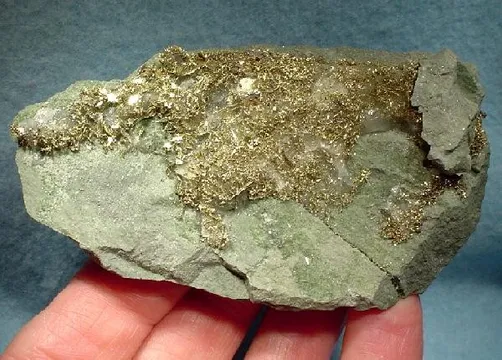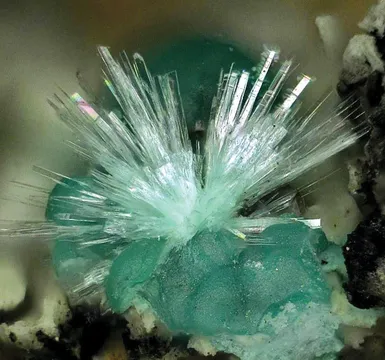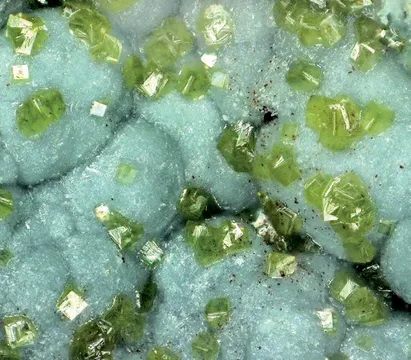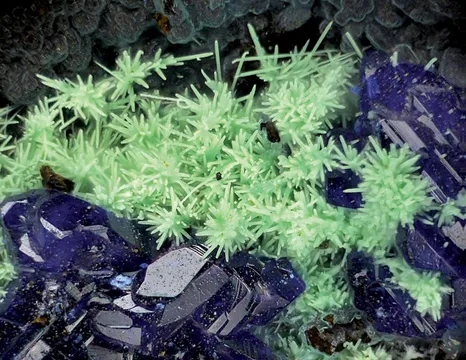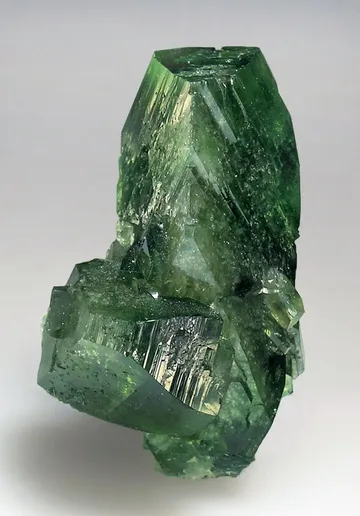
Piedmont mine, Arizona - famed for azurite-to-malachite specimens with quartz druse; rarity and contrast make it a legend among copper-oxide localities.
Key facts
The Piedmont mine near Brooklyn Peak in eastern Yavapai County, Arizona, is one of those localities whose reputation rests on almost no mining success and a very small number of unforgettable specimens. Economically it was a modest Au-Ag-Cu vein prospect in the high desert west of Bloody Basin, worked in massive granite cut by quartz veins and dike-related structures. Mineralogically, however, it became famous for a single early-to-mid-1950s specimen find: sharp, blocky azurite crystals that had been completely replaced by malachite, then frosted or armored by a later generation of sparkling quartz druse. In a state crowded with celebrated secondary copper occurrences, the best Piedmont pieces still stand apart: green pseudo-rhombs under sugary to gemmy quartz, perched on dark iron-stained breccia or gray-white quartz matrix, with a look more intimate and uncanny than the large, lustrous azurites of Bisbee, Morenci, or Ajo.
Regional View
Country View
The locality is also appealing because the mine itself is so paradoxical. Promotional literature and later reminiscences describe shafts, levels, and repeated evaluations; the ground visible today, by contrast, has offered collectors little more than collapsed collars, sparse dumps, quartz veining, and scattered copper staining. That mismatch between advertised mine and physical evidence has fed much of the Piedmont legend. The specimens are not products of a long, systematic collecting history but of a tiny number of vugs or boulders, now dispersed through old Arizona collections and rarely released.

Photo: Wikimedia Commons

Photo: Wikimedia Commons
Search for specimens: View all specimens from Piedmont mine, USA
The Piedmont mine is the Copper Creek / Copper Queen / Bloody Basin property at Brooklyn Peak, Yavapai County, Arizona, not the separate “Piedmont” or “Congress West” occurrence farther west in the Date Creek–Congress area. Its published coordinates place it in the NW¼ of section 33, T10N, R4E, on the Brooklyn Peak 7.5-minute quadrangle, at roughly 4,000 feet elevation. The mine lies in the Tonto National Forest, reached from Bloody Basin Road, and the immediate country is dry, open Arizona upland: scattered juniper and scrub, prickly pear, grass, basalt-capped hills in the surrounding landscape, and low exposures of granite and vein quartz.
The deposit is best understood as a small oxidized Au-Ag-Cu vein system. Local records describe a tabular ore body controlled by faulting, shearing, and igneous activity, with copper concentrated near the surface by oxidation. The country rock is massive, unfoliated granite, reported in the specimen literature as medium-grained and cut by quartz dikes. Mine-data summaries also describe veins parallel to andesite or mafic dikes trending from east-west to northeast and dipping at low angles, generally less than 40 degrees. On the collecting side, this translates to sparse but distinctive secondary copper mineralization in quartz: malachite and chrysocolla staining, copper carbonate fillings, iron-oxide-stained breccia, occasional calcite, and very limited vug development.
The mine’s claim history is cluttered with names. The original Copper Queen claims were located in 1892 and remained unpatented. Later names used for the property included Piedmont, Arizona Copper Queen, Legal Tender, Gold Flower, and Copper Creek; one mid-20th-century promoter attempted to tie the “Arizona Copper Queen” name to the Douglas family of Phelps Dodge fame, but the connection appears promotional rather than historical. The mine was heavily advertised in various periods, yet the hard production record is meager. Mindat and MRDS-derived records list production in the 1936–1940 interval, while the best historical summary emphasizes that only one carload of ore was prepared for shipment in the long history of the property.
Development stories are equally slippery. Prospectuses reportedly spoke of four shafts, with original depths of 300–350 feet and the Piedmont shaft later carried to 1,050 feet with drifting on two levels. Field visits by experienced geologists and collectors found a much less convincing scene: the Piedmont and Sunshine shafts collapsed at the collars, little dump material around them, and a lack of the large dikes that some early reports implied. This does not make the mineral occurrence imaginary—specimens and surface copper mineralization are real—but it does place Piedmont among Arizona’s classic “promoted beyond its ore” prospects.
For collectors, the essential event was the discovery of quartz-coated malachite pseudomorphs after azurite in the early 1950s, often repeated in the literature as a 1951 or 1955 find depending on the account. The important material was not hauled from normal ore stopes. It came from a very small number of vugs or vuggy boulders, perhaps more than one, because surviving specimens differ markedly in matrix, quartz coating, color, and crystal style. The most memorable pieces show compressed pseudo-rhombic forms, with the original azurite habit preserved but the mineral replaced by fibrous malachite, then coated by white to clear quartz. The best-documented pieces range from thumbnail and miniature size to large plates, including a celebrated 25 cm specimen photographed for the Mineralogical Record.
Collecting access today should be approached cautiously and conservatively. The locality is on federal land in the Tonto National Forest area, but historic and modern claim status can change, and old mine workings are collapsed and hazardous. The classic pocket has not been re-found despite repeated searches over decades. Loose copper-stained quartz, chrysocolla, malachite coatings, and occasional quartz pieces may explain why the locality still attracts interest, but expectations should be realistic: a visitor is far more likely to encounter unsafe collars, sparse dumps, and stained vein quartz than a specimen comparable to the old pseudomorphs.
Piedmont malachite is famous above all as a replacement mineral: in the classic specimens it completely pseudomorphs blocky azurite, preserving compressed pseudo-rhombic forms that may reach several centimeters on edge, then disappears under a later skin of drusy quartz. The best pieces show forest-green to emerald-green fibrous malachite with sharp azurite-derived geometry, contrasting dark breccia or quartz matrix, and a bright, even coating of white to clear quartz crystals; lesser Piedmont malachite occurs as coatings, crack fillings, small satin-lustrous blocky pseudomorphs only a few millimeters across, or rounded short-fiber masses in quartz. Associations include quartz, chrysocolla, calcite, hematite-stained matrix, and, in the old vug material, the vanished azurite form itself; collector quality here depends less on size alone than on crisp pseudomorph shape, undamaged corners, lively quartz sparkle, and an old, credible provenance.
Quartz is the structural and visual stage on which Piedmont’s best copper minerals appear: it forms the mine’s veins and dikes, gray-white matrix crystals beneath many pseudomorphs, and the later drusy to small-point coating that gives the malachite-after-azurite specimens their unmistakable frosted surface. Most quartz veins at the mine are not richly vuggy, though small crude vugs and boulders near the Piedmont shaft have yielded modest quartz sprays on the order of 1–3 cm; in the great pseudomorph find, however, the quartz ranges from fine white sugary druse to larger transparent points over green malachite. The finest quartz-bearing Piedmont pieces are not simply “quartz specimens” but balanced copper-quartz compositions, where the druse is clean, sparkling, undamaged, and transparent enough to reveal green pseudomorph form beneath.
Azurite at Piedmont must be read carefully: the locality’s fame comes from azurite crystal forms, not from abundant fresh blue azurite crystals. Weathered azurite occurs as sky-blue to medium-blue chalky blebs and coatings in rubble near the collapsed Sunshine shaft, while material near the Piedmont shaft is reported as having altered to fibrous malachite; the collectible “azurite” identity of the classic specimens is therefore mainly morphological, recorded by blocky azurite crystals now replaced by malachite and coated with quartz. Good Piedmont pieces preserve the azurite habit sharply enough that the pseudomorph reads instantly as an azurite-derived crystal, while ordinary or suspect pieces may be only green copper staining, shapeless malachite, or mislabelled Arizona pseudomorph material from another district.
Other documented minerals from the Piedmont assemblage include chrysocolla, calcite, barite, hematite, jarosite, mottramite, and milky quartz. Chrysocolla occurs with malachite and quartz, including attractive old specimens with blue chrysocolla under translucent botryoidal quartz and malachite beneath. Calcite is represented by old combination specimens with emerald-green malachite in vugs lined by tan rhombic calcite and later flesh-colored calcite rhombs. Barite is a true locality rarity, reported as tiny pale tan tabular crystals only a few millimeters across from a prospect pit north of Bloody Basin Road. Mottramite is another notable minor species, recorded in small massive amounts along quartz dikes and confirmed by Raman analysis. Piedmont is not celebrated as a type locality; its importance rests instead on a very small, visually distinctive suite of secondary copper minerals and pseudomorphs.
Piedmont is a provenance-sensitive locality. The classic malachite-after-azurite specimens are so few, and so visually specific, that an old label chain matters almost as much as the specimen itself. Strong provenance names associated with the classic material include the Thompson family, Monnie Speck, Sandi Aston, Mark Hay, Dick Morris, Keith Williams, Ed Swoboda, Jim Minette, Les Presmyk, Rukin Jelks, and the Arizona-Sonora Desert Museum. Pieces with vague “Arizona” labels, generic “Copper Queen” wording, or no history should be examined with caution.
The most common locality problem is not outright fakery but mislabelling. Piedmont has been confused in databases and older labels with a different Piedmont / Congress West mine in Yavapai County, and the “Copper Queen” name can mislead buyers into thinking of Bisbee. Specimens of malachite after azurite from Ajo, Morenci, Bisbee, and other Arizona copper districts can also be superficially similar to inexperienced eyes. True Piedmont pseudomorphs should combine blocky azurite-derived form, green malachite replacement, quartz druse or small quartz points, and the appropriate dark breccia or quartz matrix style. A specimen sold as Piedmont but lacking quartz association, pseudomorph geometry, or credible old provenance deserves scrutiny.
Condition is central. Many classic pieces show damage, and the collecting lore itself suggests that hard removal methods, possibly including dynamite, may have contributed to bruised corners, cleaved-off pseudomorphs, and broken quartz druse. This does not automatically disqualify a Piedmont specimen—some damage is common and historically understandable—but clean crystal edges, intact quartz sparkle, and undisturbed display surfaces are premium features. Check for dull crushed zones under magnification, repaired pseudomorphs, over-cleaned malachite fibers, and sawn backs or trimmed quartz matrix that may be acceptable if honestly described.
No Piedmont-specific treatment tradition or documented fake industry appears in the standard sources. The usual copper-mineral cautions apply: malachite and azurite are soft relative to quartz, copper carbonates can be damaged by acids, and aggressive ultrasonic cleaning is risky for fibrous malachite and tiny quartz druse. Calcite-bearing specimens should also be kept away from acidic cleaning. No notable fluorescence behavior is documented for the classic Piedmont suite, so fluorescence should not be used as an authentication criterion.
Market availability is thin. Literature estimates place the number of classic quartz-coated malachite-after-azurite pseudomorph specimens at about fifty, with many held in major Arizona collections or institutional hands. Damaged or modest examples occasionally surface, but fine, sharp, well-provenanced pieces are genuinely rare. Even when small, they are locality specimens for advanced Arizona collectors rather than casual copper-mineral examples; the best pieces are valued for their place in Arizona collecting history as much as for their aesthetics.
The Piedmont mine is a story of a mine that should have been ordinary—another small Arizona copper-gold prospect with more paperwork than ore—but instead became a minor legend because of one improbable find. The old claims sat west of Bloody Basin, north of Copper Creek, under the name Copper Queen before becoming Piedmont. That name alone tells part of the story. “Copper Queen” carried the aura of Bisbee, Phelps Dodge, and Arizona copper wealth, and a 1940s promoter even tried to attach the property’s reputation to Walter Douglas, son of James Douglas of Phelps Dodge. It was a bold bit of reflected glory. The historical record gives no reason to think the Douglas family had anything to do with the place.
The physical mine never seems to have matched the promotional mine. Reports spoke of four shafts, each originally 300–350 feet deep, and of the Piedmont shaft reaching 1,050 feet with drifting on two levels. Later visitors found something more puzzling: two collapsed collars, identified as the Piedmont and the Sunshine, little dump rock, and no convincing sign of the scale implied by the old claims. Wayne Thompson and his uncle, also Wayne Thompson, visited in 1981 and were struck by the absence of significant dumps and quartz dikes; they even doubted whether some supposed shafts were more than shallow prospect pits. Barbara Muntyan’s later field visit with exploration geologist James McGlasson found much the same. For a property repeatedly evaluated and renamed through 125 years, the most telling production detail is almost comic in its smallness: only one carload of ore is said to have been prepared for shipment.
Then came the specimens. The most persistent tale places Wayne Thompson, Sr., Evert Thompson, and Monnie Speck at the center of the discovery. The Thompsons were uncles of the later collector and dealer Wayne Thompson; Monnie Speck ran a Phoenix rock shop with her husband. All three moved in the Mineral Society of Arizona orbit of Arthur Flagg, Arizona’s first State Geologist and one of the great evangelists for collecting in the state. One version says the find came from a tip given to Wayne Thompson, Sr. Another hints at one of Flagg’s “special” field trips for favored members, quiet excursions that would not have appeared in club bulletins because they excluded most of the membership. The exact route into the story has blurred, but the names stayed attached to it.
One account has the three families on a picnic outing from Phoenix, a long drive in 1951, when they happened on a huge, vug-filled quartz boulder and collected roughly fifty specimens in a burst of luck and energy. Another version is more dramatic. Wayne, Sr. is said to have found a boulder beside the road with a large vug near the top, but the rock was too stubborn to move. He returned to Phoenix and recruited Evert Thompson and Monnie Speck. Evert had mined in the Black Hills of South Dakota and knew how to handle dynamite. After the blast, the collectors gathered about fifty specimens—the same number that appears again and again in Piedmont lore.
The saddest part of the story concerns a great plate, reportedly about 30 cm, or 12 inches, long. None of the three collecting partners would surrender their claim to it. Rather than leave the argument unresolved, the specimen was broken into three sections so each could take a share. For collectors, that detail has the ring of truth because it is both practical and painful: a once-whole Arizona classic divided by human nature.
The specimens themselves argue that the story is not quite as simple as “one vug, one boulder.” Surviving pieces differ too much. Some sit on hematite-included breccia, others on flattened gray-white quartz crystals, still others on tan, red-brown, or dark-gray rock, including breccia and andesite. The quartz coating can be fine and white, or coarser and clear. The malachite beneath ranges from forest and emerald green through grass green, pale green, and nearly white. Those differences suggest several vugs or several boulders, not one chemically uniform pocket.
The aftermath is almost a collecting genealogy. Monnie Speck’s specimens went first to Sandi Aston of Phoenix and were later acquired by Mark Hay, Dick Morris, and Keith Williams. Wayne Thompson, Sr. sold two fine examples early on. Ed Swoboda acquired one in the 1980s for his pseudomorph collection; it later passed to Jim Minette and then to Les Presmyk. Rukin Jelks purchased another from Wayne, Sr. for the Arizona-Sonora Desert Museum, and the museum later obtained the bulk of Wayne Thompson’s specimens. Les Presmyk eventually acquired many of Evert Thompson’s pieces in two purchases about a decade apart. That is why a good Piedmont specimen so often reads like a compact history of Arizona collecting: the labels are nearly as important as the minerals.
There is one more small thread in the Piedmont story: the bright green “worms.” These are vermiform chains of malachite pseudomorphs after an unknown material, probably monoclinic according to the Mineralogical Record account. Examples are known in the collections of Dick Morris, Les Presmyk, Paul Matt, Jim McGlasson, and Barbara Muntyan. They are not the famous blocky azurite pseudomorphs, but they add to the locality’s strangeness—another hint that this little mine, economically nearly negligible, preserved several odd moments of copper-mineral replacement in its oxidized quartz veins.
Barbara L. Muntyan, “The Piedmont mine: History, minerals and myths,” 38th Annual New Mexico Mineral Symposium, 2017 — The most vivid published narrative of the mine’s history, promotion, field evidence, and the classic malachite-after-azurite discovery.
Barbara L. Muntyan, “The Piedmont Mine, Yavapai County, Arizona,” The Mineralogical Record, Volume 51, Number 1, January–February 2020 — The key modern locality article, with specimen photographs, mineral descriptions, and collecting history.
Mindat.org locality page: Piedmont Mine, Brooklyn Peak, Yavapai County, Arizona, USA — Locality coordinates, alternate names, geology summary, production interval, species list, and references.
Mindat.org: Malachite from the Piedmont Mine — Occurrence page noting malachite pseudomorphs after azurite coated by clear to milky quartz, with associated photo-data minerals.
Mindat.org: Quartz from the Piedmont Mine — Occurrence page for quartz and its Piedmont associations, especially malachite.
Anthony, John W.; Williams, Sidney A.; Bideaux, Richard A.; Grant, Raymond W. (1995), Mineralogy of Arizona, 3rd edition, University of Arizona Press, p. 287 — Cited in Mindat for the Piedmont malachite occurrence.
Arizona Department of Mines and Mineral Resources, Open File Report on the Piedmont Mine, #1999-01-0373 — Cited in the New Mexico Mineral Symposium abstract as a primary file source on the mine.
Niemuth, Nyal J.; Phillips, Ken A. (1992), Copper Oxide Resources, Arizona Department of Mines and Mineral Resources Open-File Report 92-10 — Cited in the locality literature for copper-oxide resource context.
Grant, Raymond W. (1988), Rockhound Record #16, Mineral Society of Arizona, Phoenix — Cited as a collecting-history reference for the locality.
Wallace, Terry, ed. (2012), Collecting Arizona: State of Mines, Legacy of Minerals, Lithographie — Cited in the 2017 symposium abstract as a broader Arizona collecting reference.
Piedmont Mine locality page on Mindat — Best single database entry for coordinates, alternate names, geology, references, and mineral listings.
The Piedmont mine: History, minerals and myths — Barbara Muntyan’s detailed symposium account of the mine’s promotion, dubious workings, and the famous pseudomorph find.
The Piedmont Mine, Mineralogical Record sample article — Authoritative modern article with specimen descriptions and photographs.
Malachite from the Piedmont Mine on Mindat — Useful occurrence entry for the classic malachite-after-azurite material and photo-based associations.
Quartz from the Piedmont Mine on Mindat — Useful occurrence entry for Piedmont quartz associations and photo records.
Wikimedia Commons: Quartz-Chrysocolla-Malachite from the Piedmont Mine — Photograph and specimen note for an old Piedmont quartz-chrysocolla-malachite example.
Wikimedia Commons: Malachite-Calcite from the Piedmont Mine — Photograph and specimen note documenting the uncommon malachite-calcite association.
Mineral Auctions: Quartz coating Malachite pseudomorphs after Azurite — Auction record showing size, condition language, and provenance expectations for market examples.
Mineral Auctions: Quartz on Malachite ps. Azurite — Auction record illustrating rarity, damage tolerance, and recent-market context for a Piedmont pseudomorph.