Pöhla, Germany — Western Erzgebirge locality famed for honey-yellow barite and fluorite-barite veins, native silver and arsenic, plus historic tin-skarn and ur…
Key facts
Pöhla is one of the modern classic names of the western Erzgebirge: a locality where the collector’s cabinet, the Wismut uranium era, and Saxony’s long tin-skarn geology all meet in one complicated ore field. In specimen terms, “Pöhla” most often means the Pöhla-Tellerhäuser system near Schwarzenberg, but the broader district is better understood as a cluster of related sub-deposits: Pöhla-Globenstein to the northwest with its Sn-W skarn emphasis, Hämmerlein with tin-indium polymetallic skarn and schist ore, and Tellerhäuser with uranium-bearing hydrothermal veins overprinting a tin-bearing skarn setting. The specimens that made the name famous are not bulk ore; they are the late, open-space products of the system — honey-yellow barite, fluorite-barite vein pieces, native silver on dark native arsenic, native arsenic masses, and assorted arsenide-sulfide rarities that speak directly to the deposit’s overprinted history.
Regional View
Country View
Geologically, Pöhla sits in the Western Erzgebirge in the saxothuringian setting of the Fichtelgebirge-Erzgebirge anticline, influenced by the NW-SE Gera-Jáchymov deep fault zone and by granitic magmatism related to the Eibenstock-Nejdek granite complex. The ore field is hosted by Cambro-Ordovician metasediments — mica schists, gneisses, phyllites, quartzitic rocks, amphibolites, carbonate-bearing “bunte” sequences, and skarn horizons. This is why Pöhla mineralogy is so varied: early and main-stage skarn and greisen assemblages supplied cassiterite, magnetite, sphalerite, scheelite, fluorite, and indium-bearing sulfides; later hydrothermal veins introduced uranium, arsenides, native arsenic, native silver, calcite, quartz, fluorite, and barite.
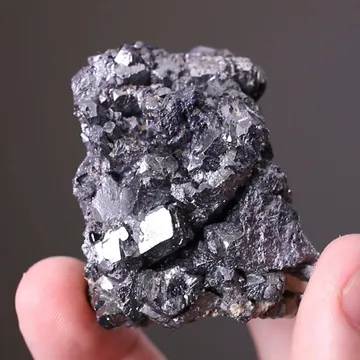
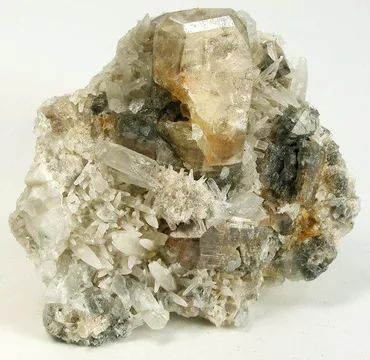
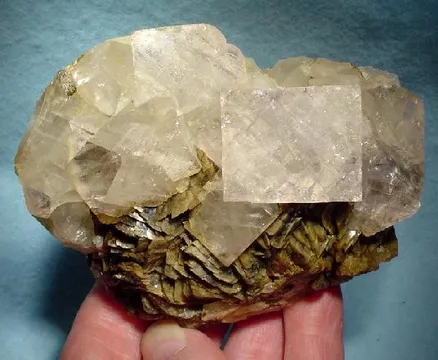
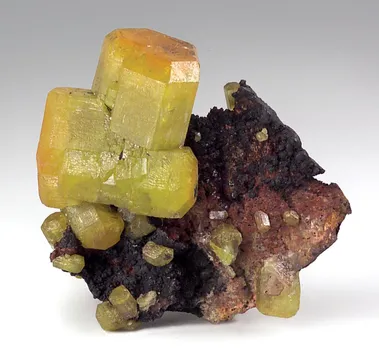
For collectors, Pöhla’s two most recognizable visual signatures could hardly be more different. The barite is warm and architectural: yellow to amber, transparent to translucent, chisel-shaped, prismatic, or tabular, most prized when standing cleanly on quartz with fluorite present. The silver-arsenic specimens are darker, stranger, and more metallic: bright silvery white dendrites, herringbone growths, and fern-like aggregates rising from dense gray-black native arsenic. A fine example of either instantly identifies the locality.

Photo: Wikimedia Commons

Photo: Wikimedia Commons
Pöhla also matters because it is a late 20th-century classic, not merely an old Saxon mining name inherited from the Renaissance. Wismut drove the modern Pöhla adit beginning in 1967, explored the Hämmerlein and Tellerhäuser ore bodies, produced uranium from Tellerhäuser, and left behind both a highly studied ore field and a finite population of collectible specimens. After mining ended around German reunification, the deeper workings were flooded and remediated; the Hämmerlein part survives as the visitor mine Zinnkammern Pöhla, while top specimen material now comes from old production, collection dispersals, and dealer inventories rather than from active collecting.
Search for specimens: View all specimens from Pöhla, Germany
The collector locality “Pöhla” is best treated as the Pöhla ore field around the village of Pöhla, now part of Schwarzenberg in Saxony’s Erzgebirgskreis. Within that field, the most important specimen-producing name is Pöhla-Tellerhäuser Mine, though labels may also mention Tellerhäuser, Hämmerlein, Dreiberg, Globenstein, Block 0985, the +120 m level, or simply “Pöhla, Erzgebirge.” This label variation is normal for a district where mine development, geological sub-units, and specimen marketing never followed exactly the same boundaries.
The deposit system is polymetallic and overprinted. Regionally it belongs to the Western Erzgebirge part of the saxothuringian unit and lies near the important Gera-Jáchymov fault zone. The host sequence includes Cambro-Ordovician metasediments — phyllites, mica schists, gneiss varieties, amphibolites, quartzites, carbonate-bearing horizons, and skarns. The Eibenstock-Nejdek granite complex crops out west of the deposits and continues beneath parts of the ore field; its heat and fluids are central to the interpretation of the Sn-W-In skarn-greisen mineralization.
At Hämmerlein-Tellerhäuser, modern geological descriptions distinguish three resource-bearing horizons or ore bodies: the Hämmerlein horizon and, in the Tellerhäuser area, the Zweibach and Dreiberg horizons. The skarn ore is the dominant ore type and carries tin, zinc, iron, and indium; it consists of pyroxene-, garnet-, amphibole-, chlorite-, and magnetite-skarn varieties with irregular sulfide and cassiterite mineralization. Cassiterite occurs with quartz, fluorite, and chlorite, while sphalerite, magnetite, chalcopyrite, and indium-bearing phases such as roquesite are part of the economically important assemblage. A second ore type, the so-called schist ore, is a greisen-like quartz-muscovite-feldspar schist cut by quartz-cassiterite-fluorite-tourmaline-topaz veinlets.
Pöhla-Globenstein is the Sn-W member of the district. It was investigated in several stages after the Second World War and explored on multiple levels, with skarn horizons carrying cassiterite, magnetite, sphalerite, scheelite, fluorite, and related polymetallic components. Scheelite is especially important in the tungsten portions of the Globenstein system, and modern project literature emphasizes that much of it is fine grained and intergrown with fluorite and quartz. This is economically interesting but generally less important for display specimens than the barite and silver-arsenic material from Tellerhäuser.
Tellerhäuser supplied the locality’s classic native element specimens. The hydrothermal uranium veins there are described as polymetallic veins in metamorphic host rocks, with pitchblende, Co-Ni arsenides, native arsenic, löllingite, magnetite, pyrite, marcasite, chalcopyrite, native silver, quartz, and calcite. In specimen collections, the celebrated material is silver on arsenic: dense gray to black native arsenic matrix carrying bright dendritic, fern-like, herringbone, wire, or arborescent native silver. Labels for the best-known late material often record the Tellerhäuser mine field, Strecke 922 or Querschlag 9209, Block 0985, and the +120 m level.
Modern mine history at Pöhla is inseparable from Wismut. Exploration and drilling in the 1950s and 1960s revealed uranium anomalies and complex Sn-W-polymetallic potential. The Pöhla adit was begun in October 1967 from the Luchsbach valley; by 1970 it had reached nearly 7.9 km. At roughly 3 km in, development intersected the Hämmerlein skarn; farther in, Tellerhäuser was developed with deep internal workings. Uranium production at Tellerhäuser took place principally during the late Wismut period and ended in 1990–1991. Published mine-water and geological accounts give about 1,200 metric tons of uranium produced from the Pöhla-Tellerhäuser deep mine, after which the deeper mine voids were flooded between early 1991 and autumn 1995.
The locality today is not a casual collecting site. The deeper Tellerhäuser workings were flooded and are subject to long-term mine-water management, including arsenic and radium treatment. The Hämmerlein section is accessible to the public only as the visitor mine Zinnkammern Pöhla, where visitors ride about 3,000 m by mine train to the Hämmerlein deposit and see the large tin chambers and preserved mining installations. That access is educational and historical, not a collecting opportunity. Any remaining dumps, adits, industrial areas, or project lands should be assumed to require explicit permission and appropriate safety clearance.
Specimen production was episodic. Barite pieces are tied to fluorite-barite vein systems, particularly the Kunnersbach and Gang Luchsbach structures reported in specimen and geological descriptions. The best barites came as sharp golden crystals on quartz, sometimes with fluorite, and the finest examples are old-production cabinet pieces rather than recently collected material. The silver-arsenic specimens are more closely associated with the late Tellerhäuser uranium-arsenide-silver mineralization; the famous 1990–1991 material from Block 0985 at the +120 m level produced the recognizable modern Pöhla silver habit now seen in advanced collections.
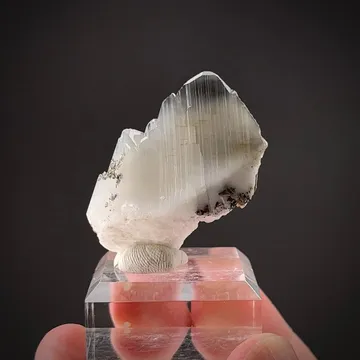
Barite from Pöhla is the American-spelling face of the same BaSO4 classic that European labels usually call baryte: transparent to translucent honey-yellow, wine-yellow, butterscotch, or deep amber crystals, most characteristically chisel-shaped, elongated prismatic, tabular, or spear-like, commonly perched on quartz and locally associated with fluorite from the Tellerhäuser fluorite-barite vein stage. Fine individual crystals are commonly in the 1–3 cm range on thumbnails and miniatures, with better cabinet pieces showing sharper crystals several centimeters long; published specimen descriptions record Kunnersbach material with transparent yellow crystals reaching about 10 cm. Ordinary pieces are pale, bruised, isolated, or muddied by iron staining; good Pöhla barite has glassy luster, saturated golden color, undamaged terminations, visible transparency at the edges, and a matrix that proves the locality’s vein context rather than leaving the crystal looking like a generic detached yellow barite.
Baryte is the spelling collectors will most often encounter on German and older European Pöhla labels, and here it refers to the classic golden BaSO4 crystals of the Pöhla-Tellerhäuser system rather than a separate mineral species from “barite.” The most desirable pieces show bright yellow to amber orthorhombic crystals standing proud from quartz, chalcedony, or quartz-rich matrix, sometimes with small fluorite cubes or massive fluorite in the same assemblage; crystals may be tabular, bladed, prismatic, chisel-terminated, parallel-grown, or doubly terminated. The best-known specimen style is linked to the Kunnersbach fluorite-barite vein system, and quality is judged less by bulk size than by the combination of saturated color, sharp geometry, lively luster, translucency, and freedom from edge chips, since the broad blades and chisel terminations bruise easily during mining, trimming, and decades of cabinet handling.
Native silver from Pöhla is one of the most distinctive late Saxon silver styles: not the thick historical wires of Freiberg or Kongsberg-like curls, but bright metallic Ag forming dendritic, herringbone, arborescent, fern-leaf, wire, and feather-like growths on dense dark native arsenic. The most sought-after specimens are attributed to the Tellerhäuser mine field, especially the Block 0985, +120 m level material encountered around the end of Wismut mining, with some labels also recording Strecke 922 and Querschlag 9209. Typical collector pieces range from thumbnail fragments with a few silvery sprays to small-cabinet and cabinet specimens densely covered by branching silver; the premium pieces have three-dimensional, free-standing dendrites rather than silver merely embedded or smeared in arsenic, bright untarnished luster, strong contrast against the black-gray As matrix, and enough matrix to make the paragenesis unmistakable.
Native arsenic from Pöhla is both a collectible mineral and the matrix that made the locality’s silver famous: dense, dark gray to black, metallic to dull masses from the Tellerhäuser arsenide-uranium-silver system, commonly carrying native silver and locally associated in the ore assemblage with Co-Ni arsenides, nickeline, nickelskutterudite, löllingite, galena, pyrite, marcasite, calcite, and quartz. As display specimens, arsenic-only pieces tend to be heavy, massive, and visually severe; the most desirable examples are those with well-crystallized silver, visible arsenide associations, clean old labels, or unusual surface textures rather than plain lumps of arsenic ore. Because arsenic is a toxic native element and Pöhla material may also include secondary arsenic minerals, serious collectors handle it with dry hands or gloves, avoid abrasion or trimming, keep dust out of the case, wash after handling, and never use acid cleaning on mixed arsenic-sulfide specimens.
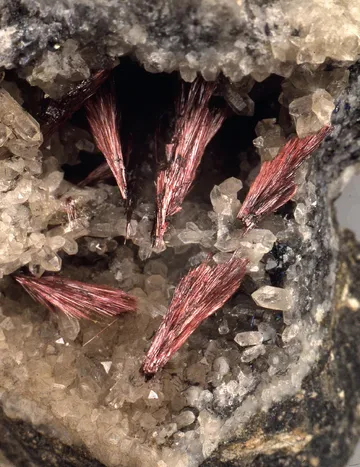
Beyond barite, silver, and arsenic, Pöhla’s documented mineral suite is broad and unusually instructive. The Pöhla-Tellerhäuser list includes acanthite, argentopyrite, proustite, native bismuth, bismuthinite, galena, pyrite, marcasite, chalcopyrite, löllingite, nickeline, nickelskutterudite, arsenopyrite, calcite, quartz, fluorite, magnetite, sphalerite, cassiterite, scheelite, and uranium minerals such as pitchblende/uraninite and secondary uranium species. Native bismuth deserves special mention: “Federwismuth” specimens from Pöhla show feather-like stepped bismuth crystals and have circulated as desirable German classics. Prospect 24 at Pöhla is a smaller but notable recorded occurrence for native silver, native arsenic, fluorite, nickeline, opal, proustite, and pyrrhotite. The district is not famous because it is a type locality for a single celebrated species; it is famous because a compact ore field records skarn, greisen, uranium-vein, fluorite-barite, arsenide, silver, and bismuth mineralization in collectible form.
The first authenticity issue with Pöhla is locality precision. A label reading only “Pöhla” may be perfectly old and legitimate, but a serious collection benefits from more detail: Pöhla-Tellerhäuser Mine, Tellerhäuser field, Hämmerlein, Globenstein, Prospect 24, Kunnersbach, Gang Luchsbach, Block 0985, +120 m level, Strecke 922, or Querschlag 9209. Not every specimen will have such specificity, yet high-value silver-arsenic and top barite pieces should be judged against the label. A rich herringbone silver on massive arsenic with a Block 0985/+120 m label is a different historical object from a generic “Pöhla silver” with no supporting provenance.
There is no widely documented, locality-specific epidemic of fabricated Pöhla barite or silver comparable to well-known fake problems at some other mineral localities. The more common problem is mislabelling, over-broad labelling, and imprecise spelling. “Barite” and “baryte” are the same mineral, but EarthWonders, older labels, dealer catalogues, and international databases may separate or duplicate the spelling. “Pohla” without the umlaut, “Pöhla Mine,” “Tellerhauser,” “Tellerhäuser,” “Schwarzenberg,” “Erzgebirge,” and “Saxony” may all appear. Provenance matters because golden barite from many localities can look superficially similar, while Saxon native silver from Freiberg, Schneeberg, Schlema, Johanngeorgenstadt, and Pöhla can be confused when labels are vague.
For barite and baryte, condition is everything. Pöhla’s attractive crystals have vulnerable edges and chisel terminations, and the very features that make a specimen desirable — transparency, sharpness, protruding crystals, and isolated blades — also make damage easy to see. Minor nicks on back crystals are common; bruised main terminations, glued crystals, oiled surfaces, and heavy iron staining are more serious. Some barite pieces show weak fluorescence, but fluorescence should be treated as an added observation rather than a primary identifying feature. Fluorite associations improve interest, especially when the fluorite is visible and not merely massive vein material.
For silver on arsenic, be wary of pieces that are too clean, too bright in a way that suggests aggressive chemical treatment, or suspiciously perched on matrix without natural contact. The best Pöhla silver has an organic, growth-in-place relationship with the arsenic matrix, and the herringbone or fern-like forms are often delicate. Repaired tips, rubbed high points, and flattened dendrites are common condition issues. Tarnish is less objectionable than physical damage, but bright metallic luster against dark arsenic is a major part of the locality’s appeal.
Handling is more important here than for many display minerals. Native arsenic is toxic, and arsenic-bearing specimens should not be abraded, sawed, trimmed, brushed aggressively, or cleaned in acid. Keep arsenic and arsenide specimens in closed boxes or stable display cases, avoid loose dust, wash hands after handling, and do not allow children or pets access. If a specimen includes uranium minerals or is from uranium-vein material, treat it as a potential low-level radioactive specimen: store sensibly, avoid sleeping or working for long periods beside large masses, and use a radiation meter if the piece is rich in uraninite, secondary uranium minerals, or unknown yellow-green coatings.
In the present market, Pöhla is available but selective. Barite/baryte appears regularly enough that collectors can choose for color and condition, but truly sharp, saturated, glassy cabinet pieces with old provenance are scarce and bring strong prices. Silver on arsenic appears in small numbers from old stock and collection dispersals; fine examples remain desirable because the 1990–1991 find was finite and the mine is not producing new material. Native arsenic without silver is less commercial, but a well-provenanced Pöhla arsenic, arsenide association, or silver-bearing matrix is still important to a systematic or Saxony-focused collection.
Near the end of Wismut mining, Pöhla produced the kind of find that rewrites a locality’s collector identity. The ore body was not opened in the romantic age of Saxon silver mining, but in the final chapter of East German uranium work. At Tellerhäuser, on the +120 m level, in the area collectors now know by the label details Block 0985, Strecke 922, and Querschlag 9209, miners encountered an arsenic-rich silver shoot. The material was heavy, dark, and chemically troublesome: massive native arsenic carrying bright native silver. For metallurgists, it was awkward ore; for collectors, it became one of the great modern Saxon silver styles.
The timing was extraordinary. The mine was closing, the political order around Wismut was collapsing, and material that might once have disappeared into processing instead survived as specimens. Accounts differ in small details — some emphasize February 1991, others the broader 1990–1991 period, and dealer labels sometimes note pieces recovered from mine dumps — but the essential scene is consistent: the final years of Tellerhäuser yielded arborescent, dendritic, and herringbone native silver on native arsenic at exactly the moment when mining was ending. Unlike Freiberg’s historic wires or Schneeberg’s old cabinet legends, Pöhla’s silver entered the collecting world as a modern classic almost immediately.
A good Pöhla silver specimen looks as if metallic frost grew in ferns. The silver does not merely coat the arsenic; it branches in repeated ribs, crossbars, and leaflets. Some pieces show free-standing “fern leaves” more than a centimeter long, while others are tighter mats of silver etched from or exposed on arsenic. The contrast is the drama: silver-white Ag against gray-black As, delicate branching against dense heavy matrix. That visual language is why Pöhla silver is recognizable at arm’s length in a case.
The barite story is quieter but equally rooted in the mine’s history. The golden crystals were not the commodity. They were found in fluorite-barite vein systems while the mine was being investigated and worked for uranium, tin, zinc, magnetite, indium, and related metals. Kunnersbach and Gang Luchsbach became names of interest to specimen collectors because they produced the warm amber crystals that now define Pöhla barite. In the best pieces, the mine’s industrial geometry — faults, veins, crosscuts, skarn horizons — is transformed into cabinet-scale architecture: yellow prisms and chisel-shaped crystals on white quartz, sometimes with fluorite as the quiet clue to the vein stage.
Today the visitor approaches a different Pöhla. The public mine train of Zinnkammern Pöhla travels about 3,000 m underground to Hämmerlein, not into the flooded Tellerhäuser workings that produced the famous silver. The attraction is the scale of Wismut’s underground work: chambers about 45 m long, 12 m high, and 10 m wide, preserved as a monument to the tin chambers and late 20th-century mining. For the collector, that ride is a reminder that the specimens in the case are fragments of a much larger industrial and geological system — one whose deeper workings were flooded, sealed, treated, and left to circulate only through labels, literature, and old collections.
The afterlife of the mine is also a water-treatment story. When the deeper Pöhla-Tellerhäuser workings were flooded after decommissioning, roughly a million cubic meters of mine voids became part of a chemically reduced underground water pool. Uranium concentrations declined faster than expected, but arsenic and radium remained a treatment challenge. The same element that forms the dark matrix for Pöhla’s showiest silver specimens became one of the defining environmental concerns of the closed mine. It is a sobering continuity: arsenic as collector matrix, arsenic as ore-stage record, arsenic as mine-water problem.
Werner Schuppan and Axel Hiller, Die Komplexlagerstätten Tellerhäuser und Hämmerlein, Bergbaumonographie — Bergbau in Sachsen Band 17, Landesamt für Umwelt, Landwirtschaft und Geologie, 2012. The central modern monograph for the Tellerhäuser and Hämmerlein complex deposits east of Pöhla, including host rocks, tectonics, ore relationships, geophysics, hydrogeology, and remaining resources. Publication page (publikationen.sachsen.de)
G. Hösel, Die polymetallische Skarnlagerstätte Pöhla-Globenstein, Bergbaumonographie — Bergbau in Sachsen Band 8, Landesamt für Umwelt, Landwirtschaft und Geologie, 2001. A dedicated monograph on the Pöhla-Globenstein polymetallic skarn deposit, documenting the postwar discovery and extensive drilling and underground exploration of the Sn-W system. Publication page (publikationen.sachsen.de)
Michael Paul, Andrea Kassahun, Klaus Sommer, Jürgen Meyer, and Lars Braun, “Advanced chemical oxidation for arsenic treatment at a flooded uranium mine with a bio-geochemically reduced mine water pool,” in Mining Meets Water — Conflicts and Solutions, IMWA 2016, Freiberg. This paper is important for collectors because it concisely summarizes the Pöhla-Tellerhäuser mine history, the uranium-vein mineral assemblage, the flooding period, and the arsenic-rich mine-water conditions after closure. PDF (imwa.info)
Martin Miehlbradt, Thomas Seifert, Tilman Jeske, Mathias Burisch, and Axel Hiller, “Mineralogy, geochemistry and fluid inclusion analyses of schist-hosted cassiterite-quartz-tourmaline-fluorite-sulfide veins of the Sn-In-polymetallic Hämmerlein project, Erzgebirge (Germany),” GeoBonn 2018 abstract. Useful for the schist-ore component of Hämmerlein, including cassiterite-quartz-tourmaline-fluorite veinlets, greisenization, fluid-inclusion temperatures, and geochemical enrichment in Sn, B, F, Li, Rb, and Cs. PDF proceedings (dmg-home.org)
Thomas Seifert and Finlay M. Stuart, “Evolution of the ore fluids responsible for late-Variscan Sn-In-polymetallic mineralisation in the skarn ore district Pöhla, Germany based on He-S isotope signature of arsenopyrite,” Goldschmidt 2024 abstract. A compact recent research abstract tying the Pöhla-Hämmerlein Sn-In deposit to the Gera-Jáchymov fault zone, late-Variscan magmatic-hydrothermal activity, and structure-bound Sn-As-Zn-Cu-In ore bodies in skarn layers. PDF (goldschmidtabstracts.info)
W. Büder, A. Hiller, and W. Schuppan, “Ein ungewöhnlicher Silberfund in der Lagerstätte Tellerhäuser bei Pöhla, Erzgebirge,” Mineralien-Welt, 2(5), 34–36, 1991. This is the key collector reference for the unusual Tellerhäuser silver find; it is cited in locality and species records for Pöhla native silver. Mindat native silver locality references (mindat.org)
The Mineralogical Record index entries for silver note Pöhla Mine silver as arborescent or dendritic silver in native arsenic, including references to volume 23 and volume 35 notices. These index entries are useful for tracing how quickly Pöhla silver entered the international collector literature. Index excerpt (mineralogicalrecord.com)
Wikimedia Commons specimen records document representative Pöhla-Tellerhäuser material, including golden baryte by Rob Lavinsky/iRocks and silver-arsenic by Géry PARENT. These are useful visual references for comparing habit, color, and matrix. Baryte photo and silver-arsenic photo (commons.wikimedia.org)
“CCDN6859 Silver with Arsenic, Tellerhäuser Mine, Pöhla, Germany,” Crystal Classics. A rotating specimen video showing the Pöhla silver-on-arsenic habit in three dimensions. URL: https://vimeo.com/848901763 (vimeo.com)
“First Tin: Sitevisit im Besucherbergwerk Pöhla und der aktuellen Bohrkampagne auf Tellerhäuser,” Rohstoff-TV, 1 September 2022. A German-language site-visit video linking the visitor mine, visible mineralization, and modern Tellerhäuser exploration context. URL: https://www.rohstoff-tv.com/play/first-tin-sitevisit-im-besucherbergwerk-poehla-und-der-aktuellen-bohrkampagne-auf-tellerhaeuser/ (rohstoff-tv.com)
Mindat locality record: Pöhla-Tellerhäuser Mine — Standard collector reference for the mine hierarchy, coordinates, mineral list, photographs, and literature citations. (mindat.org)
Mindat locality record: Prospect 24, Pöhla — Useful for the smaller Pöhla silver-arsenic-fluorite-proustite occurrence and for separating Prospect 24 labels from Pöhla-Tellerhäuser labels. (mindat.org)
Saxore Bergbau: Geological overview of Hämmerlein-Tellerhäuser — Current project geology with host-rock setting, skarn and schist ore descriptions, resource figures, and modern deposit terminology. (saxorebergbau.com)
Saxore Bergbau: Development of mining — Concise modern account of drilling, Wismut adit development, uranium production, and the 1991 closure. (saxorebergbau.com)
First Tin: Tellerhäuser project — Current company overview of the Tellerhäuser project, historical infrastructure, adit length, drilling data, and modern resource work. (firsttin.com)
Besucherbergwerk Zinnkammern Pöhla — Official visitor-mine site for present-day access to the Hämmerlein tin chambers, tour information, and underground context. (zinnkammern.de)
SME AG: Pöhla-Globenstein mineralogy — Useful project-level summary of the Globenstein Sn-W skarn and greisen mineralogy, including cassiterite, scheelite, fluorite, magnetite, sphalerite, and related ore textures. (smeag.de)
G.E.O.S.: Development of the polymetallic tin-tungsten deposit in Pöhla-Globenstein — Engineering and exploration context for the modern Pöhla-Globenstein project, including the new shaft and scheelite ore imagery. (geosfreiberg.de)
Wikimedia Commons: Baryte from Pöhla-Tellerhäuser — Open-access specimen photograph of the classic golden Pöhla baryte habit. (commons.wikimedia.org)
Wikimedia Commons: Silver and arsenic from Pöhla-Tellerhäuser — Open-access photograph showing the locality’s distinctive silver-on-arsenic texture. (commons.wikimedia.org)