A collector's guide to Pöhla-Tellerhäuser Mine, Germany: its geology, mining history and notable minerals, illustrated with the 105 specimens documented from this locality on EarthWonders.
Key facts
Pöhla-Tellerhäuser is one of the great modern Erzgebirge specimen localities: not an old medieval silver mine reopened by romantics, but a deep, industrial Wismut mine whose best collector pieces came out of a complicated uranium–tin–silver system in the late twentieth century. The mine lies near Pöhla, now part of Schwarzenberg in Saxony, in the upper Western Erzgebirge, where Cambro-Ordovician mica schists, quartzites, gneisses, amphibolites, carbonaceous schists, and skarn-altered metacarbonate horizons are cut by a dense system of faults and hydrothermal veins. Beneath the metamorphic pile is the Eibenstock-Karlovy Vary granite massif, whose contact-metasomatic influence helped build the skarn bodies and whose later structural setting helped focus uranium, fluorite-barite, carbonate, arsenide, silver, bismuth, and sulfide mineralization.
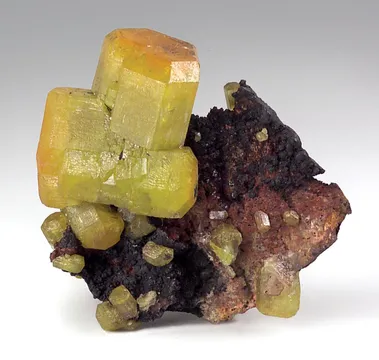
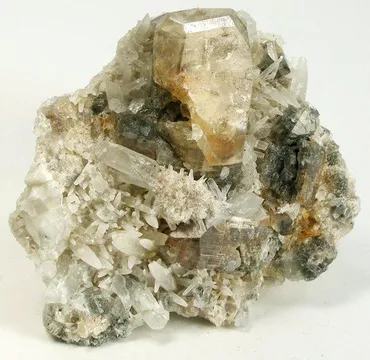
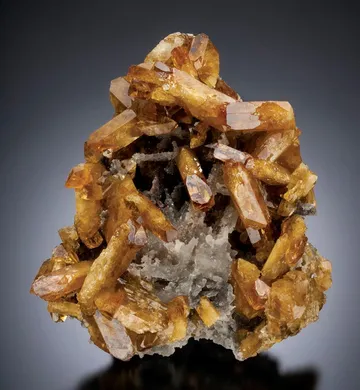
For collectors, the name Pöhla-Tellerhäuser usually means two very different visual worlds. One is bright and crystalline: honey-yellow to wine-yellow baryte in transparent chisel-shaped, tabular, or elongated prismatic crystals on quartz, fluorite, and carbonate gangue. The other is dark and metallic: native silver as dendrites, mossy aggregates, herringbone “fern” forms, or bright white leaflets contrasting sharply with black to brown native arsenic. These two specimen suites do not feel like products of the same mine at first glance, yet both reflect the same intensely overprinted Erzgebirge ore system—one formed in fluorite-barite vein episodes, the other in late Bi-Co-Ni-Ag and Ag-sulfosalt stages superimposed on uranium-bearing veins.
Regional View
Country View
The mine’s collector reputation is unusually well anchored in mining geology. Pöhla-Tellerhäuser is part of the broader Pöhla-Tellerhäuser ore field, commonly divided from northwest to southeast into Pöhla-Globenstein, Hämmerlein, and Tellerhäuser. Hämmerlein is principally a tin skarn deposit; Tellerhäuser is the tin-uranium part most closely associated with the later hydrothermal vein systems and the classic silver-arsenic and baryte specimens. The richest baryte material is associated especially with the Kunnersbach system, while the celebrated silver-arsenic material is tied above all to the +120 m level and, in the best-known occurrence, Block 0985.

Photo: Wikimedia Commons
What separates the best Pöhla-Tellerhäuser pieces from ordinary Erzgebirge specimens is contrast. The finest barytes have a warm internal glow, with transparent yellow bodies, sharp terminations, and white quartz or fluorite matrix that gives the crystals room to breathe. The finest silvers are almost graphic: bright native silver fronds or herringbone sprays standing out against massive native arsenic. Good labels matter here, because many pieces came from a relatively short window of late Wismut and early post-Wismut dispersal, and the most desirable labels preserve not just “Pöhla,” but precise Tellerhäuser details such as Kunnersbach, Gang Luchsbach, Schildbach, the +120 m level, or Block 0985.
Search for specimens: View all specimens from Pöhla-Tellerhäuser Mine, Germany
The Pöhla-Tellerhäuser Mine lies in the Western Erzgebirge of Saxony, in the Schwarzenberg district, near the borderward high country between Pöhla, Tellerhäuser, Breitenbrunn, and the Fichtelberg area. Geologically it occupies a particularly favorable structural and lithologic setting: the intersection of the Fichtelgebirge-Erzgebirge anticlinal zone with the Gera-Jáchymov fault zone, in the transition from the Schwarzenberg dome toward the Tellerhäuser-Hundsmarter syncline. The host rocks are largely Cambro-Ordovician metamorphic successions—mica schists, quartzitic schists, carbonaceous schists, amphibolites, gneisses, and metacarbonate layers—locally transformed into skarn, greisenized zones, and hydrothermal vein systems.
The ore field is a complex deposit rather than a single simple lode. The earliest economically important mineralization was contact-metasomatic skarn, developed where carbonate-rich beds and related metamorphic rocks were altered by fluids connected with the underlying granite. This produced skarn bodies carrying magnetite, cassiterite, sphalerite, and associated silicates. Later greisenization and tin-sulfide mineralization affected both skarn and adjacent schists. The final major collector-relevant overprint is a suite of hydrothermal veins carrying uranium, quartz, calcite, fluorite, baryte, dolomite-ankerite carbonates, Co-Ni arsenides, native arsenic, native silver, bismuth minerals, sulfides, and silver sulfosalts.
The mine name can be confusing because collectors often use “Pöhla-Tellerhäuser” for material from the system as a whole. In geological and mining usage, however, the field is more finely divided. Pöhla-Globenstein, to the northwest, is a separate Sn-W skarn complex. Hämmerlein, reached first from the main Pöhla adit, is chiefly a tin deposit and is the part preserved for visitors in the Zinnkammern Pöhla show mine. Tellerhäuser, farther in, is the deeper tin-uranium deposit that produced many of the classic hydrothermal specimens. The famous baryte comes especially from the fluorite-baryte sequence in Tellerhäuser, restricted chiefly to the Kunnersbach and Gang Luchsbach fault systems. The famous silver-arsenic specimens come from a late silver-bearing episode in the Tellerhäuser vein system, especially the +120 m level in the northwestern part of the mine.
Modern Wismut mining at Pöhla began late compared with the first postwar uranium rush in the Erzgebirge. Surface drilling in the 1950s and 1960s revealed large complex ore deposits with uranium, tin, tungsten, iron, zinc, silver, and other metals. In late 1967, SDAG Wismut began driving the main Pöhla adit from the Luchsbach valley toward the Fichtelberg area at roughly the +590 to +600 m elevation. At about 3 km in, the adit reached the Hämmerlein tin deposit; around 6 km in, it reached the Tellerhäuser uranium deposit. The completed main adit is generally described as about 7.8 to 8 km long.
Tellerhäuser was developed as a deep mine by two blind shafts and a system of levels and sublevels. Published descriptions record two blind shafts reaching roughly 500 m deep below the adit horizon, with principal levels including the +480, +360, +300, +240, +180, and +120 m levels, and development extending downward toward the +60 m level. Uranium mining at Tellerhäuser began in 1979 and ended around the political and economic transition of 1990–1991. The mine produced approximately 1,200 metric tons of uranium from polymetallic hydrothermal veins, a significant output but only a small part of the total calculated uranium resources.
Mining was not limited to uranium. Magnetite ore was mined for several years from the Dreiberg skarn body; about 31,344 tonnes of magnetite ore were extracted between 1983 and 1987. Tin was the major non-uranium target of the broader Hämmerlein-Tellerhäuser system, but at Hämmerlein it saw only experimental extraction rather than sustained commercial tin mining. The modern renewed interest in the Tellerhäuser project is tied to tin, zinc, indium, copper, and other critical metals rather than specimen collecting.
The baryte specimens that made the locality famous came from the fluorite-baryte sequence, especially the Kunnersbach system. Published mine records describe baryte as well-formed tabular to elongated prismatic crystals, including transparent wine-yellow crystals up to 10 cm long from Gang Kunnersbach. Collector pieces preserve this character: chisel-like yellow baryte crystals on white quartz, columnar baryte on fluorite, and less commonly larger cabinet pieces with multiple golden crystals. These were not specimen-pocket operations in the Alpine sense; many pieces were recovered incidentally during industrial development and mining, which is why damage-free matrix specimens with complete terminations are scarce.
The silver story is more dramatic. Earlier silver-bearing material had already been recognized in hydrothermal veins, and in 1972–1973 approximately 178.6 tonnes of silver-bearing ore from the intersection of Gang Schildbach with a branch of Gang Luchsbach were mined and delivered to Freiberg, containing about 479.4 kg of silver. Further complex silver-uranium ores from the +180 m and +120 m levels on Schildbach and Kunnersbach were processed in 1987, yielding about 203.5 kg of silver from 1,202 tonnes of ore. The specimen-producing event collectors know best, however, came at the very end: in early 1991, final mining work in the northernmost part of the +120 m level encountered Block 0985, with rich native arsenic, abundant native silver, löllingite, argentopyrite, proustite, pyrargyrite, polybasite, and related species. Because mining was ending, the occurrence was never investigated as fully as it deserved.
Collecting access today is not open-mine access. After mining ceased, the deeper Tellerhäuser workings were flooded beginning in 1991, and the Tellerhäuser part is blocked off from the main adit. The Hämmerlein section remains accessible as the Besucherbergwerk Zinnkammern Pöhla, where guided visits travel by mine railway about 3 km to the old tin chambers. Those visits are cultural and educational, not collecting trips. Fine Pöhla-Tellerhäuser specimens now come from old collections, dealer stock, auction dispersals, museum holdings, and the secondary collector market.
Barite from Pöhla-Tellerhäuser is the locality’s most immediately recognizable cabinet mineral: transparent to translucent honey-yellow, wine-yellow, butterscotch, or amber BaSO4 in sharp orthorhombic crystals, commonly chisel-ended, tabular, or stretched into blocky prisms on quartz and fluorite. The best documented source is the fluorite-barite sequence of Tellerhäuser, particularly Gang Kunnersbach and related Kunnersbach-system structures, where crystals are recorded up to 10 cm long; most collector specimens are smaller, with individual crystals more often in the centimeter range, but a fine small-cabinet plate can have excellent color, luster, and matrix balance. The strongest pieces show glassy, undamaged crystal faces, saturated golden color without dull brown opacity, and clean placement on white drusy quartz or pale fluorite; ordinary pieces tend to be more opaque, contacted, broken at the terminations, or visually crowded by massive gangue.
Baryte is the internationally preferred spelling for the same BaSO4 species, and Pöhla-Tellerhäuser baryte is best understood as a late fluorite-baryte vein mineral rather than a generic gangue afterthought. Published descriptions distinguish white to pink tabular aggregates from Bi-Co-Ni-style veins and the classic transparent wine-yellow prismatic to tabular crystals from Gang Kunnersbach; in trade, the latter are the coveted “Pöhla” barytes. Good examples show lustrous golden crystals rising freely from quartz, sometimes with fluorite, pyrite, chalcopyrite, or carbonate accents, while the finest pieces combine saturated yellow color, sharp chisel geometry, some transparency, and credible old German or post-Wismut provenance. Large pieces exist, including museum-documented fields of view in the 30–40 cm range, but most market specimens are miniatures to small cabinets, and condition becomes the decisive quality factor.
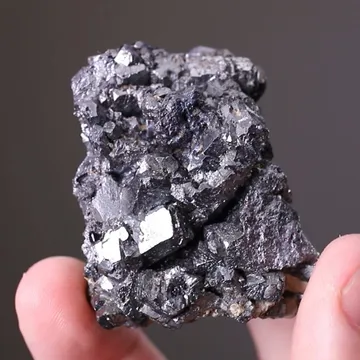
Native silver from Pöhla-Tellerhäuser is famous for bright metallic dendrites, mossy aggregates, herringbone growths, and fern-like sprays on or within dark native arsenic, especially from Block 0985 on the +120 m level. The silver-bearing paragenesis is part of the late ags silver stage associated with native arsenic, löllingite, argentopyrite, proustite, pyrargyrite, polybasite, and other sulfides and sulfosalts in carbonaceous mica schist wall rocks. Most collector specimens are miniatures or small cabinets showing silver exposed by natural or careful trimming from arsenic-rich matrix; exceptional pieces have free-standing, undamaged silver “ferns” or herringbone branches rather than merely embedded silver seams. The ideal Pöhla silver is all contrast: fresh silvery-white metal against black to dark gray arsenic, with enough three-dimensional relief to show that the silver is crystallized, not just a cut or polished ore texture.
Native arsenic from Pöhla-Tellerhäuser is usually the dark stage on which the silver performs, but it is mineralogically important in its own right. Mine records describe arsenic as earthy to massive, with shells up to 7 cm thick from the Luchsbach fault system on the adit level and masses up to 20 cm thick in Strecke 922A on the +120 m level; Block 0985 material commonly contains native arsenic intergrown with dendritic to mossy native silver, löllingite, galena, chlorargyrite, pyrargyrite, polybasite, and other late silver minerals. Good specimens are judged by the quality of the associated silver and the stability of the arsenic matrix: compact, dark, coherent arsenic with crisp metallic silver is far better than crumbly, oxidized, brown-altered material. Arsenic specimens should be handled as toxic heavy-element specimens, kept dry, and not abraded, sawn, or cleaned aggressively.
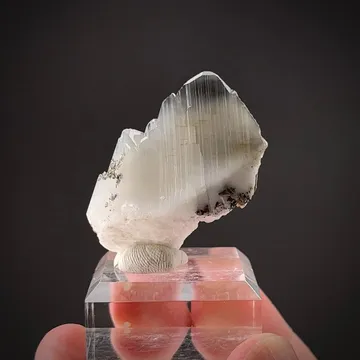
Quartz is one of the structural minerals of the Pöhla-Tellerhäuser story, present in schists and gneisses, in older comb-quartz vein stages, in uranium-bearing kku veins, and as the white drusy or crystalline matrix for classic baryte. In the mine’s documented mineral list, quartz occurs as comb quartz in many veins, amethyst from Gang Reibach on the +120 m level, bipyramidal crystals to about 1 cm associated with fluorite and baryte, and several-centimeter crystals from skarn cavities such as Strecke 1555c on the +240 m level. For collectors, quartz is rarely the headline species here unless it is well crystallized, amethystine, or provides an especially clean matrix for yellow baryte or fluorite. The best quartz-associated specimens use the quartz as visual architecture: white or colorless crystals beneath golden baryte, or crisp vein quartz contrasting with darker ore minerals.
Fluorite at Pöhla-Tellerhäuser is widespread through the skarn and vein system, but only select pieces cross from ore geology into desirable specimen territory. Gang Kunnersbach produced yellowish fluorite cubes up to very large size in mine descriptions, as well as green aggregates; other vein stages include violet, rose, colorless, white, pale yellow, and black fluorite, with the dark variety associated with pitchblende-rich “stinkspat” contexts. In the collector suites, fluorite is most appealing as a companion to baryte and quartz from the Kunnersbach fluorite-baryte sequence, where pale, yellow, green, or colorless cubes give both color contrast and paragenetic significance. Standalone fluorite is less common in fine condition than baryte, and pieces with intact cubes, visible color, and a clean association with baryte, galena, pyrite, chalcopyrite, or quartz are markedly better than massive or ore-textured material.
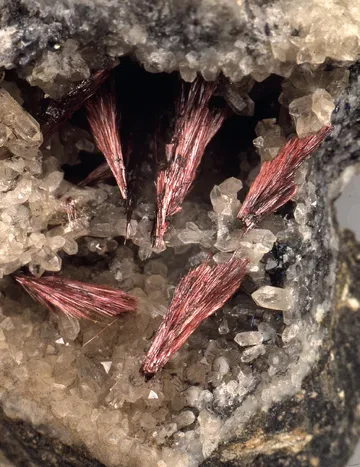
Pyrargyrite, Ag3SbS3, is a scarce but important member of the Pöhla-Tellerhäuser silver suite, documented as crystals up to about 5 mm with chalcopyrite on dolomite from Strecke 522 on the +300 m level, and also from Gang Schildbach on the +180 m level and Block 0985 on the +120 m level. It belongs to the late silver-sulfosalt stage with proustite, argentopyrite, polybasite, acanthite, stephanite, and native silver, and it is usually a small, dark red to nearly black metallic mineral that rewards magnification and good lighting rather than casual display. A worthwhile Pöhla pyrargyrite specimen should have confirmed identification, visible discrete crystals or rich microcrystalline areas, and meaningful association—especially with native arsenic, silver, proustite, dolomite, quartz, or chalcopyrite. Because many Pöhla silver ores are visually complex and dark, unverified “ruby silver” labels deserve caution unless the crystal habit, color in transmitted or edge light, and provenance are persuasive.
Beyond the headline species, Pöhla-Tellerhäuser is a remarkably rich ore-mineral locality. Documented minerals include acanthite, argentopyrite, proustite, polybasite, stephanite, dyscrasite, chlorargyrite, xanthoconite, native bismuth, bismuthinite, aikinite, emplectite, galena, sphalerite, chalcopyrite, pyrite, marcasite, pyrrhotite, arsenopyrite, löllingite, safflorite, rammelsbergite, nickelskutterudite, skutterudite, nickeline, millerite, pitchblende, coffinite, magnetite, cassiterite, scheelite, helvine, axinite, grossular-andradite garnet, vesuvianite, wollastonite, prehnite, datolite, nordenskiöldine, and a wide suite of alteration minerals including annabergite, erythrite, arsenolite, johannite, uranopilite, and kaatialaite. Many are microscopic or matrix-bound, but the locality rewards systematic collectors because precise level, block, and vein information can transform a dark ore fragment into an important paragenetic specimen.
Pöhla-Tellerhäuser is a locality where provenance is almost as important as species. “Pöhla” alone is a useful but incomplete label; “Pöhla-Tellerhäuser,” “Gang Kunnersbach,” “Gang Luchsbach,” “Schildbach,” “+120 m level,” “Strecke 922A,” or “Block 0985” are far more meaningful. The broader Pöhla area contains several related but distinct deposits, including Pöhla-Globenstein and Hämmerlein, so older labels can be imprecise. Golden baryte on quartz or fluorite is most plausibly Tellerhäuser-Kunnersbach material, while silver on native arsenic from the famous find should ideally carry a Block 0985 or +120 m level attribution.
No major, locality-specific fake tradition is attached to Pöhla-Tellerhäuser in the way collectors discuss fabricated wires or assembled specimens from some classic silver localities. The main risks are subtler: overbroad “Pöhla” labelling, confusion between Pöhla-Tellerhäuser and other Erzgebirge uranium-silver districts, polished ore fragments marketed as display specimens, or silver-arsenic pieces with the silver over-cleaned or mechanically exposed. Native silver from here naturally occurs in dark arsenic-rich matrix, and preparation can improve display dramatically; the question is whether the specimen still preserves natural texture and credible context.
Condition is critical on baryte. The yellow crystals are attractive but brittle, and many specimens were recovered during industrial mining rather than delicate pocket collecting. Expect minor bruising, contacted backs, cleaved edges, or missing terminations on average examples. A pristine, three-dimensional miniature with sharp golden crystals on quartz is much rarer than a flat plate or repaired-looking fragment. Check crystal tips, exposed edges, and the contact between baryte and matrix; good old specimens often have minor mining wear but should not look freshly glued or unnaturally perched.
Silver and arsenic pieces demand different caution. Native arsenic is toxic, and arsenic-bearing alteration products can form on old specimens, especially if kept damp. Handle with clean hands or gloves, do not lick, grind, saw, or ultrasonically clean the material, and wash hands after handling. Store the piece dry and stable, away from acids and from high-humidity cabinets. Bright silver can tarnish, but aggressive chemical cleaning can ruin the delicate herringbone texture and may mobilize arsenic-bearing compounds. The safest collector practice is dry, minimal handling and a well-sealed display or storage environment.
Uranium minerals occur at the mine, but the showiest collector material on the general market is usually baryte or silver-arsenic rather than pitchblende. Any specimen containing pitchblende, coffinite, or uranium alteration minerals should be treated as radioactive and handled under normal radioactive-mineral precautions: distance, limited handling time, secure labelling, ventilation for storage, and avoidance of dust. Do not assume every Pöhla-Tellerhäuser specimen is radioactive; do not assume it is non-radioactive either if it contains black heavy ore minerals from uranium veins.
Market availability is steady but not abundant. Golden baryte appears periodically from European dealers, auctions, and collection dispersals, ranging from modest miniatures to expensive small cabinets and rare large plates. Silver on arsenic from Block 0985 is less common and more variable: small pieces with embedded silver may be obtainable, but specimens with free-standing fern-like or herringbone silver are much more desirable and command a premium. Pyrargyrite, proustite, argentopyrite, and other silver sulfosalts are usually specialist pieces or micromounts, and should be bought with confidence only when the dealer provides meaningful locality and identification detail.
The modern Pöhla story begins not with a romantic medieval shaft but with Wismut arriving late to a small Erzgebirge village. After the Second World War, the uranium rush had already transformed Johanngeorgenstadt, Schlema, Annaberg, Schneeberg, and other districts. Pöhla entered the Wismut era in 1967, after surface drilling in the 1950s and 1960s indicated major hidden complex ore bodies. From the Luchsbach valley, miners began driving a main adit toward the high country below the Fichtelberg. It was a huge commitment: nearly 8 km of tunnel, built first to reach Hämmerlein and then pushed onward toward Tellerhäuser.
At about 3,000 m in, the adit reached the Hämmerlein tin deposit. There, in 1976 and 1977, Wismut opened the great “Zinnkammern,” experimental tin stopes that still impress visitors today. These chambers are not small hand-dug cavities; they are industrial rooms roughly 45 m long, 12 m high, and 10 m wide, preserved as underground evidence of the scale and confidence of late GDR-era mining engineering. The visitor mine now carries people into that part of the system by mine train, making Pöhla unusual among specimen localities: the collector cannot legally work the old producing areas, but can still ride into the mountain and stand in a surviving part of the same industrial landscape.
The real prize for Wismut, however, lay farther in. Around 6,000 m from the portal, the Tellerhäuser uranium deposit was developed by two blind shafts, six main levels, seven sublevels, and a network of ventilation raises. Uranium mining began in 1979. By the late 1980s, Tellerhäuser had become important enough that 1989 saw about 143 tonnes of uranium production, nearly a quarter of the output of the Aue mining operation in that year. Yet the timing was brutal: just as Tellerhäuser was proving its industrial value, the political order that had built Wismut was ending.
The most memorable collector episode came at the very end. In early 1991, during final mining work on the northernmost part of the +120 m level, miners encountered an extraordinarily rich silver occurrence in Block 0985. The setting was specific: a kku/mgu vein with pitchblende, overprinted by biconi and ags mineralization, hosted by mica schist with carbonaceous layers of the H2 package. Within the vein were lenses and layers 5–15 cm thick carrying native arsenic, abundant native silver, and löllingite, with silver sulfosalts including argentopyrite, proustite, pyrargyrite, and polybasite. It was the kind of find that, in an active specimen mine, might have been carefully mapped, photographed, prepared, and marketed as a named pocket. At Pöhla-Tellerhäuser, it arrived as the mine was closing. The published monograph notes plainly that the end of mining prevented a comprehensive investigation of the occurrence.
That late silver find explains the character of the specimens now prized by collectors. Many are not freestanding wire-silver sculptures but dense arsenic-rich ore pieces from which silver appears as bright dendritic, mossy, or herringbone forms. Some pieces show silver as sharp metallic fronds against black arsenic; others show more massive or nearly massive silver with only minor arsenic. Museum and publication captions preserve exact mining coordinates for some of the best material: Tellerhäuser NW, Strecke 922/921, Querschlag 9209 NW, +120 m level, Abbaublock 0985, Trum Schildbach. Those details are not collector ornament; they are the key to understanding why the material looks so unlike ordinary Saxon silver.
There is also a post-mining story below the specimen story. After active mining ceased, the deeper workings were flooded beginning in 1991. By 1995 the mine had reached its final flooding level and treatment of overflow water became a long-term responsibility. The chemistry proved unusual: uranium concentrations declined faster than expected under reducing, microbially active conditions, but arsenic and radium remained problematic in the mine water. Decades after the last ore was hoisted, Pöhla-Tellerhäuser was still geochemically alive—quiet, flooded, and closed to collecting, but still requiring engineered treatment of the waters moving through the old uranium mine.
Werner Schuppan and Axel Hiller, with Inge Krejny, Die Komplexlagerstätten Tellerhäuser und Hämmerlein: Uranbergbau und Zinnerkundung in der Grube Pöhla der SDAG Wismut, Bergbau in Sachsen Band 17, Landesamt für Umwelt, Landwirtschaft und Geologie / Oberbergamt, Freiberg, 2012 — The essential technical monograph for the geology, mining history, ore bodies, vein systems, paragenesis, production figures, mineral list, Wismut collection photographs, and the Block 0985 silver occurrence.
W. Büder, A. Hiller, and W. Schuppan, “Ein ungewöhnlicher Silberfund in der Lagerstätte Tellerhäuser bei Pöhla, Erzgebirge,” Mineralien-Welt, 2(5), 34–36, 1991 — The key collector-mineral reference for the unusual native silver–native arsenic discovery at Tellerhäuser.
R. Haake and F. Hofmann, “Die Mineralien der Skarn-Lagerstätte Pöhla im Erzgebirge,” Mineralien-Welt, 2(3), 1991 — A mineralogical article cited in the Saxon monograph and relevant to the broader Pöhla skarn mineral suite.
A. Hiller, “Geologischer Bau der Lagerstätten Hämmerlein und Tellerhäuser im Westerzgebirge,” Zeitschrift für geologische Wissenschaften, 23(5/6), 1995 — A geological treatment of the Hämmerlein and Tellerhäuser deposits cited in the main monograph bibliography.
W. Schuppan, W. Büder, and G. Lange, “On uranium mineralization in the vein deposits of the Western Erzgebirge, Germany,” Monograph Series on Mineral Deposits, 31, 191–207, Gebrüder Borntraeger, Berlin-Stuttgart, 1994 — Regional uranium-vein context for Pöhla-Tellerhäuser and related Western Erzgebirge deposits.
C. Paul, M. Burghardt, and colleagues, “Advanced chemical oxidation for arsenic treatment at a flooded uranium mine with a bio-geochemically reduced mine water pool,” in Mining Meets Water – Conflicts and Solutions, IMWA 2016 — A post-mining hydrogeochemical study of Pöhla-Tellerhäuser mine water, with a concise site-history summary and treatment data.
Mindat locality record: Pöhla-Tellerhäuser Mine, Pöhla, Schwarzenberg, Erzgebirgskreis, Saxony, Germany — Species list, locality hierarchy, references, and user-contributed specimen photographs.
Mindat occurrence record: Native Silver from Pöhla-Tellerhäuser Mine — Species-specific occurrence record listing the Büder, Hiller, and Schuppan 1991 silver-find publication.
Mindat photo: Native arsenic, native silver, nickelskutterudite, galena, pyrite, and calcite from Pöhla-Tellerhäuser — A polished-section photomicrograph documenting the fine-grained silver-arsenic assemblage and associated ore minerals.
Wikimedia Commons file: Baryte from Pöhla-Tellerhäuser Mine, photo by Rob Lavinsky / iRocks.com — Freely licensed photograph of a classic golden baryte specimen with quartz and minor fluorite, including specimen size and descriptive notes.
“ANB2529 Baryte Pöhla-Tellerhäuser Mine, Germany” — Crystal Classics — Short specimen video of a Pöhla-Tellerhäuser baryte offered by Crystal Classics.
“First Tin: Sitevisit im Besucherbergwerk Pöhla und der aktuellen Bohrkampagne auf Tellerhäuser” — Rohstoff-TV — Site-visit video showing the Pöhla visitor mine context and modern Tellerhäuser exploration discussion with First Tin.
Pöhla-Tellerhäuser Mine on Mindat — Best single online index for the locality, mineral list, references, hierarchy, and photo gallery.
Mindat photo gallery for Pöhla-Tellerhäuser Mine — Useful visual survey of baryte, native silver, arsenic, fluorite, and associated specimens.
Schuppan and Hiller, Die Komplexlagerstätten Tellerhäuser und Hämmerlein, 2012 — The authoritative Saxon mining monograph for geology, history, mine development, production, and mineralogy.
Besucherbergwerk Zinnkammern Pöhla — official history page — Clear public summary of Wismut’s Pöhla development, the main adit, Hämmerlein, Tellerhäuser, and post-mining flooding.
Besucherbergwerk Zinnkammern Pöhla — guided tours — Current visitor information for the accessible Hämmerlein/Zinnkammern part of the mine system.
First Tin — Tellerhäuser project — Modern project overview for the renewed tin-resource interest at Tellerhäuser and the historic Pöhla adit infrastructure.
Saxore Bergbau — Projektüberblick — German project overview for Tellerhäuser, Hämmerlein, Dreiberg, and Zweibach.
IMWA 2016 paper on arsenic treatment at flooded Pöhla-Tellerhäuser — Technical source on post-mining mine-water chemistry, arsenic, radium, uranium behavior, and treatment.
Wikimedia Commons: Baryte from Pöhla-Tellerhäuser Mine — Licensed reference photograph of classic golden baryte from the locality.
Mindat occurrence record: Native Silver from Pöhla-Tellerhäuser Mine — Concise occurrence and reference page for the locality’s native silver.
Mindat occurrence record: Argentopyrite from Pöhla-Tellerhäuser Mine — Useful species-specific page for one of the locality’s rarer silver minerals.
Mindat occurrence record: Nordenskiöldine from Pöhla-Tellerhäuser Mine — Species occurrence page for a notable tin-borate rarity recorded from the locality.
Crystal Classics Germany inventory including Pöhla-Tellerhäuser examples — Market reference for recent dealer examples of baryte, silver in arsenic, and silver-sulfosalt material.