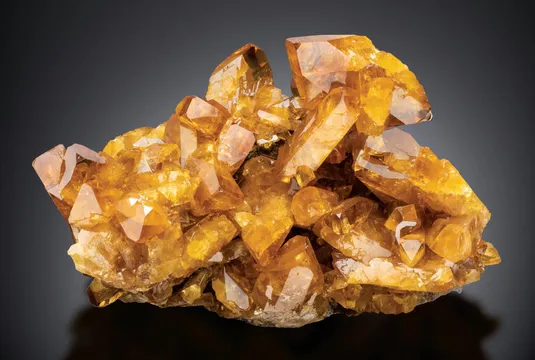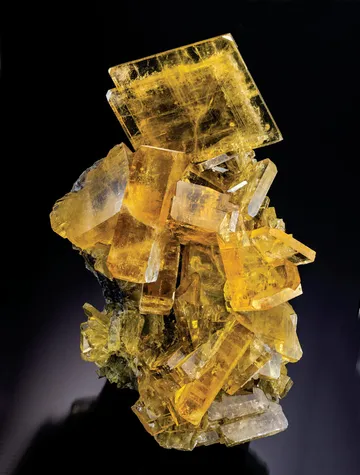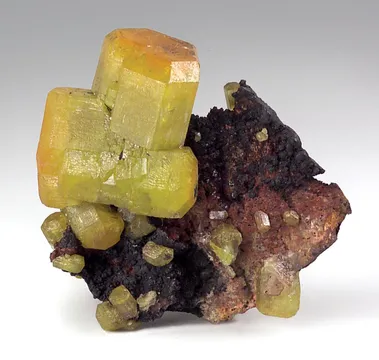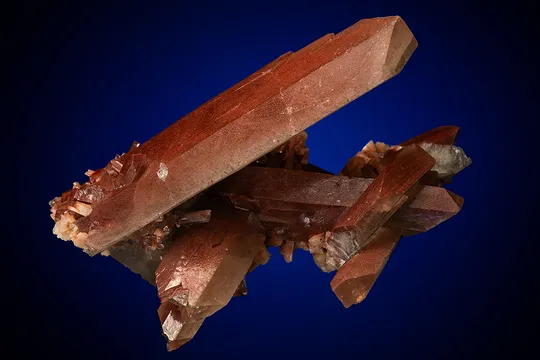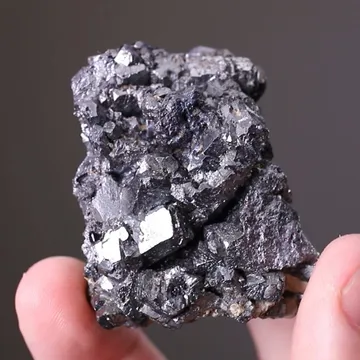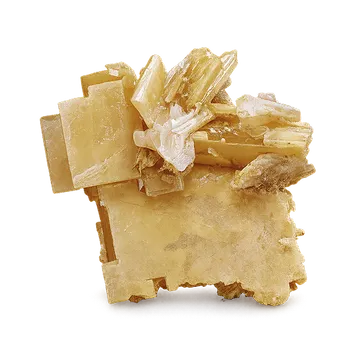
Barite from Pöhla-Tellerhäuser Mine, Germany: golden honey-yellow orthorhombic crystals on quartz/fluorite, prized for color, form, and classic pedigree.
Key facts
Pöhla-Tellerhäuser is one of the classic European names for golden barite. The finest pieces are not the flat, colorless plates many collectors first associate with the species, but warm honey-yellow to amber, transparent-to-translucent orthorhombic crystals with a chisel-like or elongated prismatic habit, commonly perched on quartz and, in better combinations, set against fluorite. The color can be remarkably rich: wine-yellow, butterscotch, or deep amber in the thicker zones, with brighter yellow highlights along sharp edges and terminations.

Photo: Wikimedia Commons
The locality belongs to the Pöhla-Tellerhäuser ore field in the upper Western Erzgebirge of Saxony, a complex skarn-and-vein system developed in metamorphic rocks and later overprinted by hydrothermal uranium, fluorite-barite, carbonate, arsenide, silver, and bismuth-bearing mineralization. That complicated geological history matters to collectors because the best barites are not merely “pretty gangue”; they are part of a distinctive fluorite-barite vein episode in the Tellerhäuser system, especially tied to the Kunnersbach and Gang Luchsbach structures.
Pöhla barite is collected for three things above all: color, form, and pedigree. The ideal specimen has glassy luster, rich golden color without muddy brown tones, sharp chisel or spear-like terminations, and some degree of transparency. Matrix pieces are especially desirable when the barite rises cleanly from white drusy quartz, chalcedony, or colored fluorite rather than being an isolated cluster with little context. Doubly terminated crystals and parallel-growth groups add a further premium, as do old labels from European collections and pieces traceable to the post-Wismut era when classic material reached the broader collector market.
Search for specimens: View all barite specimens from Pöhla-Tellerhäuser Mine, Germany
The Pöhla-Tellerhäuser Mine lies near Pöhla, now part of Schwarzenberg in the Erzgebirgskreis district of Saxony, Germany. The broader ore field sits in the upper Western Erzgebirge between Schwarzenberg and the Oberwiesenthal area, within the structural intersection of the Fichtelgebirge-Erzgebirge anticline and the Gera-Jáchymov fault zone. The mine name is usually used by collectors for material from the Pöhla-Tellerhäuser system as a whole, but the geology is more finely divided: Pöhla-Globenstein is the Sn-W part to the northwest, Hämmerlein is primarily a tin deposit, and Tellerhäuser is the Sn-U deposit most closely tied to the hydrothermal uranium and fluorite-barite vein systems.
The host rocks are Cambro-Ordovician metamorphic sequences: mica schists with skarn-altered metacarbonate layers, gneisses, amphibolites, quartzitic schists, and carbon-rich schists, overlain locally by phyllitic schists. Beneath this metamorphic pile is a granite ridge assigned to the Eibenstock-Karlovy Vary massif, the heat and fluids of which helped create the skarn bodies. The deposit history began with contact-metasomatic skarn formation, followed by greisenization and stratabound tin-sulfide mineralization, and then by later fault-controlled hydrothermal veins rich in uranium, fluorite, carbonate, quartz, arsenides, silver minerals, and barite.
The barite of collector interest belongs especially to the fluorite-barite sequence in Tellerhäuser. Published geological descriptions place this sequence mainly in the Kunnersbach and Gang Luchsbach fault systems. Fluorite is the dominant mineral of that sequence, but barite occurs as well-formed tabular to elongated prismatic crystals. The classic golden crystals that collectors call “Pöhla barite” are most notably tied to Kunnersbach, where transparent wine-yellow crystals up to 10 cm long are documented.
Mining at Pöhla in its modern form was a Wismut story. SDAG Wismut began driving the main Pöhla adit in late 1967 after surface drilling in the 1950s and 1960s had revealed major complex ore potential. The access adit was approximately 7.8 to 8 km long and ran from the Luchsbach valley toward the Fichtelberg area at about the +590 to +600 m level. Around 3 km in, the Hämmerlein skarn was reached; farther in, around 6 km from the portal, the Tellerhäuser deposit was developed by two blind shafts and multiple working levels.
Uranium mining at Tellerhäuser began in 1979 and ended with the political and economic transformation of 1990–1991. Published mine-water and geological summaries give approximately 1,200 metric tons of uranium recovered from the Pöhla-Tellerhäuser deep mine between 1967 and 1990, with the Tellerhäuser uranium veins hosted in a metamorphic environment and associated with pitchblende, Co-Ni arsenides, native arsenic, löllingite, magnetite, pyrite, marcasite, chalcopyrite, native silver, quartz, and calcite.
After mining ceased, the deeper workings were flooded beginning in 1991. Access to the Tellerhäuser deposit was sealed off in the main adit, while the Hämmerlein area remained accessible and became the visitor mine known as Besucherbergwerk Zinnkammern Pöhla. Today, visitors enter by mine train for roughly 3 km to the Hämmerlein tin chambers, where the underground spaces are famous for their large stopes, about 45 m long, 12 m high, and 10 m wide. For mineral collectors, this means Pöhla-Tellerhäuser is not a contemporary collecting locality in the usual sense. Fine barite specimens are primarily old-production pieces circulating from collections, dealers, and auctions.
Notable finds include both specimen and ore-mineralogical material. The Wismut geological collection documented chisel-shaped barite crystals on quartz from the Kunnersbach vein system with a 30 cm field of view, as well as columnar barite on fluorite from the Kunnersbach system with a 40 cm field of view. Those records match what collectors see on the market: golden prismatic or chisel-shaped barite, usually on quartz, sometimes with fluorite, and much more rarely in large, undamaged crystals.
Pöhla-Tellerhäuser barite is most recognizable in its golden habit: lustrous honey-yellow to amber crystals, commonly transparent at the edges and terminations, and typically sharper and more prismatic than the broad, pale barite plates from many other European localities. The best crystals are chisel-shaped, spear-like, or elongated prismatic; some are tabular, and a few occur in flat bladed parallel groups or fan-like clusters. Doubly terminated crystals are an important quality marker and appear often enough to be a known Pöhla trait, though undamaged examples remain desirable.
Crystal size varies widely. Many collector specimens are thumbnails, miniatures, and small cabinets with individual crystals in the 1–3 cm range. Better pieces show crystals around 4–6 cm, and documented Kunnersbach material includes transparent wine-yellow prismatic to tabular crystals up to 10 cm long. Large crystals are not automatically superior: Pöhla barite is judged heavily on sharpness, glassy luster, saturated color, and lack of bruising along the terminations and blade edges.
The main color range is honey-yellow, amber, golden yellow, butterscotch, and wine-yellow. White to pale pink barite aggregates are also documented from biconi veins, and radial intergrowths of tabular crystals can be influenced in color by hematite inclusions. The collector market, however, prizes the transparent golden material most strongly, especially when the color is even and the crystal interiors show attractive phantom-like zoning rather than cloudy fractures.
Associations are a major part of the locality’s identity. Quartz is the most common matrix mineral on collector pieces, occurring as drusy quartz, chalcedony, or quartz-rich vein material. Fluorite is the most important aesthetic association, appearing as yellow, greenish, violet, or color-zoned cubes and masses in the same fluorite-barite system. Hematite, pyrite, calcite, siderite, and various sulfides and arsenides belong to the broader vein environment, though not all are common on display-quality barite specimens.
The best Pöhla specimens have a very specific look: golden barite crystals elevated above a pale quartz matrix, with enough open space to show the chisel terminations. Dense carpets of smaller crystals can be attractive when the luster is high and the color is uniform, but more sculptural pieces with a few isolated, doubly terminated crystals often carry stronger cabinet appeal. Fluorite-bearing examples are especially compelling when the barite color contrasts with purple or yellow fluorite rather than being visually lost in a busy matrix.
Condition is critical. Barite has perfect cleavage and modest hardness, so Pöhla crystals are vulnerable to edge nicks, cleaved terminations, pressure bruises, and contact damage on crystal tips. Because many specimens were recovered during industrial mining rather than specimen-oriented pocket collecting, truly pristine pieces with intact terminations on all exposed crystals are much less common than “good-looking but touched” examples.
There is no well-established Pöhla-specific fake or treatment problem comparable to dyed agates or assembled Moroccan vanadinite, but the locality does require careful buying. The main authenticity concern is not whether the mineral is barite, but whether the specimen is genuinely Pöhla-Tellerhäuser rather than a generic golden barite from another European or modern world locality. A credible old label, a consistent matrix, and the right habit all matter.
A good Pöhla label should usually read Pöhla-Tellerhäuser Mine, Pöhla, Schwarzenberg, Erzgebirgskreis, Saxony, Germany, though older labels may use “Pöhla Mine,” “Pohla,” “Pöhla, Erzgebirge,” “Schwarzenberg,” or the English spelling “Saxony.” Some older commercial labels may also use “Crottendorf” or broader Erzgebirge wording imprecisely, so locality confidence improves when the specimen’s appearance matches known Kunnersbach/Tellerhäuser material: golden chisel-shaped barite, quartz matrix, and possible fluorite association.
Repairs are a more realistic concern than outright fakery. Inspect large crystals under magnification for glued terminations, filled cleavages, and mismatched luster across breaks. Doubly terminated crystals are desirable, so broken and reattached tips are worth checking carefully. The high specific gravity of barite means specimens can be surprisingly heavy for their size; loose crystals can detach from quartz matrix if the contact is small or previously fractured.
Common condition issues include nicked chisel edges, cleaved points, chatter along exposed crystal ridges, and small bruises that turn otherwise transparent amber areas dull or whitish. On quartz matrix pieces, also check for sawed bases, hidden repairs where barite meets quartz, and old iron staining that may obscure either damage or attractive contrast. A little peripheral wear is common and acceptable on older cabinet specimens, but damage across the main display crystals should be reflected in price.
Pöhla barite is scarce but not unobtainable. It appears periodically from old European collections and in specialist dealer inventories, with recent public offerings showing thumbnails to cabinet specimens rather than new production. Fine examples with gemmy crystals, strong golden color, quartz matrix, and old collection provenance command a premium; large cabinet pieces with many sharp crystals or unusual fluorite association are significantly harder to replace than single loose clusters.
For long-term care, store Pöhla barite away from harder minerals that can abrade the edges. Avoid ultrasonic cleaning, aggressive chemical treatment, and repeated soaking, especially on repaired or matrix-heavy specimens. Dust with a soft brush or air blower. The mineral’s beauty is in its glassy faces and crisp terminations; once a chisel edge is bruised, it cannot be restored.
Pöhla’s modern mining story begins not with a prospector holding a golden barite crystal to the light, but with the cold machinery of the postwar uranium hunt. The Erzgebirge had known iron, tin, silver, cobalt, nickel, and arsenic mining for centuries, yet the great modern push came after the Second World War, when uranium pitchblende transformed parts of Saxony into strategic ground. Wismut was described in a Saxon geological foreword as a “Staat im Staate” — a state within a state — and even its name served partly as cover for the real objective: uranium.
At Pöhla, Wismut arrived later than in famous uranium districts such as Schneeberg-Schlema. Surface drilling through the 1950s and 1960s revealed complex ore deposits around Hämmerlein and Tellerhäuser, and in late 1967 the main adit began to advance from the Luchsbach valley. The drive was immense by collecting-locality standards: nearly 8 km of access tunnel. At about 3,000 m in, miners cut the Hämmerlein tin skarn. Farther still, around 6,000 m from daylight, the Tellerhäuser uranium deposit was opened by two blind shafts, six main levels, seven sublevels, and ventilation raises.
The Zinnkammern, now the public face of the mine, began as experimental tin workings in 1976–1977. They were not specimen pockets but engineered voids: chambers roughly 45 m long, 12 m high, and 10 m wide. Today those dimensions are part of the visitor experience, reached by a 3 km mine-train ride into the mountain. Formerly industrial spaces now host demonstrations, concerts, and mining-culture events, while the Tellerhäuser uranium workings beyond remain sealed and flooded.
The barite story belongs to the quieter mineralogical afterlife of the mine. During Wismut operations, the golden crystals were not the commodity. They were found as part of the fluorite-barite vein systems — particularly Kunnersbach and Gang Luchsbach — amid a far more politically important search for uranium and a technically difficult evaluation of tin, tungsten, zinc, indium, and other metals. The geological monograph preserves the collector’s key details almost as an aside: barite from Kunnersbach occurs as transparent wine-yellow prismatic to tabular crystals up to 10 cm, and the Wismut collection held chisel-shaped barites on quartz large enough to be photographed with a 30 cm field of view.
Collectors repeat another postwar detail because it explains why Pöhla barites have a distinctive market rhythm. Much of the classic material seems to have emerged from old stock and collections rather than organized modern specimen recovery. Dealer and collection records repeatedly describe golden Pöhla barites as specimens from the Communist or Wismut era that reached Western collectors in quantity only after the political opening around 1989–1990. Whether in a small old-label miniature or a dramatic cabinet cluster, that history is part of the object: the specimen is not just a golden sulfate, but a survivor from one of the most secretive mining landscapes of late twentieth-century Europe.