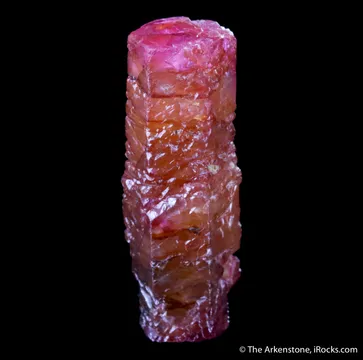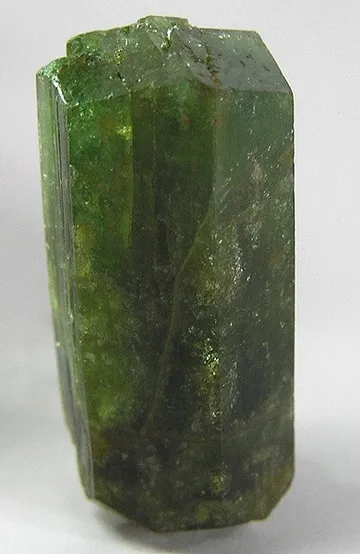
A collector's guide to Palelni Mine, Myanmar: its geology, mining history and notable minerals, illustrated with the 100 specimens documented from this locality on EarthWonders.
Key facts
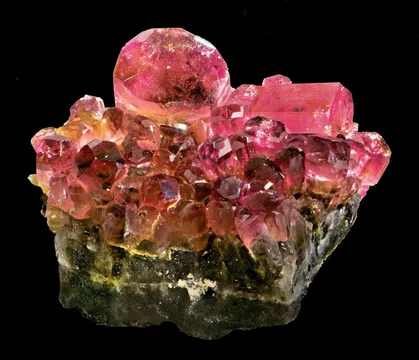
Palelni Mine—also known in the literature and old labels as the Kat Chay or Khat Che mine—is one of the great modern surprises of the Mogok gem province: not a ruby-in-marble locality, but an evolved rare-element pegmatite occurrence near Khetchel village in the Molo quarter of Momeik Township, Shan State. Its collector reputation rests on two very different visual signatures. The first is the unmistakable “mushroom” tourmaline: dark schorlitic cores capped and overgrown by pink to raspberry-red elbaitic tourmaline, commonly with curving, divergent, almost botryoidal or fan-like growth. The second is its suite of beryllium- and lithium-bearing pegmatite minerals—especially sharp, colorless to pale-yellow phenakite, gemmy petalite, hambergite, pollucite, beryl, topaz, quartz, feldspar, and lepidolite.
The deposit belongs to the rare-element, LCT-type pegmatite world of lithium, cesium, tantalum, boron, and beryllium enrichment. Palelni’s pegmatites occur in the Momeik area north of Mogok, within the broader belt of evolved tin-tungsten S-type granites and associated pegmatites that runs north-south through Myanmar. The better-known Mogok marbles gave the world ruby and spinel; Palelni instead gave collectors a pegmatite expression of the same regional complexity—small pockets, resistant hard rock, abundant etching, and a mineral assemblage that looks more like a Burmese cousin to the high-Cs pegmatites of Madagascar and Siberia than to the classic ruby diggings of Mogok Valley.
Regional View
Country View
The best Palelni specimens are not large in the way Brazilian or Afghan pegmatite specimens can be large; they are valued for form, color, strangeness, and locality character. A fine tourmaline “mushroom” may be only a thumbnail or miniature, but it can show a black stem, a lustrous raspberry cap, curved growth surfaces, and subtle internal zoning that is instantly recognizable. Palelni phenakite is prized for the opposite effect: water-clear, glassy, sharply twinned prismatic crystals whose terminations can look like tiny drill bits. Matrix pieces are far scarcer than loose crystals, and combinations with smoky or pale gray quartz, white feldspar, calcite, hambergite, or schorl carry a premium because they preserve the pocket context rather than just the crystal.
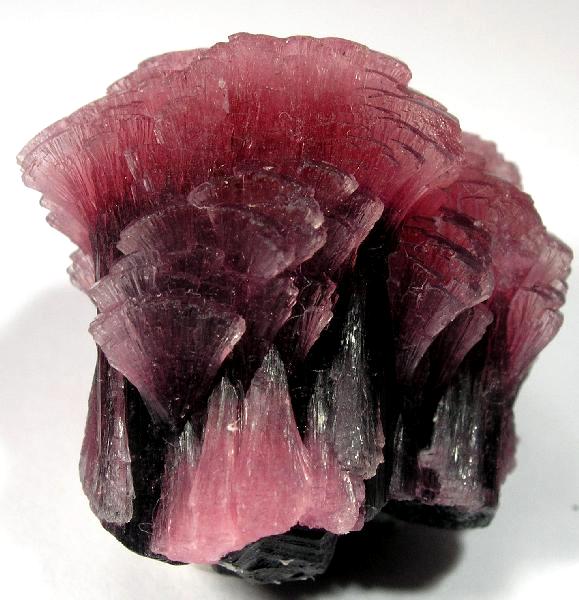
Photo: Rob Lavinsky, iRocks.com / Wikimedia Commons
Search for specimens: View all specimens from Palelni Mine, Myanmar
Palelni Mine is in the Khetchel village area of the Molo quarter, Momeik Township, Kyaukme District, Shan State, Myanmar. Older labels may place it simply at “Mogok,” “Momeik,” “Molo,” “Khetchel,” “Khat Che,” “Kat Chay,” “Cache,” or “Burma,” and this label history matters: much of the material entered the specimen trade through Mogok dealers, while the pegmatite source itself is in the Momeik-Molo area north to northeast of the classic Mogok ruby district.
The deposit is a rare-element granitic pegmatite system rather than a corundum marble deposit. Published descriptions place the Molo pegmatites as dykes and veins cutting peridotite country rock, and broader regional work describes the host environment as pegmatite dikes intruding a peridotite body within rocks of the Mogok Group, including gneiss, marble, and calc-silicate rocks. The pegmatites are part of an evolved tin-tungsten granite belt; individual bodies are modest by global pegmatite standards, commonly only a few meters thick, yet chemically rich enough to yield lithium, cesium, beryllium, boron, tantalum, and tin mineralization.
The ore bodies are best understood as pocket-bearing, kaolinized to weathered granitic pegmatite veins and dykes. The major gangue and pocket minerals include quartz, feldspar, mica, topaz, beryl, and tourmaline, with the specimen suite enriched in phenakite, petalite, hambergite, pollucite, elbaite, schorl, danburite, microcline, albite, orthoclase, lepidolite, calcite, and rare tantalum-niobium oxides. Many pocket minerals show the effects of corrosive late fluids: etched petalite, pitted or etched phenakite faces, decomposed feldspar, and isolated loose crystals are all part of the Palelni look.
The mining history is short in its modern specimen-mineral sense. The Momeik pegmatites were reportedly recognized in 1993, but the area was not immediately developed because the material did not fit the miners’ traditional ruby-and-spinel economy and hard-rock pegmatite mining demanded methods different from the local alluvial gem work. In late 2003, drilling into weathered granite led to the major phenakite discovery that became the Palelni operation. In 2004 the discovery was publicized in Myanmar gem circles as a new Shan State source of rare minerals and gems, including phenakite, petalite, hambergite, morganite, and pollucite. Commercial specimen labels and dealer records show important Palelni tourmaline and petalite production entering the international market in the 2003–2009 period, with later trickles and re-circulated collection pieces continuing to appear.
The mine has been described as an open-pit operation on a steep slope of weathered granite above Khetchel village. Mining appears to have been small-scale rather than industrial, and collector specimens were recovered from both primary pegmatite pockets and nearby alluvial or eluvial sediments derived from the pegmatites. Matrix is uncommon because many crystals were recovered loose, feldspars were kaolinized or discarded, and pocket minerals were often separated for gem or specimen value.
Collecting access today should be treated as effectively closed to casual foreign field collecting. Myanmar’s gem fields are controlled, politically sensitive, and difficult to access even in stable periods; current security conditions in the country make independent travel and field collecting especially inadvisable. Specimens reaching collectors today are generally older stock, dealer-held material, collection dispersals, or pieces that moved through the trade before the most severe recent disruptions. For United States collectors, documentation and ethical sourcing deserve special attention because Myanmar’s gem sector is subject to sanctions and elevated due-diligence concerns; Palelni pegmatite specimens are not the same commodity as Burmese ruby or jade, but provenance, date of export, and chain of custody still matter.
The notable pockets are remembered less by formal mine-zone names than by specimen styles: 2003–2004 mushroom rubellite-elbaite on schorl and calcite; sharp, twinned, colorless phenakite prisms from the early hard-rock work; loose, etched petalite crystals seen in quantity at the 2008 Denver Show and then through dealers; and occasional combination pieces where phenakite or tourmaline remained attached to quartz, feldspar, calcite, or hambergite. The finest Palelni specimens are those that still tell that pocket story visually.
Elbaite is Palelni’s signature display mineral, best known as pink to raspberry-red “mushroom” tourmaline formed as elbaitic overgrowth on darker schorlitic cores; the classic pieces are thumbnails to miniatures, commonly a few centimeters across, with curved fan-like caps, divergent subparallel crystals, lustrous red terminal zones, and pale pink to nearly colorless prism areas. Analytical work on Kat Chay material showed black-to-gray cores and acicular, diverging outer growth, with color and chemistry changing across multiple growth zones; specimen descriptions also record elbaite with schorl, quartz, calcite, feldspar, and rare stibiotantalite. The best Palelni elbaites have rich raspberry color, obvious mushroom architecture, visible dark cores, good luster, intact cap margins, and enough matrix or associated quartz/calcite to keep them from looking like loose curiosities; ordinary examples tend to be dull, incomplete, abraded, or so compact that the characteristic overgrowth is hard to read.
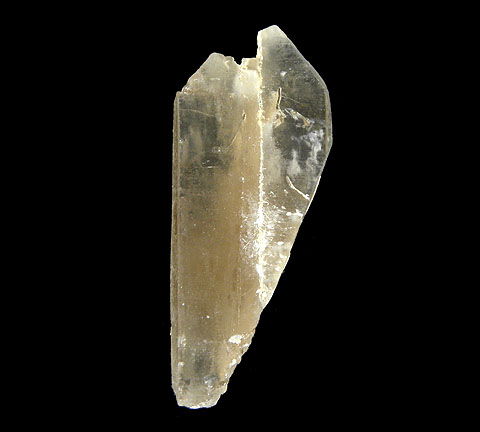
Phenakite from Palelni and the closely associated Khetchel-Molo pegmatites is prized for transparent to semitransparent colorless, white, or pale-yellow prismatic crystals, often sharply twinned and etched on prism faces, with a “drill-bit” or spoked termination look that makes the Burmese material stand apart from many other phenakite localities. Crystals are most often small—thumbnail to miniature size, with reported examples to several centimeters—and most are loose, though a few occur on white feldspar or on quartz, including smoky quartz combinations. The best pieces are glassy, sharply terminated, distinctly twinned, and clean enough to reward magnification; matrix specimens, balanced quartz associations, and large gemmy singles are much more desirable than frosted, chipped, or shapeless loose crystals.
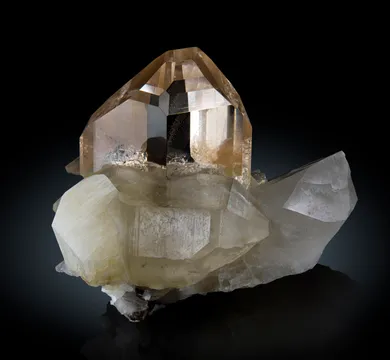
Quartz at Palelni is not merely background gangue: pale gray to smoky quartz crystals are documented from the pegmatite pockets and are important because they provide the contrasting matrix for some of the best phenakite and elbaite combinations. The quartz may appear as glassy translucent crystals, dark smoky branching or scepter-like forms, or pale pocket quartz associated with feldspar, schorl, calcite, and phenakite. Good Palelni quartz specimens are those where quartz preserves context—supporting a phenakite crystal, setting off red elbaite, or showing intact pocket growth—whereas loose quartz without associated rare minerals is usually of far less interest to collectors.
As a group label, tourmaline from Palelni covers the locality’s complex black, pink, red, pale, and zoned tourmalines, including schorl cores, elbaitic overgrowths, rossmanitic zones, olenitic outer growth in some analyzed samples, and unusual divergent “mushroom” and “wheatsheaf” morphologies. Specimens range from conventional prismatic crystals to bizarre polycrystalline caps and curved aggregates; the scientific interest lies in the transition from Fe-rich dark tourmaline to Li-Al-rich elbaitic and related compositions, while the collector interest lies in the sculptural shapes. Strong pieces show the contrast between dark core and red-pink cap, crisp growth zoning, three-dimensional form, and minimal edge bruising; weak pieces are often broken caps, dull partial overgrowths, or labels that say “tourmaline” without preserving the Palelni morphology.
Calcite from Palelni is chiefly valued as an association mineral rather than as an independent cabinet mineral, occurring as pale to white cleavages or crystalline matrix beneath rubellite-elbaite aggregates and, in some dealer records, showing fluorescence under both longwave and shortwave ultraviolet light. It gives welcome contrast to the raspberry-red tourmaline and helps identify pieces as pocket specimens rather than detached mushroom caps. The most collectible calcite-bearing pieces are those where the calcite is stable, reasonably fresh, and aesthetically subordinate to lustrous red elbaite; cleavage bruising, etched or chalky surfaces, and detached tourmaline caps reattached to calcite should all be examined carefully.
Other documented Palelni and Molo-area pegmatite minerals include petalite, hambergite, pollucite, beryl varieties including goshenite, aquamarine, and Cs-rich morganite, topaz, danburite, microcline, orthoclase, albite, feldspar-group minerals, lepidolite, muscovite, biotite, almandine-spessartine garnet, magnetite, cassiterite, wolframite or hübnerite-ferberite, manganocolumbite, and rare stibiotantalite. The most consequential rarity associated specifically with Kat Chay/Palelni is avdeevite, described in 2020 from the mine as a Na-dominant alkali beryl occurring in pale pink sheaf-like aggregates with beryl; collectors should note, however, that avdeevite has since been discredited under the new beryl-supergroup nomenclature, making older “avdeevite” labels important historically but in need of current taxonomic explanation.
Palelni specimens demand careful label scrutiny. The same material may be labeled Palelni, Kat Chay, Khat Che, Khetchel, Cache, Molo, Momeik, Mogok, Shan State, Mandalay Division, Burma, or Myanmar. Some older “Mogok phenakite” labels may refer broadly to the trading district rather than strict Mogok Township, and some sharp Burmese phenakite formerly sold as Mogok is better understood as Khetchel-Molo material. Conversely, not every generic “Mogok tourmaline” is Palelni; the mushroom morphology, schorl core, red-pink elbaitic overgrowth, and pegmatite associations are the strongest visual clues.
No widely documented fake Palelni occurrence dominates the literature, but there are predictable specimen-market risks. Mushroom tourmaline caps can break away from their bases, and calcite or feldspar matrix makes reattachment tempting; examine contact points for glue, unnatural gaps, and mismatched dirt or luster. Loose phenakite, petalite, and hambergite are easy to relabel because they are pale, gemmy, and small, so provenance is especially important. For high-value phenakite, ask whether the crystal is from an old Burmese lot, a documented collection, or simply a broad “Mogok” attribution copied from earlier trade labels.
Condition is central to value. Palelni tourmaline commonly has thin curved edges, acicular outer growth, and delicate cap margins; even small bruises can interrupt the mushroom outline. Phenakite should be checked under a 10x loupe for tiny edge chips on terminations and along prism ridges, because these transparent crystals can look cleaner to the naked eye than they really are. Petalite is cleavage-prone and often etched, so one must distinguish natural etched surfaces from fresh cleavages and damage. Hambergite is also commonly incomplete or nicked, and genuinely gemmy Palelni hambergite is much scarcer than the more familiar phenakite or tourmaline.
Fluorescence is not the headline property at Palelni, but it is still worth testing matrix pieces. Some calcite-bearing rubellite specimens have been reported as fluorescent under both longwave and shortwave UV; avdeevite, as described from Kat Chay, was reported as non-luminescent in ultraviolet light. For handling, the principal issues are physical rather than chemical: protect tourmaline caps from pressure, keep phenakite and petalite from rattling in perky boxes, and avoid aggressive cleaning of calcite or kaolinized feldspar matrix.
Availability is uneven. Small mushroom tourmalines, especially repaired or partial ones, appear periodically and can be affordable; fine balanced red caps on matrix are much less common. Sharp twinned phenakites were once seen in small waves but now tend to surface as older dealer stock or collection pieces. Petalite and hambergite from Palelni are genuinely scarce as attractive specimens, and avdeevite-labeled material is a systematic-mineral niche complicated by nomenclature changes. The best Palelni pieces are now provenance specimens as much as aesthetic ones: date of acquisition, old labels, and reputable collection history can matter nearly as much as size.
The Palelni story begins with a false start. The Momeik pegmatites were reportedly discovered in 1993, but for roughly a decade they attracted little serious exploitation. Local miners knew rubies, spinels, and alluvial gem gravels; they did not yet have a strong reason to chase hard-rock pegmatite pockets that produced pale minerals instead of the traditional red and blue gems that made Mogok famous. The ground was there, chemically prepared and mineralogically exotic, but the market had not yet taught miners what collectors would pay for a perfect little colorless phenakite or a bizarre raspberry tourmaline cap.
That changed in late 2003, when drilling into weathered granite on a steep slope above Khetchel village opened the way to a major phenakite discovery. By mid-2004, the find was notable enough to be reported in the English-language Myanmar Times & Business Review, following a Myanmar Geosciences Society presentation at the University of Yangon on June 25. The language of that report captured the excitement plainly: a “new source of rare minerals and gemstones” had been found in Shan State, including a “rare, quartz-like gemstone” called phenakite. For collectors, the important detail was not simply that phenakite occurred there, but that it occurred with a whole pegmatite cast: petalite, hambergite, morganite, pollucite, and other uncommon species.
Within a few years, Palelni’s strangest mineral had become a scientific problem as well as a collector’s prize. The tourmalines did not behave like ordinary prisms. Some grew as caps and fans, with dark cores hidden beneath pink to red overgrowths; others diverged in sheaf-like masses. When researchers sectioned and analyzed the mushroom tourmalines, they found a black-to-gray core and an outer half made of extremely acicular, subparallel crystals diverging toward the cap edge. The color sequence was almost theatrical: dominantly colorless to white needles, a continuous black zone near the edge, and pale pink outside it. What collectors saw as a miniature forest of red caps turned out to be a record of changing fluid, chemistry, pressure, temperature, and growth dynamics inside a pegmatite pocket.
Dealers and collectors quickly learned that Palelni could produce small things of very high charm. One famous specimen style—raspberry-red elbaite over schorl—looked less like a conventional mineral crystal than a cluster of tiny fungi. Rob Lavinsky’s description of one 2.2 cm thumbnail from the Wendell E. Wilson Collection compared the overall effect to something from “an enchanted forest,” an unusually apt phrase for a locality whose best tourmalines seem grown rather than crystallized. That is the enduring appeal of Palelni: the specimens are mineralogically rigorous, but they are also playful, odd, and instantly memorable.
The petalite episode is a quieter but telling chapter. At the 2008 Denver Show, flats of loose Palelni petalite appeared through the Czech dealership KARP, followed by a December 2008 Mineral Classics offering of 17 etched crystals. These were not matrix miniatures or colorful showpieces; they were loose, pale, glassy crystals with odd pebbled surfaces and transparent interiors. In the Mineralogical Record’s January 2009 online report, they were singled out as among the world’s best specimens of petalite—a remarkable claim for a mineral that usually hides as massive or poorly crystallized material in lithium pegmatites. Palelni had again taken a species that many collectors overlook and made it specimen-worthy.
A. J. Lussier, P. M. Aguiar, V. K. Michaelis, S. Kroeker, S. Herwig, Y. Abdu, and F. C. Hawthorne (2008), “Mushroom elbaite from the Kat Chay mine, Momeik, near Mogok, Myanmar: I. Crystal chemistry by SREF, EMPA, MAS NMR and Mössbauer spectroscopy,” Mineralogical Magazine, 72(3), 747–761 — The foundational crystal-chemical study of Palelni/Kat Chay mushroom elbaite.
A. J. Lussier, F. C. Hawthorne, S. Herwig, Y. Abdu, P. M. Aguiar, V. K. Michaelis, and S. Kroeker (2008), “Mushroom elbaite from the Kat Chay mine, Momeik, near Mogok, Myanmar: II. Zoning and crystal growth,” Mineralogical Magazine, 72(5), 999–1010 — Explains the internal zoning and growth mechanism of the mushroom habit.
A. U. Falster, A. Peretti, and W. B. Simmons (2008), “Mushroom tourmaline and associated minerals from pegmatites near Momeik, Mogok Stone Tract, Myanmar (Burma)” — A concise specimen-mineralogy summary of the LCT pegmatite setting, mushroom tourmaline chemistry, and associated minerals.
U Hla Kyi, Ted Themelis, and U Kyaw Thu (2005), “The pegmatitic gem deposits of Molo (Momeik) and Sakhan-gyi (Mogok),” Australian Gemmologist, 22(7), 303–309 — Key paper on the Molo pegmatite gem suite, including phenakite, petalite, hambergite, Cs-rich morganite, pollucite, tourmaline, topaz, quartz, and lepidolite.
A. A. Agakhanov, D. A. Stepanenko, N. V. Zubkova, L. A. Pautov, I. V. Pekov, A. V. Kasatkin, V. Yu. Karpenko, V. A. Agakhanova, R. Škoda, S. N. Britvin, and D. Yu. Pushcharovsky (2020), “Avdeevite, a Na-dominant alkali beryl: definition as valid mineral species and new data,” Proceedings of the Russian Mineralogical Society, 149(1), 1–19 — Describes the pale pink alkali beryl material from Kat Chay/Palelni; historically important even though avdeevite has since been discredited.
Mindat: Avdeevite — Current database page showing the Palelni first recorded locality, 2018 approval, 2020 publication, and later discredited status.
Gems & Gemology, Fall 2011, “An examination of some colorless gems from Myanmar” — Gemological note on phenakite, petalite, pollucite, and goshenite from granitic pegmatites near Molo village.
Mineralogical Record, January 2009 “What’s New” report — Important trade record for Palelni petalite crystals and early market context for phenakite and matrix pieces.
Mineralogical Record, What’s New in the Mineral World, 2021 online report — Includes a Palelni elbaite “mushroom” specimen from The Arkenstone, documenting continued collector interest.
Mindat: Palelni mine (“Kat Chay mine”), Khetchel village, Molo quarter, Momeik Township, Shan State, Myanmar — Core locality page for names, hierarchy, mineral list, photos, and references.
Wikimedia Commons: Category Palelni Mine — Open-license images of Palelni elbaite and petalite specimens.
Wikimedia Commons: Category Minerals of Momeik — Useful broader image set for Momeik-area pegmatite minerals, including phenakite, danburite, microcline, and tourmaline.
Cambridge Core: Mushroom elbaite from the Kat Chay mine, Part I — Technical study of Palelni mushroom-tourmaline crystal chemistry.
Cambridge Core: Mushroom elbaite from the Kat Chay mine, Part II — Technical study of zoning, growth discontinuities, and the mushroom morphology.
GemResearch Swisslab PDF: Mushroom tourmaline and associated minerals from pegmatites near Momeik — Short, highly relevant overview of the deposit setting and associated species.
ResearchGate: The pegmatitic gem deposits of Molo (Momeik) and Sakhan-gyi (Mogok) — Accessible abstract and bibliographic entry for the key 2005 Australian Gemmologist paper.
GIA Fall 2011 Gems & Gemology PDF — Contains the Gem News International note on colorless Molo pegmatite gems.
Mineralogical Record: January 2009 What’s New Article — Collector-market report on Palelni petalite and phenakite.
U.S. Department of State: Burma Travel Advisory — Current safety context for any discussion of field access in Myanmar.
U.S. Treasury: Treasury Sanctions Key Gems Enterprise in Burma — Due-diligence background for Myanmar gem-sector sourcing.