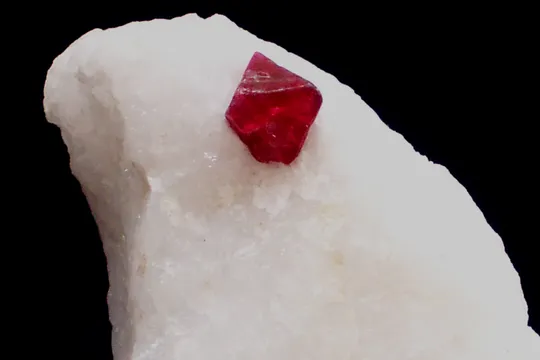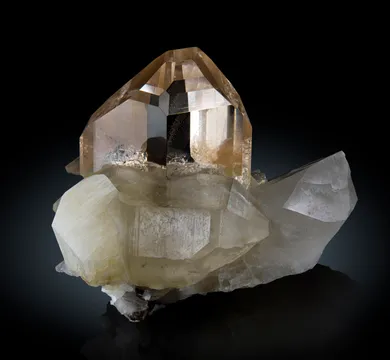
Pein-Pyit, Myanmar — Mogok locality famed for red to purplish-red spinel on calcite and as the type-locality for johnkoivulaite-(Cs), delivering high-contrast…
Key facts
Pein-Pyit is one of the indispensable names of eastern Mogok: not a single showy quarry face, but a gem village and mining zone where marble-hosted ruby-and-spinel geology meets secondary gem gravels worked in fields, small stream banks, and shallow pits. For specimen collectors its fame rests above all on red to purplish-red spinel—often on white calcite, sometimes with clinohumite or chondrodite—and on the flattened twinned crystals that have made Pein-Pyit and nearby Mansin a reference point for Mogok spinel morphology. The locality also matters scientifically. The Pein-Pyit gravels produced johnkoivulaite-(Cs), a beryl-group mineral known originally from a single grayish-violet crystal and now tied to this area as a type-locality species. That combination—classic Burmese spinel aesthetics, gem-lab importance, and rare-mineral significance—gives Pein-Pyit a stature far beyond the modest scale of its workings.
At their best, Pein-Pyit specimens have a look that serious collectors recognize instantly: glassy red octahedral spinel, sometimes flattened or twinned, perched on snowy calcite or enclosed in pale marble, the whole piece reading as a high-contrast miniature rather than merely a cut-stone source. The finest crystals are not always large, but they can be startlingly bright. The locality’s stronger pieces combine saturated color, transparency, sharp form, undamaged edges, and an honest matrix relationship—features that separate them from the abundant loose gem rough that also comes out of the Mogok fields.
Regional View
Country View
Geologically, Pein-Pyit belongs to the central Mogok Metamorphic Belt, the high-grade marble, calc-silicate, gneiss, quartzite, and intrusive-rock terrain that has supplied Burma’s most celebrated ruby, sapphire, and spinel for centuries. Modern petrologic work on Mogok wall rocks points to granulite-facies conditions in the district, with ruby and spinel formation connected to high-grade metamorphism of marble sequences and, in places, to the influence of alkaline and related intrusions. At Pein-Pyit this geological story is filtered through secondary concentration: durable gem minerals weathered from their original marble, calc-silicate, and pegmatitic sources and accumulated in productive gravels.
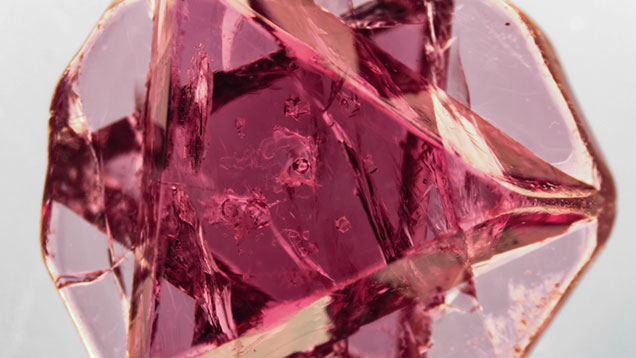
Photo: GIA
Search for specimens: View all specimens from Pein-Pyit, Myanmar
Pein-Pyit lies in Mogok Township, Pyin-Oo-Lwin District, Mandalay Region, about 10 km northeast of Mogok town. The locality name appears in several transliterations—Pein-Pyit, Painpyit, Pyan Pyit, and Pein Pyit—and collector labels may also refer to subareas such as Mansin/Thet-kachan, Pein-pyit-le-taw, Kyini-taung, Gaw-Ra-Khar, Htan-yan-sho, and the Pyant Gyi mine. That label complexity is not trivial: in the trade, “Mogok” may be used broadly, while a more precise Pein-Pyit or Mansin label can add both geological and collector significance when the specimen’s provenance is credible.
The deposit type most relevant to collectors is secondary gem gravel. Gems at Pein-Pyit have long been recovered from alluvial deposits along small stream banks and from paddy-field ground, where the pay layer contains dense, weather-resistant minerals liberated from marble, calc-silicate, gneissic, and pegmatitic source rocks. At Pyant Gyi, a Pein-Pyit sublocality, the productive byôn gem gravel is recorded as occurring in variable thicknesses around 1.5–2 m in alluvium, loos, and letkya workings. These gravels are unusually mixed: spinel and corundum sit beside beryl, topaz, danburite, feldspar, scapolite, tourmaline, apatite, zircon, and rare borosilicates, reflecting both the marble-hosted ruby-spinel environment and the intrusive/pegmatitic influence in eastern Mogok.
Traditional Mogok mining methods include shallow shaft digging, open-pit work, hillside hydraulic washing, and sinkhole or cavern excavation, with local terms such as twinlon, myaw-dwin, ludwin, lebin, loo-dwin, and letkya-dwin appearing in descriptions of the district’s mining practice. Pein-Pyit itself is best understood as a patchwork of small-scale workings rather than a modern industrial pit. Ruby and spinel have been principal targets in parts of the area, while sapphires—especially yellowish green, greenish blue, and grayish blue “teal” stones—have become more visible in the gem trade in recent years.
The notable specimen-producing episodes cluster around matrix spinel rather than bulk gem output. Labels from the late 1990s and early 2000s appear on many classic Pein-Pyit spinel-on-calcite specimens, including examples with red octahedra, obvious spinel-law twinning, and white calcite matrices. The flattened “Star of David” spinel macles reportedly mined near Pein-Pyit in the early 2000s are another landmark: they are thin, twinned, 12-sided crystals, fascinating to gemologists but often too fragile to survive cleaning and handling intact. More recent dealer and museum records show continuing, though sporadic, availability of Pein-Pyit spinel crystals and rarer associated species.
Collecting access today should not be imagined as a casual field opportunity. Mogok has long required special permissions for foreigners, and gem mining and export are regulated in Myanmar. Since 2021, the political and sanctions environment around Myanmar gemstones has added serious due-diligence concerns, especially for recently mined material moving through state-supervised channels or opaque trade routes. For most collectors, Pein-Pyit is a locality encountered through older collections, established dealers, museum holdings, and specimens with documented provenance rather than through direct collecting.
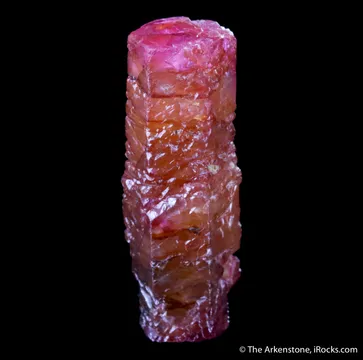
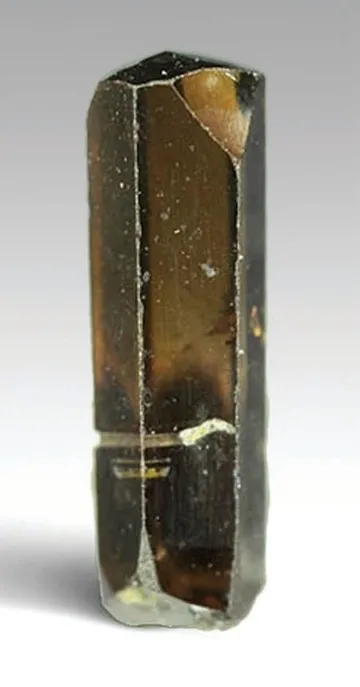
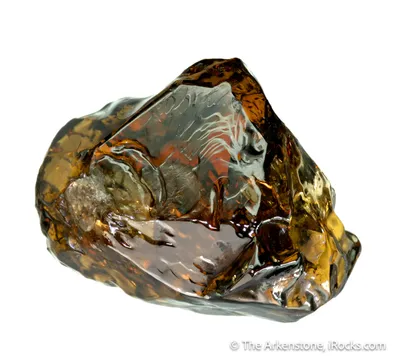
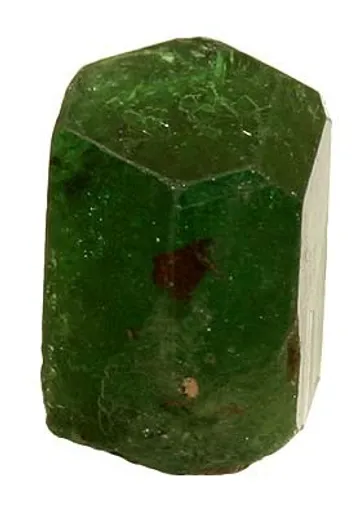
Pein-Pyit spinel is prized in red, purplish red, vivid pinkish red, and occasionally dark to black-looking crystals, typically as octahedra, flattened octahedra, aggregates, and spinel-law twins; the most admired specimens are transparent to translucent, glassy, saturated, and set cleanly on white calcite or marble. Individual crystals on documented specimens commonly fall in the 0.5–1.5 cm range, but larger aggregates and crystals several centimeters across are recorded from the area, including deep purplish-red intergrown clusters and dramatic calcite-hosted examples. Associations include calcite, dolomite, clinohumite, chondrodite, phlogopite, pyrite, and other Mogok marble minerals, while Mansin material within the Pein-Pyit area is especially associated in the gem trade with bright “Jedi” spinel. The finest collector pieces here are judged less by sheer size than by color intensity, transparency, sharpness or attractive twinning, freedom from edge damage, and contrast against the pale carbonate matrix.
Calcite at Pein-Pyit is the indispensable stage on which many of the locality’s best spinel and clinohumite specimens perform: white to translucent cleavage masses and rhombic carbonate matrix pieces that host red spinel crystals, yellow to orange clinohumite, pale chondrodite, and other marble-associated minerals. It is not usually collected here as a stand-alone calcite locality, but good Pein-Pyit calcite matters when it is clean, bright, stable, and visually contrasting, with enough translucency or whiteness to intensify the red spinel rather than muddy it. Ordinary pieces are simply broken carbonate with scattered gem minerals; desirable ones preserve an aesthetic matrix, an undisturbed contact, and a crystal placement that makes the specimen read as a composed miniature rather than a trimmed fragment of ore-bearing marble.
Beyond spinel and calcite, Pein-Pyit is remarkably rich for a compact locality. Johnkoivulaite-(Cs), Cs[Be2B]Mg2Si6O18, is the headline rarity and type-locality mineral, originally described from a single approximately 5.8 × 5.7 × 5.5 mm grayish-violet crystal recovered from Pein-Pyit gem gravels. Documented minerals from the broader Pein-Pyit area and its sublocalities include ruby and sapphire, clinohumite, chondrodite, danburite, diopside, dolomite, phlogopite, poudretteite, scapolite, hackmanite, beryl varieties including aquamarine and goshenite, chrysoberyl, topaz, tourmaline, sillimanite, sinhalite, scheelite, pyrite, pyrrhotite, stibnite, zircon, and zirconolite. Pyant Gyi is particularly important for rare gem species, with poudretteite, johachidolite, hackmanite, and related pegmatitic or calc-silicate minerals adding a second layer of collector interest beyond the famous red spinels.
The first authenticity issue is locality precision. A specimen labeled simply “Mogok” may be entirely correct but not necessarily Pein-Pyit; conversely, older labels may use Pain Pyit, Pein Pyit, Pyan Pyit, or a sublocality name such as Mansin or Pyant Gyi. For serious specimens, especially matrix spinel, retain all old dealer tags and collection labels. A Pein-Pyit attribution is strongest when supported by an older provenance, a recognizable carbonate-matrix association, or publication/dealer history rather than a modern verbal claim attached to loose red spinel.
Synthetic and treated spinel are major gem-market concerns, though matrix Pein-Pyit specimens are less likely to be fabricated than cut stones or loose rough. Laboratory work on a reported Pein-Pyit Star of David spinel confirmed oil in some fractures, plausibly from the Mogok practice of keeping crystals in oil before sale. That does not make every Pein-Pyit specimen “treated” in the gem-trade sense, but it does mean collectors should inspect fractures, ask whether a piece has been oiled, and avoid aggressive solvents or cleaning that might change the look of a crystal or expose hidden damage.
Condition matters intensely. Red spinel on calcite is visually durable but physically vulnerable at the contact points: spinel is hard, calcite is soft and cleavable, and the matrix can chip or bruise easily. Flattened twinned spinels are especially fragile. The GIA-documented Star of David specimen broke during cleaning, a reminder that thin macles may be more brittle than their elegant outlines suggest. Do not acid-clean Pein-Pyit matrix specimens; calcite and dolomite will react, and associated minerals such as clinohumite or phlogopite may be compromised by careless treatment.
Fluorescence can be a useful observation but should not be treated as proof of origin. Some Pein-Pyit spinels show strong long-wave and short-wave fluorescence, and clinohumite from the locality has been reported with mustard-yellow short-wave fluorescence. In spinel, bright red fluorescence is tied to chromium and low iron, and it contributes to the “neon” impression of high-end Mansin/Pein-Pyit material. Still, origin determination for valuable cut stones or loose crystals belongs with a competent gem laboratory using chemistry and inclusion work, not with a UV lamp alone.
Market availability is uneven. Small red spinel crystals and matrix miniatures appear periodically, often from older holdings; top Pein-Pyit pieces with transparent, saturated, undamaged crystals on clean calcite are scarce and can be expensive. The best “Jedi” spinel is more often traded as faceting rough or cut gems than as specimens, and the label is a commercial color/origin term rather than a formal mineral species. Recent Myanmar material also requires ethical and legal due diligence, particularly for U.S. buyers and institutions, because sanctions and import restrictions around Myanmar gems and state-linked gem entities have changed the practical market for newly mined material.
In December 2015, Vincent Pardieu obtained a small spinel from the Mogok gem market that looked less like an ordinary octahedron than a crystallographic emblem: two triangles laid over a central 12-sided polygon, the pattern that gave it the “Star of David” name. The crystal was reportedly mined in the early 2000s near Pein-Pyit, and GIA’s examination showed why such pieces have acquired their own mythology among spinel collectors. It was a spinel-law twin flattened parallel to an octahedral plane; if only octahedral faces were present it would have appeared hexagonal, but because both octahedral and dodecahedral faces contributed to the outline, the crystal became a 12-sided macle. The story had a sting in it. The very thinness that made the crystal elegant also made it brittle, and the specimen broke during cleaning. For collectors, that small casualty is one of the best cautionary tales in modern Mogok spinel: the rare form you most want to study is often the one least tolerant of handling.
The same GIA study found a microscopic drama inside the crystal. Carbonate inclusions—calcite and dolomite—sat with multiphase inclusions in the middle of the spinel; at least eight were observed near the center. Some had negative-crystal shapes filled with colorless liquid and a flattened or spherical bubble. Under gentle warmth from the microscope well light, small bubbles disappeared, suggesting a gas phase dominated by CO2, though Raman confirmation was not possible. Even the fractures told a Mogok story: FTIR detected oil in some of them, probably from the local practice of storing crystals in oil before offering them for sale. In one palm-sized gem-market purchase, Pein-Pyit’s identity appeared at every scale—twinning visible to the eye, carbonate inclusions under the microscope, and trace chemistry consistent with Burmese spinel.
Another Pein-Pyit story begins not with a red crystal but with a grayish-violet oddity. A local dealer, Nay Myo, obtained a small stone from the Pein-Pyit gravels and recognized that its basic properties did not fit the familiar run of Mogok gem species. Instead of forcing it into a known category, he submitted it to GIA first in Bangkok and then in Carlsbad. The result was johnkoivulaite-(Cs), a new beryl-group mineral named for gemologist John Koivula. The holotype measured only about 5.8 × 5.7 × 5.5 mm, but it carried a mineralogical surprise: cesium in the channel sites, boron substituting into the beryl structure, strong pleochroism from nearly colorless to dark bluish violet, and a chemical formula that placed it as a distinct member of the beryl group. Pein-Pyit’s gem gravels had again done what Mogok gravels do best—hide something scientifically important among the familiar sparkle of ruby, spinel, sapphire, and feldspar.
Bill Larson’s reaction to a black spinel from Pein-Pyit has also become part of the locality’s collector lore. After more than 30 trips to Burma, he described the specimen as unlike anything he had seen. In ordinary lighting it presented as a jet-black spinel embedded in pure white calcite, a severe black-and-white object rather than the expected Burmese red. But when light passed through it, the crystal revealed an intense reddish-purple hue. The specimen was given the nickname “The Prince’s Black Spinel,” and its appeal lay precisely in that contradiction: a Mogok spinel that looked black until illumination uncovered the color hidden inside.