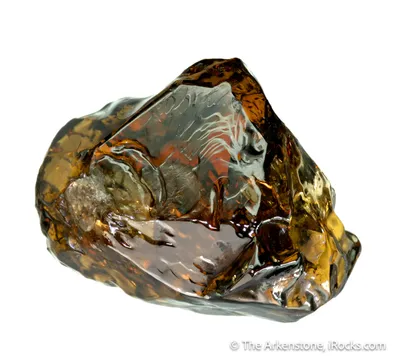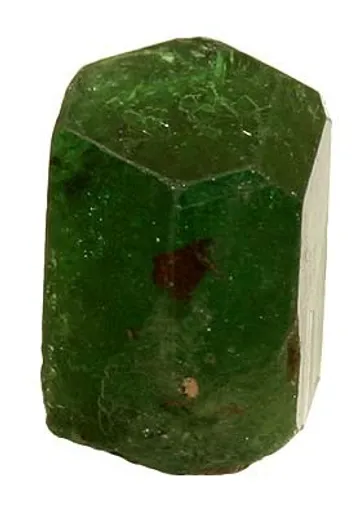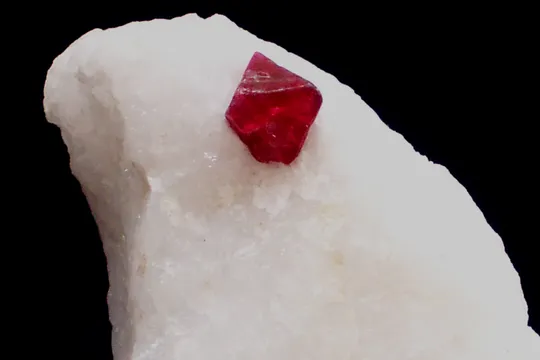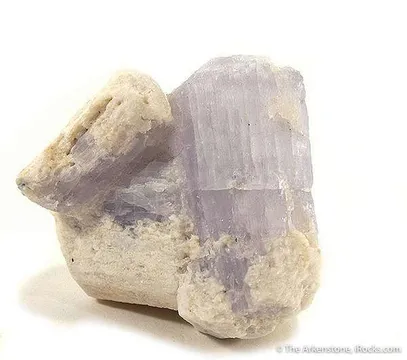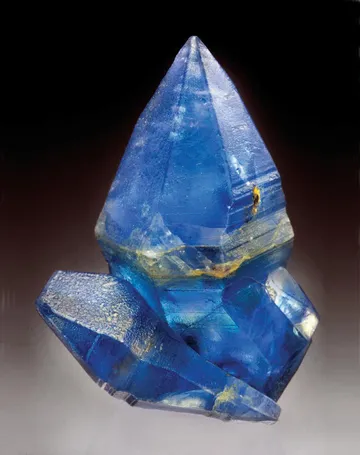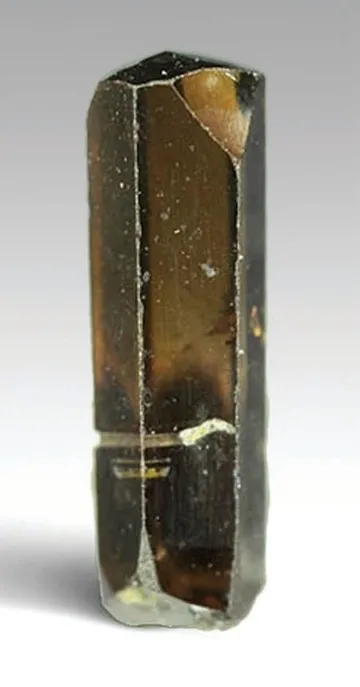
Dattaw-taung, Myanmar — premier Mogok hard-rock ruby locality with red to pink corundum in marble, large crystals, and a complex mineral assemblage.
Key facts
Dattaw-taung is one of the great hard-rock ruby localities of the Mogok Stone Tract: a hill just northeast of Mogok where ruby-bearing marble, scapolite marble, diopside marble, phlogopite-rich marble, pegmatitic and skarn-like rocks, and gneiss are crowded into an unusually complex body. For collectors, that complexity is the point. Dattaw is not merely another “Mogok ruby” name on an old label; it is a locality with a recognizable mineralogical signature, famous for red to pink corundum in marble and scapolite, for large ruby crystals, and for the volatile-rich assemblage around the corundum—scapolite, sodalite, cancrinite/davyne-group material, phlogopite, spinel, pargasite/edenite-series amphiboles, tourmaline, apatite, titanite, pyrite, and related calc-silicate species.
The best Dattaw specimens have the look that makes Mogok marble-ruby collecting so addictive: saturated red to rose-pink corundum standing out against pale calcite or translucent scapolite, sometimes with a color-zoned ruby showing a deeper red rim around a lavender-pink center. The locality is also a serious field for petrologists because its rubies are not isolated from their host assemblage. Dattaw pieces commonly preserve the reaction textures that tie ruby to alkali- and volatile-bearing skarn-like fluids, making them more than gem rough on matrix—they are small records of marble, pegmatite, metasomatism, and corundum growth colliding in one hill.
Regional View
Country View
Dattaw’s reputation was sealed in the modern collecting literature during the late twentieth century, especially after the large “Nawata” or “SLORC” ruby was recovered there in early 1990. That stone weighed 504.5 carats before trimming and measured 43 mm x 37 mm x 33 mm; other large crystals reported or examined from the mine in the early 1990s included a 560-carat stone and a remarkable 1,743-carat crystal. Even where the material was not the finest transparent cutting ruby in Mogok, Dattaw was recognized as one of the more important producers by total caratage and one of the reliable sources of very large ruby crystals.

Photo: Wikimedia Commons
Search for specimens: View all specimens from Dattaw-taung, Myanmar
Dattaw-taung lies in the Mogok Valley of Mandalay Region, Myanmar, with the Mindat locality centered on the summit of Dattaw Hill at approximately 22°57'25" N, 96°31'00" E. The broader mining area sits on the northeastern side of Mogok in the direction of Momeik; descriptions vary between about 3 km northeast of downtown Mogok for the foothills and about 5 km northeast for the joint-venture mine reached by road and foot climb. In locality labels, one sees Dattaw, Dat Taw, Dattaw Hill, Dattaw-taung, Dattaw-upper, Dattaw-mid, Dattaw-pyant, Dattaw-chaung, and the Laung-pyit and Nay-pyi-daw mine sublocalities; serious labels should preserve those distinctions when they are known.
The deposit is best understood as an integrated marble–skarn–pegmatite–alluvial system rather than a single simple mine. Dattaw is characterized by alluvial, pegmatitic, skarn, contact-zone, and marble mineralization compressed into one complex mass. The recorded rock suite includes leucogranite, scapolite marble, ruby-bearing marble, diopside marble, apatite-phlogopite-diopside marble, pure marble, graphite marble, graphite-phlogopite marble, phlogopite-forsterite marble, and gneiss. That varied rock inventory explains the collecting mix: Dattaw yields not only ruby but also scapolite, spinel, calcite, apatite, danburite, diopside, beryl, sodalite/hackmanite, feldspar, amphibole, tourmaline, zircon, titanite, and other accessory species.
The ruby-bearing marble bands at the Dattaw mines lie near the summit of the hill. They are described as very coarse-grained, commonly associated with fracture zones, and alternating with phlogopite marble and titanite-diopside marble. In the Dattaw area, ruby-bearing bands can be white, blue, or greenish yellow, with reported dimensions generally around 1.2 m wide and 0.3–0.5 m across. Indicator minerals include light blue scapolite, apatite, pyrite, and phlogopitic mica. Fracture-filled and cave-style secondary deposits are also recorded, and the lower parts of the area have produced eluvial and alluvial gem material.
Field descriptions from visits in the early 1990s give a vivid sense of the mine. The route involved a narrow dirt road followed by a steep climb on foot of about an hour, with independent miners working stream gravels along the lower approach. The hard-rock mine announced itself from a distance by white marble tailings spilling down the mountain. Tunnels had been driven into exposed marble at several levels; one entry led into a natural limestone cave, reportedly as high as 10 m in places, with additional excavated tunnels running from the cavern. Pneumatic drilling and blasting were used, and one tunnel entrance was specifically associated with the discovery site of the Nawata/SLORC ruby.
Mining methods at Dattaw have varied with the part of the hill and the type of deposit. The upper area has been described as having primary and fracture-filled deposits worked by loo-dwin, gwe-dwin, and tunnel methods. The middle site has been described with open-pit and loo-style mining, while the lower area has yielded stones from eluvial and alluvial ground. A Mindat sublocality entry for the Nay-pyi-daw mine records ruby-bearing marble bands as very coarse-grained and worked by open-pit methods. As elsewhere in Mogok, the division between “mine” and “collecting locality” can be porous on old labels: specimens may have come from hard-rock workings, cave/fracture zones, marble dump material, stream gravels, or closely adjacent named sublocalities.
The modern access situation is not that of a casual collecting locality. Mogok has long required permissions for foreigners, gem extraction is regulated, and the region has also been affected by the wider conflict in Myanmar. In recent years, Mogok’s gem districts have been reported as politically and militarily volatile, with control of mining areas shifting during the civil war. For collectors outside Myanmar, the practical route to Dattaw material is the secondary market: old dealer stock, documented private collections, historic Mogok parcels, and specimens with labels traceable to recognized dealers, museums, or collections.
Corundum from Dattaw-taung is chiefly collected as ruby and pink to purple sapphire, but the species-level story is broader: Dattaw corundum occurs in coarse ruby-bearing marble bands near the summit, in fracture-related zones, and on or within scapolite- and calcite-rich matrix. Collector specimens range from small embedded grains and rough crystals to miniature-size pieces with distinct hexagonal form; a documented pink sapphire floater from Dattaw measures 3.8 x 3.0 x 1.7 cm, while the mine’s production history includes much larger ruby crystals measured in hundreds to more than a thousand carats. The finest specimens show a readable crystal outline, bright luster, pleasing translucency, strong red to rose color, and meaningful matrix association—especially scapolite, calcite, or marble—whereas ordinary pieces tend to be massive, bruised, heavily included, or merely broken corundum rough without locality-characteristic context.
Dattaw ruby is the locality’s signature mineral: red to pink-red corundum in coarse marble, often with scapolite and calcite, and locally with blue cancrinite/davyne-group material, colorless sodalite, phlogopite, spinel, amphibole, tourmaline, apatite, titanite, and pyrite in the broader assemblage. The locality is especially noted for large crystals—the Nawata/SLORC ruby was 504.5 carats before trimming, a 560-carat stone was reported in March 1992, and a 1,743-carat crystal was examined in February 1993—but matrix specimens prized by mineral collectors are usually much smaller, commonly thumbnails to miniatures. Good Dattaw ruby pieces are not judged only by “pigeon-blood” gem color; they are judged by undamaged crystal faces, translucency, rich red or rose-red saturation, strong contrast with white calcite or pale scapolite, and, where present, the distinctive Dattaw color zoning in which a deeper red outer zone outlines a lavender-pink interior.
Sapphire from Dattaw-taung is documented chiefly as purple, white, and pink corundum rather than the dark-blue sapphire that makes other Mogok localities famous. The most attractive Dattaw sapphires are lustrous, translucent crystals with clear hexagonal habit; one well-documented pink sapphire from the locality is a doubly terminated miniature with a vivid bubble-gum pink color and a size of 3.8 x 3.0 x 1.7 cm. Purple to pale sapphire is recorded from Dattaw-pyant and Dattaw-chaung, and the presence of both ruby and sapphire varieties in the same hill reflects the mixed, chemically variable corundum environment of the Mogok tract. Collectors should prize clean form, full termination, lively translucency, and an old, specific Dattaw label; pale or white fragments without habit are much less compelling unless they sit in a diagnostic marble/scapolite assemblage.
Scapolite is one of the minerals that makes Dattaw-taung immediately recognizable among Mogok ruby localities. It occurs with ruby in marble and skarn-like assemblages, is recorded from Dattaw-upper, Dattaw-pyant and Dattaw-chaung, Laung-pyit, and Dattaw-taung proper, and is specifically described at Laung-pyit as light blue. In the Dattaw ruby assemblage, scapolite is often described as mizzonite, intermediate in the marialite–meionite series, and it can form pale, massive to gemmy matrix through which red corundum is visible. The best collector pieces pair ruby with clean, contrasting scapolite—especially translucent, colorless to pale blue or grayish material—while fluorescence-minded collectors should also test cautiously under UV, since Dattaw’s sulfur-bearing scapolite and feldspathoid-bearing marbles are part of the broader Mogok suite famous for orange UV response.
Other documented minerals from Dattaw-taung and its sublocalities include apatite, aragonite, beryl with aquamarine and goshenite, calcite, danburite, diopside, dravite, edenite, elbaite, hornblende-group amphibole, moonstone/orthoclase, phlogopite, pyrite, quartz, schorl, sodalite including hackmanite, spinel, titanite, topaz, tourmaline, and zircon. Scientific descriptions also bring out species and groups not always reflected in simplified locality lists: blue cancrinite/davyne-group material, colorless sodalite, nepheline, marialite/mizzonite, balliranoite, pargasite, and magnesiosadanagaite have all been tied to Dattaw assemblages in the literature. The locality is not known here primarily as a type locality, but it is a reference locality for unusual volatile-rich ruby-in-marble assemblages, and it has supplied research material to the American Museum of Natural History, including Dattaw specimens used in studies of balliranoite and Al-rich amphiboles.
The most important authenticity issue for Dattaw is locality precision. “Mogok ruby” is a broad label; “Dattaw-taung” is much narrower. Because Mogok parcels were historically sorted through many dealers, cutters, and gem markets, old specimens may be honestly labeled only “Mogok” or “Burma,” and later owners sometimes over-specify them without evidence. A confident Dattaw attribution is strongest when the piece preserves a diagnostic assemblage—ruby with scapolite, calcite, marble, phlogopite, sodalite/cancrinite-type material, or related calc-silicates—and when the label history is traceable to a known source.
Dattaw ruby on matrix is less commonly faked as a “constructed specimen” than high-value faceted ruby is treated, filled, or origin-laundered, but collectors should still inspect contact points carefully. Ruby fragments can be glued into calcite or marble cavities, and pale scapolite/calcite matrix can hide repairs. Use magnification and side lighting to check for adhesive sheen, unnatural gaps, sawed backs, acid-cleaning residues, and matrix that does not continue naturally around the crystal. On legitimate Dattaw matrix specimens, corundum commonly looks embedded, intergrown, or naturally perched rather than simply placed.
Condition is central. Corundum itself is hard, but Dattaw specimens are commonly on calcite, marble, scapolite, mica, or altered feldspathoid matrix that is far more vulnerable. Calcite cleavages bruise easily, scapolite can chip, mica can flake, and marble matrix can be abraded or acid-etched. Avoid ultrasonic cleaners and acids. A soft brush, compressed air, and minimal distilled water are safer for most matrix pieces, but any sodalite/hackmanite- or cancrinite-bearing association deserves extra caution because subtle color, fluorescence, and surface texture can be part of the specimen’s value.
Dattaw material rewards UV examination. Mogok rubies are famed for strong red fluorescence because of low iron and chromium activation, and Dattaw’s scapolite and feldspathoid-bearing marbles may add orange to yellow-orange responses in the associated minerals. This is not a substitute for identification, but it is useful for appreciating paragenesis and for spotting repairs or mismatched fragments. Long-wave and short-wave UV should be used responsibly: do not overheat specimens, avoid prolonged intense exposure on photochromic sodalite/hackmanite pieces, and record fluorescence separately from daylight color.
Rarity varies sharply by quality. Broken ruby rough and small included corundum from Mogok are not rare, but matrix pieces securely attributable to Dattaw with good crystal form, bright color, and intact calcite or scapolite association are genuinely desirable. Older Dattaw specimens from the William Larson, Lloyd Tate, Rob Lavinsky/iRocks, Mineral Classics, and other recognized dealer or private-collection channels are especially valuable because they predate many of today’s sourcing uncertainties. Current acquisition should be approached with ethical and legal caution: Myanmar gems are linked to conflict finance concerns, and export/import rules can change. Serious collectors should seek documented old stock, legal export history, and transparent provenance rather than anonymous recent “Burma ruby” material.
The early-1990s description of the Dattaw mine reads like a field notebook entry from a locality that wanted to stay hidden. The mine was not simply at the end of a road. Visitors drove a narrow dirt track northeast of Mogok, then climbed steeply on foot for about an hour. Along the lower part of the climb, independent miners were already at work in the narrow stream gravels, picking over the secondary deposits below the hard-rock source. Long before the main workings came into view, the hill announced itself: white marble tailings poured down the mountainside like a pale scar.
At the mine, the geology became architecture. Marble was exposed on the mountain face, tunnels had been driven at several levels, and the main entry led not directly into a mine gallery but into a natural limestone cave, in places up to 10 m high. From that cavern, additional excavated tunnels branched away into the hill. The working method was hard-rock Mogok mining at its most direct: pneumatic drilling, blasting, and following the ruby-bearing marble through the mountain. During a March 1992 visit, one tunnel entrance was pointed out as the way to the place where the SLORC ruby had been found; in front of that entrance, workers were preparing blasting charges.
The SLORC ruby itself began as the Nawata ruby, recovered at Dattaw in early 1990. Before trimming it weighed 504.5 carats and measured 43 mm x 37 mm x 33 mm; after trimming it still weighed 496.5 carats. Such numbers matter because they are far beyond the scale of most ruby crystals collectors ever handle. They also define Dattaw’s reputation: the mine was not always ranked above every Mogok locality for finest cut quality, but it was known as a dependable source of very large ruby crystals and a major producer by total caratage.
The big-stone run did not end there. In March 1992, a ruby reported at 560 carats was shown to two visiting authors at the mine only a few days after its recovery. Then, in early 1993, Dattaw produced another extraordinary specimen: a 1,743-carat ruby crystal examined during a February 1993 visit. Those successive finds explain why Dattaw’s name carried weight in Mogok mining circles. It was a hill of marble bands, fracture zones, caves, and tunnels—but also a hill capable of releasing ruby crystals that belonged in the same conversation as royal and state stones.
Dattaw has a quieter story as well, one told not by giant rubies but by odd minerals pressed against them. In the American Museum of Natural History work on Mogok assemblages, Dattaw stood apart. The rubies were described as a shade of red-pink unlike the other studied samples, and only Dattaw consistently showed a blue cancrinite phase, often accompanied by a colorless variety. Colorless sodalite—a mineral most collectors expect to be blue—was regularly found next to that cancrinite. The relationship was not casual: the phases lay directly next to corundum and often formed a corona around it. To a petrologist, that corona is an event frozen in place: fluid arriving, chemistry changing, and new minerals growing around an older ruby.
Even the non-ruby gem record at Dattaw has its surprises. A 58-carat green danburite rough from the locality yielded a 24.98-carat oval gem. In a place known internationally for ruby, that little detail is a reminder that Dattaw’s mineral system was broader than one red oxide. Boron, chlorine, sodium, sulfur, carbonate, and silica-poor assemblages all had roles to play, and the hill’s best specimens show that breadth in miniature.
Kammerling, R. C.; Scarratt, K.; Bosshart, G.; Jobbins, E. A.; Kane, R. E.; Gübelin, E. J.; Levinson, A. A. (1994), “Status of Ruby and Sapphire Mining in the Mogok Stone Tract,” Journal of Gemmology, 24(1), 1–23. Essential field report with firsthand early-1990s observations of Dattaw, including access, tunnels, marble tailings, the cave workings, the SLORC/Nawata ruby, and large crystals from 1992–1993.
Sutherland, F. L.; Zaw, K.; Meffre, S.; Yui, T.-F.; Thu, K. (2015), “Advances in Trace Element ‘Fingerprinting’ of Gem Corundum, Ruby and Sapphire, Mogok Area, Myanmar,” Minerals, 5(1), 61–79. Open-access geochemical study summarizing Dattaw ruby-bearing marble bands near the hill summit, associated phlogopite marble and titanite-diopside marble, and indicator minerals including light blue scapolite, apatite, pyrite, and phlogopitic mica.
Harlow, G. E.; Pamukcu, A.; Saw Naung U; Kyaw Thu U. (2006), “Mineral Assemblages and the Origin of Ruby in the Mogok Stone Tract, Myanmar,” Gems & Gemology, 42(3), 147. Abstract documenting Dattaw ruby in marble with blue cancrinite/davyne, scapolite, colorless sodalite, nepheline, phlogopite, spinel, pargasite, and tourmaline.
Harlow, G. E., “Mogok Rubies” working document, American Museum of Natural History-hosted copy. Detailed assemblage discussion emphasizing that Dattaw samples are distinct within the studied Mogok suite, with ruby adjacent to blue cancrinite, colorless sodalite, and scapolite/mizzonite.
Gatta, G. D.; Lotti, P.; Kahlenberg, V. (2013), “The low-temperature behavior of balliranoite (CAN topology): An in situ single-crystal X-ray diffraction study,” Microporous and Mesoporous Materials, 174, 44–53. Structural study using a centimeter-size gem-quality balliranoite crystal from Mogok; related thesis material identifies the studied specimen as from Dattaw, AMNH #108339, associated with ruby, marialite/mizzonite, and probable calcite.
Lotti, P. (2013), PhD thesis, Università degli Studi di Milano, including Chapter 6 on balliranoite from Dattaw. Useful for the specific Dattaw balliranoite specimen history, AMNH catalogue reference, and interpretation of a skarn-like environment produced by granite-fluid interaction with marble wall rocks and corundum inclusions.
Hawthorne, F. C.; Oberti, R.; Cámara, F.; et al. (2008), “The crystal chemistry of Al-rich amphiboles: Sadanagaite and potassic-ferrisadanagaite,” The Canadian Mineralogist, 46, 151–162. Includes magnesiosadanagaite from the Dattaw mine, AMNH 107971, as a corroded prismatic crystal coated with phlogopite in marble near ruby.
Mindat: Dattaw-taung, Mogok Valley, Mogok Township, Mandalay Region, Myanmar. The main locality database entry, with coordinates, sublocalities, mineral list, rock types, and the Themelis description of Dattaw’s complex geology.
Mindat locality page for Dattaw-taung — Best single database reference for the locality hierarchy, coordinates, sublocalities, mineral list, gallery, and rock-type record.
Mindat entry for the Nay-pyi-daw mine, Dattaw-mid — Useful sublocality page documenting ruby-bearing coarse marble bands and open-pit mining at a specific Dattaw mine.
Mindat entry for Dattaw-mid — Useful for the Dattaw-mid and Laung-pyit mineral list, including beryl, danburite, ruby, scapolite, sodalite/hackmanite, topaz, and related species.
Ruby & Sapphire: Burma (Myanmar), by Richard W. Hughes — Readable historical and gemological synthesis noting Dattaw/Dat Taw among the joint-venture primary-source mines and identifying it with the SLORC ruby.
“Status of Ruby and Sapphire Mining in the Mogok Stone Tract,” Journal of Gemmology, 1994 — The most valuable field account for the Dattaw mine’s early-1990s access, workings, methods, and large ruby finds.
“Advances in Trace Element ‘Fingerprinting’ of Gem Corundum, Ruby and Sapphire, Mogok Area, Myanmar,” Minerals, 2015 — Open-access scientific paper with specific descriptions of Dattaw ruby-bearing marble bands and associated indicator minerals.
“Mineral Assemblages and the Origin of Ruby in the Mogok Stone Tract, Myanmar,” Gems & Gemology abstract — Concise scientific source for the distinctive Dattaw ruby assemblage with cancrinite/davyne, scapolite, sodalite, nepheline, phlogopite, spinel, pargasite, and tourmaline.
Wikimedia Commons: Corundum from Dattaw Hill — Open-license image of a pink sapphire/corundum crystal from Dattaw Hill, photographed by Rob Lavinsky.
Wikimedia Commons: Corundum–Scapolite from Dattaw Hill — Open-license image of ruby in scapolite from Dattaw, useful for visualizing the classic matrix association.
MinSocWA event abstract: “Orange fluorescent minerals from Mogok, Myanmar,” Nicolas Hébert — Helpful overview of sulfur-bearing fluorescent scapolite and feldspathoid minerals in Mogok, with Dattaw specifically noted for impure spathic marble hosting cancrinite, davyne, haüyne, scapolite-series minerals, and balliranoite.
AP News: 2026 report on a large ruby from the Mogok area — Current-context source on Mogok’s continuing ruby significance and the conflict-sensitive status of Myanmar gem mining.