Pack Rat Mine, USA - a small, collectible pegmatite near Jacumba, famed for wine-red spessartine on albite, aquamarine and goshenite, and purpurite pockets.
Key facts
Pack Rat Mine is the California Pack Rat: a small but choice-bearing granite pegmatite locality on Tule Mountain near Jacumba, in southeastern San Diego County. For collectors it matters less for tonnage than for the quality and individuality of its pocket minerals. The mine sits in the eastern San Diego pegmatite province, where Cretaceous granitic magmatism and older metamorphic roof-pendant rocks produced the kind of lithium-, beryllium-, boron-, tantalum-, and phosphate-bearing pockets that make Southern California pegmatites famous. At Pack Rat, the collectible signature is not one mineral alone but a sharply recognizable assemblage: wine-red spessartine on white albite, greenish to silvery muscovite books, quartz and smoky quartz, schorl, beryl including aquamarine and goshenite, and a surprising suite of manganese-iron phosphate species led by lithiophilite altered to purpurite.
The best Pack Rat specimens have a distinctly San Diego look but not quite the same personality as Pala, Mesa Grande, or Ramona classics. They are generally less abundant on the market, often older collection pieces, and commonly show small, gemmy garnets scattered like dark red pepper across sugary or bladed albite. Muscovite may form lustrous gray, greenish, or silvery books standing upright from white feldspar. Quartz plates with spessartine are especially attractive because quartz is less often the dominant showpiece here than feldspar-and-mica matrix. The phosphate specimens are the locality’s other serious draw: violet purpurite, sometimes as replacements after large primary lithium-manganese phosphates, gives Pack Rat an analytical and specimen-mineral dimension beyond the usual “gem pegmatite” narrative.
Regional View
Country View
The mine is a pocket locality in the strict collector’s sense: the meaningful specimens came from openings in pegmatite rather than from continuous ore shoots. Most recorded pockets were clay-filled, and the surviving specimens preserve the contrast between fresh pocket minerals and the pale, decomposed, montmorillonitic pocket filling that once protected and obscured them. This is why undamaged, well-cleaned Pack Rat pieces are so desirable: the same clay that can preserve crystals also leaves adherent films, bruised edges, or awkward trimming on specimens removed from narrow, irregular cavities.

Photo: Wikimedia Commons

Photo: Wikimedia Commons

Photo: Wikimedia Commons
Search for specimens: View all specimens from Pack Rat Mine, USA
Pack Rat Mine is on Tule Mountain, northeast of Boulevard, west-southwest of Dos Cabezas, and north-northwest of Jacumba in San Diego County, California. The locality is recorded as a granite pegmatite mine at about 32°43′01″ N, 116°13′50″ W. Its published geologic description places it in a set of pegmatite dikes cutting schist and quartzite, with several dikes 10 to 20 feet thick, trending nearly north-south at about N. 6° W., dipping steeply west at about 65°, and traceable for as much as one-half mile.
The pegmatites are part of the broader Jacumba–Tule Mountain gem-pegmatite setting in the eastern Peninsular Ranges. Regional work on the Indian Hill–Tule Mountain roof pendant describes a package of metamorphic rocks that includes quartz-rich pelitic units with muscovite, sillimanite, and biotite, interlayered quartzites, and meta-igneous rocks. The Pack Rat dikes sit in exactly the kind of metamorphic screen and granitic intrusive environment that favors pocketed rare-element pegmatites: rigid country rock, fractures for dike emplacement, volatile-rich residual melts, and late-stage fluids capable of producing miarolitic cavities.
The mine’s pocket assemblage is exceptionally diagnostic. Published observations list microcline, green mica, black tourmaline identified as schorl, columbite/tantalite, gem-grade beryl, apatite, red garnet identified historically as spessartite, and quartz. Later mineralogical compilations expand the list to include albite, beryl varieties aquamarine and goshenite, cassiterite, danburite, eosphorite, frondelite, helvine, herderite, hydroxylherderite, hureaulite, lithiophilite, mitridatite, montmorillonite, phosphosiderite, purpurite, robertsite, spodumene including kunzite, strengite, and tantalite-group material. In collector terms, Pack Rat is both a gem pegmatite and a phosphate pegmatite.
The workings are modest: eight open cuts are recorded rather than deep, extensive underground development. By 1986, the then-current claimant reported that specimens of aquamarine and garnet had been sold. That same survey recorded a random chip sample of green mica containing notable potassium, fluorine, beryllium, lithium, magnesium, and manganese values, and observed pocket indicators within the pegmatite. The commercial history appears to have been specimen-focused and intermittent rather than a continuous industrial mining operation.
The most important finds were clay-filled pocket finds. Pockets were described as ranging from a few inches to several feet across, and the neighboring Beebe Hole workings in the same Tule Mountain area show how these pegmatites can produce multiple-pocket zones. Pack Rat’s known specimens suggest several styles of pocket production: feldspar-albite pockets with spessartine, mica-rich pockets with muscovite books and schorl or schorl casts, quartz-bearing pockets with scattered garnets, beryl-bearing pockets with aquamarine or goshenite, and phosphate-rich material in which primary lithiophilite or related phosphates altered to purpurite, mitridatite, robertsite, and other secondary phosphates.
No current public-fee collecting program is reliably documented for Pack Rat Mine. Treat the locality as a historic mine/claim area rather than an open collecting site. Any field visit should be made only with clear permission from the landowner or current claim holder and with proper attention to claim status, private-property boundaries, desert access conditions, and the hazards of old cuts. For collectors today, Pack Rat is primarily a label locality encountered through older San Diego County collections and occasional marketplace specimens.
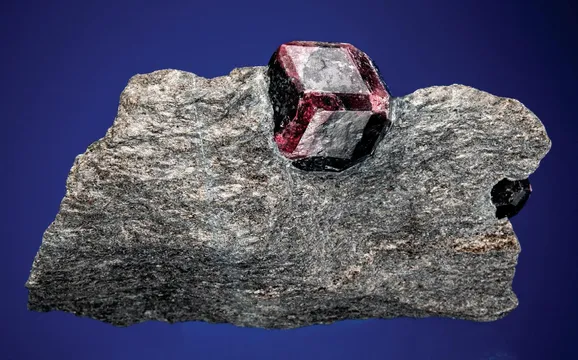
Pack Rat spessartine is the locality’s most recognizable aesthetic mineral: small, sharp, lustrous, wine-red to orangey-red garnets, commonly only a few millimeters across, sprinkled over white albite or albite-microcline matrix and less commonly accompanied by quartz or smoky quartz. Published photo records and dealer descriptions emphasize the albite association as the normal Pack Rat presentation, with quartz-bearing combinations being distinctly scarcer and therefore more desirable. The best pieces show bright, isolated trapezohedral crystals with good luster and transparency, evenly distributed on clean white feldspar or set off by smoky quartz; ordinary examples tend to be sparse, dark, damaged, or lost visually in iron-stained or clay-coated matrix.
Muscovite from Pack Rat occurs as greenish mica in the pegmatite and as collectible gray, silvery, or pale green books and wedge-shaped crystals on white albite, sometimes associated with quartz, beryl, schorl, and spessartine. The standout specimens are not merely mica plates but architectural pieces: upright, lustrous books with contrasting orientations, perched cleanly in feldspar pockets. A particularly distinctive Pack Rat habit is muscovite replacing or pseudomorphing after tourmaline, recorded as a silvery 6.5 cm muscovite pseudo after a tourmaline crystal on albite with orangey-red spessartine, a style tied to late-1980s to early-1990s collecting while Fred Stevens was working the mine. Strong muscovite pieces here are judged by form, luster, isolation, and matrix contrast; ragged cleavage, bent books, and dull clay film are the usual downgrades.
Albite is the principal stage on which many Pack Rat specimens perform, forming white, milky, sugary, blocky, and locally cleavelandite-like feldspar matrix for spessartine, muscovite, beryl, quartz, microcline, and phosphate species. Although albite is seldom the rarest label on a Pack Rat specimen, it is often what makes the piece collectible: clean white feldspar gives the wine-red garnets their contrast, supports mica books without visual clutter, and records the pocket texture of the pegmatite. Good albite specimens from this mine have crisp, sparkling, minimally stained matrix with accessory species well placed on the display face; lesser pieces are massive, iron-stained, granular, or trimmed so that the feldspar dominates without carrying a strong associated mineral.
Quartz at Pack Rat occurs as clear to milky and smoky crystals in the pegmatite pockets, associated with muscovite, beryl, albite, microcline, schorl, and spessartine. The classic quartz-bearing Pack Rat specimen is a plate of modified prismatic or tabular quartz on albite with small red spessartines scattered through the matrix; smoky quartz with spessartine is notably less common than spessartine on albite alone. The finest examples show sharp, glassy or lightly smoky crystals with clean terminations and good separation from the feldspar, especially when garnets accent the surface. Common faults include bruised terminations, quartz that is too milky to show internal life, and quartz plates in which garnets are present but visually too small or sparse to register.
Purpurite is the mineral that gives Pack Rat unusual depth for phosphate collectors. It occurs as rich violet to purple alteration material after primary manganese-lithium phosphate, especially lithiophilite, and is recorded in specimens with albite, mitridatite, and tantalite-group material. Known pieces include large phosphate crystals or crystal remnants replaced partly or completely by purpurite, including examples around 4.5 cm and a reported 6 cm lithiophilite crystal replaced by purpurite, as well as cabinet-sized purpurite masses and purpurite with golden mitridatite. The best Pack Rat purpurites have intense violet color, visible crystal form or convincing pseudomorph texture, and a meaningful association rather than featureless massive material; because the mineral is softer and earthy, rubbed surfaces, dull brown weathering, and vague labels are significant condition and authenticity concerns.
The documented Pack Rat tourmaline is principally black tourmaline, identified in locality records as schorl, occurring in the pegmatite pockets with muscovite, albite, quartz, beryl, microcline, and spessartine. Unlike the famous elbaite-producing San Diego mines, Pack Rat is not a major colorful tourmaline locality; its tourmaline value is as a structural and paragenetic component of the pocket assemblage. Collectible pieces show sharp black schorl crystals or schorl-related forms in white albite, and the most unusual tourmaline-related Pack Rat specimens are muscovite pseudomorphs after tourmaline. Good examples need clean contrast, recognizable crystal habit, and undamaged terminations; ordinary material is massive black tourmaline embedded in feldspar without display quality.
Other documented minerals make Pack Rat a much more complex locality than its common spessartine-albite specimens might suggest. Beryl is recorded as aquamarine and goshenite, and the 1986 claimant specifically noted aquamarine and garnet specimens as sold material. Cassiterite, columbite/tantalite-series minerals, tantalite, danburite, helvine, herderite, hydroxylherderite, and spodumene variety kunzite place the pegmatite in the rare-element family. The phosphate suite is particularly noteworthy: lithiophilite, purpurite, eosphorite, frondelite, hureaulite, mitridatite, phosphosiderite, robertsite, and strengite have all been documented from the mine. No type-locality mineral is established from this Pack Rat Mine; do not confuse it with the Colorado Packrat mine, which is a different locality and is tied to different vanadate minerals.
The first authenticity issue is locality confusion. “Pack Rat Mine” and “Packrat Mine” labels exist for several U.S. mines, including a Colorado vanadium locality and a Montana baryte-fluorite locality. For EarthWonders and the San Diego County pegmatite material, the correct locality is Pack Rat Mine, Tule Mountain, Jacumba, San Diego County, California, USA. Labels that mention Mesa County, Colorado; Gateway; Beaver Mesa; Pryor Mountains; Lisbon adit; or Montana refer to different deposits and should not be merged with the California pegmatite material.
The second issue is mineral naming. Older labels may say “spessartite,” a historically common gem/mineral trade usage for what modern mineralogy normally records as spessartine. That is not a red flag by itself. “Tourmaline” from Pack Rat should normally be assumed to be black schorl unless a specific analysis or credible label says otherwise. “Tantalite” labels should be treated cautiously because tantalite-(Fe), tantalite-(Mn), columbite-(Fe), and columbite-(Mn) can be difficult to distinguish visually and may be recorded as series material rather than a fully determined species.
Condition is critical. The pocket minerals came from clay-filled cavities, and clay removal can leave residues in garnet faces, mica cleavages, feldspar seams, and phosphate surfaces. Spessartines are small and easily abraded; inspect them under magnification for chipped high points and missing crystals. Muscovite books can look impressive from the front while being bent, frayed, or bruised along cleavage edges. Quartz terminations should be checked for tiny impacts. Purpurite is commonly earthy or alteration-derived, so surface wear, polishing, oiling, or overly saturated color should be viewed skeptically, especially on loose masses lacking old provenance.
There are no widely documented Pack Rat fakes in the sense of manufactured specimens, but mislabelling and over-specific naming are realistic concerns. San Diego County pegmatite material can resemble specimens from Little Three, Pala, Mesa Grande, and other districts, especially where the assemblage is simply albite, quartz, mica, schorl, and garnet. Strong old labels from known San Diego collectors or dealers add real value. Pieces from the Chuck Houser, Bill Larson, Robert Nowakowski, Chris Korpi, Tim Sherburn, Cal Graeber, Gary Wallace, or Cal Neva orbit deserve careful preservation of paperwork because those names recur in documented Pack Rat specimen histories.
Rarity varies sharply by species. Small spessartine-on-albite pieces are the most available Pack Rat specimens, though truly fine examples are still not common. Muscovite books on albite are scarcer than comparable generic pegmatite micas from many localities because attractive Pack Rat specimens usually come from older collections. Quartz with spessartine, smoky quartz with spessartine, muscovite pseudomorphs after tourmaline, aquamarine, and large purpurite/lithiophilite replacements are all significantly scarcer. The phosphate specimens in particular should be bought for both aesthetics and documentation, because they are among the clearest ways to separate Pack Rat from more familiar Southern California gem-pegmatite localities.
The most vivid Pack Rat story is not a grand industrial mining story but a pocket story told through surviving specimens. In the federal mineral survey of the mid-1980s, the mine was already a specimen locality rather than a major producer: eight open cuts, steep dikes in schist and quartzite, and clay-filled pockets only inches to several feet across. The claimant told surveyors in 1986 that aquamarine and garnet specimens had been sold. That modest note captures the scale of the place perfectly: not a famous commercial mine with trainloads of ore, but a desert pegmatite where a few pockets could justify careful hand work and produce minerals worth saving.
A later specimen record gives the mine a human face. A muscovite pseudomorph after tourmaline, 9.2 x 8.5 x 5.0 cm, was described as coming from the Chuck Houser collection and self-collected by Houser in the late 1980s or early 1990s while the mine was owned and worked by Fred Stevens. The specimen is exactly the kind of object that keeps a small locality alive in collector memory: a 6.5 cm silvery mica form preserving the shape of a tourmaline crystal, set in albite and accented with orangey-red spessartine. It is not the usual colorful San Diego tourmaline fantasy; it is stranger, more mineralogical, and much more specifically Pack Rat.
Another thread runs through the phosphate specimens. One purpurite–mitridatite piece is recorded as having been collected by Gary Wallace in 1994, then given by Cal Graeber to Tim Sherburn, before later entering the market as a richly colored study specimen with golden mitridatite and purple purpurite. That chain of names matters because Pack Rat phosphates are not abundant anonymous commodities. They are often individual, traceable pieces, and their collection histories preserve the difference between a true Tule Mountain phosphate specimen and a merely purple pegmatite rock.
The Bill Larson collection adds a final collector-market vignette. A 4.8 x 4.7 x 3.4 cm miniature of spessartine with smoky quartz on albite, sold at auction in December 2021, reached a winning bid of $619. The attraction was not size alone; it was the rare combination. Pack Rat spessartine is usually seen on albite, but this miniature carried sharp, lustrous, gemmy garnets to about 4 mm with several smoky quartz crystals, including a nearly water-clear doubly terminated crystal. For a locality where the most familiar look is red garnet on white feldspar, that extra quartz association made the specimen memorable.