






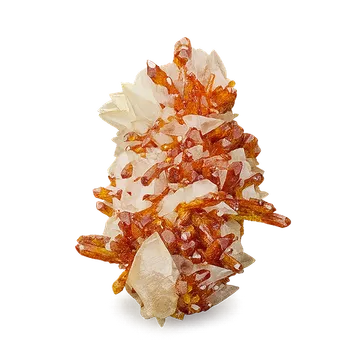
Orpiment Twin Creeks Mine, Nevada: iconic orange-to-honey yellow crystals with luster, rescued from mining, prized for color, translucency, and quality.
Key facts
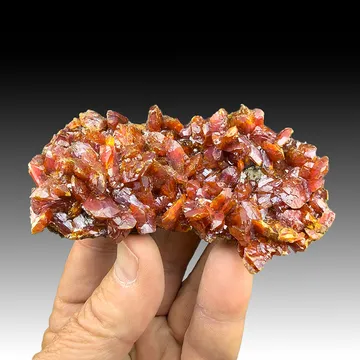
Twin Creeks orpiment is the modern American benchmark for the species: lustrous, translucent to transparent, orange to honey-yellow As2S3 in thick, sculptural crystal clusters rather than the crumbly foliated crusts that define so many lesser occurrences. The best pieces have a wet, resinous flash, chisel-like terminations, and a color range that moves from butterscotch and amber through fiery reddish orange. In fine light they do not simply look yellow; they appear lit from inside.
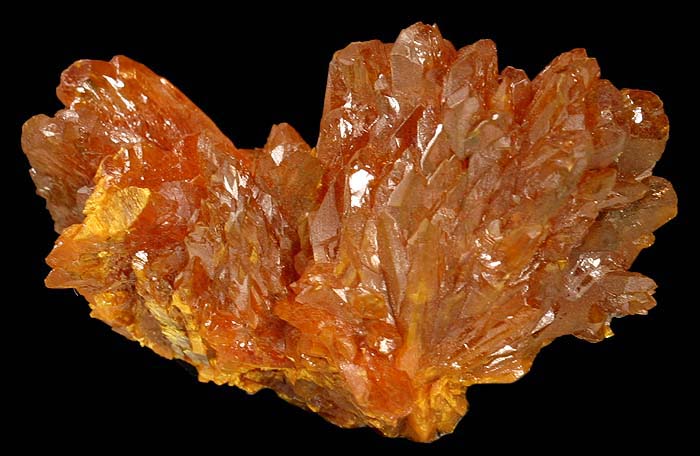
Photo: Wikimedia Commons
The locality is not a romantic hand-dug vein in the old collector’s sense, but a large Carlin-type gold operation in the Potosi Mining District of the Osgood Mountains. The gold itself is microscopic, tied to arsenian iron sulfides in altered Paleozoic sedimentary and volcanic rocks; the orpiment is the spectacular visible expression of that arsenic-rich hydrothermal system. The contrast is part of the fascination: one of the world’s most colorful display minerals came from an orebody mined for gold no collector could see with the naked eye.
Twin Creeks became famous almost overnight in 1999, when mining in the Mega Pit exposed bright yellow-orange pocket zones. Newmont geologists recognized that the material was not just geologically interesting but specimen-grade, and Collector’s Edge Minerals was brought in to recover it before normal mine production destroyed it. That collaboration is a key part of the locality’s legacy. The best specimens were not casually picked up from a dump; they were rescued under industrial mining constraints, between blasting schedules, heavy equipment, safety rules, and the relentless economics of a working gold mine.
Collectors prize Twin Creeks orpiment for three things above all: saturated color, robust crystals, and condition. Strong luster matters enormously. So does translucency, especially on crystals that glow at the edges. The most desirable examples show three-dimensional crystal groups, isolated or diverging crystals, or unusually good matrix presentation. Most specimens are clusters of intergrown crystals, and matrix pieces are less common than loose orpiment-on-orpiment plates; a sharp crystal group rising from dark matrix can be especially effective.

Photo: Wikimedia Commons
Search for specimens: View all orpiment specimens from Twin Creeks Mine, Nevada, USA
Twin Creeks Mine is in the Potosi Mining District, Osgood Mountains, Humboldt County, Nevada, northeast of Winnemucca. The broader operation includes the famous Mega Pit and Vista Pit areas, along with later underground development. Historically, the operation consolidated the Rabbit Creek and Chimney Creek mines in the early 1990s; Newmont acquired Santa Fe Pacific Gold in 1997, and the property later became part of Nevada Gold Mines LLC, the Barrick-Newmont joint venture established in 2019.
Geologically, Twin Creeks is a Carlin-type, sediment-hosted gold system on the Getchell Trend. The main ore environment involves Cambrian-Ordovician to younger Paleozoic units, with the Comus Formation particularly important as a gold host. The mine geology is structurally complicated: thrusting, folding, high-angle faults, decalcification, silicification, mafic sills, and later hydrothermal overprints all helped focus mineralizing fluids. In the Mega Pit, the productive orpiment pockets were tied to open spaces created by folding, fracturing, and carbonate removal—exactly the sort of small, protected voids needed for delicate arsenic sulfide crystals to grow.
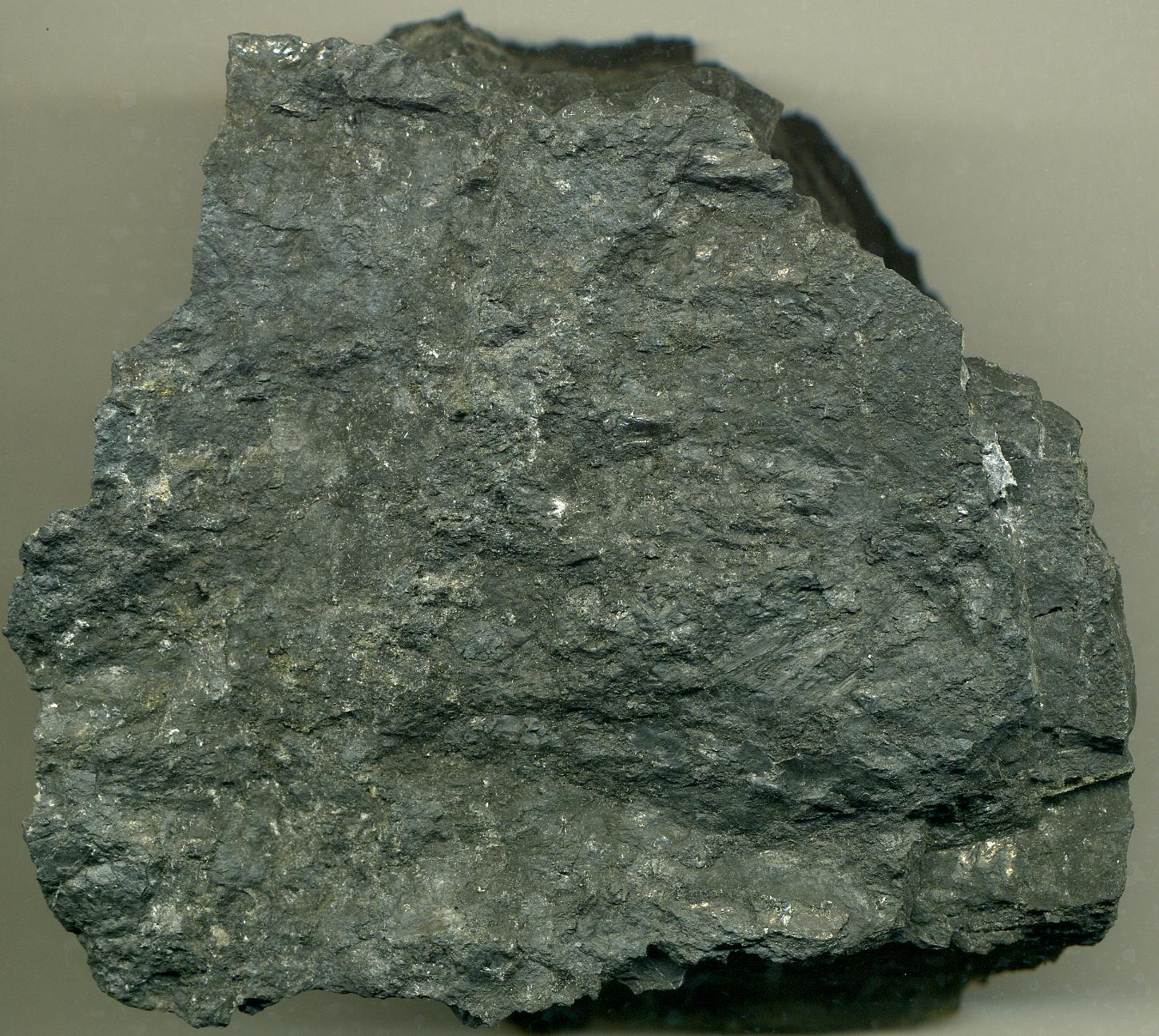
Photo: Wikimedia Commons
The orpiment discovery that made the locality famous came during active mining, when blasted ground exposed yellow and orange zones that proved to contain small pockets lined with bright crystals. Between spring and autumn 1999, the principal productive zone was recovered in a controlled collecting effort. The material is most commonly associated in the collector market with Cut 62 in the Mega Pit, although labels may also refer more generally to Twin Creeks Mine, the Mega Pit, or occasionally other cut designations.
Twin Creeks is an active industrial mine complex, not an open collecting locality. There is no casual public access, and modern collecting is governed by mine ownership, safety procedures, permitting, and production priorities. Nearly all collector-grade orpiment on the market comes from the preserved late-1990s/early-2000s material and subsequent dispersal through Collector’s Edge, major dealers, auctions, museums, and private collections.
The original orpiment zone was finite and was worked out quickly. That is essential to understanding the locality: Twin Creeks orpiment is not a recurring show supply. Fine pieces appear because old collections are sold or dealer inventories are recycled, not because new pockets are being collected every season.
Twin Creeks orpiment is best known for thick clusters of sharp, lustrous monoclinic crystals. Many crystals are squat, wedge-shaped, or chisel-terminated rather than long and needlelike. Fine examples show strong face development, parallel growth, pronounced striations, and lively internal reflections. Individual crystals commonly fall in the millimeter to low-centimeter range, with many collector specimens showing crystals around 1–2 cm; exceptional crystals may be larger, but size alone does not make a top specimen if the luster is dull or the edges are bruised.
The color range is one of the locality’s signatures. Some pieces are golden yellow or honey yellow, others deep amber, orange, or reddish orange. The finest have a saturated butterscotch-to-fire-orange body color with translucent edges. Backlighting can reveal glowing yellow interiors even in crystals that appear darker in ordinary cabinet light. Dark inclusions or matrix behind the crystals can deepen the visual effect, giving some pieces a smoky amber cast.
Most specimens are plates, rosettes, fans, and mound-like clusters of intergrown orpiment crystals. Many are essentially orpiment on orpiment, with little obvious matrix. Matrix specimens are less common and tend to command additional interest, especially where the crystals rise cleanly from a contrasting dark base. Barite is an occasional and desirable association, sometimes as pale yellowish or gray blades. Mindat photo data and specimen descriptions also record associated realgar, stibnite, getchellite, and picropharmacolite, though the classic aesthetic Twin Creeks orpiments are usually appreciated first for orpiment itself rather than complex paragenesis.
Quality is judged by luster, translucency, crystal definition, color saturation, aesthetics, and damage. A small, sharply crystallized, gemmy, undamaged piece may be more desirable than a larger but rubbed plate. Collectors look closely at terminations and edges because orpiment is very soft and cleavage-prone. Bright, glassy-to-resinous faces with crisp chisel terminations are the premium look. Dull, chalky, heavily contacted, or friable examples are much less desirable, even if the locality label is correct.
Twin Creeks orpiment should be treated as a fragile, toxic arsenic sulfide specimen. Normal cabinet ownership is manageable with sensible handling, but it is not a mineral for children, jewelry use, pocket carrying, or repeated bare-handed abrasion. Handle it gently, wash hands afterward, keep dust generation to an absolute minimum, and avoid any cutting, grinding, or cleaning method that could make powder.
Condition is the main collecting issue. Orpiment has very low hardness and excellent cleavage, so bruised edges, nicked terminations, contacted faces, and small cleaved patches are common. On this locality’s material, minor edge wear can be acceptable if the specimen has strong color and luster, but pristine pieces command a premium. Always inspect crystal tips under magnification and look for flattened, lighter-colored bruises along ridges.
Repairs and stabilization deserve careful attention. Because many specimens were recovered from friable blasted ground and because orpiment itself is mechanically weak, some pieces may have repairs, backed areas, reattached crystals, or clear consolidant. These are not automatically disqualifying on major Twin Creeks specimens, but they should be disclosed and reflected in price. Watch for glossy adhesive lines, unnatural plastic-like sheen, misaligned striations, or matrix bases that look reinforced.
No major, locality-specific fake scandal is widely documented for Twin Creeks orpiment, but mislabeling is possible. Nevada has other important arsenic-sulfide occurrences, especially Getchell-area material, and non-Nevada orpiment can be superficially similar to buyers who shop by color alone. A credible old label from Collector’s Edge, The Arkenstone, John Betts, or another established dealer is useful provenance. Cut 62 labels are especially meaningful when supported by older documentation.
Light exposure should be conservative. Orpiment is more stable than realgar in the usual collector sense, but prolonged strong light can dull or darken color. Display away from direct sun and intense hot lamps. Store in a dust-free case with stable humidity and minimal vibration. Do not use aggressive cleaning: a photographer’s blower and a very soft brush, used sparingly, are safer than water soaking, solvents, ultrasonic cleaning, or chemical dips.
Market availability is steady but limited. Miniatures and small-cabinet specimens still appear regularly through dealer listings, auctions, and collection dispersals, but top examples with strong color, luster, matrix, and minimal damage are increasingly treated as American classics. The locality has moved from “recent find” status into the realm of modern classics, and the best pieces are now bought as benchmark species specimens rather than merely attractive Nevada sulfides.
The story begins in a place where nobody was looking for beautiful minerals. Twin Creeks was a gold mine built around invisible gold—microscopic metal dispersed in arsenian sulfides, measured by assay rather than admired by eye. Before the orpiment discovery, specimen-quality minerals were not what mine geologists expected to see in the pit. Then, in April 1999, a fresh blast opened a working face marked by yellow and orange smears.
At first glance, those colors might have been just another alteration signal in an arsenic-rich gold system. Up close, they were something else entirely: small open pockets lined with bright crystallized orpiment. In a mine where the normal destiny of rock was drilling, blasting, hauling, crushing, oxidation, leaching, and gold recovery, the pockets represented a mineralogical emergency. Beautiful specimens were sitting directly in the path of production.
Newmont’s geologists contacted Collector’s Edge Minerals, and an unusual agreement followed. The mine’s first priority remained gold production, so the collectors had to work inside the rhythm of a large open-pit operation. Blastholes showing orpiment signs were noted. Barren rock could be blasted and removed, while mineralized sections were left as standing columns or zones for specimen recovery. The practical aim was simple but rare: let the mine keep mining, while giving the crystals a chance to survive.
The collecting was not leisurely field collecting. Heavy equipment exposed ground; then the fine work began with pneumatic chisels, diamond saws, hand tools, and careful trimming. The collectors worked between safety restrictions and blast evacuations. The same forces that made the pockets accessible also damaged many of them: blasting vibrations collapsed or shattered some cavities, and friable ground made intact recovery difficult. Even so, the operation saved thousands of specimens that otherwise would have gone through the gold circuit.
One detail captures the scale of the rescue. The productive zone was not a single hand-sized pocket but a mine-scale interval of pockety ground, worked over a short season as the pit advanced. Some cavities reached impressive depth, yet the window was brief. By the time the zone was mined through, the combination of structure, open space, and crystallized orpiment that had produced the classic specimens had disappeared. The discovery became famous not just because the crystals were beautiful, but because the opportunity to save them was so narrow.
The Twin Creeks find also changed expectations. Before it, collectors looked to localities such as Quiruvilca in Peru and Shimen in China for world-class crystallized orpiment. After Twin Creeks, Nevada had to be included in the top rank. The pieces were not merely good for the United States; the best were good by global standards. That is why the locality still carries such weight in advanced collections: it is a case where industrial gold mining briefly intersected with museum-grade mineral preservation, and the crystals survived because people on both sides recognized what was at stake quickly enough.

_(18720354540).jpg)
