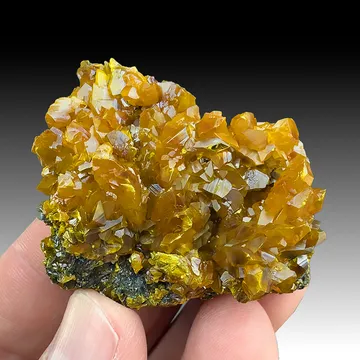
Twin Creeks Mine, Nevada - renowned orpiment locality with lustrous golden-orange crystals, transparency, and collector appeal from the Mega Pit.
Key facts
Twin Creeks is one of the rare modern gold mines whose name means two very different things at once. To economic geologists, it is a major Carlin-type gold system on the Getchell gold belt of northern Nevada, a deposit where the payable metal is largely invisible: micron-scale gold bound to arsenian pyrite in decalcified, carbonaceous Paleozoic rocks. To mineral collectors, however, Twin Creeks is remembered for an astonishing interruption in that world of invisible ore: brilliant, transparent to translucent orpiment crystals, recovered from the Mega Pit in the late 1990s before the rock could disappear into the mine’s normal gold-processing circuit.
The mine lies in Humboldt County, in the Potosi Mining District at the northeastern end of the Osgood Mountains, roughly 40 miles northeast of Winnemucca. The geologic setting is classic northern Nevada in scale and complexity: Cambrian to Ordovician Comus Formation carbonate and tuffaceous sedimentary rocks, Ordovician Valmy volcanic rocks, Pennsylvanian-Permian Battle and Etchart units, major thrust contacts, high-angle faults, Cretaceous intrusions, and Eocene Carlin-type hydrothermal mineralization. In the Mega Pit, ore controls include the Roberts Mountains thrust contact and the Conelea Anticline, with gold concentrated in favorable decalcified carbonate horizons and along structural feeders.
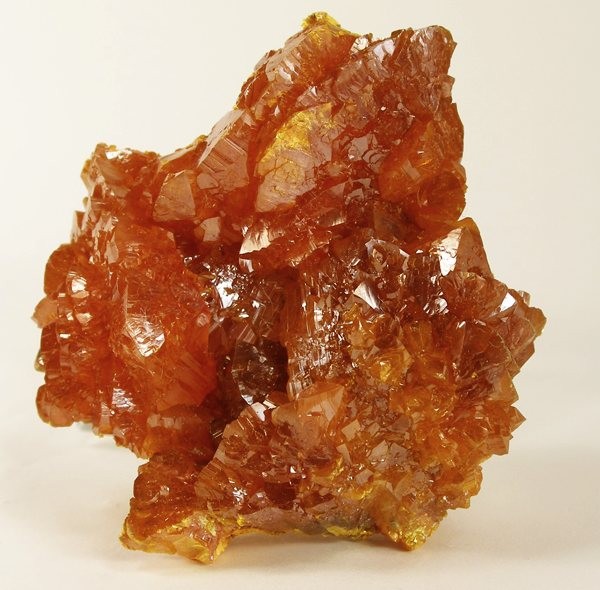
For collectors, Twin Creeks is above all an orpiment locality. The best pieces are immediately recognizable: lustrous golden-orange to deep butterscotch crystals, commonly squat and chisel-terminated, with sharp striations, perched on contrasting dark matrix or clustered into rich, glassy orange plates. The finest specimens have the combination that orpiment almost never grants in one piece: saturated color, transparency, clean terminations, three-dimensional architecture, and surprisingly little edge bruising for a very soft arsenic sulfide.
Regional View
Country View
Twin Creeks also belongs to a larger family of arsenic-antimony-mercury-bearing Carlin systems in the Getchell area. That explains both the beauty and the mineralogical oddity of the specimens: orpiment, realgar, stibnite, cinnabar, galkhaite, getchellite, baryte, quartz, pyrite, and marcasite are not incidental decorations here but part of the low-temperature, reduced, arsenic-rich hydrothermal environment that made the gold ore body.
Search for specimens: View all specimens from Twin Creeks Mine, USA
Twin Creeks is a large sediment-hosted Carlin-type gold mine in the Potosi Mining District of Humboldt County, Nevada. The original Twin Creeks operation was formed in 1993 by consolidating the Rabbit Creek and Chimney Creek mines into what became the Mega Pit complex. Rabbit Creek occupied the southern part of the property, while Chimney Creek included the northern Mega Pit area and the Vista area. Gold Fields discovered the Chimney Creek orebody in 1985, Santa Fe Pacific Gold worked the Rabbit Creek side, a drilled trend between the deposits was recognized by 1987, and initial production began in 1989. Newmont acquired the Santa Fe Pacific properties in 1997. Since July 1, 2019, the former Twin Creeks surface operation has been part of the Turquoise Ridge Complex within Nevada Gold Mines, the Barrick-operated joint venture owned 61.5 percent by Barrick and 38.5 percent by Newmont.
The deposit is not a vein mine in the old western sense. The economic gold occurs mostly as micron-scale particles or chemically bound gold in arsenic-rich rims and bands on pyrite grains. That pyrite is hosted in decalcified, carbonaceous sedimentary rocks and locally in argillized and sulphidized basalt. The collector minerals are the visible expression of the same arsenic-rich system: orpiment, realgar, stibnite, cinnabar, pyrite, marcasite, quartz, baryte, and rare thallium-mercury and arsenic-antimony species occur in fractures, vugs, breccias, and late-stage hydrothermal pockets.
The mine’s principal ore-hosting rocks at the surface operation are Paleozoic strata of the Comus, Valmy, Battle, and Etchart formations. The Comus Formation is especially important in the Mega Pit, where carbonate and tuffaceous sedimentary units are folded, faulted, intruded, and hydrothermally altered. The Roberts Mountains thrust places Valmy rocks against Comus rocks, and the Conelea Anticline is a major ore-controlling structure in the Mega North Pit. North- and northeast-striking faults acted as important fluid pathways; in places, those structures localized higher gold grades even where the host lithology was less favorable.
The broader Twin Creeks mine includes the Mega, Vista, West, and Disco areas. The Mega Pit has produced much of the classic orpiment material, especially from Cut 62 and related bench/cut labels found on specimens. The Vista area is geologically distinct in part, with important oxide mineralization in decalcified lower Etchart rocks near the Etchart-Valmy unconformity, and a later underground component beneath or near the Vista pit. Modern mine descriptions now group the former Twin Creeks property with Turquoise Ridge Surface and Vista Underground.
Specimen collecting at Twin Creeks has always been dependent on mine operations and company permission. The famous orpiment was not the result of recreational collecting or dump picking; it was a controlled recovery from an active industrial gold mine. Access today should be regarded as closed to the public. The mine is an active, permitted, safety-controlled operation, and no collector should expect access without direct authorization from the operator.
The decisive specimen event occurred in 1999, when mining exposed an orpiment-rich zone in the Mega Pit. Before that discovery, mine geologists were looking for gold ore, not showy cabinet specimens, and specimen-quality minerals were seldom encountered. A freshly blasted face revealed conspicuous yellow and orange staining, and closer inspection showed small cavities lined with bright crystallized orpiment. Newmont geologists contacted Collector’s Edge Minerals, and an organized recovery program followed. Between April and October 1999 the orpiment zone was worked out, yielding thousands of specimens, mostly large miniatures to small cabinet pieces, along with a much smaller number of superb cabinet examples.
The best-known specimen labels include Twin Creeks Mine, Mega Pit, Cut 62, and sometimes Cut 20. Collector’s Edge labels are especially desirable because they tie a specimen to the original professional recovery. Good older labels may also mention the care and handling warnings that accompanied arsenic-sulfide material from the find.
Twin Creeks orpiment is the locality’s signature mineral and one of the defining American orpiment occurrences. The crystals are generally honey-yellow, golden-orange, butterscotch, or reddish orange, with high adamantine to resinous luster and good translucency to transparency. Habits are commonly squat, sharply striated, and chisel-terminated rather than long and bladed; many crystals range from a few millimeters to around 2 cm, with exceptional crystals reported larger, and fine specimens commonly falling in the miniature to small-cabinet range. Classic pieces show orpiment on dark silicified or sulphidic matrix, sometimes with baryte, stibnite, getchellite, realgar, pyrite, marcasite, or black oxide-rich surfaces. The finest Twin Creeks pieces are not merely bright; they are balanced, three-dimensional clusters with clean terminations, strong color in transmitted light, minimal bruising, and enough matrix contrast to make the orange crystals read from across a case.
Other documented minerals from Twin Creeks include baryte, realgar, stibnite, pyrite, marcasite, native gold, quartz, calcite, dolomite, fluorite, galena, sphalerite-related base-metal minerals, cinnabar, galkhaite, getchellite, native tellurium, calaverite, coloradoite, beudantite, conichalcite, hinsdalite, montgomeryite, mitridatite, variscite, kingsmountite, and the rare arsenate gaitite. Getchellite is better known from its type locality at the nearby Getchell Mine, but Twin Creeks specimens with getchellite, orpiment, and stibnite are highly interesting because they place the locality within the same arsenic-antimony-mercury-thallium mineralogical province. Galkhaite from Twin Creeks is especially important scientifically: it occurs as small cubic, octahedral, and more complex crystals in silicified hydrothermal breccia with sulphides, and because of its rubidium-rich, strontium-poor chemistry it has been discussed as a potentially useful mineral for dating Carlin-type mineralization.
The first question with any Twin Creeks specimen is not whether it is showy, but whether it has survived well. Orpiment is very soft, has excellent cleavage, and bruises readily along crystal edges and terminations. Even good specimens often show minor rubs at high points or along the perimeter where the pocket was broken out. On this material, “nearly damage-free” is a meaningful phrase; perfectly pristine larger pieces are genuinely uncommon.
Color stability is a second concern. Twin Creeks orpiment is much more stable than associated realgar, which can alter under light, but prolonged direct sunlight is still poor practice and can dull or brown orpiment over time. Display it away from windows and strong UV-rich lighting. Keep realgar-bearing association pieces in darker storage or low-light display, and avoid placing them in warm, brightly illuminated cases for long periods.
Handling requires common sense. Orpiment is As2S3, an arsenic sulfide. It should not be cut, ground, abraded, ultrasonically cleaned, soaked, or handled by children. Do not generate dust. Wash hands after handling, keep it away from food-preparation areas, and store friable pieces in a box or case where flakes cannot migrate. The hazard is most significant when dust or fragments are ingested or inhaled; an intact display specimen handled carefully is manageable for an informed collector.
No widely documented systematic faking program is associated with Twin Creeks orpiment, but mislabeling is a real issue. Bright orange orpiment from China, Peru, and other Nevada localities is sometimes visually tempting, and vague labels such as “Nevada orpiment” deserve scrutiny. Conversely, “Twin Creeks Mine” can also refer to a quartz collecting locality in Arkansas; that material has no relationship to the Nevada gold mine. A proper Twin Creeks label should normally place the specimen in Humboldt County, Nevada, often with Potosi Mining District, Osgood Mountains, Mega Pit, Cut 62, Cut 20, or Collector’s Edge provenance.
Market availability is better than for many one-time pocket discoveries because the 1999 recovery yielded thousands of specimens, but the supply is finite and quality is sharply tiered. Small miniatures and bruised clusters remain obtainable. Fine miniatures and small cabinets with glassy color and clean chisel terminations are desirable. Large cabinet pieces with strong three-dimensional form, saturated orange color, good translucency, undamaged main crystals, and early provenance have become modern American classics.
The great Twin Creeks orpiment story begins with a blast face that looked wrong for an ordinary gold mine. In early 1999, the mine was working rock whose real value could not be seen by eye: microscopic gold in arsenian pyrite. Then a fresh face in the Mega Pit showed yellow and orange smears. In most mines, color like that might have been a curiosity noted in passing before the next production cycle. At Twin Creeks, someone looked closely enough to see that the smears were not just stains. They marked a zone full of small cavities lined with brilliant orpiment crystals.
That decision to look closely changed the fate of the find. Newmont geologists contacted Collector’s Edge Minerals, and the recovery became a rare collaboration between an active gold operation and professional specimen miners. The arrangement had to respect the mine’s first priority: gold production could not be slowed. The solution was practical and elegant. Areas showing orpiment indications were recognized during drilling and mining, and the barren portions could be blasted away while mineralized rock was left standing long enough to be worked. Accounts of the recovery describe long, bench-scale zones and standing rock masses preserved temporarily so the specimen team could extract pockets before the normal mining rhythm resumed.
The physical work was not romantic in the easy sense. It happened inside a working open pit, under mine schedules, with production equipment moving nearby and blasting cycles dictating when collectors could stay and when they had to leave. Heavy machinery opened ground; then the specimen work slowed to the pace of pneumatic chisels, saws, hammers, hands, and judgment. Orpiment is unforgiving. A blow that would free a calcite plate might ruin an orpiment group. Many pockets were already cracked or shaken by blasting. Some yielded only fragments; others opened into cavities deep enough to produce the gleaming orange clusters that now anchor serious American mineral collections.
The recovery window was brief. From April to October 1999, the orpiment zone was worked out, and then it was gone. That is part of the power of Twin Creeks specimens today: they represent a moment when a large mine temporarily made room for something it was not designed to save. The rock’s commercial destiny was to become ore feed. Instead, thousands of specimens were preserved, including pieces now in museums, major private collections, and the high end of the mineral market.
A second, quieter chapter took place after the specimens left the mine. Labels, provenance, and handling notes became part of the history. Some pieces retained Collector’s Edge labels with care warnings. Others entered museum collections, including a notable donation by Newmont to the Nevada State Museum in 2001: three jewel-like orpiment specimens from the Twin Creeks deposit, one accompanied by pale yellow baryte. Museum staff described colors ranging from brilliant orange to “something like root beer,” a phrase that still captures the best Twin Creeks material better than any formal color chart.