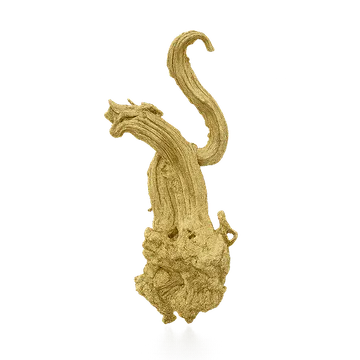
Olinghouse Mining District gold, Nevada — pale-yellow native gold and electrum with wire nests and crystalline textures, prized for locality and architecture.
Key facts
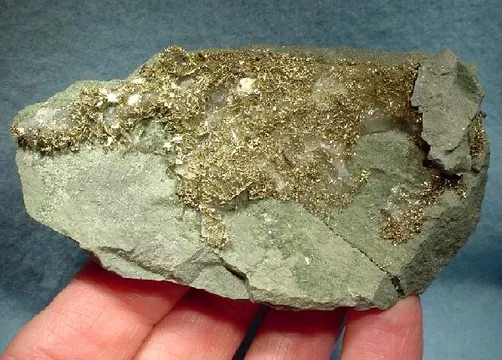
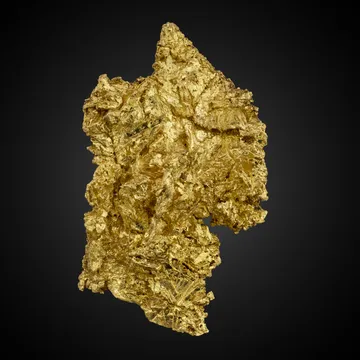
Gold from the Olinghouse Mining District is a modern Nevada classic: not the heavy, rounded placer nugget of popular imagination, but pale-yellow, sharply crystallized native gold and electrum occurring as wires, leaves, open nests, and sparkling spongy aggregates on altered volcanic matrix. The best pieces have an instantly recognizable look — bright, wiry gold emerging from greenish-gray andesite or from cream-colored calcite-filled cavities, often with quartz, zeolites, and earthy iron oxides giving the matrix a subdued desert palette that makes the metal stand out.

Photo: Wikimedia Commons
The district lies in the southern Pah Rah Range of Washoe County, near Wadsworth and east of Reno, within a faulted volcanic terrain of Oligocene to Miocene age. The important specimen material is tied to epithermal gold-silver veining in the Pyramid Sequence — basaltic to andesitic volcanic and volcaniclastic rocks cut by northeast-trending structures and dikes. In the productive zones, gold occurs in open fractures and veinlets with quartz, calcite, zeolites such as laumontite and heulandite, K-feldspar, adularia, epidote, goethite, and minor sulfides including pyrite, galena, chalcopyrite, and sphalerite.
What sets Olinghouse apart for collectors is texture. A good Olinghouse specimen is less about bullion weight than architecture: tiny wires crossing one another like metallic grass, flattened leaves flashing on the surface of matrix, spinel-twinned crystals and delicate wire nests revealed when calcite was dissolved away during specimen preparation. Much of the material is electrum-rich and paler than high-fineness native gold; some pieces deepen or tarnish with age, a useful clue when evaluating older examples.
The collecting importance of the locality is concentrated in a short modern window. The old district dates back to nineteenth-century prospecting, but the gold specimens that made Olinghouse famous in mineral collections came largely from the Alta Gold open-pit era of the late 1990s, especially the 813 pit and the celebrated “Zeolite vein.” These finds surprised collectors because they came from a Nevada bulk-mining environment yet produced distinctive thumbnail, miniature, and occasional cabinet specimens with genuine crystallographic interest.
Search for specimens: View all gold specimens from Olinghouse Mining District, Nevada, USA
The Olinghouse Mining District, also known historically as the White Horse District, occupies the southeast flank of the Pah Rah Range in Washoe County. The modern Olinghouse Mine area is centered near Green Hill, with the 813 pit of the Alta Gold Mine one of the key names attached to specimen labels. Mindat places the 813 pit at approximately 39.66407, -119.42609, and the broader modern mine area lies roughly northwest of Wadsworth.
Geologically, Olinghouse is an epithermal vein system in volcanic rocks near the western margin of the Basin and Range. The principal host is the Pyramid Sequence, a middle Miocene package of vesicular basalt, andesite, flow breccias, lahars, and volcanic sediments. Older Oligocene to Miocene ignimbrites, ash-flow tuffs, rhyolite flows, and lahars are present, while younger Kate Peak Formation volcanic rocks unconformably overlie the mineralized sequence. The gold-bearing structures trend northeast and are associated with basaltic to dacitic dikes; the named productive structures include the Number 1, Number 2, Number 3, Blue Dike, Sunbeam, and Standard structures.
The alteration is one reason the deposit can seem visually understated in the field. Olinghouse lacks the bold color anomalies of many oxidized mining camps. The broad propylitic halo includes chloritization of volcanic rocks, calcite-sericite-epidote-albite alteration of plagioclase, and increasing epidote toward the district center. Close to veins, feldspar alteration becomes more intense, with K-feldspar and sericite replacing plagioclase. The best ore and specimen zones are associated with open-space veins, fault zones, shear zones, dikes, K-feldspar, chlorite, and zeolite minerals.
Mining began as scattered prospecting in the 1860s, with the district formally organized in 1899 and its early lode-mining peak between about 1901 and 1903. The town took its name from Elias Olinghouse, a former teamster and sheepman who settled in the canyon and was drawn into the mining excitement around him. By 1903, electric and telephone service had reached the camp, and in 1907 a standard-gauge railroad was completed from near Wadsworth to Olinghouse. The railroad’s life was notably brief: regular operations ceased on November 1, 1907.
Placer gold was also important. Olinghouse Canyon, Frank Free Canyon, Tiger Canyon, and associated alluvial fans produced from shallow workings, pits, and later mechanized efforts. The placer deposits concentrate gold near bedrock in reddish clay-matrix conglomeratic gravels beneath less productive greenish-gray overburden. Estimates for placer production vary, but published summaries put the minimum historical and later placer output in the tens of thousands of ounces.
Modern exploration reshaped the district. Western Goldfields drilled in 1986 but lacked the land position to test the central district effectively. Phelps Dodge consolidated a stronger position in 1991 and drilled reverse-circulation and core holes by 1993. Alta Gold acquired the property in 1994, advanced drilling and permitting, and began mine production in September 1998. The modern operation was planned as a conventional open pit, with the Green Hill pit first and later work contemplated at Payback, Keystone, and Sunbeam. Alta’s early high-grade drill intercepts included visible gold, with one core hole cutting a 64-foot interval grading 1.97 ounces gold per ton, including 31.5 feet at 3.9 ounces gold per ton.
The classic specimen production belongs to that modern open-pit period. The 813 pit’s “Zeolite vein” was named for weathered fractures containing laumontite and heulandite. Specimen gold occurred in calcite- and zeolite-filled cavities and open fractures, and many pieces were saved and later prepared specifically for collectors. Open-pit mining and specimen recovery in the late 1990s and around 1999–2000 produced the material now seen in collections under Olinghouse, Alta Gold Mine, Green Hill, 813 pit, and related labels.
The mine is not a casual collecting site. The modern mine workings have been blocked or fenced, the townsite and mine area include private and active-claim issues, and the current 327 Apex Mine Project permit area remains a controlled mine property. A 2025 Nevada Division of Environmental Protection fact sheet describes Lake Mountain Mining, LLC as the permittee for the 327 Apex Mine Project, an underground mine project at the former Olinghouse Mine area, and states that no mining or processing had occurred there since 2013, with the site in temporary closure at that time. Serious collectors should treat the locality as closed to collecting unless they have explicit permission from the controlling operator or landowner.
Olinghouse gold is best known for wires, leaves, and “nest” aggregates. The wires are commonly fine, irregular, and intergrown; some are loose tangles, while others are anchored in matrix or cross the surfaces of small cavities. Leafy forms range from tiny flattened plates to glittering masses of compressed leaf crystals. The collector term “nest gold” is especially apt here: the gold can form compact, open, sponge-like bundles of twisted wires, sometimes sitting in depressions where calcite or zeolite once filled the space.
Color is a major locality clue. Much Olinghouse material is not the saturated butter-yellow of high-purity gold. The gold is commonly pale yellow to soft yellow because a significant proportion is electrum, with silver in solid solution. Mindat records Olinghouse electrum as long, thin plates resembling steel wool, with pale yellow color that may darken as tarnish develops; some specimens have been observed to tarnish nearly black over time. Freshly prepared or recently cleaned specimens may look brighter, while older pieces can develop a warmer or more subdued surface.
Crystallization is typically small-scale but fine. Many pieces require magnification to appreciate the sharpness of the gold. Good miniatures may show hundreds of tiny bright leaves or wires; higher-end pieces show isolated crystals, spinel-twinned gold, and more three-dimensional wire networks. Documented specimens include leaves reaching several millimeters, and one well-known Mindat specimen from the 813 pit is described with gold leaves reaching 5 mm on a 9.3 cm matrix specimen. Another published example notes leaves reaching 6 mm. These are large for the district; most visible crystallization is much smaller.
Matrix is important to value and identification. The most characteristic matrix is altered greenish-gray volcanic rock, commonly andesite or basaltic-andesitic material of the Pyramid Sequence, sometimes with quartz-lined open fractures. Cream-colored calcite filled many vugs and fractures; on many collector specimens the calcite was partly or entirely etched away to expose gold. Zeolites are more than incidental accessories at Olinghouse. Laumontite and heulandite are tied directly to the main specimen zone, and the association of wiry gold with calcite, quartz, and zeolitized volcanic matrix is one of the locality’s signatures.
Associated minerals recorded from the district and the 813 pit include calcite, quartz, laumontite, heulandite subgroup minerals, phillipsite subgroup minerals, epidote, clinozoisite, K-feldspar, adularia, galena, chalcopyrite, pyrite, sphalerite, scheelite, anglesite, goethite, and wad. Telluride minerals such as hessite, petzite, coloradoite, and rucklidgeite are recorded elsewhere in the broader district, reflecting the chemically varied epithermal system, though they are not what most collectors are buying when they buy a typical Olinghouse gold specimen.
Typical collector sizes range from micromounts and thumbnails to small miniatures. Many fine pieces are only a few centimeters across because the gold habit is delicate and the cavities were small. Cabinet specimens exist but are far less common, and the most desirable cabinet-size pieces combine size with dense gold coverage, intact matrix, and balanced composition. A large matrix specimen with two visible nests or a broad U-shaped nest of wires is notably more important than a small isolated flake, even if the gold weight is modest.
Quality is judged by crystallization, openness, brightness, and matrix contrast. The best Olinghouse specimens show sharp wire or leaf texture without looking crushed or smeared; the gold should sit visibly on or within matrix rather than appearing as a flat stain. Aesthetic pieces with isolated wires on quartz, rich nest clusters on green altered volcanic rock, or gold exposed from calcite-filled vugs are especially desirable. Because the material is often pale electrum, experienced collectors do not penalize a piece simply for lacking deep yellow color; instead they look for undisturbed form, strong luster, and convincing Olinghouse texture.
Olinghouse specimens are locality-sensitive. A loose nest of pale electrum without matrix can be beautiful, but it is easier to misattribute than a piece on the district’s characteristic green altered volcanic matrix with calcite, quartz, or zeolite association. Old labels from the late-1990s find, Scott Kleine-associated material, Alta Gold Mine labels, 813 pit labels, and documented collection histories carry real importance.
The most common “treatment” issue is preparation by acid etching, not artificial enhancement. Many specimens originally had gold enclosed or partly enclosed in calcite; dissolving the calcite exposed the wires and leaves that collectors prize. That preparation is normal for the locality, but it should be disclosed. Residual acid or incomplete neutralization can create condition problems, especially where minor copper sulfides are present. A documented Mindat photo note describes an Olinghouse electrum-wire specimen originally in decayed white laumontite and calcite, etched in hydrochloric acid, then developing a green copper bloom after neutralization, probably from microscopic chalcopyrite. Buyers should inspect prepared pieces for powdery residue, green or white blooms, soft decayed zeolite, and any unnatural-looking cement or repair.
Condition can be deceptively fragile. Fine wires may bend, mat down, or break with careless handling. Leafy surfaces can be flattened or abraded. Laumontite is prone to dehydration and decay, so specimens retaining laumontite or zeolitic matrix should be kept in stable, dry conditions and handled minimally. Calcite remnants may be acid-etched, roughened, or partly dissolved; this is not necessarily damage, but over-etching can leave gold unsupported and matrix unattractive.
Color change is another locality-specific concern. Because much Olinghouse gold is electrum-rich, tarnish can darken the surface over time. A pale or slightly tarnished Olinghouse specimen is not automatically inferior, and in some cases tarnish supports the interpretation of electrum. However, blackened or unevenly stained pieces should be assessed under magnification to distinguish natural tarnish, dirt, iron oxides, and chemical residue from post-collection problems.
Rarity is relative. Olinghouse is not a one-specimen locality; many thumbnails and small miniatures entered the market after the 1990s finds. But the supply was finite, the mine is not currently a specimen-producing collecting site, and top examples are increasingly locked in collections. Small pieces still appear through dealer inventories, auctions, and old collections, while rich, well-composed miniatures and cabinet specimens are much less common. Recent auction records show a broad range: small thumbnail or miniature examples can trade in the low hundreds, while an exceptional cabinet specimen with a prominent elongated spinel-twinned crystal and good matrix provenance sold for several thousand dollars.
For serious collectors, the ideal Olinghouse specimen has three things: authentic late-1990s/Alta provenance, visible wire or leaf gold with crystallographic interest, and matrix that tells the geological story. The gold should look like it belongs in the rock — not sprinkled on it — and the matrix should show the volcanic, calcite-quartz-zeolite setting that made this Nevada locality distinctive.
Olinghouse began with a man trying to get away from activity and ended up lending his name to a gold camp. Elias Olinghouse had been a teamster, then a sheepman, settling in a quiet canyon at the base of the Pah Rah Range. As prospectors worked closer and closer around him, he entered the “whirl of things,” bought claims, and in 1903 erected a small stamp mill to process ore. The district had been prospected as early as 1860, but organization did not come until 1899, and the energetic early phase was brief: between 1898 and 1903 the district produced $410,000 in gold and silver values.
The old newspaper accounts have the unmistakable tone of a Nevada boom in the making. In May 1897, W. H. A. Pike came down from Wadsworth with “a pocket full of Olinghouse canyon rock that is good for sore eyes.” A few weeks later, a Reno Evening Gazette reporter visited with C. T. Bender and T. K. Stewart and called Olinghouse Canyon one of the most promising gold finds to attract attention in the West in fifteen years. The Gold Center was said to have hardly a piece of rock that did not show free gold. At the Mountain Boy, a thirty-foot tunnel was being driven and rich ore was being sacked; a two-stamp mill from White Horse had arrived in camp. The reporter went all in, predicting that if McClainesburg, as the new camp was being christened, did not startle the world and outrival Cripple Creek, the Comstock, or any recently discovered mining region, the paper would be “very much mistaken.”
Not everyone came by wagon. According to a later historical account drawing on David F. Myrick’s railroad history, when Brooks McClane and F. Plane located the source of placer deposits on Green Hill in 1897, word spread fast. Some men pedaled bicycles from Reno, thirty miles to the west; others came from Wadsworth, eight miles to the east. A two-stamp mill was brought to the settlement, the left fork of the canyon creek carried the early names McClanesburg and Ora, and W. C. “Bill” Williams was ready to claim fatherhood of the town because he located Cabin No. 2, one of the camp’s notable producers.
Cabin No. 2 had its moment. In July 1901, Spiro Francovich returned from Olinghouse Canyon speaking highly of the property, jointly owned by Francovich, Luigi Della Piazza, and A. Dondero. A stamp mill had been erected on the grounds, twenty-one men were employed, and a day-and-night shift had been underway until the scarcity of water forced the operation back to a day shift. That little detail — rich ore but not enough water — is pure western Nevada mining history.
By September 1901, Constable Golding of Wadsworth told a Gazette reporter there were around seventy-five men employed in Olinghouse mines and that values were increasing as depth was attained. In November, the San Francisco Call reported three mills in operation, each able to crush ten to twenty tons per day, with the ores described as medium- to high-grade gold. Again, water was the limiting factor. In 1904 the Springfield-Nevada Mining Company contemplated more mills and weighed whether to use the native supply or bring water from Fort Defiance; without an imported supply, they would be limited to a nine-month milling season even if the mills could treat 100 to 150 tons per day.
The railroad story is wonderfully disproportionate to the size of the camp. In 1907, the standard-gauge Nevada Railroad reached Olinghouse from a Southern Pacific junction near Wadsworth. It was built in the hope that Olinghouse could join the parade of Nevada mining successes inspired by Tonopah and Goldfield. The line used Shay-geared locomotives, remembered as the first of their kind in Nevada, because portions of the route were steep enough to demand geared power. The boom did not justify the rails. Regular operations ceased on November 1, 1907; another account notes that the railroad was dismantled in 1909 and the track sold to the Nevada Copper Belt Railroad near Yerington.
The modern specimen story is almost as sudden as the old boom. Alta Gold’s open-pit work in 1998–2000 exposed the fine wire and nest gold that made Olinghouse a collector locality. The best material was saved from a bulk-mining operation that otherwise would have reduced it to ore. In April 2000, after about 30,000 ounces of gold production, Alta Gold went bankrupt and, with only a few hours’ notice, operations shut down. The gold market, spotty production, and the company’s financial trouble ended the episode. The specimen legacy, however, had already escaped the leach pad: wires, nests, and pale electrum leaves had entered collections around the world.