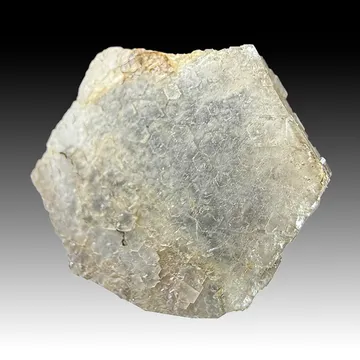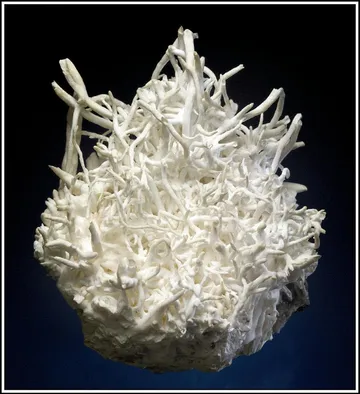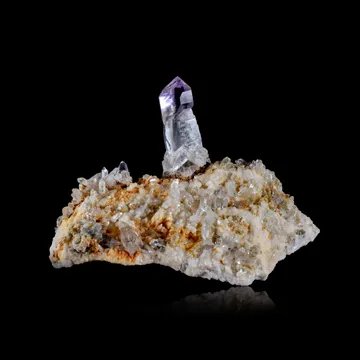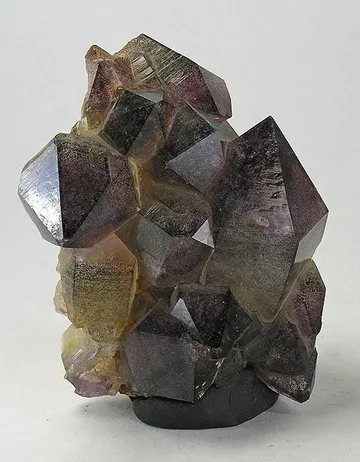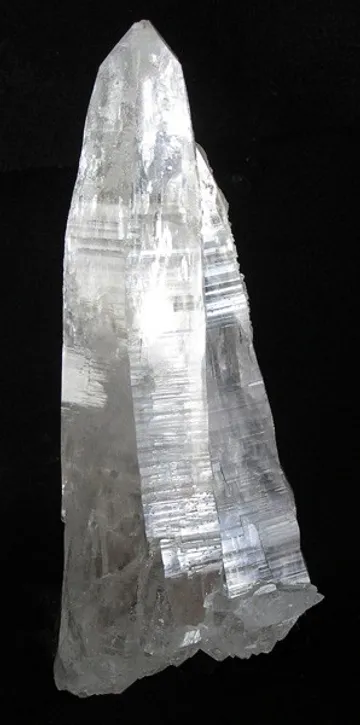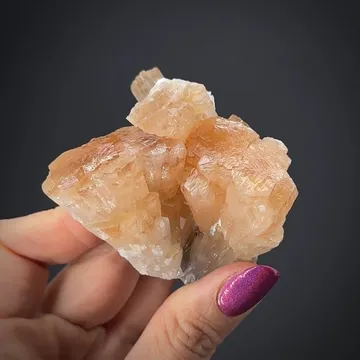
Oberdorf, Austria — Classic locality for magnesite with world-class strontianite crystals; prized for sculptural display and rare associated minerals.
Key facts
Oberdorf an der Laming is one of the classic European collector localities that looks modest on a map and immense in a cabinet. The locality is the Oberdorf magnesite deposit in Styria, northwest of Bruck an der Mur, within the magnesite-talc district of the Eastern Greywacke Zone. Industrially it is a sparry magnesite operation of the Veitsch type, developed in Paleozoic carbonate rocks and worked through named mining areas such as Wiesergut or Wieser, Angerer, and Kaintaleck or Kaintalegg. Mineralogically, however, Oberdorf’s reputation rests on cavities in magnesite and dolomite that yielded world-class strontianite: pseudo-hexagonal twinned crystals, commonly cream, yellow, amber, orange, reddish brown, or pale greenish when fresh, sometimes standing as lustrous prisms on white dolomite, magnesite, calcite, quartz, or celestine.
The finest Oberdorf specimens are instantly recognizable. Instead of the white fibrous or radiating strontianite familiar from many low-temperature carbonate settings, Oberdorf produced sharp, glassy to resinous, well-terminated crystals with a deceptive “hexagonal” outline created by cyclic twinning. Good pieces are not merely rare-species specimens; they are true display minerals, with sculptural matrix, visible individual crystal architecture, and the warm waxy glow that collectors prize in the best Austrian material. The same cavities also produced handsome dolomite and pyrite, plus a long list of rarities that make the district much more than a single-species locality.
Regional View
Country View

Photo: Wikimedia Commons / Rob Lavinsky, iRocks.com

Photo: Wikimedia Commons / Rob Lavinsky, iRocks.com
Oberdorf is also historically important because the collector finds are inseparable from more than a century of magnesite mining. Talk mining at Kaintaleck preceded the magnesite industry, magnesite extraction at Wieser began in the early twentieth century, and local processing at Oberdorf followed soon after with shaft kilns for caustic-burned magnesite. The mine district therefore occupies a special position: an active or recently active industrial raw-material district whose by-product pockets entered the highest tier of European mineral collecting.
Search for specimens: View all specimens from Oberdorf, Austria
The Oberdorf locality is best understood as a mining field rather than a single hole in the ground. Collector labels may read Oberdorf an der Laming, Oberdorf/Laming, Laming Valley, Bruck an der Mur, Wieser, Wiesergut, Angerer, Kaintaleck, Kaintalegg, or Hohenburg. In modern locality usage these names refer to the magnesite mining area near Oberdorf in the present municipality of Tragöß-Sankt Katharein, Bruck-Mürzzuschlag District, Styria.
Geologically, the deposit belongs to the magnesite-talc district of the Veitsch Nappe in the Eastern Greywacke Zone. The host succession is Paleozoic carbonate rock, commonly described in the Austrian literature as part of the “Magnesitkarbon” or Steilbachgraben Formation. The ore bodies are Veitsch-type sparry magnesite: lensy, stratiform to irregular carbonate-hosted masses, accompanied by dolomite alteration and talc-rich zones. Oberdorf’s specimen cavities formed within this industrial magnesite-dolomite system, where open cracks and pockets in the carbonate rock allowed later crystals to grow freely.
The strontianite pockets are traditionally described by local miners and collectors as “Krack,” a useful word because each cavity could behave like its own miniature locality. One pocket might carry pale, short-prismatic twinned strontianite on dolomite; another might produce amber crystals with celestine; another might be mainly dolomite, calcite, pyrite, or magnesite. The best strontianites show cyclic twinning, stepped growth, and a pseudo-hexagonal habit; crystal generations reported from the locality include tabular to short-columnar forms, more elongate columnar forms, quartz-like habits, and younger needle-like aggregates. Large columnar crystals from Oberdorf are reported to reach about 10 cm in length and roughly 3 cm in diameter, although fine cabinet specimens with crystals in the 1–4 cm range are more often encountered on the market.
Mining history at Oberdorf begins before the famous strontianites. Talk was being mined at Kaintaleck by about the middle of the nineteenth century, and magnesite in the Oberdorf area was recognized and documented in the nineteenth century. Industrial magnesite extraction at the Wieser deposit began in 1906. At first the raw magnesite was transported away for processing, but in 1911 Oberdorf received its own shaft kiln, followed soon by additional kiln capacity. During the First World War the plant supplied both raw and burned material for wartime uses. After the war, the operation was modernized with a narrow-gauge industrial railway from Bruck to Oberdorf and a material ropeway connecting the Wieser mining area with the Oberdorf works.
By 1960 Oberdorf had reached a high point as a mining community. The works employed nearly two hundred people, the mining crew numbered roughly eighty-eight, and annual raw-stone production was reported around 120,000 tonnes, with caustic magnesia output around 30,000 tonnes. Later modernization included abandonment of the ropeway in favor of truck transport, conversion of kiln energy supply, and the installation in 1985 of a fluidized-bed kiln for caustic-burned magnesite. In the 1980s the Oberdorf works passed out of the older Veitscher/Magindag corporate structure and into STYROMAG, Styromagnesit Steirische Magnesitindustrie GmbH. STYROMAG remains closely identified with Oberdorf and with the production of caustic-burned magnesite from its Styrian mining operations.
For collectors, access should be treated as industrial-mine access, not as a casual collecting locality. The relevant workings are or have been commercial mining areas, with open pits, underground workings, haulage roads, blasting, unstable faces, and private operating rights. Old specimens from miners, local collections, Austrian dealers, and older European collections are the normal route into this locality. A specimen with a precise old label naming Wieser, Wiesergut, Angerer, or Kaintaleck/Kaintalegg is preferable to one labelled only “Austria,” “Styria,” or “Oberdorf,” especially for the rarer species and for high-value strontianite.
Oberdorf strontianite is the defining mineral of the locality and one of the great European occurrences of the species: SrCO3 forming sharp, lustrous, translucent to transparent twinned crystals that often read visually as hexagonal prisms. Documented habits include tabular to short-prismatic crystals, taller columnar crystals, quartz-like forms, needle-like sprays, parallel aggregates, stacked twinned crystals, and less common botryoidal or knobby aggregates; colors range from colorless, white, cream, and grey to yellow, orange, reddish brown, pinkish yellow, and pale greenish material that may fade somewhat after exposure to daylight. The best pieces are on matrix—dolomite, magnesite, calcite, quartz, or celestine—with aerial crystals, visible cyclic twinning, stepped faces, undamaged terminations, and enough translucency that the amber or waxy internal glow is apparent; ordinary examples tend to be smaller, duller, more contacted, or crowded into massive aggregates where the signature pseudo-hexagonal crystal form is harder to read.
Dolomite at Oberdorf is both a collector mineral in its own right and the most important stage-setting mineral for the strontianites. It lines numerous cavities and fissures in the magnesite deposit as white to pale cream, translucent, pearly to highly lustrous rhombohedral crystals, commonly stepped, curved, saddle-like, scalloped, or arranged in parallel growth. Fine Oberdorf dolomites may reach small-cabinet size, with individual crystals to several centimeters across, and old dealer records describe flattened, extremely stepped rhombs and reflective scallop-shaped clusters from this classic locality; the best examples have sharp visual rhythm, clean luster, and complete crystal groups, while matrix pieces carrying well-positioned strontianite, calcite, chalcopyrite, or pyrite are especially desirable because they show the paragenetic role dolomite played in the pocket assemblage.
Oberdorf pyrite is less famous than the strontianite but can be excellent, especially where bright brass-yellow pyritohedra perch on white to grey magnesite matrix. The species is documented from the main Oberdorf magnesite deposit and from the Angerer, Kaintaleck/Kaintalegg, and Wieser workings, occurring both in magnesite and in talc-rich parts of the deposit. Collector-grade examples are judged by crystal isolation, metallic brightness, pyritohedral form, and contrast against sculptural magnesite; a strong small-cabinet specimen may carry a mirror-bright pyritohedron around 2 cm across with smaller accessory crystals, while lesser pieces are more embedded, tarnished, bruised, or visually lost in massive ore.
Beyond these three showcase species, Oberdorf has a broad and unusually interesting magnesite-deposit assemblage. Magnesite itself forms the industrial ore and the common matrix; calcite occurs as scalenohedra on dolomite; celestine is an important strontium associate and gives some of the most attractive strontianite specimens their white contrasting base; aragonite, baryte, gypsum, chalcopyrite, pyrrhotite, quartz, rock crystal, chalcedony, talc, chlorite-group minerals, palygorskite, sepiolite, rutile, titanite, and apatite are all part of the documented mineral suite. Rarity collectors also watch for Oberdorf references to small sulfides and secondary species including arsenopyrite, acanthite, cinnabar, chrysocolla, bournonite, boulangerite, brannerite, native selenium, native sulfur, uraninite, realgar, stibnite, azurite, cerussite, parnauite, pseudomalachite, ranciéite, todorokite, woodhouseite, and related tetrahedrite-tennantite minerals. Oberdorf is not primarily prized as a type-locality story; its importance lies in the combination of world-rank strontianite, strong accessory carbonates and sulfides, and a surprisingly deep rare-species list generated by a compact industrial magnesite district.
The chief authenticity issue with Oberdorf is locality precision. The name “Oberdorf” is not unique in Austria, and older labels may also use older administrative geography such as Bruck an der Mur rather than today’s Bruck-Mürzzuschlag District. Better labels specify Oberdorf an der Laming, Oberdorf/Laming, Laming Valley, the Oberdorf magnesite deposit, or a sublocality such as Wieser, Wiesergut, Angerer, or Kaintaleck/Kaintalegg. Because Oberdorf strontianite has a distinctive habit, convincing specimens should show cyclic-twinned pseudo-hexagonal form, stepped or prismatic growth, and typical carbonate-matrix associations; anonymous “Austrian strontianite” with fibrous habit, no matrix, or a vague label should be examined carefully.
I have not found a well-documented tradition of fabricated Oberdorf strontianites comparable to the known faking problems at some gem and zeolite localities. The more realistic concerns are over-cleaning, old repairs to exposed crystals, trimmed matrix, and confused labeling. The crystals can be brittle, and their value often lies in clean terminations and uninterrupted faces, so tiny bruises on prism edges and tips matter. Amber, orange, and reddish crystals may hide contacts better than pale examples, while pale cream crystals show chipping readily.
Color should be judged with some caution. Oberdorf material is reported in a wide range from colorless and white through yellow, orange, reddish brown, and pale greenish; fresh greenish crystals may lose some intensity in daylight. That does not make all pale specimens inferior—clarity, luster, crystal shape, and placement are usually more important than saturated color alone—but a strong, stable amber to orange tone in sharp transparent crystals is always desirable. Strontianite can fluoresce and phosphoresce, and some Oberdorf-associated calcite or matrix minerals may also respond under ultraviolet light, but fluorescence is a secondary bonus here, not the primary basis of value.
For pyrite, watch for edge bruising, dulling, and oxidation. Pyrite on magnesite from Oberdorf is most attractive when the crystal is a clean pyritohedron rather than a shapeless metallic patch. Dolomite specimens should be checked for cleaved rhomb edges, contacts on the back, and luster loss from aggressive cleaning. As a rule, the best Oberdorf specimens are older and have already passed through several collections; provenance from Austrian collections, the Folch collection, the Paris School of Mines collection, Francesco S. Stoppani, or long-established dealers can add both confidence and collector interest.
Market availability is uneven. Small strontianite thumbnails and miniatures appear regularly enough that the locality is obtainable, but top pieces with large, undamaged, translucent crystals on matrix are genuinely scarce and command strong competition. Dolomite and pyrite are much less frequently seen as standalone Oberdorf specimens, even though both species can be very attractive from the deposit. Rarity-suite material is often micro or small cabinet at best and is generally of greatest interest when analytically supported or accompanied by a precise sublocality label.
The Oberdorf story begins not with strontianite but with a practical nineteenth-century search for useful stone. Around the middle of the 1800s, talc was being worked at Kaintaleck and hauled away to Trofaiach for processing. Magnesite, now the rock that defines the district, was recognized in the Oberdorf area soon afterward; on May 10, 1858, landowner Karl Rust granted Polykarp Geldner the right to search for and use the magnesite and bitter spar occurring on the property. Even then the value of the material was not obvious in the modern sense. A technical debate in 1859 turned on the fire-resisting behavior of talc schist versus magnesite: talc schist hardened at high temperature without melting, while magnesite lost carbon dioxide, cracked, and became friable unless it was artificially treated for refractory use. That argument foreshadows the later industrial identity of Oberdorf: a place where mineralogy, furnace technology, and commerce were always entangled.
The industrial rise was rapid. In 1906 the Wieser deposit entered magnesite production, and the raw stone first went to Kraubath for smelting or burning. By 1911 Oberdorf had its own shaft kiln with a daily capacity of about 1.5 tonnes; a second kiln followed within months with a daily capacity around 12 tonnes. Early transport was laborious, and the mine district’s growth can be read in the successive attempts to move rock faster: horse carts, then trucks, then a narrow-gauge railway from Bruck to Oberdorf, then a material ropeway from Wieser to the works. The railway began carrying coal to the kilns and burned magnesite away from the works in 1920. The ropeway, built in 1920–1921, became one of the characteristic pieces of industrial scenery in the valley before it was dismantled in the mid-1960s when truck transport took over.
The human history is darker during the wars. In 1917, Oberdorf’s plant was placed under wartime service and supplied raw and burned rock for military needs. About seventy soldiers from the Lebring military labor cadre were assigned as day laborers and miners, and Russian prisoners of war were also put to work. During the Second World War, prisoners of war were again used in both mining and processing. Those facts sit behind many old European mining localities, but Oberdorf is unusual because the same industrial cavities later produced delicate cabinet specimens now admired in quiet display cases.
For collectors, the most memorable local word is “Krack.” Miners used it for the pockets in the magnesite, and collectors learned that a Krack was not just an empty space but a lottery ticket. Local accounts stress that each cavity differed in its mineral development. One could yield dolomite-lined walls, another calcite on dolomite, another pyrite in magnesite, and another strontianite of a quality that might not be repeated for months or years. That is one reason old Oberdorf pieces have such presence: they were not mined from a continuous vein of specimen-grade material but rescued from rare pockets encountered during industrial extraction.
The great strontianite finds were already known by 1938, but Oberdorf’s reputation grew as collectors realized how unusual the crystals were. Local descriptions divide the strontianite into four broad habit types: columnar crystals, tabular crystals, quartz-like crystals, and needle-like crystals. The sequence is also described as generational, with tabular to short-columnar crystals early, columnar crystals later, and needle-like strontianite youngest. The color range is equally vivid. Fresh greenish crystals were reported to lose some color in daylight, while the more familiar pieces run yellowish, yellow-orange, strong orange-red, and dark red-brown. Nearly all are twinned, especially as cyclic trillings, creating the pseudo-hexagonal forms that make Oberdorf recognizable across a room.
A charming detail from the collector lore is that many pieces never reached the market at all. Because the good pockets were so intermittent and might yield only a handful of specimens, miners often kept the best pieces as personal treasures rather than selling them. That scarcity was noted in local accounts: sometimes months or years passed between finds, and a few specimens from a single cavity could disappear into private hands immediately. Modern collectors see the consequence in today’s market. Oberdorf is famous, but truly great Oberdorf strontianite is not common.
The locality’s peak as a working mining community came around 1960, when the works counted 199 employees and the mining crew of about 88 men produced roughly 120,000 tonnes of raw stone. The plant produced about 30,000 tonnes of caustic magnesia, and Oberdorf itself still had the texture of an industrial village: four inns, two general stores, two butchers, a cinema, and a primary school. Those numbers matter because they show the scale behind the specimens. The most elegant crystals from Oberdorf were accidental passengers in a serious twentieth-century raw-material economy.