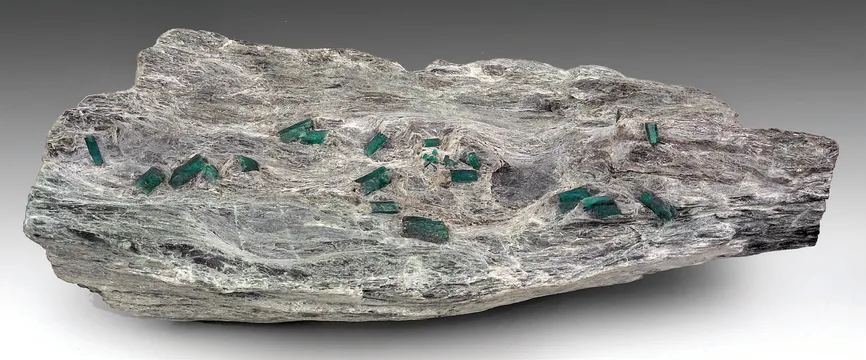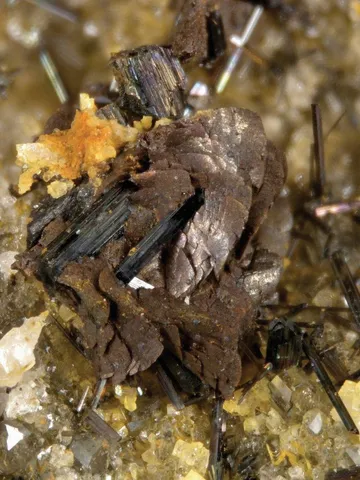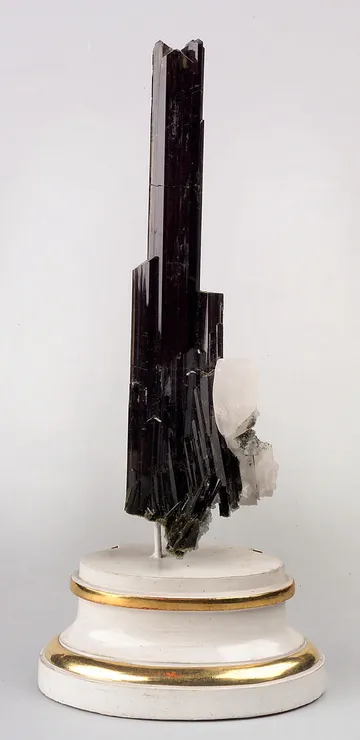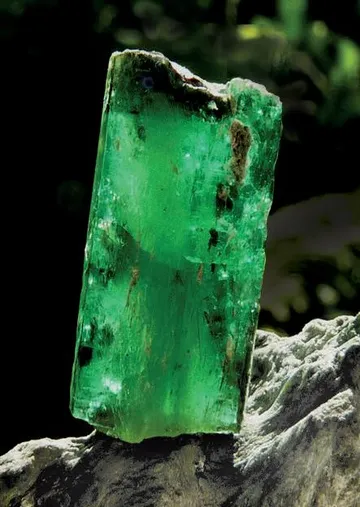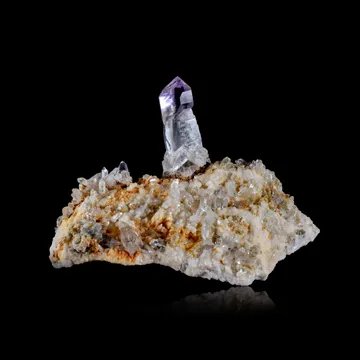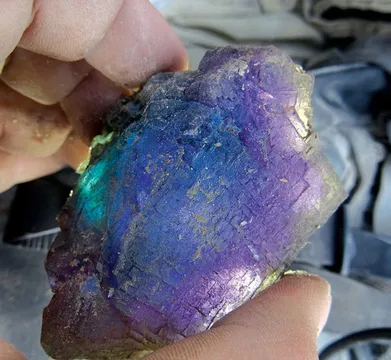
Grieswies, Austria: alpine quartz from a cleft-rich slope in the Rauris Valley; water-clear crystals with chlorite or rutile, plus euclase/phenakite allure.
Key facts
Grieswies is one of the classic high-alpine collecting names in the Rauris Valley of Salzburg, on the north side of the Goldberg Group in the Hohe Tauern. Its importance is not that of a single mine or quarry, but of a steep, cleft-rich alpine slope system: the Grieswies–Krumlkeeskopf area exposes a tight alternation of Penninic amphibolites, chlorite schists, mica schists, phyllites, prasinites, quartzites, and Triassic lime and dolomite marbles of the Seidlwinkl Formation. In the cliffs above the upper Hüttwinkltal these layers are opened over several hundred metres of relief, and the fissures in them have produced the kind of alpine quartz that serious collectors recognize at a glance—clear, lustrous, often sculpture-like rock crystal, sometimes with chlorite, rutile, pericline, calcite, or limonite giving the specimens their local accent.
The best Grieswies pieces are not merely “Austrian quartz.” They have a distinct alpine sharpness: water-clear single crystals, elongated intergrown groups, doubly terminated floaters, sceptres, rare gwindels, and transparent crystals carrying green chlorite phantoms or fine rutile. Good specimens can be deceptively simple—one bright, undamaged crystal with a clean termination and a little adularia or pericline at the base—but the locality also produced larger cabinet-size groups with real presence. The same district is mineralogically important for beryllium species, especially euclase and phenakite, and for rare micro-minerals documented from the Gamskarlgraben, Lachegggraben, Todora cleft, and related clefts around Grieswies.
Regional View
Country View
Historically, Grieswies also sits beside the great Tauern gold story. The nearby Grieswies-Schwarzkogel and Goldzeche workings belong to the same high mountain world as the famous Rauris and Gastein gold districts, where steep gold-silver quartz veins were followed into difficult, glaciated country. For collectors, that background matters because it explains both the mineralogical diversity and the old locality names encountered on labels: Grieswies, Grieswies-Mähder, Gamskarlgraben, Schwarzer Graben, Lachegggraben, Todora cleft, Hieflwand, Goldzeche, and Grieswies-Schwarzkogel are not interchangeable, but they are often found together in older alpine collections.

Photo: Wikimedia Commons

Photo: Wikimedia Commons
Search for specimens: View all specimens from Grieswies, Austria
Grieswies is best understood as a high-alpine cleft locality in the upper Hüttwinkltal of the Rauris Valley, within the Salzburg part of the Hohe Tauern. The locality lies in the broader Grieswies–Krumlkeeskopf area, west of the upper Hüttwinkltal and south of the Ritterkopf massif toward the upper Krumlbach valley. Its collecting value comes from mineralized alpine fissures developed across a rapidly alternating metamorphic sequence: amphibolite and prasinitic greenstone, chlorite and mica schists, phyllites, quartzites, and interlayered Triassic carbonate rocks. The changing host rocks explain why specimens from neighbouring clefts can differ markedly—one pocket may be dominated by glassy quartz and pericline, another by chlorite-rich quartz, another by rutile, euclase, monazite, or secondary copper minerals.
The specimen deposit is a classic alpine fissure system rather than a conventional orebody. Fluids moving during late- to post-metamorphic uplift opened steep clefts and deposited quartz first with albite/pericline and adularia in many fissures, followed in various pockets by rutile, anatase, hematite, carbonates, chlorite, monazite, euclase, phenakite, and other rarities. Work on cleft monazites in the Sonnblick region, including material from Griesswies, has placed hydrothermal monazite growth in the late stages of Tauern exhumation, around the Miocene, at temperatures on the order of 300–200 °C. For a collector, that scientific framework is visible in hand specimen: early, bright quartz and feldspar give the architecture; later chlorite, rutile, calcite, and rarer phosphates or beryllium minerals give the individuality.
The neighbouring ore-mining history belongs to the Tauerngold belt. In the Rauris and Gastein districts, the gold-silver ores were mined from steep, generally north-northeast-trending quartz veins in granitic gneiss, commonly only about one to two metres wide and irregular at depth. The Grieswies-Schwarzkogel and Goldzeche workings were among the highest gold-mining sites in the region, with mining activity tied to the broader Rauris system rather than to the specimen clefts alone. The high Tauern gold boom reached its height in the fifteenth and sixteenth centuries, when Rauris and Gastein were among the great European gold producers. Later revivals included eighteenth- and nineteenth-century efforts, but the severe terrain, narrow veins, complex arsenic-rich ores, transport costs, and repeated unprofitability ultimately ended large-scale ambitions.
Names attached to historic operation in the broader Goldzeche/Rauris world include the Putz and Stampfer families, the Jenner of Vergutz, and, in the nineteenth-century Rauris revival, Ignaz Rojacher. The Goldzeche itself, close to the glacier and recorded from the fifteenth century, was worked intermittently until its final abandonment in 1876 after avalanche damage. Although that mine is primarily a gold-silver locality, it gives context to labels mentioning Goldzeche, Goldzechkopf, Goldzechscharte, Grieswies-Schwarzkogel, or Hieflwand.
For collectors, the modern history is more important than the mining history: Grieswies has long been a field locality for Salzburg alpine “Strahler” and later for documented mineral projects in the Hohe Tauern National Park. Today, responsible collecting is not casual hammer work. The Salzburg National Park mineral-documentation program treats collecting as citizen science: approved, knowledgeable participants document finds and localities with photographs and field data, and the National Park administration and Haus der Natur Salzburg coordinate the scientific record. Anyone considering field work must first establish whether the exact site lies within a National Park zone, whether landowner and legal permissions apply, and whether special project authorization is required. The slopes are steep, high, unstable in places, and seasonally affected by snow, rockfall, and weather; historical labels are far safer than undocumented modern field excursions.
Documented specimen-producing places in and near Grieswies include Grieswies itself, Grieswies-Mähder, Gamskarlgraben or Schwarzer Graben, Todora cleft, Lachegggraben, Hieflwand, and the Erfurter Steig/Grieswies-Schafkar area. The Gamskarlgraben is especially important for euclase and unusual secondary species; the Todora cleft is recorded for quartz, rock crystal, albite, calcite, euclase, rutile, and limonite; Hieflwand has yielded phenakite in association with rock crystal; and a newly recognized Lachegggraben cleft has produced fine bazzite crystals and a scandium- and vanadium-bearing crichtonite-group mineral. In 2018 National Park mineral documentation, rock crystal and smoky quartz were the most frequent finds in the Rauris/Goldberg reporting area, often accompanied by pyrite or rutile, and the report specifically noted faden-bearing quartz aggregates and rock crystals with included rutile needles.
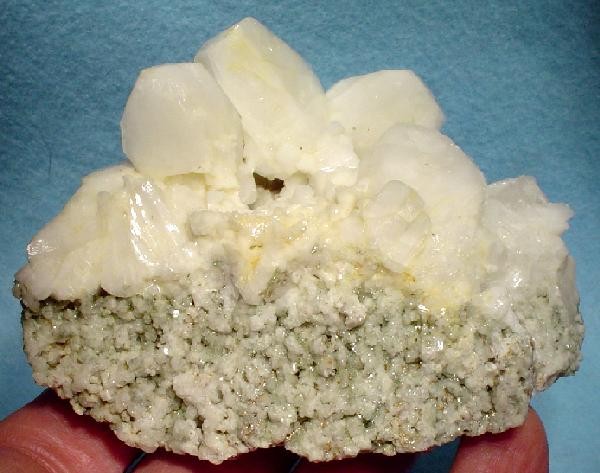
Photo: Wikimedia Commons
Quartz is the signature collectible mineral of Grieswies, and the best examples are bright alpine rock crystals rather than massive vein quartz: transparent to water-clear single crystals, elongated intergrown pairs, doubly terminated floaters, sceptres, and rare gwindels, with cabinet pieces documented around 20 cm and smaller, jewel-like floaters commoner in trade. Associations give many specimens their locality character—white pericline or adularia at the base, green chlorite included as mossy phantoms or coatings, scattered limonite, calcite, pyrite, and rutile either as sagenitic grids, included needles, or small crystals on the surface. Fine pieces are judged here on luster, clarity, completeness, and sculptural balance; ordinary Grieswies quartz tends to be contacted, bruised, cloudy, or compositionally awkward, while the memorable specimens have glassy faces, sharp terminations, minimal damage, and enough feldspar, rutile, chlorite, or sceptre form to distinguish them from anonymous alpine quartz.
Other documented minerals from Grieswies and its immediate district make the locality far richer than a quartz occurrence. Albite, especially pericline, is an important matrix and companion mineral, with lustrous white crystals recorded to centimetre size. Rutile is common enough to be a characteristic associate and can appear both as inclusions in quartz and as well-formed crystals. Calcite, chlorite-group minerals, pyrite, anatase, adularia, microcline, muscovite, fluorite, titanite, monazite, xenotime, and hematite all occur in the broader cleft suite. The locality’s rarities are led by euclase from Gamskarlgraben/Grieswies-Schwarzkogel and Todora cleft, phenakite from Hieflwand, and the Gamskarlgraben-Lachegggraben suite of chukhrovite-(Ce), cyanotrichite, gibbsite, malachite, and related secondary minerals. In the neighbouring Lachegg gorge, a 2023 alpine cleft produced excellent bazzite crystals up to about 2 mm with a Sc- and V-bearing crichtonite-group mineral, adding a modern rare-species chapter to the old Rauris collector tradition.

Photo: Wikimedia Commons
Grieswies specimens are most often quartz, quartz with feldspar, quartz with chlorite, quartz with rutile, or alpine cleft association pieces. The principal authenticity risk is not fabrication but locality drift. Older labels may say simply “Rauris,” “Hohe Tauern,” “Goldberggruppe,” “Grieswies,” “Grieswiesalm,” “Grieswies-Mähder,” or “Grieswies-Schwarzkogel,” and these names can be collapsed by dealers even when they refer to different clefts or neighbouring slopes. For valuable pieces—especially euclase, phenakite, bazzite, unusual rutile inclusions, or gwindel quartz—the exact old label, collection history, and any matching published occurrence matter.
Quartz from Grieswies is sometimes confused in the market with Swiss alpine quartz because the style can be very clean, transparent, and sharply formed. The locality should be supported by credible provenance rather than by appearance alone. Doubly terminated floaters, sceptres, and gwindels are especially worth scrutinizing: they are desirable, and therefore more vulnerable to optimistic relabelling from broader Rauris or Hohe Tauern material. I have not seen a well-documented tradition of artificial coating, irradiation, or assembled fakes specific to Grieswies, but glued repairs and concealed contact areas are always possible on alpine quartz. Examine bases, rehealed zones, and crystal junctions under strong side light.
Condition is the major grading issue. Many attractive Grieswies crystals have natural contacts, broken attachment points, bruised edges, or small tip dings, which is normal for alpine pocket recovery and transport. Because the quartz is often highly transparent, back-side contacts can visually project through the crystal and make a clean face appear rough in photographs. Conversely, a specimen that looks superb from the front may hide a large contacted rear. Chlorite inclusions and coatings are part of the locality’s appeal and should not be automatically “cleaned”; aggressive acid cleaning can leave feldspar dull, expose old bruises, or remove delicate limonite/chlorite contrasts that make the piece recognizable.
Rutile-included quartz and quartz with sagenitic rutile are particularly sensitive to lighting. In hand, the needles can flash strongly under direct light but disappear in diffuse photography, so video or inspection under a focused lamp is useful. Euclase, phenakite, monazite, bazzite, and crichtonite-group material from the district is commonly micro to small miniature scale and should be handled as scientific material: keep old labels, avoid trimming matrix too aggressively, and do not clean with assumptions based on ordinary quartz specimens.
Market availability is moderate for quartz and much lower for the rare species. Grieswies quartz appears periodically from old Austrian and German alpine collections, and contemporary dealer listings show miniature to cabinet-size quartz, quartz-pericline, quartz-adularia, sceptre quartz, rutile-included quartz, and occasional gwindel material. Fine large pieces are scarce and quickly recognized. Euclase, phenakite, bazzite, and well-documented micro-mineral association pieces are specialized and generally move through alpine collector networks rather than as routine show stock.
One of the finest Grieswies stories begins not with a new species, but with a label problem. In the nineteenth century, euclase specimens entered the Natural History Museum in Vienna through the dealer Otto with the locality given as “Gamsgrube, Kärnten—Tiroler Grenzkamm, Graden.” Koechlin described the material in 1886, and for decades the exact source remained clouded by the kind of alpine locality ambiguity that still haunts old collections. Much later, fresh finds by Mr. and Mrs. Scherzer of Vienna from a collapsed cleft in the northeast wall of the Grieswies-Schwarzkogel changed the story. Their material came from the uppermost Gamskarlgraben, at about 2700 m elevation, in a dark phyllitic mica schist—the same kind of host rock visible on the older museum piece. The new specimens carried abundant colourless, clear euclase crystals, mostly on quartz or chlorite, with individuals up to about 5 mm; some pieces also bore calcite scalenohedra several centimetres across. The sequence recorded for the cleft was quartz, pericline, and rutile, followed by chlorite, euclase, and finally calcite. That find did more than add attractive specimens to collections: it effectively solved where one of the best alpine euclase specimens had truly come from.
The Grieswies quartz story has its own almost mythic moment. In July 1977 Josef Kolb found a small suite of gwindel quartz at Grieswies. Gwindels are already rare in the alpine world, and for Rauris they are exceptional. One documented specimen from that find measures 8 cm and shows the tell-tale character of the pocket: chloritized tips, but a clear, lustrous front and back through which light passes cleanly. For a locality known mainly for clear rock crystal and quartz-pericline combinations, that pocket has become a collector’s footnote with outsized importance—the kind of “one-time historic find” that makes an otherwise familiar name suddenly specific.
The modern National Park mineral documentation has produced its own glimpses of field life. In the 2018 reporting season, the Rauris/Seidlwinkl/Goldberggruppe sector accounted for a substantial share of the documented finds, and the report noted that several productive alpine clefts lay less than 100 m apart. In that terrain, however, closeness on a map does not mean closeness in the field: steep ground and overhanging walls can hide neighbouring pockets completely from one another. The report’s examples read like a compressed season in the high Tauern: an open cleft in the Grieswies area, work at the Erfurter Steig at 2526 m, and a Krumlkees cleft in the Hocharn area at 2996 m. The mineral results were classic but varied—rock crystal with calcite, citrine from the Goldzechscharte, pyrite from Krumlkees, faden quartz aggregates, rutile-included rock crystals, phenakite from Hieflwand, and euclase with rock crystal and pericline from Gamskarlgraben.
Behind the specimen localities lies the older drama of the gold country. The Goldzeche, close to the glacier at 2737 m above sea level, was one of the famed gold and silver mines of the Sonnblick region. Written records reach back to the fifteenth century, and the mine passed through hands including the Putz family, the Stampfers, and the Jenner of Vergutz. It was worked intermittently for centuries, but the mountain had the last word: in 1876 an avalanche damaged the site, and the mine was finally abandoned. The survival of textile fragments and mining traces from these high workings gives the Tauern gold story a physical immediacy—a reminder that the same cold, steep landscape admired by crystal collectors was once an industrial workplace at elevations where weather, snow, and falling rock were constant partners.