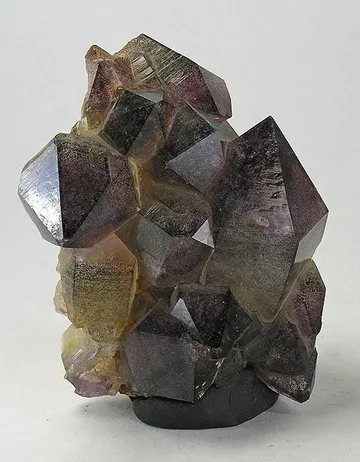
Saurüssel, Austria — Alpine amethyst locality in the Zillertal Alps, famed for scepters and skeletal terminations in architectural quartz, prized by collectors.
Key facts
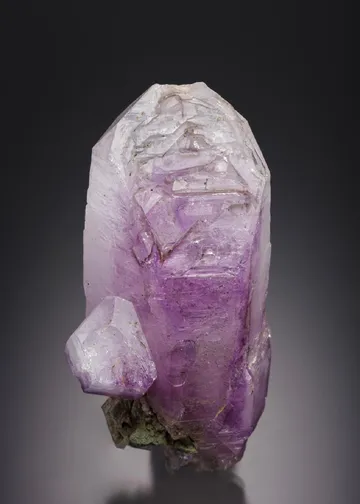
Saurüssel is one of the great high-Alpine quartz localities of the Zillertal Alps, not because it was ever an ore mine, but because a steep ridge above the Zemmgrund opened into one of the most memorable amethyst cleft systems in Alpine collecting history. The locality lies in the Mörchner area near the Kleiner and Großer Mörchner, in the western Tauern Window, where gneissic Alpine rocks are cut by fissures that occasionally grew quartz under the low-temperature, open-space conditions collectors know as Alpine clefts. Here the quartz did something extraordinary: clear to smoky crystals gave way to pale lavender and violet amethyst, commonly as scepters, negative scepters, fenstered crystals, and skeletal double terminations.
The Saurüssel look is instantly recognizable when the specimen is good. The best pieces are not massive purple amethyst in the Brazilian geode sense; they are airy Alpine crystals, lustrous and architectural, with lilac to wine-violet color concentrated in terminations and skeletal growth zones. Clear rock-crystal stems may carry amethyst caps, and some specimens show window-like faces, stepped growth, phantom-like chlorite effects, rutile or sagenite, or pale tremolite needles. This is amethyst for the Alpine specialist: elegant rather than opaque, structurally fascinating rather than simply colorful, and historically anchored in a famous 1976 discovery by Erika and Rudolf Planitzer and their collecting companions.
Regional View
Country View
Saurüssel’s reputation rests on specimen quality rather than abundance. The 1976 pocket system produced hundreds of pieces, but many remained together for decades in the Planitzer collection, and the locality has not behaved like a commercial source. Later and nearby Mörchnerkar finds confirmed the broader district’s status for Alpine amethyst and hematite “iron roses,” yet Saurüssel remains the name that collectors associate with the classic scepter and skeletal amethysts of the Zillertal.

Photo: Mineralica / Martin Grüll
Search for specimens: View all specimens from Saurüssel, Austria
Saurüssel is a ridge locality in the municipality of Mayrhofen, Schwaz District, Tyrol, in the upper Zemmgrund of the Zillertal Alps. Mineralogically it belongs to the Mörchner area, close to the Mörchnerkar, the Kleiner Mörchner, the Großer Mörchner, the Mörchnerkees, and the routes leading from the Berliner Hütte. Mindat places the ridge at about 47.03560, 11.84219 and describes it as a steep ridge west of the Kleiner Mörchner and the Mörchnerkees. The collecting terrain is high, exposed, and Alpine in the strict sense: rock ribs, cleft-bearing gneiss, snow and weather even in summer, and pockets that were won by chisels, hands, patience, and mountain sense rather than by mining.
The deposit type is Alpine cleft mineralization. In such fissures, open cracks in metamorphic rocks act as crystal chambers for quartz, feldspar, mica, hematite, rutile, and accessory minerals. At Saurüssel, the collector’s “ore body” is not an ore lens or vein system developed for metal production, but a series of quartz-bearing fissures and cavities. The famous 1976 Planitzer cleft was entered from signs as subtle as loose black biotite, rough white quartz, amethyst splinters, and a narrow quartz vein. One vein described in the field notes was only about 10 to 12 mm thick, showing slight color changes along its margins and disappearing roughly 2 m into the gneiss; following that clue led to a much larger open cavity lined with amethyst and quartz.
The mineralization is quartz-dominant, with amethyst as the defining variety. The strongest specimens came as scepters, skeletal crystals, fenstered crystals, and double-terminated amethyst, accompanied by rock crystal, smoky quartz, pyrite, rutile, sagenite, tremolite, pericline, and chlorite. The literature and locality records also document albite, aragonite, beryl including aquamarine, calcite, euclase, fluorapatite, hematite including iron roses, magnetite, muscovite, and limonitic alteration products. This is an assemblage familiar to Alpine fissure collectors, but Saurüssel’s amethyst habit and the scale of the 1976 pocket system make it exceptional.
There is no mining history in the normal commercial sense: no mine operator, no ore mill, no recorded production of metal or industrial raw material. Saurüssel’s “production period” is best understood as a specimen-collecting history. The locality is recorded as discovered in 1976, and that year’s Planitzer find is the central event. In late July and early August 1976, Erika and Rudolf Planitzer, together with Hermann, Karl, Heide, Hannes, Gerhard, and Otto at various points, opened and worked a large amethyst cleft system near the Saurüssel. The main pocket, when closed by the group, was later described as roughly 3 m deep, 1 m wide, and 2.5 m high. By the Planitzers’ own accounting, their share alone amounted to around 600 larger crystals and specimens plus countless smaller pieces, transported in 18 full backpacks.
The pocket yielded large matrix groups, individual crystals, and delicate combinations. One early specimen from the entrance was nicknamed the “gatekeeper” and measured 17 x 12 x 8.5 cm. A later highlight was a flawless, heavily skeletal, double-terminated amethyst weighing about 2.62 kg. Other pieces included roughly 30 cm skeletal amethyst specimens, a large specimen nicknamed the “turtle” with two amethyst scepters about 16 cm long, small scepters perched on quartz, and rare combinations such as amethyst on quartz with rutile. The best Saurüssel pieces combine Alpine cleft geometry with unusually strong identity: a clear or smoky quartz architecture, lavender to violet amethyst zones, and the “window” growth that gives many faces a hollowed, skeletal brilliance.
Collecting access today requires far more caution than older collecting stories may suggest. The Zemmgrund lies within a sensitive high-mountain landscape, and mineral collecting in the area is subject to landowner consent and Tyrolean nature-protection rules. The Hochgebirgs-Naturpark Zillertaler Alpen specifically notes past collecting damage in the Zemmgrund above the Berliner Hütte, including disturbed turf and erosion scars, and stresses that collecting in the Zemmgrund is generally allowed only with the consent of the landowner. Simple tools such as hammer and chisel may be permissible under the general rules, but machines, blasting agents, propellants, chemical aids, avoidable ground damage, and unrepaired collecting sites are not. In practical collector terms, Saurüssel should be treated as a classic locality to study, document, and acquire from old collections rather than as an invitation to dig.
Saurüssel amethyst is prized for high-Alpine habits: scepter crystals, negative scepters, skeletal double terminations, and fenstered faces in pale lavender to deeper violet zones, commonly on clear or smoky quartz and locally associated with rutile, sagenite, tremolite, pyrite, pericline, and chlorite. Specimens range from thumbnail and small-cabinet crystals to major cabinet and museum pieces; documented examples include an 8 cm scepter of unusually balanced form, a 17 x 12 x 8.5 cm “gatekeeper” specimen, crystals around 20 cm, groups to about 32 cm, and large skeletal pieces around 30 cm across from the 1976 Planitzer cleft. Good pieces show undamaged tips, bright luster, recognizable scepter or skeletal architecture, pleasing violet concentration, and enough matrix or clear-quartz support to make the specimen read as Alpine rather than merely as a loose purple quartz crystal.
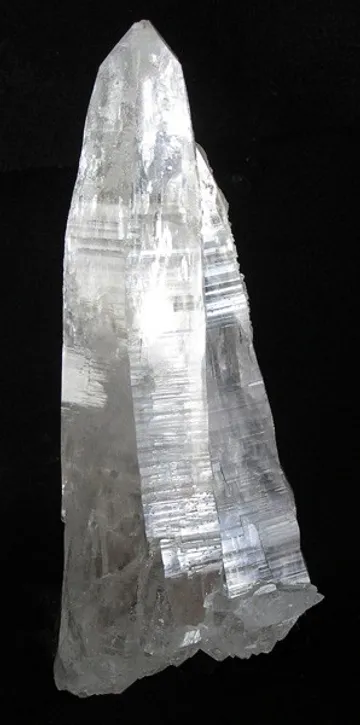
Quartz from Saurüssel is the framework on which the locality’s amethyst reputation is built: water-clear rock crystal, smoky quartz, rutilated quartz, fensterquartz, and scepter quartz occur in the same cleft environment as the amethyst, with clear stems, double terminations, windowed faces, and skeletal growth all recorded. In the 1976 pocket, water-clear crystals lined parts of the cavity wall, while other quartz carried chlorite effects, rutile or sagenite, tremolite needles, or amethyst caps; a particularly desirable Saurüssel quartz specimen is therefore not just “clear quartz” from the Zillertal, but a crystal or group showing the locality’s alpine architecture, transparency, clean terminations, and direct association with amethyst-style scepter or fenster growth.
Beyond amethyst and quartz, Saurüssel is a compact but interesting Alpine assemblage. No type-locality mineral is documented for Saurüssel in the standard locality records, but several species are significant to collectors because of their rarity or associations here: euclase and aquamarine-bearing beryl are the standout rarities; rutile occurs both as individual crystals and as sagenite lattices; hematite is known as iron roses in the broader Saurüssel-Mörchner context; pyrite occurred as lustrous octahedrons and limonitized cubes in the Planitzer pocket; tremolite needles, pericline, chlorite, muscovite, fluorapatite, calcite, aragonite, magnetite, albite, biotite, and limonitic alteration products round out the documented suite.
Saurüssel material is scarce in a way that differs from most commercial amethyst localities. The locality produced a spectacular historic suite, but the Planitzers famously kept their material rather than dispersing it through dealers, so important specimens tend to surface as collection pieces, illustrated examples, or occasional old-provenance offerings. On EarthWonders, the locality is represented by a small number of amethyst and quartz entries rather than by steady dealer stock, which matches the broader market pattern: when fine Saurüssel pieces appear, they are judged as historic Alpine specimens, not as commodity amethyst.
The most important authenticity issue is locality precision. “Zillertal,” “Mörchnerkar,” “Mörchner area,” and “Saurüssel” are related but not interchangeable labels. Nearby Mörchnerkar also produced amethyst, and older labels may use broader or older-style names such as Zemmgrund, Mörchnergebiet, or North Tyrol. A credible Saurüssel specimen should have a provenance chain, an old label, a publication reference, or a habit consistent with the classic Saurüssel material: pale to medium violet Alpine amethyst, scepter or skeletal form, fenstered faces, and associations such as clear quartz, rutile/sagenite, chlorite, pyrite, or tremolite. A vague “Austrian amethyst” label is not enough for a premium attribution.
No named Saurüssel-specific fake or treatment scheme is established in the standard collector literature, but mislabelling is a real commercial risk because Alpine amethyst from several Zillertal localities can look related to the non-specialist eye. Repairs should also be considered on large scepters and skeletal crystals. These pieces are structurally open, with projecting tips, thin windowed edges, and matrix contacts that are easy to chip or reglue. Ask specifically about repaired scepter heads, reattached crystals, bruised terminations, acid-cleaning residues, and whether delicate rutile or tremolite inclusions are natural associations rather than later-adhered debris.
Condition matters intensely. Ordinary Saurüssel specimens may have a good locality name but only weak color, incomplete tips, dull etched areas, or broken skeletal edges. Fine pieces show clean terminations, strong luster, attractive transparency, and a balanced composition between quartz stem, amethyst cap, and matrix. The best large groups are rare enough that minor peripheral damage may be acceptable, but damage through a main termination or the front edge of a fenstered amethyst face has a major effect on value. Display amethyst away from prolonged strong sunlight, and avoid ultrasonic cleaning on matrix specimens with pyrite, limonitic coatings, rutile, tremolite, or open cleft clay in fragile recesses.
The Saurüssel story begins with bad weather, stubbornness, and the sort of clue only a persistent Alpine collector respects. Erika and Rudolf Planitzer, a collecting couple from Linz, had gone to the Zillertal after years of mineral trips together; their honeymoon in 1962 had taken them to the emerald locality in the Habach valley, and by 1968 they had begun visiting the Ziller valley. In 1976 they returned with friends. The plan was to leave on July 25, but rain and fog threatened the trip from the start. By July 27 the fog finally lifted, and the group climbed to the Berliner Hütte. The next day brought fog again and about 10 cm of snow. Erika, Rudolf, and Hermann still went out onto the Saurüssel near the Edelweißklamm, finding only small amethyst splinters and quartz crystals at first. Erika’s diary caught the hesitation perfectly: “Suspicious.”
Two days later the sun returned. Rudolf and Hermann went back to a small cleft they had found the previous year and enlarged it with long chisels until the first double-terminated amethyst came out. Erika, meanwhile, wandered to the side of a large old hole. The signs were unimpressive but promising: loose black biotite “like poppies,” rough white quartz, and a small cavity she quietly began to uncover. At one point she fell asleep sitting on her pick at the work site. That almost comic detail is part of why the account rings true: the century-scale find was not announced by a glittering wall of crystals, but by tired people, poor weather, and a little black mica in the rubble.
The next day, while the men worked their cleft, Erika returned to hers. At 11 a.m. she asked Rudolf for help with chiseling. At first there was only coarse quartz, then more promising structure, and soon Hermann joined them. The first amethyst-colored crystal faces flashed in the sunlight. A funnel-like cavity opened, lined with crystals. Erika later wrote that she was picking crystals from the cleft with her fingers: “It was great, incredible and exciting.” At the end of the day the specimens were laid out and shared, as Alpine collectors traditionally do among trusted companions.
On July 31 the pocket began to reveal its real size. The cleft sloped steeply downward and to the right, and more specimens appeared. Hermann’s wife and son joined the work in the afternoon. Then early August brought cold, rain, wind, and snow again. Hermann’s family descended, and even the Planitzers had to retreat to the Berliner Hütte for a day. On August 2 an avalanche broke loose in the Rutilschlucht, yet Erika and Rudolf climbed back to the pocket. The scene could hardly have been more Alpine: cold wind, new snow, clear air, bright sun, and the couple alone except for 12 ptarmigans.
That day Rudolf became fixed on a narrow quartz vein a short distance in front of Erika’s cleft. It was only about 10 to 12 mm thick, with slight color changes at the sides, and it ran roughly 2 m into the gneiss before disappearing. By mid-afternoon nothing had come of it, but Rudolf kept working. A stubborn block finally broke free at the lower end, exposing another cavity. The opening had to be enlarged with exhausting effort. Rudolf, more used to desk work than heavy lifting in a cold mountain cleft, developed cramps and pain in his forearms. Erika bandaged him, and he continued.
When the gap was finally wide enough, Erika reached in first and pulled out a large amethyst. They called it the “gatekeeper,” because it sat at the entrance to the cleft. It measured 17 x 12 x 8.5 cm. Her diary response was not technical, and that is exactly why collectors remember it: “So big and beautiful!!!” The pocket then began to pour out crystals. The wind and cold ceased to matter. They removed pieces with pickaxes, scrapers, and mostly their fingers. Erika kept saying they had enough, that the backpacks could not hold more, but more amethysts kept emerging from the clay-like pocket filling. They ran out of newspaper for wrapping and used whatever they had: hats, work pants, kerchiefs, toilet paper, tins.
By 7 p.m. they sealed and camouflaged the pocket and carried the first heavy load down. They did not want other people at the hut to understand what had happened. There were no cell phones in 1976, and Rudolf did not want to announce a major amethyst cleft over the hut telephone, so he improvised code. Playing on the name Saurüssel, he told his friend Karl, “We pulled a tooth out of the sow.” He added, “It’s our wedding anniversary, friends should come.” Karl understood. Hermann, Hannes, Gerhard, and Otto came to help.
On August 3 Rudolf climbed to the site alone before the others reached the Berliner Hütte. Erika stayed back to recover. Gerhard, having driven through the night from Linz, got directions from Erika and climbed up without stopping. At the pocket he found only Rudolf’s shoes visible; the rest of Rudolf was already deep inside the cleft. Gerhard photographed the scene, and for years that image was the only published evidence of the find. Rudolf later remembered the shock of seeing legs appear in his limited field of view, thinking for a moment that another collector had found him and might steal the pocket. Then he saw his friend’s smiling face.
That day produced one of the great single moments in the Saurüssel account. Near quitting time Rudolf pushed into the cleft again and grabbed a long stone from the back, passing it between his legs. Outside, he wiped it clean. It was a flawless, heavily skeletal, double-terminated amethyst weighing about 2.62 kg. Erika watched part of the work from the hut through binoculars, then hurried out around 6:30 p.m. to meet the men. They came down dusty and battered, with bulging backpacks, a plastic bag of specimens, and cameras they had also been carrying for botanical photography. Their faces were still covered with pocket debris; their fingers were bloody and bandaged. At the Diopsidbacherl, Erika wrote, they had no thirst and no hunger — only amethysts.
Among the day’s specimens were pieces about 30 cm long and 15 cm wide, skeletal and well colored. One large specimen about 30 cm long, with two amethyst scepters about 16 cm long, was named the “turtle” for its shape. Back at the hut the simple meal tasted transformed: mountaineering fare, red wine, omelette or cake, and the knowledge that their packs contained some of the finest Alpine amethyst any of them had ever seen.
August 4 became a transport day. By the end of the work, the find would require 18 full backpacks. The loads were carried down toward the Breitlahner parking area with many stops, then repacked into suitcases, bags, and boxes to avoid attention and placed carefully in car trunks. Gerhard had to return to Linz for work. The Planitzers, almost absurdly, climbed back up toward the Berliner Hütte with empty packs to bring down two more full ones, then went home only briefly. On August 6 they returned with Karl, Heide, Otto, Hermann, and Hannes. They reached the Berliner Hütte around 10 p.m. under a starry sky.
The next day the enlarged group opened the pocket further. Erika remembered that they hardly stopped for breaks and drank soda mixed with clear water from the Mörchner, joking that only mineral collectors and sheep drank from it. The cleft grew large enough that three clay-smeared men could work inside. Everyone wanted the front position, because it was the most exciting. Erika also crawled in on her stomach, searching by hand, while amethyst crystals still shone from the walls and ceiling.
On August 8 the final act came from above. A new opening appeared in the ceiling of the cleft around 6:30 p.m. Otto, the tallest member of the team, was given a makeshift pedestal inside the pocket so he could reach farther into the ceiling void while the others supported him. He felt a loose, thick crystal. After that final recovery, the group closed and camouflaged the pocket for the last time that season. As they descended, the glacial streams spread through the landscape like silver ribbons in the evening light. At a cairn, they lay on their stomachs for about fifteen minutes watching the moon rise over the Mörchner and move toward the Schwarzensteinsattel. Erika called it the great finale of that year’s Zillertal tour.
Decades later, Rudolf told Martin Grüll that the Planitzers’ portion alone amounted to 18 full backpacks and around 600 larger specimens, not counting countless small pieces. The display cases were packed so tightly that hardly a leaf could fit between specimens, and even that did not contain everything; more material remained in boxes and cases in the cellar. The pocket itself changed with time. When the group closed it in 1976 it measured about 3 m deep, 1 m wide, and 2.5 m high, but over the decades the surrounding rock was almost completely eroded away. Rudolf later recognized specimens from the pocket in other collections, proof that the system had continued to yield and circulate far beyond the original team’s share.
The moral of the Saurüssel find is unusual in a collecting world often shaped by secrecy and money. Very large finds can strain friendships, but the Saurüssel group shared the work and the joy, and the Planitzers did not sell their pieces. Even after initial skepticism about publicizing the discovery, Erika and Rudolf eventually allowed the story to be told in detail, with diaries, photographs, and measurements. Erika, still the sharp observer in the story, expressed one more wish: to go up to the Mörchner again — this time with someone else to carry her backpack.