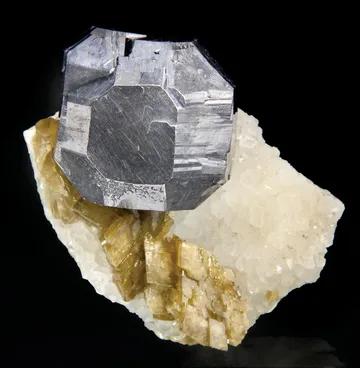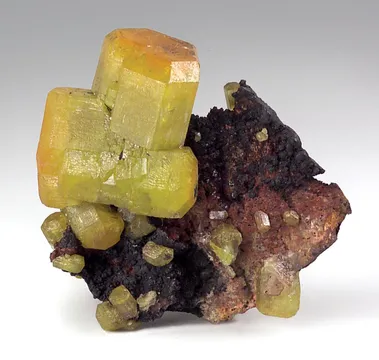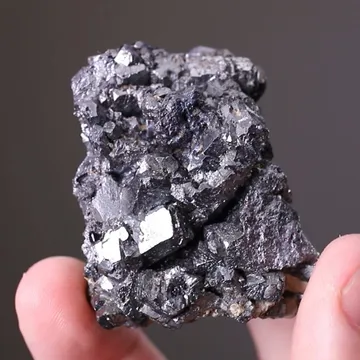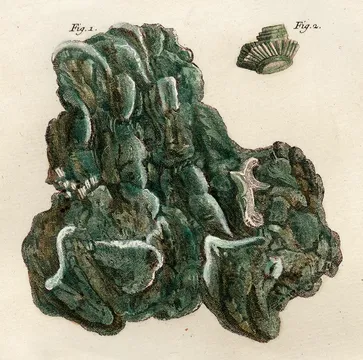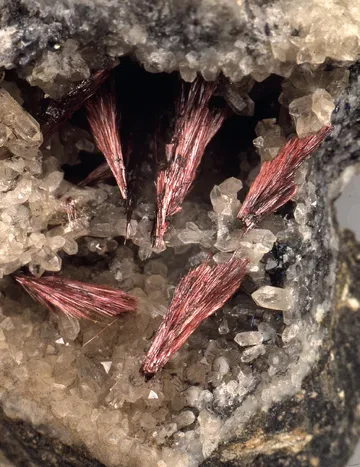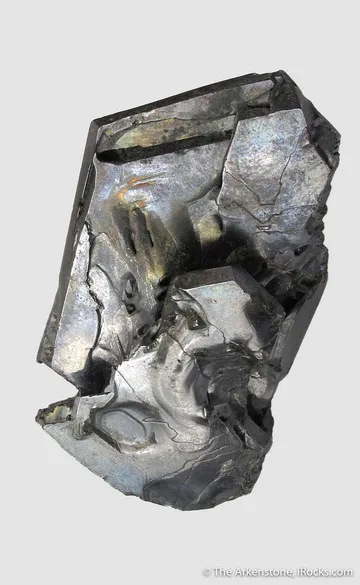
Dreislar Mine, Germany - a classic Sauerland baryte locality: white to salmon-pink bladed baryte with brassy pyrite and chalcopyrite, rare strontianite, prized…
Key facts
Dreislar is one of Germany’s classic baryte localities: a compact Sauerland vein deposit whose industrial life was built on BaSO4, but whose collecting reputation rests on the specimens saved from that mining. The mine worked steep hydrothermal baryte veins cutting Carboniferous clay slate and greywacke near Medebach in North Rhine-Westphalia, in the northeastern part of the Rhenish Massif. For collectors, the name “Dreislar” immediately calls up white to salmon-pink bladed baryte, sparkling brassy chalcopyrite and pyrite on the blade faces, attractive dolomite and calcite associations, and the much scarcer strontianite that appeared particularly from deeper workings.
Regional View
Country View
The best Dreislar specimens have an instantly recognizable visual rhythm: stacked, lamellar baryte blades forming cockscomb to rosette-like sprays, sometimes with knife-edged parallel growth and a faint blush of pink along otherwise white crystals. The sulfides are usually small, but they matter aesthetically; a dusting of glittering pyrite or iridescent chalcopyrite can transform an ordinary baryte plate into a classic display piece. Museum and dealer descriptions repeatedly stress the contrast—snow-white or creamy baryte against bright metallic yellow—and that contrast is the core of Dreislar’s appeal.

Photo: Wikimedia Commons

Photo: Wikimedia Commons
Historically, Dreislar occupies the borderland between old European ore searching and modern industrial-mineral mining. Early work looked for iron and copper ores and repeatedly failed to create a durable operation. Only in the twentieth century, when baryte became a valuable industrial raw material for chemistry, fillers, pigments, drilling and radiation-shielding applications, did the deposit become a serious mine. The final decades under Sachtleben made Grube Rudolf at Dreislar one of the notable modern baryte mines in Germany, and the specimens recovered by miners over those years now form the backbone of many German systematic and aesthetic collections.
Search for specimens: View all specimens from Dreislar Mine, Germany
Dreislar Mine, also known in German sources as the Schwerspatgrube Rudolf or Schwerspatbergwerk Dreislar, lies at Dreislar, a village in the Medebach area of the Hochsauerlandkreis, North Rhine-Westphalia. The deposit is an epigenetic hydrothermal vein system. The country rocks are lower Carboniferous clay slates and greywackes of the Rhenish Slate Mountains, while the baryte veins themselves are much younger, generally described as Tertiary or Paleogene mineralization related to renewed fracturing of the old Variscan basement during the broader Alpine tectonic episode.
The ore was localized in a steeply dipping fracture system. Geological summaries describe two principal veins, accompanied by subsidiary veins, dipping roughly 40–60 degrees and converging or clustering at a low angle. The average vein filling was about 2.5 m thick in one technical description, while public geosite material notes that the ore vein could locally reach about 15 m in width. Earlier mine descriptions give the deposit as two main veins and several minor veins with workable thicknesses in the 2–10 m range. The system is tied to a regional fracture zone extending from the Brilon area toward Neustadt in Hesse, and it belongs to the family of late hydrothermal gangue deposits so characteristic of the Rhenish Massif and Sauerland.
The paragenesis is more complex than a simple baryte vein. Published and museum-oriented sources record multiple generations of baryte with quartz, calcite and sulfides; one summary notes primary fluid-inclusion homogenization temperatures of about 70–140 °C for the baryte-forming stage. A broader genetic model begins with hot, saline, silica-rich fluids depositing quartz in open fractures and breccias, followed by cooler mixed fluids in which sulfate- and carbonate-bearing waters allowed baryte, carbonates and sulfides to crystallize. For collectors, that sequence is visible in the specimens: baryte can stand alone as thick or thin blades, but it also carries chalcopyrite, pyrite, dolomite, calcite, strontianite and marcasite in distinctly collectible combinations.
Mining at Dreislar is documented from 1777, when Johann Adam Florenz Pape of Meschede searched for ironstone. Rights later passed through ecclesiastical and noble ownership, including Kloster Grafschaft, Rudolf Graf von Spee in 1847, and the Graf zu Stolberg in 1870. None of those earlier phases created a sustained ore-mining success. The decisive shift came in 1909, when Deutsche Baryt-Industrie Dr. Rudolf Alberti acquired the rights with the specific intention of mining baryte for the chemical industry rather than chasing iron and copper ores.
The First World War interrupted operations; production resumed in 1920 but was again halted by the economic turmoil of the early 1920s. Alberti’s period left one of the more evocative industrial fragments of the district: a narrow-gauge railway toward Liesen was begun to carry baryte and waste rock, and its route and a small tunnel were reportedly completed before the work stopped in 1923. In 1925 the mine installations and rights were sold to IG Farben and Sachtleben, but the operation did not immediately revive.
The modern specimen-producing era began in 1957, when postwar demand for baryte made renewed mining economic. Sachtleben developed the operation into a modern underground baryte mine. Early extraction included both surface and underground work, but from 1962 onward mining was underground. Technical descriptions from the active period describe trackless mining with sublevel stoping, cemented fill, ramp and inclined-shaft access, loaders, trucks and hoisting. The mine was explored or developed to several hundred metres depth; public geosite material gives a total mining depth of about 500 m, while Mindat and some mining summaries refer to exploration around the 400 m level.
The annual production figures vary depending on whether raw ore or saleable baryte products are being described. Active-period technical material cites about 60,000 tonnes per year of high-grade baryte ore running roughly 95–97% BaSO4. Later historical summaries state that, in its final operating years, Dreislar produced about 27,000 tonnes of saleable baryte products per year. In either framing, Dreislar was a significant German baryte mine and, in its mature phase, was regarded as one of the most modern baryte operations of its type in Europe.
Production ceased in 2007 or 2008, depending on whether the last extraction, final closure and museum opening are being distinguished. The mine entrance was subsequently covered or filled to prevent vandalism, and the underground workings are not a collecting site. The surviving public experience is above ground: the Schwerspatmuseum Dreislar, opened in August 2008 in the former village school, preserves the mining history and displays major crystal specimens; the Linsenberg geologic exposure above the village shows the old surface working and the baryte vein in its host rock. Serious collectors should treat Dreislar today as a closed classic locality: specimens come from old mine production, private collections, museum deaccessions where applicable, and established dealer stock, not from legal casual collecting underground.
The notable finds were not single named pockets in the way alpine clefts or pegmatite pockets are often remembered; they were the cumulative reward of decades of active mining in a clean baryte vein system. The pieces saved by attentive miners include thin-bladed baryte aggregates, thick tabular crystals, “Dreislar rose” rosettes, baryte with pyrite or chalcopyrite dusting, and scarcer strontianite associations from deeper levels. Markasite aggregates as fissure fillings and perimorphs after calcite are another Dreislar specialty, less common on the general market but well known among specialists.
Barite from Dreislar is the locality’s defining collector mineral, most often seen as white, cream or pale salmon-pink bladed to tabular crystals in parallel, lamellar, cockscomb and rosette-like aggregates; specimen sizes range from thumbnails and miniatures to cabinet plates over 10 cm, with documented dealer and museum examples around 6–12 cm and older commercial lists describing individual creamy blades to about 1–1.5 inches across. The most attractive pieces are not merely heavy masses of BaSO4 but sculptural plates: lustrous, sharp, clean baryte blades with a delicate pink cast, sparkling chalcopyrite or pyrite sprinkled across exposed faces, and, in better association pieces, dolomite, calcite or strontianite. Ordinary Dreislar barite is blocky, massive or bruised along the blade edges; fine pieces preserve the fragile blade terminations, show open architecture rather than a solid lump, and carry metallic accents without looking muddy or overgrown.
Chalcopyrite at Dreislar is valued chiefly as the brilliant metallic counterpoint to baryte rather than as large freestanding crystals: it occurs as small brassy to iridescent crystals, commonly millimetric and in some described specimens up to about 4–5 mm, scattered over white or pink baryte blades, nestled among dolomite rhombs, or associated with pyrite. The best chalcopyrite-bearing Dreislar specimens have bright, sharp, well-distributed crystals that animate the baryte surface without overwhelming it; a fine example may show a snowy or salmon baryte ground with glittering yellow metallic points across the blade crests. Less desirable examples have sparse sulfide, dull tarnish, or chalcopyrite embedded in damaged baryte where the visual contrast—the very reason collectors pursue this association—is lost.
Under the spelling “baryte,” Dreislar belongs firmly among the European classics, with the mine especially known for thin-bladed aggregates, thick tabular crystals and the rosette-form clusters popularly called “Dreislarer Rosen.” Good baryte here is commonly white to pink and may be opaque to translucent along thin edges, with luster ranging from pearly to glassy on fresh crystal faces; it is associated with chalcopyrite, pyrite, dolomite, calcite and, in rarer and more coveted pieces, strontianite. The strongest examples are balanced, undamaged plates or sprays where the baryte blades retain clean terminations and readable form, while the sulfides or carbonates add scale and sparkle; lesser pieces are heavy, massive chunks of vein baryte or plates whose blade edges have been knocked during mining, trimming or transport.
Beyond baryte and chalcopyrite, Dreislar has a compact but interesting documented species list: ankerite, calcite, cinnabar, dolomite, galena, gypsum, hematite, malachite, marcasite, native mercury, pyrite, quartz, rutile, siderite, sphalerite, strontianite and members of the tetrahedrite subgroup are all recorded. Strontianite is the great rarity for display collectors, especially as pale, translucent, prismatic to doubly terminated crystals on baryte, dolomite or calcite from deeper levels. Marcasite is another specialty, including lustrous aggregates and perimorphic shells after earlier calcite crystals. Cinnabar and native mercury are notable as mineralogical rarities in the assemblage rather than common display species, while malachite reflects minor copper alteration tied to the chalcopyrite-bearing parts of the system.
Dreislar specimens are usually straightforward to authenticate when the classic association is present: bladed white to pink baryte with small brassy chalcopyrite or pyrite, often on carbonate-bearing matrix. The main risk is mislabelling rather than elaborate fakery. Similar-looking barite-with-sulfide specimens from other European and global localities can be offered with vague “Germany” labels, and some pieces are casually sold as “pyrite on barite” when the metallic mineral is chalcopyrite, or vice versa. A reliable Dreislar label should name the mine or Grube Rudolf, Dreislar, Medebach or Sauerland, and older German labels may use Baryt, Schwerspat, Kupferkies for chalcopyrite, and Schwefelkies for pyrite.
Condition is the central quality issue. Dreislar baryte is dense but not tough; the thin blades chip easily, and rosette edges are often bruised. Examine blade tips, exposed ridges and the underside where trimming may have broken crystal fans. Because the baryte is commonly white or pale pink, iron staining, dirt in crevices and old glue repairs can be conspicuous under strong light. Chalcopyrite and pyrite accents should be bright and firmly attached; on friable or poorly preserved pieces, loose sulfides may shed from the baryte surface.
Some Dreislar baryte has been reported with minor shortwave ultraviolet fluorescence, but fluorescence is not the locality’s main selling point and should not be treated as an authentication test. Specimens containing pyrite or marcasite deserve dry storage, especially marcasite-rich material and perimorphs, because marcasite can deteriorate in humid conditions. Native mercury and cinnabar are documented from the mine, but they are specialist species; if a specimen is represented as containing either, keep it contained, avoid abrasion or heating, and ask for analytical confirmation.
Market availability is moderate for baryte with pyrite or chalcopyrite, especially as miniatures and small cabinet pieces from older European stocks. Large, undamaged, sculptural plates with strong pink color and bright sulfide contrast are much scarcer. Strontianite-bearing Dreislar specimens are appreciably harder to find and should command a premium when the strontianite crystals are sharp, aesthetic and clearly identified. Provenance adds value: examples from old German collections, from well-known dealer archives, or associated with the Georg Unland collecting and publication tradition are especially desirable.
Dreislar’s mining story begins with a frustration familiar across old European mining districts: people kept seeing promise in the ground, but they were looking for the wrong thing. In 1777 Johann Adam Florenz Pape of Meschede was searching for ironstone. The rights passed later to Kloster Grafschaft, then to Rudolf Graf von Spee in 1847, and to the Graf zu Stolberg in 1870. The early men hoped for iron and copper; the deposit kept offering baryte, a heavy white sulfate that would only become valuable when industry found a use for it.
The most cinematic episode belongs to the Alberti years. In 1909 Dr. Rudolf Alberti’s Deutsche Baryt-Industrie bought the rights because baryte had finally become useful to the chemical industry. The company did more than reopen a mine: it began building a narrow-gauge railway toward Liesen to move baryte and waste rock. The route and a small tunnel were already completed when work stopped in 1923 amid inflation and financial collapse. The railway never entered service. Dreislar was also electrified through Alberti’s mining work, leaving the village with a strangely modern benefit from an operation that could not yet survive economically.
The specimens collectors treasure today were often saved in the unromantic rhythm of industrial mining. Public museum accounts credit attentive miners with bringing crystal pieces to daylight over decades. That is the essential Dreislar image: not one legendary pocket opened by a named collector, but generations of miners noticing something too beautiful for the crusher—pink-edged baryte roses, plates sparkling with chalcopyrite, pyrite glitter on pale blades, and the occasional strontianite association from deeper levels.
When the museum opened in August 2008 in the former schoolhouse, the village turned the end of mining into a display of its own identity. Instead of leaving Dreislar as a closed industrial site with a sealed entrance, the Schwerspatmuseum made the mine’s underground world visible through reconstructed workings, tools, multimedia displays and illuminated crystal cases. In that setting, the local phrase “Dreislarer Rosen” makes perfect sense: the roses grew underground, were carried out by miners, and now represent the village far beyond the Sauerland.