Navegadora claim, Brazil: Minas Gerais pegmatite locality famed for lustrous spessartine garnets, deep wine-red color, sculptural forms prized by collectors.
Key facts
Navegadora is one of those Brazilian pegmatite names that became larger than its footprint. The claim lies at Penha do Norte, in the Conselheiro Pena municipality of Minas Gerais, within the great eastern Brazilian pegmatite country of the Rio Doce valley. Its collector fame rests above all on a single, extraordinary style of garnet: lustrous, gemmy to translucent spessartine floaters with deep wine-red to reddish-orange color and intricate, stair-stepped, etched surfaces. These are not the sugary orange “mandarin” garnets of Namibia, nor the matrix-heavy Chinese spessartines; Navegadora pieces are typically sculptural, blocky, dark in ordinary light, and then suddenly alive when a strong light passes through them.
Geologically, the claim is a differentiated granitic pegmatite worked principally for industrial feldspar, with beryl also noted historically. The pegmatite is part of the Galiléia–Conselheiro Pena pegmatite region, hosted in mica schists and gneisses and related to Brasiliano-age granitic intrusions. In the best collector zones, late pockets in quartz and feldspar carried albite, quartz, muscovite, helvine, and spessartine. Navegadora’s most important specimens came not from systematic specimen mining but from the accidental intersection of pocket ground during commercial extraction—a recurring theme in the great Brazilian pegmatite localities.
Regional View
Country View
The locality is also encountered under a small cloud of names: Navegadora claim, Navegador mine, Navigator mine, Orozimbo claim, and Lavra Orozimbo Coelho. “Navegador” is the widespread misspelling; the correct Portuguese form is Navegadora. The Orozimbo name preserves the local landowner’s association with the ground, and it appears frequently on older labels. Collectors should keep all of these variants in mind, because important early pieces often passed through the market under “Navegador” or “Orozimbo.”

Photo: Wikimedia Commons
The most characteristic Navegadora spessartines are complete floaters rather than classic matrix specimens. Their surfaces can be crowded with flat, glistening geometric terraces, narrow channels, and sharp recessed forms that at first glance look like growth architecture. David London’s work on these crystals argued that the stepped morphology is better understood as an etching phenomenon, involving dissolution of the garnet after crystallization in a late-stage pegmatite environment. That interpretation matters to collectors: the very features once described loosely as “stepped growth” are the locality’s signature.
Search for specimens: View all specimens from Navegadora claim, Brazil
Navegadora is a claim-level pegmatite locality at Penha do Norte, Conselheiro Pena, Minas Gerais, Brazil. Published coordinates place the Orozimbo Coelho/Navegadora pegmatite at about 19°03'42"S, 41°25'15"W. The district sits east of Governador Valadares and belongs to the eastern Brazilian pegmatite province, a region famous for gem beryl, tourmaline, phosphate species, feldspar, quartz, and a long list of collector minerals.
The pegmatite body described in the helvine study is tabular and large for a worked pegmatite, roughly 20 m thick and more than 30 m long. It is emplaced in quartz-biotite schists of the São Tomé Formation near the contact with the Palmital granodiorite. Regionally, the Galiléia pegmatite field is developed in Proterozoic schists and related metasediments intruded by syn- to late-tectonic Galiléia tonalite and Palmital granodiorite, with younger post-tectonic Urucum granite also part of the local magmatic framework. In the classification used by Chaves, Scholz, Atencio, and Karfunkel, the Orozimbo Coelho pegmatite falls among pegmatites with primary and secondary apatite, a group that can also host rare Be-, Mn-, and phosphate-bearing assemblages.
The internal structure is important for understanding the specimens. Around the quartz core, a feldspathic zone more than 15 m thick is developed, and this feldspathic part is rich in pockets containing albite and/or quartz. Helvine was described as lining many such pockets, especially on albite and quartz, and the same late pocket environment produced the etched spessartines that made the locality famous. The mine was worked mainly for feldspar; specimen production was an exceptional by-product rather than the planned object of the operation.
The first wave of international attention came from giant pocket material seen in 2002: huge quartz and feldspar crystals, including a remarkable quartz crystal and a microcline crystal accented with cleavelandite. In mid-March 2003, a far more collector-transforming pocket was discovered: a cavity estimated at 200–300 m3 containing lustrous spessartine garnets. Dealer accounts describe tens of tons of albite and quartz crystals associated with nearly 100 kg of fine etched spessartine garnets. Many of the market’s classic Navegadora garnets trace to this early-2000s period, and later labels often specify 2003 or late-2006 acquisition dates rather than a continuing series of equivalent finds.
Navegadora also yielded quartz containing spessartine inclusions. This material was available sporadically, then became more visible in 2009–2010, when Luciana Barbosa of the Gemological Center in Los Angeles showed polished pieces and gem material at the 2011 Tucson shows. Reported products included small faceted gems, larger faceted stones in the 100 ct range, polished crystal points, spheres, and cabochons showing well-formed orange to red spessartine inclusions in quartz.
Collecting access should be treated as private and controlled. Navegadora is a worked claim, not a public collecting site. Published locality databases explicitly caution against visiting mineral localities without permission from landowners and mineral-rights holders, and that advice is especially apt in the active and historically active pegmatite workings of Minas Gerais. Most serious collectors will encounter Navegadora material through established dealers, older collections, auction lots, and museum holdings rather than field collecting.
Spessartine is the defining Navegadora mineral, occurring as highly lustrous etched crystals and floaters from the early-2000s pocket discoveries, especially the famous mid-March 2003 find. The best crystals are deep cranberry-red to reddish-orange, transparent to translucent when backlit, and covered with sharply geometric stepped surfaces, grooves, and recessed etch channels rather than smooth textbook dodecahedra. Thumbnail and miniature crystals are common in collections, while cabinet-size floaters and pieces approaching several centimeters across are much scarcer; reported fine examples include crystals in the 2–6 cm range, and some sources note rare individuals approaching 10 cm. Quartz and albite are the most common associations, with occasional muscovite, and the finest pieces combine complete floater form, high glassy luster, strong internal red transmission under light, crisp etched architecture, and minimal bruising on exposed edges.
“Garnet” labels from Navegadora almost always refer, in collector usage, to the Mn-rich spessartine that made the claim famous, though some cataloging systems separate “Garnet Group” from confirmed spessartine. Good Navegadora garnets are compact, sculptural floaters with a dark wine-red body color in ambient light and glowing red-orange life under backlighting; ordinary pieces tend to be too thick, too dark, dull from heavy dissolution, or visually confused by excessive surface roughness. The most desirable garnets preserve the locality’s etched geometric skin while retaining enough transparency and polish-like luster to read as gem crystals. Matrix pieces are less common than floaters and are especially attractive when a red garnet is perched on quartz or carries a small quartz cap or albite remnant, because those associations anchor the crystal in its pegmatite pocket context.
Quartz at Navegadora plays two different collector roles: it is the pocket mineral that accompanied spessartine and albite, and it also occurs as clear to milky quartz containing included spessartine crystals. On matrix specimens, quartz may appear as small clear to milky crystals attached to garnet floaters, as caps on etched spessartine, or as part of the albite-quartz pocket lining; the very best quartz-associated pieces are prized because most classic Navegadora garnets are loose floaters. The included-quartz material became better known around 2009–2010 and was cut into faceted stones, cabochons, polished points, and spheres, with red-orange spessartine crystals visible inside the quartz. For specimen collectors, the strongest quartz pieces show undamaged terminations and a clear spatial relationship to the garnet, while included-quartz lapidary pieces are judged by transparency, distribution and form of the spessartine inclusions, and freedom from distracting cracks.
Albite is one of the essential pocket minerals at Navegadora, present in the feldspathic zone around the quartz core and repeatedly associated with spessartine and helvine. Published descriptions of the Orozimbo Coelho pegmatite describe pockets containing albite and/or quartz, and Mindat photo-association data show albite as one of the principal companions of spessartine from the locality. Cleavelandite, the platy albite variety, is also recorded, and dealer labels occasionally note albite remnants on major spessartine floaters. Good Navegadora albite specimens are usually valued not as standalone feldspar plates but as context: white albite that sets off the dark red garnet, or albite bearing rare helvine tetrahedra. The finest associations preserve bright, undamaged garnet perched against clean albite without the heavy clay, iron staining, or broken feldspar that can make mine-run pegmatite pieces look ordinary.
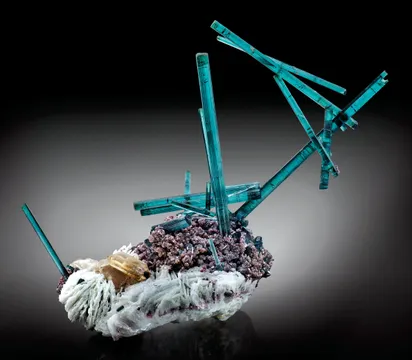
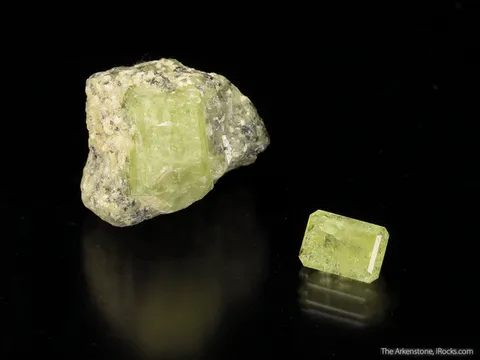
Other minerals documented from Navegadora include helvine, muscovite, fluorapatite, apatite, beryl including aquamarine, schorl, foitite, pyrite, jarosite, birnessite, and mica-group material. Helvine is the outstanding rarity: it was described from the Orozimbo Coelho/Navegadora pegmatite as the first Brazilian occurrence of the species, forming aggregates of well-crystallized tetrahedra on albite and quartz, with individual tetrahedra commonly in the 0.1–0.5 cm edge range and rare isolated crystals reported to about 1 cm. Its colors range from light green to dark gray-green in drusy aggregates, with black spherical to hemispherical microaggregates also described on quartz-rich material with muscovite.
Navegadora spessartine is usually not difficult to recognize when the specimen is typical: a red to wine-red floater, very lustrous, gemmy on backlighting, with dense stepped etching over much of the surface. The main authenticity issue is not widespread fabrication but labeling accuracy. Older labels may say Navegador, Navigator, Orozimbo, Lavra Orozimbo Coelho, or simply Conselheiro Pena; “Navegador” is a common misspelling, not necessarily a bad label. Because spessartine from Wushan/Tongbei in China and other pegmatites can also be etched or stepped, serious pieces should be evaluated by provenance, old labels, specimen style, and association, not by color alone.
Condition is critical. The etched terraces that make these garnets beautiful also create abundant sharp edges and tiny high points, so even a “complete” floater can have scattered micro-chipping. On dark crystals, bruises may disappear in low light but flash pale or frosty under magnification. Always inspect the rims of recesses, the high ridges of the stepped faces, and any quartz attachment point. A small quartz crystal on a garnet can be a major aesthetic plus, but quartz terminations are also easy to nick.
Lighting changes the specimen dramatically. Thick Navegadora garnets may appear nearly blackish red in a cabinet unless they are given strong, directional illumination. The best pieces show red transmission even through considerable thickness; lesser examples need backlighting to reveal any life. Display lighting from the front emphasizes luster and etched texture, while a small backlight or side light brings out the internal red. This is a locality where photographs often undersell or oversell a specimen depending on the lighting setup.
No widely documented treatment problem is attached to Navegadora garnets. Cleaning is generally mechanical and cosmetic: removal of clay or loose pocket material rather than enhancement. Avoid aggressive acids unless you are certain of the associations, because albite, mica, helvine, iron oxides, and delicate pocket coatings may respond differently. Ultrasonic cleaning is risky for pieces with attached quartz, mica, or thin etched projections.
Market availability is steady but finite. The classic spessartines came chiefly from a small number of early-2000s pocket zones, and much of what appears today is old stock or recycled collection material. Thumbnails and small miniatures remain obtainable; fine miniatures with strong transparency, complete form, and excellent luster command much stronger prices; and large, undamaged, highly transparent floaters with quartz or albite association are genuinely competitive specimens. Helvine from Navegadora is far less available than spessartine and should be considered a specialized rarity, especially in sharp tetrahedral aggregates on clean albite or quartz.
In June 2002, Anthony R. “Tony” Kampf, then curator of Mineral Sciences at the Natural History Museum of Los Angeles County, visited the Navegadora, or Orozimbo, mine shortly after a huge pocket had been opened. The star objects were not the red garnets for which the locality would soon become famous, but giant feldspar and quartz: a wonderful microcline crystal accented by balls of cleavelandite, paired with an equally remarkable quartz crystal. The two pieces fit together. Kampf was told at the time that the entire lot had been sold to someone from Japan, and that seemed to be the end of the matter.
Later that year the story turned. Lawrence Stoller contacted Kampf to ask whether the Los Angeles museum might be interested in buying large crystals from Brazil. They were the same crystals. Kampf later wrote, “Needless to say, I jumped at the chance.” Acquiring them, however, proved easier than displaying them. Together the pieces weighed about 6 tons. For years they remained a logistical challenge as much as a mineralogical prize, until Kampf reported that, 16 years after discovery, the crystals had finally gone on public display temporarily at the Los Angeles County Fair. A pegmatite pocket had become a museum rigging problem.
Then came the garnet event. In mid-March 2003, Navegadora produced the pocket that fixed its name in collector memory: an enormous cavity estimated at 200–300 m3, loaded with quartz and albite and yielding a comparatively small but unforgettable quantity of lustrous etched spessartine. Dealer descriptions of the find speak of tens of tons of albite and quartz crystals but only about 100 kg of fine garnet. That imbalance explains the market: many Brazilian pegmatites produce mountains of feldspar and quartz, but only rarely does the chemistry, space, timing, and luck align to produce gem red garnet floaters with a visual identity no other locality quite matches.
The scientific story of those garnets is just as compelling as the collecting story. At first sight, the shiny, stepped surfaces look like growth features—little rhombic terraces building the garnet outward. David London examined the problem from a pegmatite petrologist’s perspective and argued for etching instead. The crystals are puzzling because they preserve sharp, lustrous faces while carrying evidence of dissolution; in ordinary experiments, etching tends to produce rounded pits and duller corroded textures. Navegadora’s garnets seem to record a slower, near-equilibrium late-stage dissolution that left flat, shiny garnet faces behind. Their beauty is therefore partly an absence: crystal removed, not crystal added.