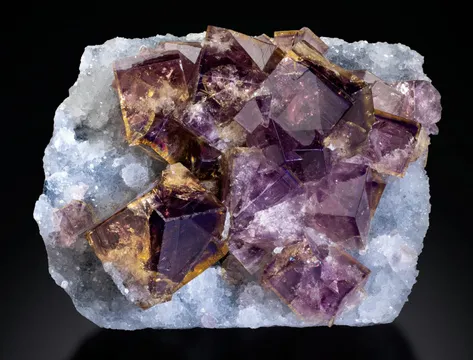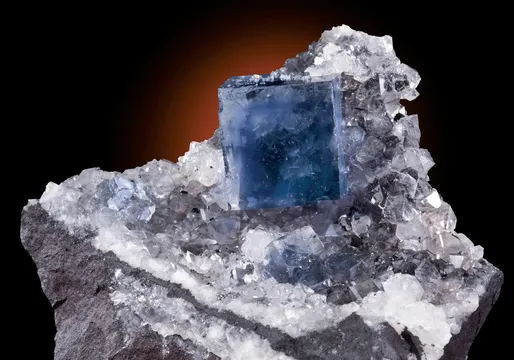
Mowbray Mine, UK - historic baryte locality renowned for colored, lustrous BaSO4 blades on dolomite, rare color variants, and classic Frizington-era specimens.
Key facts
Mowbray Mine is one of the classic British baryte localities, not because it was mined for baryte, but because a hematite iron mine on the Frizington side of the West Cumbrian Iron Field happened to open cavities in which baryte grew with unusual size, colour, and grace. The mine lay in the Carboniferous limestone country of west Cumbria, where iron-rich hydrothermal fluids replaced limestone along faults, joints, and bedding-controlled “flat” zones to form the red hematite orebodies that fed the nineteenth- and early twentieth-century iron industry. In those same replacement bodies, small amounts of gangue minerals—baryte, dolomite, calcite, fluorite, and hematite—made the specimens that collectors remember long after the ore trade ended.
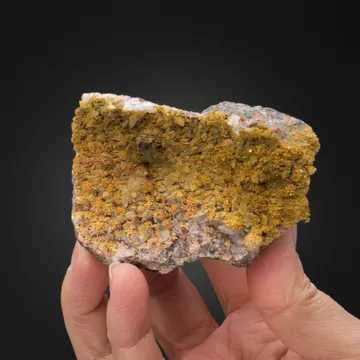
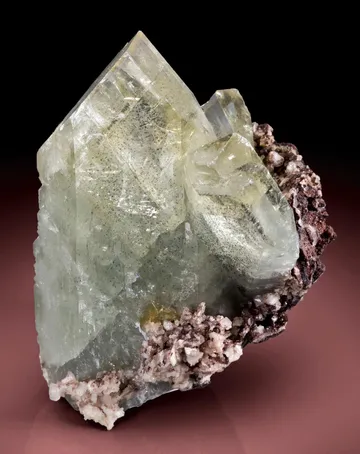
The best Mowbray pieces are instantly English and instantly Frizington: heavy, lustrous blades and tabs of BaSO4 standing on a pale, open dolomite matrix, sometimes with hematite-rich red-brown contrasts below. Colour is the signature. Mowbray baryte is documented from colourless and pale yellow through amber, yellow-brown, greenish yellow, greenish blue, and sky blue; the blue material has a special place in mineralogical literature because some yellow Mowbray crystals were observed to turn green and then blue after exposure to daylight. Fine specimens can show transparent to translucent blades, terraced faces, zoning, sharp chisel-like or spear-like terminations, and the airy spacing that makes these old Cumbrian barytes feel architectural rather than merely massive.
Regional View
Country View
Mowbray matters historically as part of the Frizington cluster of iron mines—Mowbray, Parkside, Frizington Park, Dalmellington/Holbeck, Goose Green, and others—whose barytes entered major museum and old private collections under labels that are sometimes precise and sometimes frustratingly broad. A label reading “Mowbray Mine” deserves to be preserved carefully: it separates a specimen from the large pool of generic “Frizington” barytes and ties it to the locality with the celebrated daylight-sensitive colour change.

Photo: Crystal Classics
Search for specimens: View all specimens from Mowbray Mine, UK
Mowbray Mine is recorded at Frizington, in the civil parish of Arlecdon and Frizington, Copeland, Cumbria, England, with the UK National Grid reference NY037164 and coordinates near 54.53333 N, 3.48833 W. In collector language it belongs to the West Cumbrian, formerly Cumberland, Iron Field; in specimen language it belongs to the famous Frizington suite of barytes.
The deposit was a hematite iron-ore mine in Carboniferous limestone. Across west Cumbria, the major ore bodies are large, irregular to flat-lying replacements of limestone, typically controlled by faults and joints. The host limestone was metasomatically replaced by Fe2O3, producing compact hematite, mammillated “kidney ore,” and local specular hematite. Open cavities or “lough holes” within the ore bodies could carry small crystals and gangue minerals; while hematite was the commercial target, these openings were the source of the specimen material. At Mowbray the collector assemblage is compact but distinguished: baryte is the principal specimen mineral, with dolomite, calcite, fluorite, hematite, and reported marcasite from the dumps.
Mowbray was started in 1864. Four pits were sunk, and the old Dyke Nook workings were eventually included in the mine. After 1903 it was owned by Cammell Laird & Co., whose operations also involved the nearby Frizington Park mine; Mowbray’s No. 3 and No. 4 pits were extended into the Frizington Park royalty. By the 1921 list of mines, Mowbray is recorded at Frizington under United Steel Companies Ltd., Workington Iron and Steel Branch, with T. Richardson as manager or agent and a small workforce still listed. Final abandonment came in 1921.
The notable specimen pockets were those baryte-bearing openings in the hematite and dolomite matrix that produced the now-classic tabular to bladed crystals. Old catalogues and modern records describe crystals as free-standing on creamy, saddle-shaped dolomite, sometimes doubly terminated, sometimes in groups large enough for small-cabinet and cabinet display. A 1977 Richard Barstow catalogue described Mowbray barytes as lustrous, translucent, sea-green, sharp tabular crystals to about 1.5 inches on intergrown creamy dolomite; another Barstow listing from 1980 offered sharp, clear, slightly reddish-brown terminated crystals to about 1 inch on crystallized dolomite. Museum- and dealer-described examples reach far larger sizes: documented specimen crystals include groups with baryte blades around 6 cm, 8.5–10 cm crystals, and exceptional sword-like blades over 15 cm.
Collecting access today should be regarded as closed unless current, explicit permission is obtained from the landowner or controlling authority. Mowbray is a historic abandoned iron mine, not an active collecting locality for casual underground visits. The usual hazards of the West Cumbrian iron workings apply: unstable ground, old shafts, collapsed or flooded workings, hidden voids, and the legal and safety issues associated with private post-industrial land. Most specimens now available come from old mine production, old collections, historical dealer stock, and material collected from dumps in earlier decades.
Mowbray barite is the American-spelled face of the same BaSO4 collector classic: tabular to bladed orthorhombic crystals, generally lustrous and translucent to transparent on the best pieces, with colours ranging from colourless and pale yellow through amber-brown, greenish yellow, greenish blue, and sky blue. The most desirable pieces are not simply large; they show sharp, intact terminations, open spacing on pale crystallized dolomite, visible zoning or hematite-influenced colour, and enough matrix to prove the locality without smothering the crystal group. Smaller specimens with crisp sea-green blades around a few centimetres can be very attractive, but the finest Mowbray material rises into cabinet scale, with individual blades documented from roughly 6 cm to more than 15 cm on exceptional old pieces.
Baryte is the spelling most likely to appear in British references and on modern UK labels, and Mowbray is one of the names that makes that spelling meaningful to collectors. The classic habit here is a broad, flat to sword-like blade, sometimes terraced, sometimes curved through sub-parallel growth, and commonly set on creamy saddle-shaped dolomite with hematite or calcite adding reddish-brown contrast. Colour is the great Mowbray distinction: Jessie Sweet documented colourless, pale-yellow, yellow-brown, greenish-blue, greenish-yellow, and sky-blue material, and the locality is especially famous for yellow crystals that changed toward green and blue in daylight. Good Mowbray baryte should look airy, lustrous, and old-time; ordinary pieces tend to be cloudy, chipped at the blade edges, too massive, or too vague in provenance to separate confidently from generic Frizington material.
Dolomite at Mowbray is chiefly important as the matrix mineral that gives the baryte its classic display: creamy to pale buff crystallized dolomite, often described as saddle-shaped or open-textured, beneath upright or scattered baryte blades. It is rarely the reason a specimen is bought, but it is often the reason a baryte specimen is believable and attractive. The finest Mowbray combinations use dolomite as a pale architectural base, contrasting with amber, green, blue, or hematite-tinted baryte; loose baryte crystals without this matrix may still be excellent, but a clean baryte-on-dolomite association is the form most strongly tied to the mine’s old specimen reputation.
The verified mineral list for Mowbray is short compared with many British metalliferous mines: baryte, calcite, dolomite, fluorite, and hematite are documented, and marcasite crystals have been reported from the dumps by specialist West Cumbrian collectors. No valid type-locality mineral is documented for Mowbray. Hematite was the ore mineral and may appear as massive red-brown matrix, kidney-ore texture, staining, or sparkling specular material; calcite and fluorite are much less prominent in the specimen record than baryte, though they belong to the same gangue suite of the iron field.
The first authenticity issue is locality precision. “Mowbray Mine” is a much stronger and narrower label than “Frizington,” but many Frizington barytes moved through the market under district labels, and neighbouring mines produced superficially similar material. Mowbray pieces should be judged by the complete evidence: old label, provenance chain, habit, colour, matrix, and associations. Blue or blue-green colour alone is not proof of Mowbray, but it is consistent with the mine’s documented behaviour; conversely, a yellow, amber, or brown baryte should not be dismissed as non-Mowbray simply because it is not blue.
The second issue is colour history. Mowbray baryte is famous for daylight-induced colour change from yellowish tones through greenish stages to blue. That means a blue Mowbray baryte is not automatically treated or suspicious; the colour may be the natural result of historical exposure. It also means original colour descriptions on very old labels or museum registers may not match the present specimen. A label saying pale yellow or amber on a now pale-blue piece can actually strengthen the story if the provenance is credible.
Damage is common and must be evaluated realistically. Baryte is dense, brittle, and cleavable; Mowbray’s long, broad blades are especially vulnerable at terminations, edges, corners, and attachment points. Repairs are not rare on large old English barytes, and a repaired cabinet specimen may still be important if the work is disclosed and the visual impact remains strong. Undisclosed reattachment, filled breaks, dyed-looking colour, or polished and reshaped terminations should be treated more seriously. On high-value examples, inspect with side lighting for glue lines, mismatched lustre, suspiciously continuous colour across fractures, and impact bruising along blade edges.
Fluorescence is not the main collecting feature of Mowbray baryte. Handling considerations are mostly physical rather than chemical: avoid repeated exposure to strong direct sunlight if you wish to preserve the present colour state, store large pieces where the heavy baryte blades cannot lever against the matrix, and never clean aggressively with acids without understanding the carbonate matrix. Dolomite and calcite associations can be etched or dulled by acid cleaning, and old hematite-rich surfaces may be part of the specimen’s character.
Market availability is steady only at the low to middle levels. Small and moderately damaged old Frizington or Mowbray barytes appear periodically, but sharp, well-provenanced Mowbray specimens with open dolomite matrix, attractive colour, and minimal repairs are genuinely scarce. Exceptional large blades are museum-grade British classics and command prices far beyond ordinary UK baryte specimens, particularly when supported by old labels or collection history.
The most memorable Mowbray story is a quiet one: a mineral changed colour in the hands of science. When Jessie M. Sweet studied British barytes in the British Museum collection, she noticed that several Mowbray specimens bought from J. Graves of Frizington in 1909 and 1913 no longer matched their original register entries. They had been recorded as pale yellow or amber-yellow; by the time the slip catalogue was made in 1928, their colours had shifted to pale green and sky blue.
L. J. Spencer provided the crucial comparison. He had collected pale-yellow Mowbray crystals in 1909 and kept them in the dark. On June 25, 1928, one of those crystals was placed in bright sunlight at 10:30 a.m., while another was kept dark as a control. At noon, no appreciable change had occurred. By 2:15 p.m. the exposed crystal had become pale greenish. By 4:20 p.m. it was distinctly blue-green. Left in the window, it had become completely blue by July 2. Sweet could offer no final explanation, but her locality observation was precise: among yellow Cumberland barytes, this peculiarity was known only from Mowbray.
Another Mowbray specimen entered the literature because it was not content to grow straight. Spencer discussed a yellowish-green curved baryte crystal from the mine, explaining curvature not as a single bent crystal but as the result of many nearly parallel individuals repeating a slight deviation in the same direction. Later writers on unusual baryte aggregates returned to Spencer’s Mowbray example when describing curved and ring-like baryte growth elsewhere, making this small Cumbrian mine part of a broader mineralogical conversation about how crystals build form from minute repeated misalignments.
The dealer catalogues preserve a different kind of field note: the afterlife of mine production. In 1977 Richard Barstow offered a Mowbray baryte described as sea-green, lustrous, translucent, sharp, tabular, and in places doubly terminated, with crystals to 1.5 inches standing free on creamy saddle-shaped dolomite. The specimen measured 7 x 4.75 x 3.5 inches and was priced at £22.00. In 1980 another Barstow listing described sharp, clear, slightly reddish-brown terminated crystals to 1 inch on creamy crystallized dolomite, priced at £6.00. Those entries read modestly now, but they capture the key field characters: open dolomite matrix, upright blades, colour, lustre, and enough sharpness to make a mining by-product into a classic specimen.