A collector's guide to Morenci, USA: its geology, mining history and notable minerals, illustrated with the 97 specimens documented from this locality on EarthWonders.
Key facts
Morenci is one of the great names in American copper mineral collecting: a giant porphyry copper-molybdenum system in Greenlee County, eastern Arizona, where nineteenth-century underground ore shoots, twentieth-century open-pit mining, and modern leach-and-concentrator operations all intersect with a specimen record dominated by vivid supergene copper minerals. The collector’s Morenci is not simply “a big copper mine.” It is the Copper Mountain, or Clifton-Morenci, district: Morenci, Metcalf, Detroit, Coronado, Longfellow, Shannon, and related mine areas spread across steep ground above Chase Creek near the Arizona-New Mexico line. In geological terms, the deposit is a Laramide porphyry copper system intruded into Precambrian granite and Paleozoic sedimentary rocks, later reworked by oxidation and supergene enrichment into copper oxide zones, chalcocite enrichment blankets, and richly mineralized faults, skarns, breccias, and leached caps.
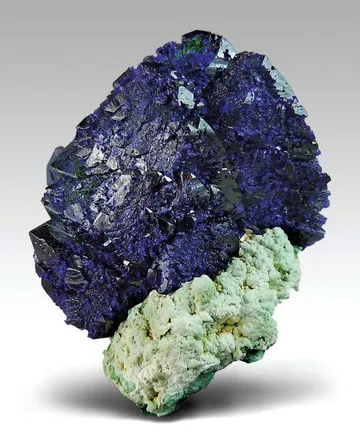
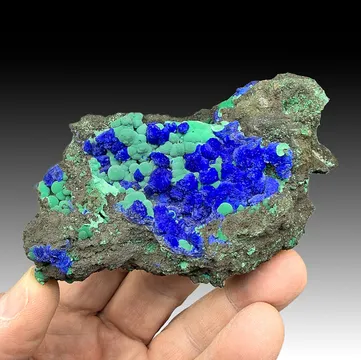
For collectors, Morenci’s signature is the blue-and-green suite: azurite, malachite, chrysocolla, brochantite, cuprite, native copper, cyanotrichite, dioptase, and iron-manganese oxide matrices. The best pieces are instantly memorable—velvety royal-blue azurite rosettes on bright botryoidal malachite, dark azurite crystal groups rising from limonite and black manganese wad, malachite pseudomorphs after azurite, rounded polished masses with concentric bands of blue and green, and rare stalactitic forms that look almost too sculptural for an open-pit copper operation. Morenci has never had quite the same specimen mythology as Bisbee, but among serious Arizona specialists its finest azurite-malachite specimens are among the most desirable secondary copper classics from the United States.
Regional View
Country View
Morenci’s importance is also historical. Copper mineralization was recorded by U.S. soldiers in 1863, prospectors were active in the early 1870s, and the district became one of Arizona’s foundational copper camps. The early mines exploited very high-grade oxide ores—material rich enough that the logistics of hauling, tramways, railroads, and smelters determined whether the ore could be worked at all. Later, Phelps Dodge consolidated the district, underground mining gave way to the large Morenci and Metcalf open pits, and Morenci became a proving ground for large-scale copper milling, leaching, solvent extraction, and electrowinning. Today it remains an active, immense industrial mine rather than a field-collecting locality, so the specimens that matter most are old-time pieces, documented recoveries from past collecting arrangements, museum specimens, and carefully labeled material from known subareas such as Detroit/Manganese Blue, Coronado, Dispatch Hill, the Crystal Zone, and the Northwest Extension.
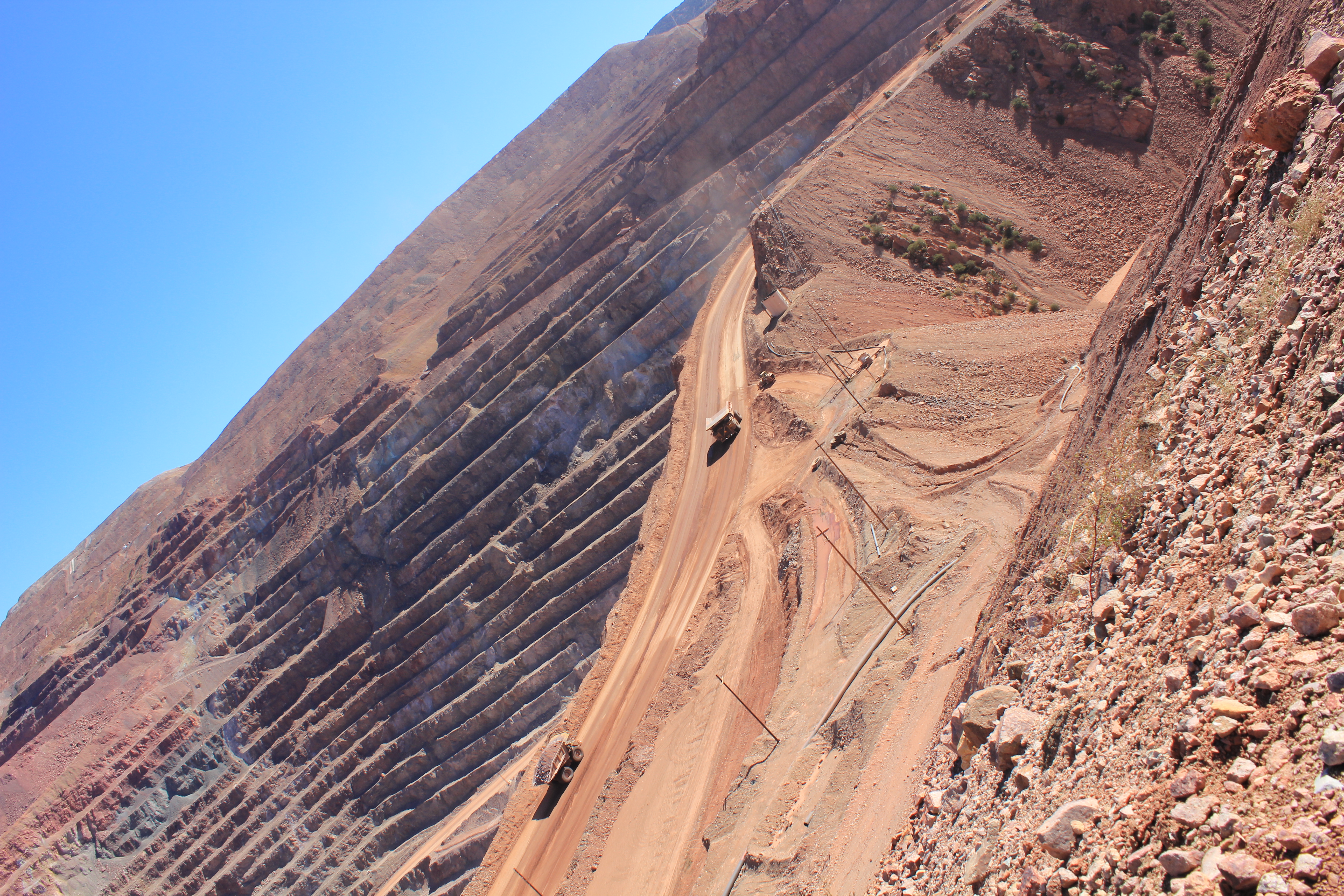
Photo: Wikimedia Commons

Photo: Wikimedia Commons
Search for specimens: View all specimens from Morenci, USA
Morenci lies in Greenlee County, eastern Arizona, near Clifton and Metcalf and close to the New Mexico border. The modern mine is an open-pit copper and molybdenum complex operated by Freeport-McMoRan in a joint venture with Sumitomo interests. Current technical reporting describes a very large land position of fee lands, unpatented mining claims, permits, easements, and rights-of-way, with production-stage operations running continuously throughout the year. For the collector, the important point is that “Morenci” on a label may refer to the modern mine, the old Morenci pit, the Morenci-Metcalf complex, the Copper Mountain or Clifton-Morenci district, or one of the older named workings now swallowed by open-pit development.
The deposit is a large porphyry copper system formed around Laramide granodiorite to quartz monzonite stocks and dike swarms intruded into Precambrian granite and Paleozoic sedimentary rocks. Primary hypogene mineralization consists largely of pyrite, chalcopyrite, and molybdenite in quartz-sericite-sulfide stockworks, with alteration changing outward and upward from potassic assemblages to sericitic and propylitic zones. Later weathering, leaching, and supergene enrichment produced the zones that collectors know best: acid-soluble copper oxides with malachite, chrysocolla, azurite, brochantite, and local cuprite; acid-insoluble oxide material with native copper, tenorite, neotocite, copper wad, manganese and iron mineraloids, and cuprite; and secondary sulfide zones in which chalcocite coats or replaces earlier sulfides.
The specimen-forming environments are more selective than the enormous scale of the mine might suggest. Azurite and malachite occur widely as fracture coatings, but specimen-quality material is concentrated in oxidized skarn deposits developed in carbonate units and in fault breccias cutting igneous rocks, particularly the Northwest Extension. The Ordovician Longfellow Limestone and the Mississippian Modoc Formation provided carbonate host rocks where acidic copper-bearing solutions could be neutralized quickly, precipitating azurite and malachite in fractures, bedding planes, vugs, and small open spaces. Skarn assemblages include diopside, epidote, garnet, tremolite, actinolite, magnetite, specular hematite, talc, and related calc-silicate minerals, with later supergene chrysocolla, tenorite, cuprite, and native copper.
The early mining history began with prospecting and high-grade oxide ore. Claims such as Arizona Central, Longfellow, Metcalf, and Yankie were being worked by the early 1870s. A camp formed at Metcalf in 1875, and a smelter was built at Clifton in 1874 because the San Francisco River provided the water needed for treatment. Ore from the high slopes above Chase Creek had to be moved by steep inclines, tramways, and narrow-gauge rail systems before it could reach the smelters. The Longfellow operation became an early center of production; the Detroit Copper Company, tied closely to Phelps Dodge, developed mines near Joy’s Camp, the first Morenci townsite; the Arizona Copper Company expanded Metcalf and related properties; and the Shannon Copper Company briefly became another major producer before depletion and low copper prices ended its independence.
By the late 1920s and early 1930s, the district was shifting decisively toward large, low-grade ore. Exploration outlined the vast disseminated deposits that would become the modern open pit. Underground mining ceased by 1932, stripping for the Morenci pit began in 1937, and the Morenci concentrator was commissioned in 1942. The Metcalf pit began in 1969, the Metcalf concentrator followed in 1975, and the Morenci and Metcalf pits merged in 1981 into the huge open-pit complex seen today. Solvent extraction/electrowinning began in 1987, extending Morenci’s long history of leaching technology that began with nineteenth-century attempts to profit from lower-grade copper material.
Collecting access today is effectively closed. Morenci is an active, controlled industrial mine with private and claimed land, heavy equipment, blasting, steep pit walls, haul roads, leach facilities, rail infrastructure, and strict safety and security rules. It is not a public rockhounding site. Specimens reaching the market generally come from old collections, historical dealer stock, museum deaccessions, estate collections, or past recovery efforts when collectors or contractors were able to save material from ore that otherwise would have gone to the leach dumps or processing stream. Public views of the mine are possible from established overlooks and roads, but collecting in the active operation is not an ordinary or permissible field option.
The best-documented specimen episodes include old Detroit and Manganese Blue mine azurite-malachite material from the 1880s and 1890s, Coronado Mine specimens collected or dispersed from late-1920s to early-1930s lessor activity, and the major modern recoveries associated with Southwest Mineral Associates beginning in the 1970s. The Crystal Zone on the 4600 Bench at Dispatch Hill produced memorable azurite and malachite in the Copper Mountain area of the old Morenci pit. The Northwest Extension yielded excellent azurite and malachite from fault breccias, including polishing material, rosettes, vug-lining crystals, and malachite pseudomorphs. A famous 1985 azurite stalactite pocket and later 1992 stalactitic material stand out because stalactites are a minor occurrence at Morenci and were preserved only because collectors were in the right place before mining removed the ground.
Morenci azurite ranges from tiny drusy coatings and 2 mm open-space crystals to blocky or platy deep-blue crystals reaching about 2 cm in favorable skarn and fault settings, with larger specimen plates and masses documented from old Detroit, Coronado, Crystal Zone, and Northwest Extension material. The most desirable pieces show saturated, velvety to brightly lustrous blue crystals or rosettes set against green malachite, pale to blue chrysocolla, limonite, hematite-goethite, or black manganese wad; lesser pieces are simply thin fracture coatings or bruised oxide-ore crusts. Especially prized are azurite on botryoidal malachite, azurite stalactites from the 1985 and 1992 finds, old Coronado pieces with minor chrysocolla, and Northwest Extension examples where azurite cements breccia or lines vugs in hematite-stained clay gouge. Strong Morenci azurite has a rugged Arizona character rather than a delicate Tsumeb or Milpillas look: compact, intense blue, often associated with botryoidal green copper minerals and iron-rich matrix.
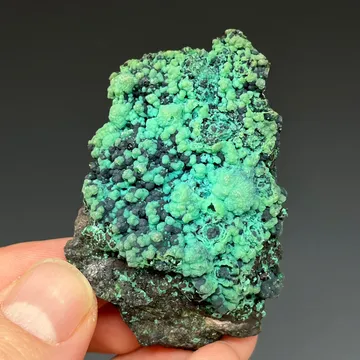
Morenci malachite is best known as botryoidal crusts, banded coatings, silky radiating aggregates, stalactitic growths, and pseudomorphs after azurite, commonly intergrown with or replacing azurite in the oxidized copper zones. Thin malachite fracture coatings are common in the district, but collector-grade material is far more restricted, especially to skarn occurrences and Northwest Extension breccias where alternating layers of malachite, azurite, and chrysocolla developed on fractures, bedding planes, and breccia clasts. The best pieces have hard, lustrous, bubble-like green malachite with sharply contrasting azurite rosettes or blue patches, or crisp pseudomorphs preserving the bladed to blocky azurite form beneath velvety green replacement. Ordinary Morenci malachite can be massive, abraded, or merely stained ore; fine examples are sculptural, bright, and texturally alive, often with enough blue azurite remaining to give the piece the unmistakable Morenci color contrast.
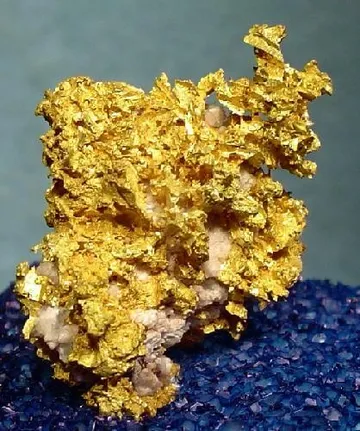
Native copper from Morenci belongs chiefly to the oxidized and acid-insoluble copper suite rather than to the massive native-copper style familiar from Michigan’s Keweenaw Peninsula. It occurs in supergene fault and oxide-ore settings with cuprite, tenorite, neotocite, copper wad, iron and manganese oxides, and locally malachite, chrysocolla, or azurite. Specimens are generally valued less for huge size than for association: copper with red cuprite, copper emerging from dark oxide matrix, copper in altered breccia or limonitic ore, or rare pieces that show the transition from oxidized copper mineralization to the native element. Good Morenci copper is honest, mineralogically contextual material from a great copper district; ordinary pieces can be difficult to distinguish from generic oxidized copper-ore fragments unless the label, matrix, and associations are convincing.
Morenci cuprite is an important but much scarcer member of the district’s secondary copper suite, occurring in oxidized zones and faults with native copper, malachite, sericite, tenorite, chrysocolla, iron oxides, and manganese-rich matrix. The classic technical description for the southeastern Morenci fault setting notes cuprite crystals to about 1 cm, commonly coated by pale-green silky aggregates of malachite and sericite, and cuprite is also listed as a possible component of both acid-soluble and acid-insoluble oxide ore types. Collector-quality Morenci cuprite is rarely a stand-alone showpiece in the manner of Bisbee or Tsumeb cuprite; it is most compelling when red crystals or granular red oxide are clearly visible with native copper or contrasting green copper carbonates. Good pieces show identifiable red cuprite, intact surfaces, and documented Morenci provenance; ordinary examples may be visually subdued or hidden under alteration coatings.
Beyond the four headline species, Morenci has a broad documented mineral list with more than 90 reported species across the district. Chrysocolla is the dominant oxide copper mineral in parts of the modern ore system and is a common associate of azurite and malachite, especially in Northwest Extension material. Brochantite, cyanotrichite, dioptase, tenorite, chalcocite, covellite, chalcopyrite, bornite, molybdenite, sphalerite, pyrite, native silver, and a range of iron-manganese oxides and skarn silicates round out the collector and ore assemblages. Coronadite is the standout type-locality connection: the lead manganese oxide was first recognized from the Coronado Mine/Coronado vein area of the Clifton-Morenci district. “Morencite,” historically proposed for a brownish-yellow silky ferric silicate from the Morenci mines, is now treated as an obsolete term related to nontronite rather than as a valid modern species.
The central authenticity issue at Morenci is label interpretation. “Morenci,” “Clifton,” “Metcalf,” “Copper Mountain,” “Detroit,” “Coronado,” “Longfellow,” “Arizona Copper Company,” and “Phelps Dodge Morenci” may all appear on older labels, and they are not interchangeable in a casual way. Some old labels reading “Clifton” reflect ore and specimen stockpiles at Clifton rather than mines actually located in the town. That does not make the labels wrong, but it does mean a collector should read them historically, not literally.
Mislabelling as Bisbee is a documented problem for Morenci azurite and malachite. The two districts both produced blue-green copper-carbonate classics, and old collections sometimes preserve little more than a dealer tag or regional memory. Matrix and associations matter: Morenci Coronado material may include minor chrysocolla that is useful in separating it from superficially similar Bisbee pieces, and Morenci material often sits in iron-stained breccia, limonite, manganese wad, or altered porphyry-related matrix rather than the classic Bisbee replacement-ore context. A fine old azurite-malachite specimen with no label should not be assigned to Morenci merely because it “looks Arizona”; confident attribution should rest on provenance, old labels, matrix, and comparison with documented specimens.
Condition is a major value factor. Morenci azurite rosettes, stalactites, and malachite pseudomorphs are easily bruised on high points, and botryoidal malachite can show contact wear, saw marks, polishing, or old cleaning residues. Some Morenci material was cut and polished historically because the concentric azurite-malachite banding is beautiful in lapidary form; polished pieces can be legitimate and collectible, but they should be valued differently from natural display specimens. Natural hard botryoidal malachite may look almost buffed even when it is not, so a glossy surface is not automatically evidence of treatment. Conversely, varnish, oiling, resin impregnation, or surface enhancement should be watched for on old slabs and altered copper-ore pieces.
Azurite is light-sensitive over long periods and can alter toward malachite under unfavorable conditions, so top Morenci azurites should be kept out of direct sunlight and away from damp storage. Malachite and azurite are copper minerals and should not be ground, inhaled as dust, or cleaned aggressively with acids. Cuprite can be fragile or partly altered, and native copper darkens naturally; do not strip patina unless conservation, not cosmetic improvement, is the goal. Because the active mine is closed to collecting and the best historical finds are finite, strong Morenci specimens with old labels, sublocality information, or collection history are increasingly desirable. Small azurite-malachite pieces remain available on the market, but top-quality Detroit, Coronado, Crystal Zone, Northwest Extension, stalactitic, and pseudomorph specimens are much scarcer than casual listings suggest.
Long before Morenci was an open pit, its color announced itself from the hills. Soldiers of the California Volunteers camped near the junction of Chase Creek and the San Francisco River in January 1863 and recorded strong copper oxide staining along the slopes. The place became known as Copper Mountain for the obvious reason: the rocks were painted blue and green. Prospectors from Silver City followed the lure of gold first, panning streams and dry washes, but it was the oxidized copper that made the district. Early workers also found evidence of much older Native American excavations; the colorful copper oxides appear to have been valued as pigments rather than smelted as ore.
The first economic problem was brutal and simple: Morenci’s ore was high on the mountains, and the smelters and water were down at Clifton. Early mine owners needed ore averaging roughly 20% copper or better before the numbers made sense. The solution was a landscape of steep railways, inclines, trams, and narrow-gauge lines that moved ore from the mine mouths down to Chase Creek and then toward the San Francisco River. Later, some mines used a common haulage drift at the base of the mountain, dropping ore down winzes to waiting trains. For a collector holding a delicate azurite rosette today, it is worth remembering that the original world of those specimens was not a velvet-lined cabinet but a hard logistics chain designed to move tons of copper rock downhill as cheaply as possible.
One of the most evocative old-label stories is the “Clifton” problem. There were no mines in Clifton in the specimen sense, but ore from the Morenci district was stockpiled there. Old specimens labeled Clifton may have been picked from those stockpiles before the material was smelted. The image is irresistible: heaps of rich Arizona copper ore, streaked with azurite and malachite, sitting where mineral dealers, miners, or visitors could see pieces that would now be treated as cabinet specimens. Some of those labels survived; many more likely vanished with the collections that held them.
Morenci never developed the same collecting culture as Bisbee. Bisbee had managers and miners who understood that a ten-pound azurite could be worth more as a mineral specimen than as copper ore. At Morenci, rich ore was ore. That difference helps explain why so many early specimens are now rare despite the immense production of the district. The best old pieces often passed through eastern dealers after railroads made the district easier to reach around 1890, and today they sometimes surface far from Arizona in old eastern collections.
The Coronado Mine lessor period of the late 1920s and early 1930s produced one of the best time-capsule episodes. A batch of azurite and malachite specimens was sold to a dealer in Oregon, then rediscovered around 2015. The dating clue was not a mining record or a faded label but the wrapping: the specimens were still packed in early 1930s newspapers. That kind of evidence is gold to a collector because Morenci pieces are so often confused with Bisbee. A newspaper-wrapped box can become as important as the matrix.
The modern era of specimen recovery changed in 1974, when Wayne Thompson formed Southwest Mineral Associates and obtained a collecting contract with Phelps Dodge’s Southwest Division, covering Bisbee, Morenci, and Ajo. At Morenci, that meant specimens could be rescued from the Metcalf pit and other mine areas before they were lost to leach dumps. Without that contract, many of the Northwest Extension azurites and malachites now in collections would simply have become copper production. The famous 1985 azurite stalactite pocket survived because collectors were there; so did later stalactitic pieces collected in 1992.
The most dramatic Morenci pocket story belongs to a Christmas Eve discovery. A collector working for Southwest Mineral Associates found a zone of hard botryoidal malachite accented by blue azurite. It was Christmas Eve, and the pull of family was stronger than the pull of the pocket. Four specimens were recovered, with the expectation that the collector would return in two days to finish the job. Mining did not pause for the holiday. By the time anyone could return, the orebody had been mined away and the zone was gone. One large cabinet specimen later surfaced with a story that surprised even Arizona specialist Les Presmyk, who had believed only three pieces existed. It is a perfect Morenci tale: superb minerals, industrial scale, and a pocket that existed in the collector world for only a few hours before the mine consumed it.