






A collector's guide to Morenci Mine, USA: its geology, mining history and notable minerals, illustrated with the 269 specimens documented from this locality on EarthWonders.
Key facts
Morenci is not a pretty little specimen mine that happened to make ore; it is one of the great industrial copper systems of North America that, by accident of geology and weathering, also made some of the most distinctive secondary-copper specimens in the American Southwest. The mine sits in Greenlee County, eastern Arizona, within the Copper Mountain or Clifton-Morenci district, where Laramide porphyry intrusions, Paleozoic carbonate rocks, Precambrian basement, skarn, fault breccias, and long-lived supergene oxidation all overlap. In collector language, that means a huge copper-molybdenum porphyry system with local pockets, seams, breccias, and vugs capable of producing electric-blue azurite, rich velvety malachite, pale to turquoise chrysocolla, emerald dioptase, cuprite, native copper, brochantite, tenorite, iron oxides, and a long list of rarities.
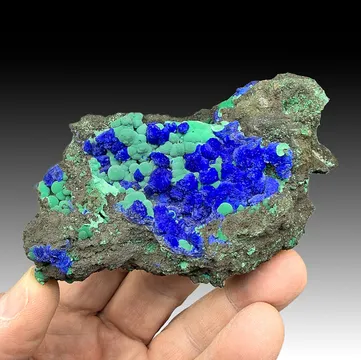
The visual signature of Morenci is high contrast: saturated blue azurite rosettes and blocky crystals on black, red-brown, or limonitic matrix; malachite as balls, botryoids, velvety coatings, and pseudomorphs after azurite; chrysocolla as powder-blue to turquoise crusts and botryoids; and, in the better dioptase pieces, tiny sparkling green crystals scattered across blue chrysocolla. Fine specimens have the oxidized-zone drama of Bisbee, but with a different matrix language and a stronger chrysocolla identity. A good Morenci azurite-malachite is not merely “Arizona copper carbonate”; it often has a particular ruggedness—hematite-goethite gossan, brecciated rock, blue-green mineral zoning, and small but intense crystals that speak to fault-controlled oxidation inside a vast open-pit mine.
Regional View
Country View
Morenci’s collector history is unusually layered. Early high-grade oxidized ores yielded old azurite and malachite specimens that entered eastern cabinets when mineral dealers and rail connections reached the district around the end of the nineteenth century. Later, open-pit expansion exposed new oxidized and breccia zones, and specimen recovery improved dramatically when Southwest Mineral Associates obtained a collecting contract for Phelps Dodge operations in the 1970s. That contract is the reason many pieces from the Metcalf pit, the Northwest Extension, Copper Mountain, and other areas survived as specimens rather than being crushed, leached, or lost in waste rock.
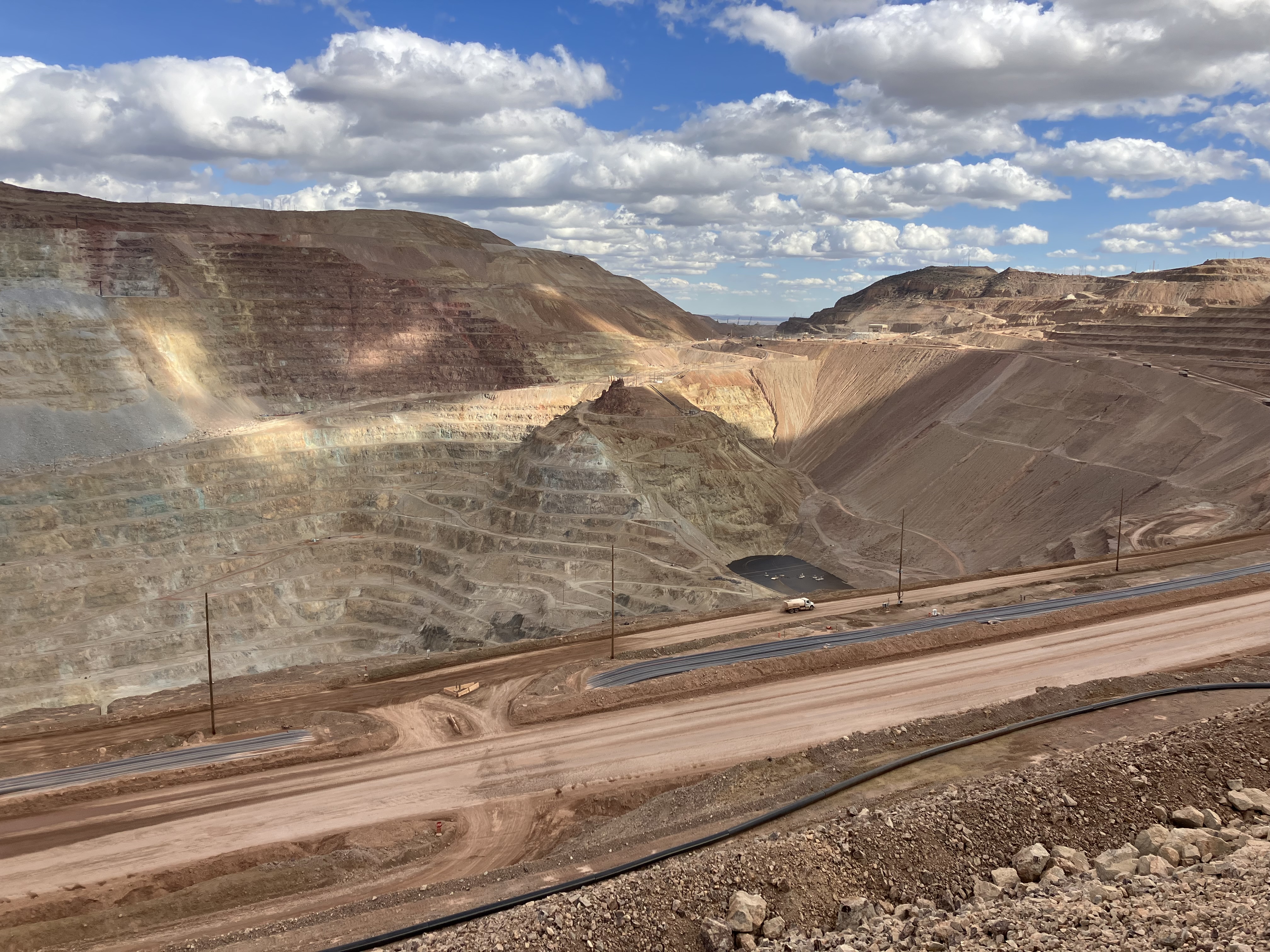
Photo: U.S. Geological Survey

Photo: Wikimedia Commons
Search for specimens: View all specimens from Morenci Mine, USA
Morenci is an active open-pit copper and molybdenum mining complex in Greenlee County, Arizona, about 50 miles northeast of Safford on U.S. Highway 191. The modern operation is run by Freeport-McMoRan as an unincorporated joint venture: Freeport-McMoRan holds 72%, Sumitomo Metal Mining Arizona holds 15%, and SMM Morenci holds 13%. It operates continuously as a production-stage mine, with concentrators, leach systems, solvent-extraction plants, and electrowinning facilities handling a mixture of sulfide and oxide copper ores.
Geologically, Morenci is a large porphyry copper system formed around Paleocene to early Eocene hypabyssal intrusions. The district includes Precambrian schist and granite, Paleozoic and Cretaceous sedimentary rocks, and early to middle Tertiary igneous rocks. Laramide stocks, laccoliths, dikes, and sills range from diorite through granodiorite, quartz monzonite, and granite; the most important porphyry-copper mineralization is associated with dacite, monzonite, and older granite porphyries. Primary hypogene mineralization is dominated by pyrite, chalcopyrite, and molybdenite in quartz-sericite-altered stockwork systems, while skarn formed where those porphyries intruded Paleozoic carbonate units.
For collectors, the essential overprint is supergene. Morenci’s orebody was repeatedly leached, oxidized, and enriched, producing copper oxide zones and secondary sulfide blankets over a large area. Faults and fractures provided the plumbing. In the enriched sulfide zone, chalcocite coats and replaces earlier pyrite and chalcopyrite; in the oxidized zone, the collector minerals appear. Freeport’s modern ore-type classification recognizes leached-cap material rich in iron oxides, acid-insoluble oxide material containing native copper, neotocite, tenorite, copper wad, manganese and iron mineraloids, and possible cuprite, and acid-soluble oxide material containing malachite, chrysocolla, azurite, and brochantite with minor sulfides or cuprite. Chrysocolla is the predominant oxide copper mineral in the mine-scale ore system, but azurite and malachite dominate the collector imagination because of their form, color, and history.
The old district was not a single pit in the modern sense. Names such as Morenci, Metcalf, Copper Mountain, Coronado, Detroit, Manganese Blue, Northwest Extension, Western Copper, Garfield Gulch, and the old limestone and skarn workings matter because specimen character changes from zone to zone. In the skarn and carbonate-related zones, azurite and malachite occur in oxidized calc-silicate settings, with hematite-goethite matrices and pseudomorphs. In the Northwest Extension, azurite and malachite occur in faults cutting Precambrian granite and Laramide granite porphyry; there, azurite may cement fault breccias, line vugs, or occur as rosettes on chatoyant malachite. The Northwest Extension was also an oxide-copper deposit in which chrysocolla was the major copper mineral, with lesser brochantite, azurite, and malachite.
Mining began as underground and high-grade work in the nineteenth century. Phelps Dodge entered the district in 1881 by buying into the Detroit Copper Mining Company, and the district later evolved from underground mining into enormous open-pit operations. The first Morenci open pit dates to the late 1930s, and the operation became one of the defining American porphyry copper mines. The 1987 commissioning of the first SX/EW plant at Morenci marked another major technological phase, allowing leachable oxide and secondary copper material to be converted into copper cathode on site. A major mill expansion achieved full rates in 2015, and the modern operation includes two concentrators producing copper and molybdenum concentrates, crushed-ore and run-of-mine leaching systems, four SX plants, and three EW tank houses producing copper cathode.
Collecting access today is essentially closed. Morenci is an active, large-scale industrial mine on controlled property, not a fee-dig site. Historic and modern specimens reached the market through old mine production, miners, contractors, Phelps Dodge-era recovery, Southwest Mineral Associates material, older dealer stock, and collection dispersals. Modern accidental specimen recovery is rare, and reported collecting by employees or contractors is against company policy. Serious collectors should therefore treat well-labeled Morenci specimens as finite historical material, especially pieces with bench, pit, pocket, collection, or Southwest Mineral Associates provenance.
The most important specimen-producing episodes include old nineteenth-century Detroit and Coronado material, the late 1920s to early 1930s Coronado lessor specimens, the 1982 and 1983 Copper Mountain azurite-malachite finds, the 1985 azurite stalactite pocket, the 1990s Northwest Extension azurite and malachite production, and later recovery from areas where the expanding Morenci mine intersected older workings. These finds produced both display specimens and lapidary-quality azurite-malachite material, but the finest crystallized pieces are much scarcer than the mine’s huge production scale might suggest.
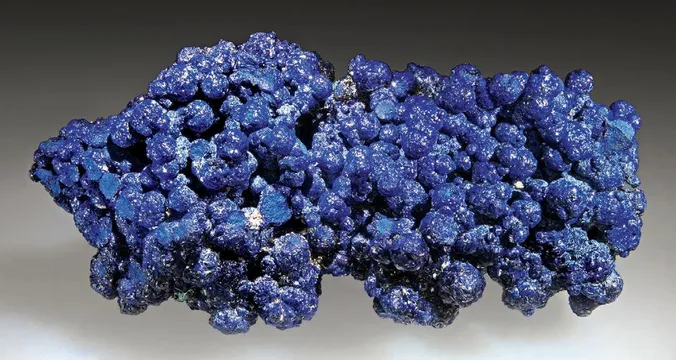
Morenci azurite is the locality’s blue signature: deep royal to electric-blue crystals occurring as blocky, platy, bladed, rosette, crust, breccia-cement, and rare stalactitic forms, commonly on hematite-goethite, limonite, chrysocolla, malachite, or dark copper-oxide matrix. Well-formed crystals to about 2 cm are documented from a fault cutting Longfellow Limestone and a monzonite porphyry dike in the southeastern Morenci mine, while Northwest Extension material includes azurite cementing fault breccias, lining vugs, “floating” in hematite-stained clay gouge, and forming rosettes on chatoyant malachite. Famous finds include the Copper Mountain Electric Blue Pocket of early 1983, with lustrous rosettes to roughly 1.7 cm, the 1985 azurite stalactite pocket, and the 1990s Northwest Extension production. The best pieces have saturated blue color without being visually black, sharp undamaged crystals, lively luster, strong contrast with malachite or chrysocolla, and specific provenance; ordinary pieces are massive blue crusts, damaged rosettes, or attractive but locality-anonymous copper-carbonate fragments.
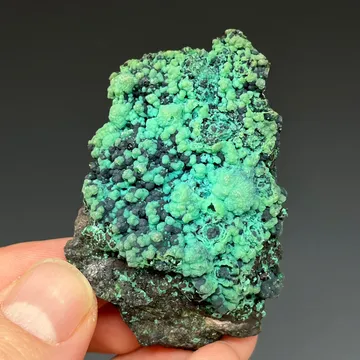
Malachite from Morenci is most prized when it is sculptural rather than merely green: rounded balls, botryoidal skins, velvety spherical aggregates, silky coatings, fracture linings, stalactitic growths, and pseudomorphs after azurite are all characteristic. The classic associations are azurite, chrysocolla, tenorite, hematite-goethite, cuprite, quartz, dioptase, and native copper; in the Northwest Extension, breccia clasts may show several generations of fine malachite banding followed by coarser azurite, while dark green malachite pseudomorphs after azurite are especially desirable. Collector-size pieces range from thumbnails with sharp pseudomorphs to cabinet specimens with blue azurite rosettes set on green balls or velvety mats, and the finest examples are judged by freshness of surface, lack of bruising on botryoids, readable pseudomorph form, saturated natural green, and strong Morenci-style contrast against blue azurite or pale chrysocolla.
Chrysocolla is the major oxide copper mineral in the modern Morenci ore system and the blue-green ground against which many of the mine’s better secondary-copper combinations are built. Collector pieces show powder-blue, sky-blue, turquoise, blue-green, and locally darker green crusts, botryoids, coatings, and massive or silicified material, commonly with malachite, azurite, tenorite, dioptase, quartz, chalcedony, agate, cuprite, hematite, calcite, limonite, native copper, allophane, gibbsite, and jasper. In the Northwest Extension and related oxide zones, chrysocolla may be the dominant copper mineral, while in specimen pieces it often frames azurite rosettes, coats dark tenorite-rich matrix, fills breccia, or supports small emerald dioptase crystals. The best Morenci chrysocolla has uninterrupted botryoidal or velvety surface, strong blue color that is not chalky, attractive contrast with azurite or malachite, and stable matrix; massive blue-green ore chunks are commoner and less desirable unless they show lapidary-quality silica or a particularly readable Morenci assemblage.
Dioptase from Morenci is a small-crystal mineral with outsized collector interest because fine Arizona dioptase is uncommon and Morenci examples often occur in handsome blue-green combinations. It typically appears as bright emerald-green, lustrous, translucent to gemmy prismatic or acicular microcrystals coating vugs, seams, and undulating surfaces on pale blue to turquoise chrysocolla-rich matrix, locally with quartz, malachite, goethite, or rare wulfenite. Dealer and collection records document small cabinet to cabinet pieces, including older 1970s material recovered by Wayne Thompson, with sparkly dioptase filling sculptural vugs or blanketing chrysocolla; individual crystals are commonly only millimeters long, but dense, undamaged coverage and high contrast make the best examples highly displayable. Good Morenci dioptase is judged under magnification: sharp crystal form, glassy luster, true emerald color, dense coverage, and clean chrysocolla association separate fine pieces from green dustings on ordinary copper-oxide matrix.
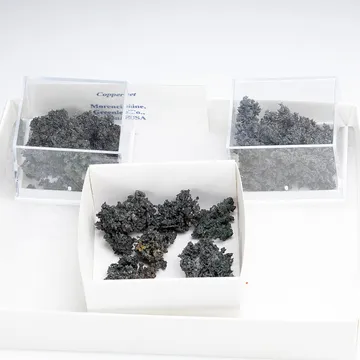
Native copper at Morenci is not the main ore story but is an important secondary-zone specimen mineral, especially in acid-insoluble oxide assemblages with cuprite, tenorite, copper wad, manganese and iron oxides, chrysocolla, malachite, and azurite. It occurs as blebs, seams, hackly masses, leafy or branching filigree growths, and copper-rich crusts within oxidized matrix; documented collector pieces include crystallized native copper branching over matrix and cuprite-rich specimens from Copper Mountain levels with scattered native copper blebs and seams. The most appealing examples retain natural patina and mineral associations rather than being cleaned into anonymous bright metal, and they are valued for sculptural form, readable paragenesis with cuprite or carbonates, old-label provenance, and stability. Compared with azurite and malachite, attractive Morenci native copper is scarcer on the collector market, particularly in well-crystallized or cabinet-size examples from old stock.
Beyond the five headline species, Morenci has documented a broad secondary and primary assemblage including brochantite, cuprite, chalcocite, chalcopyrite, molybdenite, pyrite, covellite, bornite, tenorite, neotocite, copper wad, hematite, goethite, limonite, quartz, chalcedony, calcite, allophane, gibbsite, rosasite, wulfenite, fluorite, tremolite, actinolite, epidote, garnet, diopside, magnetite, and skarn silicates. The wider Clifton-Morenci district is also historically important for rare-mineral work: coronadite was first recognized from the Coronado vein area of the district, and morencite was described from Morenci material before later work showed it to be structurally the same as nontronite. Early literature also recorded libethenite from the Coronado lode and gerhardtite-like copper nitrate crusts on weathered porphyry, giving the district a mineralogical significance well beyond its classic blue and green copper carbonates.
Morenci’s most important authenticity issue is mislabeling, especially confusion with Bisbee. Many old azurite-malachite specimens from Morenci have been sold or inherited under Bisbee labels because both localities produced vivid Arizona copper carbonates. The better way to evaluate a questionable piece is not color alone, but matrix, texture, associated minerals, and provenance. Morenci specimens commonly show chrysocolla as a meaningful association, especially on some old Coronado and Northwest Extension material; chrysocolla with azurite-malachite can be a strong Morenci clue and is much less characteristic of classic Bisbee azurite-malachite. Old labels naming Northwest Extension, Copper Mountain, Dispatch Hill, Morenci pit, Metcalf, Phelps Dodge, Southwest Mineral Associates, Les Presmyk, Wayne Thompson, or other documented Arizona collections add value.
I am not aware of a well-documented modern fake industry aimed specifically at Morenci, but treatments and presentation issues deserve attention. Some azurite-malachite and chrysocolla-rich Morenci ore has been cut, polished, slabbed, stabilized, or varnished for lapidary display; those pieces can be attractive, but they should not be priced or described as natural crystal specimens. Chrysocolla and porous copper-oxide mixtures may be fragile or absorbent, and silicified chrysocolla is more durable than chalky material. Native copper may be cleaned, lacquered, or artificially brightened; natural patina and undisturbed associations are preferable on locality specimens.
Condition is critical. Morenci azurite crystals, rosettes, and stalactitic forms are easily bruised; malachite balls and velvety coatings show rubs quickly; chrysocolla skins chip and powder at edges; and dioptase microcrystals lose much of their appeal if the sparkling surface is abraded. Inspect azurite terminations and rosette edges with a loupe, look for crushed botryoids on malachite and chrysocolla, and be cautious of specimens with suspiciously glossy coatings. Avoid prolonged soaking or aggressive cleaning. Azurite and malachite are copper carbonates, chrysocolla can be porous, and copper-oxide matrices may include friable iron oxides or clay; dust gently and keep specimens dry.
Market availability is paradoxical. Morenci is a huge, famous, active mine, so ordinary azurite-malachite-chrysocolla pieces appear regularly. Fine, well-provenanced specimens from the great pockets are another matter. Northwest Extension azurites, Copper Mountain Electric Blue Pocket pieces, 1985 stalactites, older Coronado material, good dioptase-on-chrysocolla, and attractive native copper with cuprite are finite, collection-driven material. The most desirable Morenci pieces are not necessarily the largest; a small undamaged rosette group with an old label and classic chrysocolla-malachite association may be far more important than a larger massive oxide specimen.
The Morenci specimen story has a wonderful lost-and-found quality. In the late 1920s and early 1930s, when the Coronado Mine was being worked by lessors, a batch of azurite and malachite specimens was sold to a dealer in Oregon. The material slipped out of sight for generations, then resurfaced around 2015 still packed in boxes. The giveaway was not a mine tag or a typed inventory, but the wrapping: early 1930s newspapers, a time capsule around blue and green copper minerals. For collectors, that kind of rediscovery matters because it anchors the specimens in a narrow historical window, before modern open-pit overprinting and long before Morenci material became widely sorted by sublocality.
The modern preservation of Morenci specimens owes a great deal to Wayne Thompson and Southwest Mineral Associates. In 1974 Thompson formed the company and obtained the collecting contract for Phelps Dodge’s Southwest Division, covering Bisbee, Morenci, and Ajo. At Morenci, that meant specimens from the Metcalf pit and later areas of the mine could be saved before they disappeared into leach dumps. The arrangement changed the fate of entire pockets. The famous 1985 azurite stalactite pocket and the Northwest Extension azurites and malachites survived because someone with a collector’s eye had permission to recover what an industrial operation would otherwise have treated as copper-bearing rock.
The Copper Mountain finds of the early 1980s gave Morenci one of its most memorable modern specimen episodes. In 1982, Brian Huntsman recovered roughly five flats of specimens from the old Morenci pit’s Copper Mountain area: bright green malachite spheres carrying lustrous blue azurite rosettes on matrix. The following year, in early 1983, Huntsman and Jerry Sullivan worked a crack in a large boulder loosened by blasting on the 4700 bench. From that crack came about three flats of especially fine azurite: blue rosettes to about 1.7 cm with small forest-green malachite balls. Collectors know the find by its apt name, the Electric Blue Pocket.
Another image from the Morenci story is pure mineralogical sculpture: the azurite stalactites collected in 1985 and 1992. A published group in the Les and Paula Presmyk collection shows azurite and malachite stalactites with the central stalactite 11.5 cm tall. Morenci is not primarily a cave-mineral locality in the way that word might suggest, so these stalactitic copper-carbonate forms stand out: they are oxidized-zone drip and seep chemistry frozen into blue and green pendant forms inside a vast porphyry copper operation.
The 1990s Northwest Extension finds added a different kind of Morenci classic. In spring and summer 1992, crystallized azurites of a size and quality previously uncommon from the mine emerged from the Northwest Extension area. There, azurite and malachite were not just coating skarn or lining limestone cavities; they occupied faults cutting granite and granite porphyry, cementing breccias, lining vugs, and appearing in hematite-stained clay gouge. These specimens helped define the modern Morenci look: azurite rosettes, malachite pseudomorphs, chrysocolla-rich oxide matrix, and enough geological specificity that a label reading “Northwest Extension” now carries real collector weight.

_(27890565095).jpg)