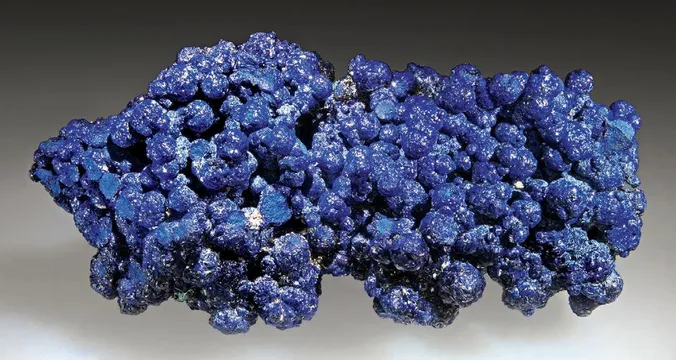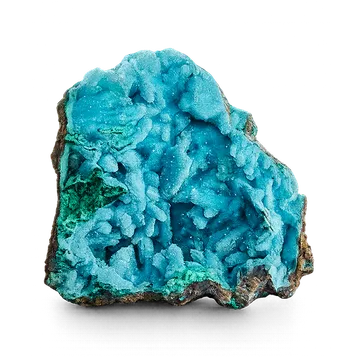
Chrysocolla from Morenci Mine, Arizona: renowned for blue botryoids and copper-oxide matrices; prized by collectors for provenance and vivid color.
Key facts
Morenci chrysocolla is a collector’s mineral born inside an industrial giant: a vast porphyry copper system in Greenlee County where the oxidized ore is not an afterthought but a major part of the mine’s identity. Freeport-McMoRan describes chrysocolla as the predominant oxide copper mineral at Morenci, and that scale matters. Unlike small pockets from narrow vein mines, Morenci chrysocolla comes from a district-sized supergene system where copper-bearing solutions moved through fractured granite, porphyry, fault zones, leached caps, and enriched blankets over a long span of weathering history.
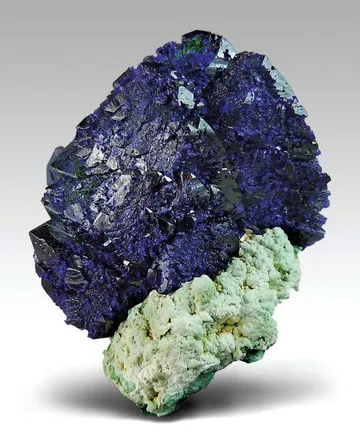
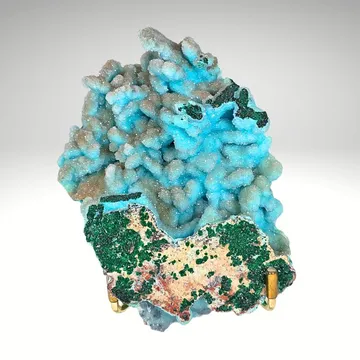
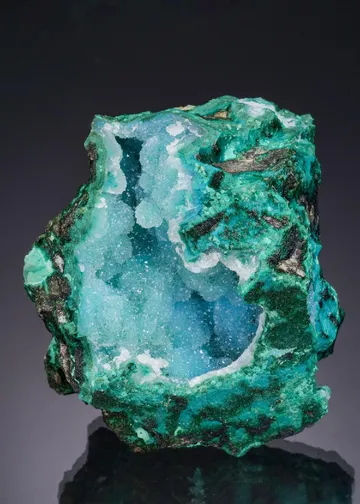
The best collector pieces are not simply “blue crusts.” They are sharply localized products of the oxidized copper zone: turquoise-blue to powder-blue botryoids, glossy rounded orbs on black tenorite-rich matrix, green-blue masses with malachite, chrysocolla pseudomorphs after azurite, and uncommon silicified or chalcedonic chrysocolla that crosses into gem silica territory. Morenci is especially admired for combination specimens in which chrysocolla frames, replaces, or contrasts with classic Arizona secondary copper minerals—malachite, azurite, tenorite, dioptase, quartz, chalcedony, cuprite, and iron oxides.
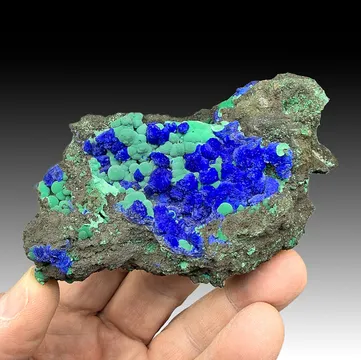
What makes the locality distinctive is the way chrysocolla participates in Morenci’s larger specimen story. The district is famous for azurite and malachite, but chrysocolla is often the locality fingerprint: pale-to-vivid blue botryoids under malachite rosettes, bright green chrysocolla over dark azurite-tenorite matrix, or minor chrysocolla on old Morenci azurite specimens that helps separate them from look-alike Bisbee material. Serious collectors look for pieces with documented mine provenance, natural surface quality, vivid but believable color, undamaged botryoidal skin, and honest disclosure when fragile chrysocolla matrix has been stabilized.
Search for specimens: View all chrysocolla specimens from Morenci Mine, Arizona, USA
Morenci Mine lies at Morenci in Greenlee County, Arizona, about 50 miles northeast of Safford on U.S. Highway 191. It is an active open-pit copper-molybdenum mining complex, historically known under names including Morenci pit, Phelps Dodge Morenci Mine, and Morenci-Metcalf. The deposit belongs to the Clifton-Morenci, or Copper Mountain, mining district near the Arizona-New Mexico border.
Geologically, Morenci is a large porphyry copper system with oxide, secondary sulfide, and primary sulfide mineralization. The district includes early Proterozoic schist and granite, Paleozoic and Cretaceous sedimentary sequences, and early to middle Tertiary intrusive and volcanic rocks. The copper system developed with intrusive activity, hydrothermal alteration, and later supergene oxidation and enrichment. Laramide porphyries intruded older sedimentary rocks and produced skarn assemblages in places, while the broader ore system records potassic, sericitic, propylitic, and argillic alteration. In the oxidized and acid-soluble oxide ore, chrysocolla occurs with malachite, azurite, brochantite, and locally minor chalcocite, pyrite, and cuprite.
The supergene story is central to Morenci chrysocolla. Multiple cycles of leaching and enrichment attacked primary sulfides and produced both a secondary sulfide blanket and copper oxide zones. Oxidation and enrichment were strongly controlled by faults, fractures, paleotopography, climate, and hydrology. Enrichment and oxidation zones tend to thicken in valleys and thin over ridges, and the long-lived enriched zone was localized in the ancestral Chase Creek Canyon. The Northwest Extension area, Western Copper area, Metcalf pit, Southside/Azurite pit area, and older mine areas all figure in the specimen and research literature.
Morenci’s mining history is as important as its geology. Copper mineralization in the district attracted attention in the 1860s, and early prospectors were drawn by the blue and green copper staining. In the nineteenth century, only very high-grade copper ore could pay because transportation costs were severe. Ore was hauled and trammed from mines high on the mountains down toward Clifton, where smelters had water from the San Francisco River. Phelps Dodge & Company entered the district in 1881 with a $50,000 investment and eventually consolidated operations by 1921. Underground mining gave way to open-pit mining beginning in 1937, and Morenci has been in continuous open-pit operation since 1939. The Morenci concentrator was commissioned in 1942, Metcalf began receiving ore in 1975, the first SX/EW plant was commissioned in 1987, and the last Morenci smelter closed in 1984.
Modern Morenci is not a casual collecting locality. It is a large active mine operated by Freeport-McMoRan, with Freeport holding a 72% undivided interest and Sumitomo-related entities holding the remaining 28%. Access is controlled, industrial, and safety-regulated; trespassing is neither legal nor safe. Historically important specimen recovery came through formal collecting arrangements, especially the Southwest Mineral Associates contract with Phelps Dodge’s Southwest Division beginning in 1974. That arrangement preserved specimens from Metcalf and other Morenci areas that otherwise would have gone to leach dumps. Outside such authorized work, specimen recovery has been rare and opportunistic, and current mine policy does not make Morenci a recreational collecting site.
Notable finds from Morenci are best known for azurite and malachite, but chrysocolla is woven through many of them. The 5000-foot-level chrysocolla-malachite material, glossy blue chrysocolla orbs on tenorite, chrysocolla pseudomorphs after azurite, and gemmy chrysocolla or gem silica veins are all documented in public specimen records. Older Morenci pieces can be difficult to separate from Bisbee without careful matrix and association work; chrysocolla, in the right setting, can be one of the clues pointing back to Morenci.
Morenci chrysocolla rarely behaves like a conventional crystalline species. It appears most often as botryoidal crusts, rounded orbs, powdery-to-waxy coatings, massive vein fillings, thin brittle blue layers, pseudomorphs after azurite, and silica-rich or chalcedonic material. Public specimen records include 2 mm pseudomorphous groups after azurite, 1–2 mm rounded blue-green surface features, thumbnails and small cabinets in the 2–8 cm range, larger cabinet specimens over 10 cm, and a documented gemmy chrysocolla specimen with a field of view of 17.8 cm. Morenci material can therefore range from microscopic sprays and pseudomorphs to substantial lapidary-style masses.
Color is one of the great attractions. The locality produces pale powder-blue botryoids, vivid turquoise-blue orbs, greenish chrysocolla intergrown with malachite, darker blue brittle coatings, and translucent blue-green silica-rich vein material. Some pieces are strongly zoned: a central vein of translucent chrysocolla or gem silica, darker outer chrysocolla skins, green malachite borders, and black tenorite or manganese-rich oxide matrix. In microprobe work on blue-green Morenci oxide mineraloids, the material identified as chrysocolla showed variable copper and silica contents; blue material carried the greatest copper contents, cloudy white material was copper-poor and silica-enriched, and green material tended to include traces of iron or manganese.
Associated minerals are a major part of Morenci chrysocolla’s identity. The most frequent collector associations are malachite and azurite, followed by tenorite, dioptase, quartz, chalcedony, agate, cuprite, hematite, calcite, limonite, native copper, chalcocite, allophane, gibbsite, and jasper. The dramatic combinations are visual as well as genetic: azurite rosettes on cracked blue chrysocolla balls, malachite blades scattered over matte powder-blue chrysocolla botryoids, bright green chrysocolla on nearly black azurite-tenorite matrix, and quartz druse sparkling over chrysocolla and malachite.
Quality depends on form, color, contrast, and integrity. The most desirable display specimens have uninterrupted botryoidal skin, strong blue color that is not chalky or faded, sharp contrast with malachite or azurite, and a stable matrix. A small undamaged chrysocolla-malachite-azurite combination can be more desirable than a larger massive lump if the surface is fresh and the paragenesis is readable. Documented sublocality or level information—such as Northwest Extension, 5000-foot level, Metcalf, Western Copper, or older Detroit/Coronado-related provenance—adds real collector value because Morenci has a long history of mislabeling and specimen migration through old dealer stock.
Silicified chrysocolla and gem silica from Morenci deserve special attention. This material is tougher than ordinary porous chrysocolla because silica gives it durability and translucency. Fine gem silica from Arizona has a separate lapidary market, but on mineral specimens the best examples are those that retain locality character: chrysocolla as part of a Morenci oxide assemblage, not just a polished blue-green stone.
Morenci chrysocolla should be evaluated first as a locality specimen and second as chrysocolla. The strongest pieces show a believable Morenci assemblage: chrysocolla with malachite, azurite, tenorite, quartz or chalcedony, iron oxides, and the distinctive dark oxide matrices common to the district. Old labels from Phelps Dodge Morenci Mine, Morenci-Metcalf, Northwest Extension, Metcalf pit, or a named collection can matter greatly, especially because Morenci azurite-malachite specimens have often been confused with Bisbee. In expert discussions of Morenci material, minor chrysocolla has even been cited as a useful clue for distinguishing certain Morenci specimens from Bisbee look-alikes.
There is no widely documented Morenci-specific chrysocolla fake tradition comparable to the well-known fakery problems in some other mineral categories. The practical risks are more ordinary but still important: dyed blue stone sold as chrysocolla, stabilized material not disclosed, polished lapidary material sold with vague or inflated locality claims, and chrysocolla-bearing pieces confused with turquoise or gem silica. Because raw chrysocolla can be soft, porous, and brittle, stabilization with resin is a real issue in the trade. Stabilization is not automatically disqualifying for a fragile matrix specimen if it is disclosed, but undisclosed resin affects value and should be treated as a condition issue.
Condition is the chief challenge. Morenci chrysocolla can crack, powder, bruise, or detach from matrix, particularly when it occurs as thin blue layers or chalky botryoidal skins. Edges of old pocket plates are often contacted where they were removed from the pocket wall, and malachite or azurite crystals on chrysocolla may show small nicks. Avoid aggressive cleaning. Acids, prolonged soaking, ultrasonic cleaning, and hard brushing can damage soft chrysocolla, loosen botryoids, or dull associated malachite and azurite. Store away from abrasion, heat, and direct harsh sunlight, and handle specimens by the matrix rather than by the blue surface.
Availability is moderate but uneven. Morenci is a famous and long-lived copper mine, so chrysocolla-bearing specimens appear regularly in dealer inventories and auctions, especially as chrysocolla with malachite, chrysocolla with azurite, or chrysocolla-rich oxide matrix. However, fine undamaged locality pieces with strong aesthetics and old provenance are not abundant. Northwest Extension azurite-malachite specimens, 5000-foot-level chrysocolla-malachite pieces, and older Southwest Mineral Associates material are more collectible than generic “Morenci chrysocolla” chunks. Prices can range from accessible small specimens to serious cabinet-level pieces, with value rising sharply for documented history, vivid color, undamaged botryoidal surfaces, azurite or malachite contrast, and gem silica character.
The old Morenci mines were not built around specimen collecting. They were built around ore, transportation, and survival in a copper district where freight costs could decide whether a mine lived or died. In the early days, the best ore lay high along Chase Creek, and the practical problem was not only finding copper but getting it down the mountain. Ore was hoisted upward, moved down steep railways on the mountain flanks, and trammed roughly six miles to the smelters at Clifton, where dependable water from the San Francisco River made smelting possible. Later, mines used a common haulage drift at the base of the mountain, dropping ore down winzes to waiting trains.
That history explains why many early Morenci specimens are scarce, scattered, or mislabeled. There was no specimen culture at Morenci like the one that developed at Bisbee under managers who understood the value of fine crystallized copper minerals. In Morenci, specimens could disappear into ore bins, smelter feed, stockpiles, or simply move east with dealers who had also been buying at Bisbee and Tombstone. One account notes that specimens labeled “Clifton” actually came from stockpiled Morenci ores rather than mines in Clifton itself—a tantalizing image for collectors, walking across old ore piles and seeing azurite, malachite, and perhaps chrysocolla-bearing material underfoot.
A particularly charming rediscovery came from the Coronado Mine period. In the late 1920s and early 1930s, when the Coronado Mine was worked by lessors, a batch of azurite and malachite specimens was sold to a dealer in Oregon. Decades passed. Around 2015, boxes of that material were rediscovered, still wrapped in early 1930s newspapers. For a collector, that is nearly ideal provenance: not only a historic Morenci source, but a built-in timestamp folded around the specimens themselves. Minor chrysocolla on those Coronado-area specimens was later noted as a telling Morenci clue, because that association does not fit the comparable Bisbee material.
Specimen recovery changed dramatically in 1974, when Wayne Thompson formed Southwest Mineral Associates and obtained the collecting contract for Phelps Dodge’s Southwest Division, including Bisbee, Morenci, and Ajo. At Morenci, that contract meant that material exposed in the Metcalf pit and later in other mine areas could be rescued before it became leach-pad feed or dump rock. The contract preserved the famous 1985 azurite stalactite pocket and the later Northwest Extension azurites and malachites that now sit in collections. Without that arrangement, many of those pieces would have been chemically processed as copper ore rather than studied as mineral specimens.
The most vivid Morenci field account comes from Christmas Eve 1992 in the Northwest Extension, when Mark Kielbaso, James Dunn, and Betsy McKitrick of Southwest Minerals checked a newly blasted bench. The day began cold, with the mine roads muddy and rutted by 300-ton haul trucks with 12-foot tires. Their own vehicle was a 1968 flatbed Ford held together, in Kielbaso’s telling, with “baling wire and assorted clothes pins,” its diamond-plate bed shaking loose over the pit roads and its non-synchronized four-speed transmission grinding its way across the mine.
The bench they searched was about 100 yards long and 30 yards wide. Everything was dust, mud, and broken shot rock until James Dunn picked up a lump that looked like a red brick, except one nicked corner showed blue. They broke it open and found a two-pound chunk of solid azurite. Within half an hour they had gathered nearly 500 pounds of solid azurite by breaking brown clay-covered lumps and judging pieces by weight. That was only the beginning.
Kielbaso fetched their Link-Belt 25-ton excavator, nicknamed “Kitty,” and cut parallel trenches through the suspected source. Within 20 minutes, one bucket came up “raining blue azurite.” Nearly 200 pounds lay in a single blue pile. Then dipper after dipper came out blue, and the group filled two 55-gallon drums on the truck. A shift foreman appeared and told them they had to leave because a shovel was going to work below. They were sitting on the kind of pocket that makes collectors remember exact minutes and exact machines.
Before leaving, Kielbaso backed up about 20 feet, cut a shallow ramp into the hole, and dropped the excavator into it so “Kitty” was out of sight. Every few minutes the arm rose above the bank and dropped another load of azurite while Jay watched for the shovel below so the excavator would not be scooped into a haul truck. In two or three hours they had put close to five tons of azurite on the bench. The vein still showed no sign of stopping. Plates reached two feet square and four inches thick, lining both hanging wall and footwall with as much as six inches of red mud between.
The shift foreman flagged the area for protection overnight. The next morning, the crew returned expecting the day of their lives. Instead, the bench edge ran straight for 200 feet, then showed a 20-foot “bite” exactly where the azurite hole had been. Looking down 50 feet, Kielbaso saw a 30-foot-wide wall of red mud, azurite dust, and chunks of blue. The excavator trench was visible like a cross section through an ant farm. Blue material had spilled from haul trucks across the bench below, leaving a trail toward the Coronado dump that he and Jay followed for nearly a quarter mile before it disappeared.
The night-shift report apparently said, “Mine the Blue Hole.” The crew recovered what they could. In all, they collected close to ten tons of solid azurite over three days and continued working the zone into the floor of the next bench for two weeks. Zee Haig, convinced the missing blue material had been stashed somewhere on the property, hired a small plane from Tucson and sent an employee named Paul Newman—not the actor—over the pit to look for piles of blue from the air. None were found. Later, the story became stranger still: what looked like superb pigment material reportedly contained too much tenorite, ground too dark for paint, and much of the material ended up in China as carving rough.
Although that Christmas Eve story is an azurite tale more than a chrysocolla tale, it captures exactly why Morenci specimens are prized. In a mine moving hundreds of thousands of tons of material daily, a pocket can appear as a flash of blue in red mud, be worked by a handful of authorized collectors for hours, then vanish overnight into the logic of production. Morenci chrysocolla belongs to that same world: beautiful, geologically revealing, and always at risk of becoming copper feed unless someone recognizes it in time.