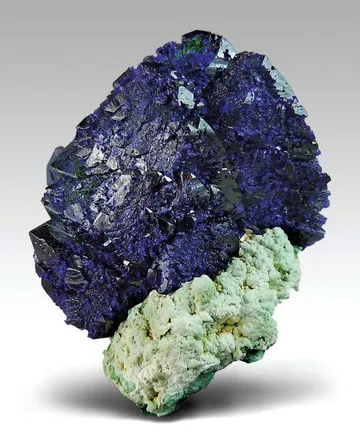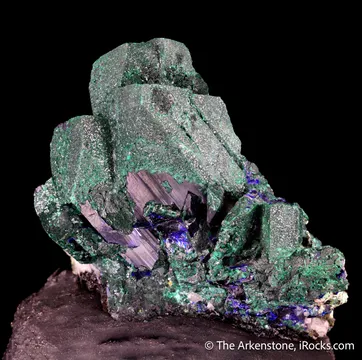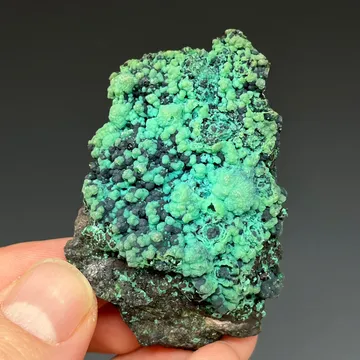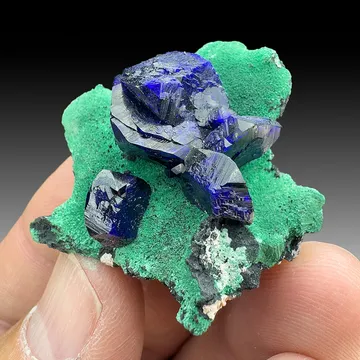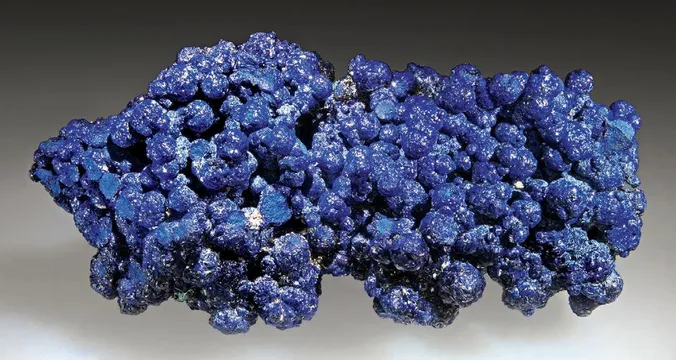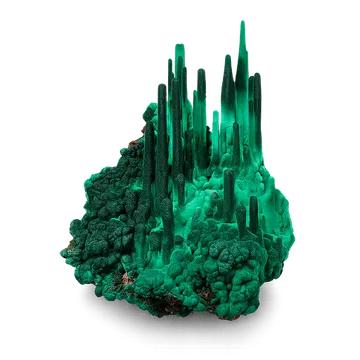
Malachite from Morenci, Arizona: vivid green botryoidal forms and pseudomorphs against a dark matrix; prized for color contrasts with azurite and chrysocolla.
Key facts
Malachite from the Morenci Mine is classic Arizona copper-country material: vivid green secondary copper carbonate from one of the great porphyry copper systems of the American Southwest. The most desirable specimens are not anonymous green crusts, but sculptural pieces in which malachite makes rounded balls, botryoidal coatings, velvety sprays, crystalline crusts, and, at its best, sharp pseudomorphs or sparkling aggregates set against the dark, oxidized matrix of the mine. When associated with electric-blue azurite or pale to turquoise-blue chrysocolla, Morenci malachite has the high-contrast color language that collectors immediately associate with the locality.

Photo: Wikimedia Commons
The appeal of Morenci malachite is tied closely to the mine’s supergene history. Morenci is a huge copper-molybdenum porphyry system in Greenlee County, southeastern Arizona, where primary sulfide mineralization was overprinted by repeated cycles of oxidation, leaching, and enrichment. In collector terms, that means the deposit made more than ore: it made pockets and fracture coatings of copper minerals with strong colors and distinct textures. Malachite, azurite, chrysocolla, brochantite, cuprite, tenorite, native copper, quartz, goethite, hematite, and other species record the chemistry of these oxidized zones.

Photo: Wikimedia Commons
Morenci is better known to many collectors for azurite, chrysocolla, turquoise, and native copper, so attractive malachite-dominant specimens carry a particular locality interest. Fine examples show saturated, naturally varied greens rather than flat dye-like color; intact rounded growths rather than abraded knobs; and, ideally, strong association with azurite rosettes or chrysocolla without overwhelming the malachite. The finest pieces read instantly as Morenci: dark gossanous or black copper-oxide matrix, velvety green balls, brilliant blue accents, and a desert-oxidation mineralogy that could only have formed in a large weathered copper system.
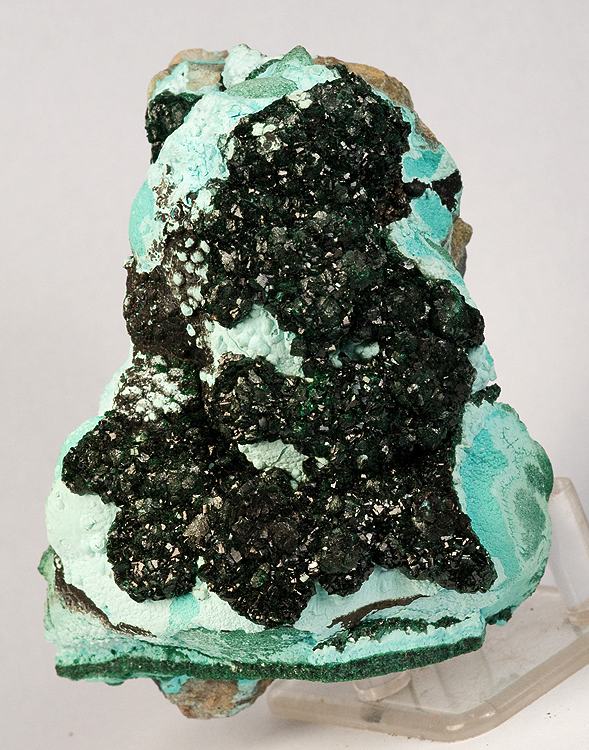
Photo: Wikimedia Commons
Search for specimens: View all malachite specimens from Morenci Mine, Arizona, USA
The Morenci Mine is an active open-pit copper and molybdenum mining complex near Morenci in Greenlee County, Arizona, about 50 miles northeast of Safford on U.S. Highway 191. The modern operation is a vast industrial mine rather than a public collecting site. Specimens with credible Morenci provenance generally come from historic mine production, authorized mine-related recovery, old collections, dealer stock, or well-documented finds from earlier decades; casual collecting at the active operation should not be assumed possible.
Geologically, Morenci is a large porphyry copper system with copper oxide, secondary sulfide, and primary sulfide mineralization. The deposit formed where Tertiary igneous intrusive rocks were emplaced into Precambrian granite and overlying Paleozoic and Mesozoic sedimentary rocks. Primary hypogene copper-molybdenum mineralization is related to Laramide-age granodiorite to quartz monzonite stocks and dike swarms, with chalcopyrite, pyrite, and molybdenite in stockwork and vein assemblages. Later supergene processes leached, oxidized, and enriched the deposit, producing the copper oxide and secondary sulfide zones that are so important both economically and mineralogically.
The official technical description of the mine separates Morenci ore into leached cap, acid-insoluble oxide, acid-soluble oxide, mixed oxide-sulfide, supergene sulfide, mixed supergene sulfide, mixed hypogene sulfide, hypogene sulfide, and unmineralized material. Malachite belongs especially to the acid-soluble oxide suite, with chrysocolla, azurite, and brochantite, and may occur with minor chalcocite, pyrite, or cuprite. This is the collector’s oxidized copper world: green carbonates, blue carbonates and silicates, black copper oxides, iron oxides, and occasional bright copper minerals in fractures and cavities.
The scale of Morenci matters. The mineralized system extends for roughly 5 miles north-south and 4 miles east-west. Structural features such as the Copper Mountain, Morenci Canyon, Apache, Kingbolt, and other faults influenced supergene mineralization, while faults and fractures acted as conduits for oxidizing copper-bearing solutions. In the oxidized zones, those solutions deposited malachite and its associates as coatings, crusts, botryoidal masses, balls, replacements, and vein fillings.
The mining history is long and layered. Copper mineralization near Morenci was recorded by soldiers in January 1863. Early work followed rich copper mineralization in lodes and fissure veins, and by the early twentieth century the district contained numerous underground workings operated by companies including the Longfellow Mining Company, Detroit Copper Mining Company, Arizona Copper Company, and Shannon Copper Company. Systematic churn drilling began in 1912. By 1921, the producers had been consolidated under Phelps Dodge management. Underground operations ceased by 1932, and by the late 1930s the district had shifted to open-pit mining. The Morenci concentrator was commissioned in 1942; the Metcalf concentrator began receiving ore in 1975; the smelter closed in December 1984 and was dismantled between 1993 and 1996; the first SX/EW facilities were commissioned in September 1987. Freeport-McMoRan acquired Phelps Dodge in 2007, and modern Morenci remains one of the major copper operations in North America.
For collectors, the most important specimen periods are not identical to the mine’s production milestones. Historic underground mining in the late nineteenth and early twentieth centuries produced oxidized copper minerals from rich zones, including azurite and malachite. Later open-pit operations, particularly from the 1970s onward, exposed fresh oxidized pockets and benches where collectors and mine-connected individuals recovered azurite-malachite specimens that became modern classics. The Copper Mountain area of the old Morenci pit is especially important in the specimen record, including the celebrated Electric Blue Pocket of 1983.
Morenci malachite is most often valued for form and association rather than for large isolated crystals. Typical collector specimens show malachite as botryoidal balls, rounded aggregates, crystalline crusts, compact green coatings, velvety surfaces, and intergrown clusters on dark matrix. Some pieces show malachite replacing or partly replacing azurite, preserving the bladed, rosette-like, or sculptural habit of the earlier blue mineral. Such pseudomorphs are particularly desirable when the crystal shape is sharp and the green surface remains intact.
Color ranges from pale mint and blue-green where malachite is intimately mixed with chrysocolla or other copper silicates, through bright grass green and rich emerald green, to dark forest green in dense crystalline aggregates. The best Morenci malachite specimens are lively rather than flat: their surfaces may shift from velvety matte to satiny to sparkling, depending on whether the malachite is fibrous, botryoidal, crystalline, or coated with microcrystals.
Association is one of the locality’s strongest signatures. Mindat’s Morenci malachite occurrence data show azurite as the most frequent photo-associated mineral, followed by chrysocolla, tenorite, hematite, cuprite, quartz, dioptase, allophane, goethite, limonite, calcite, native copper, coronadite, tremolite, rosasite, brochantite, azurmalachite, chalcocite, wulfenite, fluorite, bornite, and covellite. Not every association is common in hand specimens, but the list accurately reflects the oxidized copper richness of the mine. In the marketplace, the classic combinations are malachite with azurite, malachite with chrysocolla, malachite with azurite and chrysocolla, and malachite on dark oxidized matrix.
Typical specimen sizes range from thumbnails and miniatures with crisp green balls or azurite-malachite clusters to cabinet pieces around 7 to 12 cm. Documented Morenci examples include malachite balls to just over 1 cm on a 7.2 x 5.3 x 2.5 cm specimen, an azurite-malachite piece measuring 5.6 x 5.1 x 4.4 cm, and a malachite-chrysocolla specimen measuring 9.0 x 7.0 x 6.8 cm. The famous Electric Blue Pocket material is known for azurite rosettes to about 1.7 cm across, accompanied by small forest-green malachite balls.
Quality factors for Morenci malachite include:
Morenci is an active industrial mine, so newly collected specimen-grade malachite is not freely available to the public. The best material on the collector market tends to be older: pieces from historic underground production, open-pit finds from the late twentieth century, estate collections, or documented dealer lots. Attractive Morenci malachite is available, but truly fine malachite-dominant pieces are less common than casual buyers expect, especially compared with the mine’s better-known azurites and chrysocollas.
The main authenticity issue is provenance rather than species identity. Malachite itself is easy to recognize in many cases, but “Morenci” can be overused as a convenient label for any Arizona-looking azurite-malachite-chrysocolla specimen. Look for old labels, collection history, matching matrix style, and associations consistent with Morenci. A specimen with electric-blue azurite rosettes, green malachite balls, chrysocolla, tenorite or dark copper oxides, and gossanous matrix is plausible, but visual style alone is not proof.
No well-documented, locality-specific fake industry for Morenci malachite is apparent in the standard references, but general malachite fakes and treatments are common in the broader market. Avoid “malachite” with plastic-like luster, painted-looking black-and-green striping, suspiciously uniform bands, or an unnaturally resinous feel. Reconstituted malachite, dyed material, plastic imitations, and resin-filled lapidary goods are widespread in jewelry and decorative markets. For Morenci collector specimens, the more relevant concerns are repaired azurite-malachite clusters, glued fragments, resin-stabilized chrysocolla-rich matrix, and polished slices marketed without clear disclosure.
Condition is critical. Malachite balls bruise easily, velvety surfaces rub, azurite rosettes chip, and chrysocolla-rich matrix can be brittle. Dark tenorite or copper-oxide coatings may hide small repairs or contacts. Examine high points under magnification: broken spheres, scuffed velvet, missing azurite rosettes, and glued contacts reduce value. Stabilization is sometimes used on fragile chrysocolla or porous matrix; it may be acceptable if disclosed, but undisclosed resin can diminish collector desirability.
Rarity should be judged by quality. Small or massive Morenci malachite-chrysocolla pieces are not rare. Fine, aesthetic, undamaged, malachite-dominant specimens with crisp balls or crystals are considerably scarcer. Pieces with strong 1980s Copper Mountain or Electric Blue Pocket provenance, excellent azurite contrast, or old collection labels occupy a higher tier. For serious collectors, the best Morenci malachite is not simply a green copper mineral from a famous mine; it is a documented artifact of one of Arizona’s great oxidized copper systems.
In 1982, the Copper Mountain area of the old Morenci pit produced one of those finds that collectors still talk about by name and texture. Brian Huntsman recovered about five flats of specimens showing bright green malachite spheres with lustrous blue azurite rosettes on matrix. The pairing was exactly what Morenci does best: rounded green malachite against electric blue azurite, set on dark, rough rock.
The next year brought the pocket that gave the find its lasting aura. In early 1983, on the 4700 bench in the same Copper Mountain area, Brian Huntsman and Jerry Sullivan worked a crack in a large boulder that had been knocked loose by blasting. From that crack they extracted about three flats of outstanding azurite specimens. The azurite occurred as crystal rosettes to about 1.7 cm across, richly colored and brightly lustrous, with small balls of forest-green malachite. The find became known as the Electric Blue Pocket, and its specimens remain among the most sought-after Morenci pieces.
Another later thread runs through the early 1990s material associated with Stan Esbenshade, Wesley Stark, and dealer Doug Wallace. One documented 9.0 x 7.0 x 6.8 cm Morenci specimen from the Wesley Stark Collection shows sparkly, intergrown, dark forest-green malachite crystals on bubbly chrysocolla over banded malachite on gossan matrix. The specimen was described as early 1990s material dug by Esbenshade and sold to Stark by Wallace, who handled much of it. That little chain of names matters: Morenci material often becomes far more meaningful when it can be followed from the mine, through the hands of a knowledgeable dealer, into a named collection.