






A collector's guide to Mont Blanc Massif northwest flank, France: its geology, mining history and notable minerals, illustrated with the 72 specimens documented from this locality on EarthWonders.
Key facts
The northwest flank of the Mont Blanc Massif is one of the classic alpine-fissure specimen districts of Europe: not a mine in the usual sense, but a high, fractured granitic and gneissic mountain front above the Chamonix valley where mineralized clefts, locally called fours, have yielded quartz, smoky quartz, gwindels, red to pink fluorite, adularia, albite, chlorite, titanite, epidote, and a scattering of rarer accessory species. For collectors, the name Chamonix carries a very particular image: lustrous grey-brown smoky quartz rising from pale feldspar and green chlorite, or raspberry to rose octahedral fluorite sitting on smoky quartz, its color naturally developed in the radioactive environment of the Mont Blanc granite. The best pieces have the tension and austerity of their birthplace—sharp alpine architecture, minimal matrix, hard-won aesthetics, and a provenance rooted in dangerous high-altitude work.
Regional View
Country View
Geologically the collector material belongs to the alpine-cleft family: open fractures created and re-opened during Alpine deformation, later lined by hydrothermal minerals during uplift and cooling of the external crystalline massif. The Mont Blanc basement is dominated by Variscan granite and older metamorphic rocks, then overprinted by Alpine shear zones, faults, and tension gashes. Where those openings stayed open, solutions deposited quartz first in great abundance, followed in places by feldspar, chlorite, epidote, titanite, calcite, and fluorite. It is precisely this combination—high-temperature fissure crystallization, rapid uplift, natural irradiation, and repeated frost action—that gives the Chamonix material its characteristic smoky quartz and red-pink fluorite pairings.

Photo: Marie-Lan Taÿ Pamart, Wikimedia Commons
The northwest flank also has cultural weight beyond mineralogy. Chamonix’s cristalliers helped shape the valley’s identity long before mineral collecting became a global marketplace; the same mountains that produced the first guide traditions also produced a local profession of crystal hunters. By the nineteenth century, visitors were buying Mont Blanc rock crystal and smoky quartz as souvenirs and cabinet specimens. In the late twentieth and early twenty-first centuries the district’s red fluorites pushed the locality into the front rank of world specimen collecting, culminating in celebrated finds from Aiguille Verte, Argentière, Les Droites, Les Courtes, Leschaux, Talèfre, and nearby high cirques.

Search for specimens: View all specimens from Mont Blanc Massif northwest flank, France
This is a regional collecting locality rather than a single mine, quarry, or orebody. It covers the French, northwest-facing side of the Mont Blanc Massif in Haute-Savoie, centered on the Chamonix valley and its high glacial basins, with recorded sublocalities including Argentière Glacier and its catchment, Aiguille Verte, Les Droites, Les Courtes, Leschaux Glacier, Pointe des Périades, Talèfre Glacier, Col des Cristaux, Aiguille de Talèfre, Aiguille du Tacul, the Géant Glacier area, and related high alpine ground. The collector’s “deposit” is the network of alpine fissures and cavities opened in crystalline basement rocks, especially granite and gneiss, not an industrial vein system worked for metal.
The structural setting is fundamental. The Mont Blanc Massif is an external crystalline massif uplifted within the Alpine belt, bounded and dissected by major structures including the Mont Blanc shear zone and the Faille du Midi/Faille de l’Angle system. Granite, gneiss, amphibolite, and mica schist are recorded around the regional locality. Within the granite, later Alpine deformation produced fractures, shear zones, and tension gashes; where these openings remained porous enough for fluids, they became mineralized clefts. The open cavities may be narrow and deep, sometimes only a few decimeters in height but several meters in length, and they commonly follow quartz veins or occur near them.
The paragenesis most important to collectors begins with quartz. In favorable clefts, quartz grew as glassy to smoky prismatic crystals, gwindels, open-comb aggregates, closed-comb “sugar” forms, and morion-black crystals in rarer cases. Feldspar—especially adularia and albite—may occur as white to pale, blocky or rhombohedral crystals on or around the quartz. Chlorite commonly dusts or coats the specimens and is both an aesthetic asset and a diagnostic alpine association. Titanite, epidote, apatite, siderite, rutile-sagenite, hematite, calcite, and other species occupy narrower niches in the clefts and altered wall rock. Fluorite, the great prize, occurs as pink, rose, raspberry-red, and occasionally deeper red octahedra, typically perched on smoky quartz or partly nestled into feldspar and chlorite.
There are no conventional mine operators or ore-production periods for the northwest flank’s famous specimens. Its history is instead the history of the cristalliers: high-mountain collectors who locate, open, and empty natural clefts using mountaineering skill and hand methods. The work is seasonal, often limited to a short late-summer window when snow and ice have retreated enough to expose rock, but before renewed storms make the terrain inaccessible. Many productive areas lie above 3,000 meters, where approach, extraction, and transport are governed as much by alpinism as by mineralogy.
The historical record is long. By the eighteenth century, travelers to Chamonix noted crystal hunters working the rocks when the snow had melted. In the nineteenth century, the trade in Mont Blanc crystals fed both local curiosity shops and the wider European market for rock crystal objects and natural-history specimens. The twentieth century saw collecting fade, then revive through modern alpinism and mineral clubs. From the 1960s and 1970s onward, a new generation of Chamonix guides and climber-collectors reopened the tradition, and by the late twentieth century the locality’s smoky quartz, gwindels, and pink fluorites had become international classics.
Access today is controlled. Since 2008, mineral collecting on the territory of Chamonix-Mont-Blanc requires a prior declaration at the mairie and acceptance of the cristalliers’ code of honor. The local rules tolerate traditional crystal collecting but prohibit explosives, mechanical extraction, motorized removal, and methods that damage the classified Mont Blanc site. Finds of scientific or heritage interest must be declared, and significant specimens may be offered first to the Musée des Cristaux in Chamonix. For visiting collectors, the practical message is straightforward: this is not casual rockhounding ground. It is regulated, dangerous high-alpine terrain requiring permission, technical mountain competence, and local knowledge.
The great pockets are spoken of by locality and often by the cristallier who found them. Aiguille Verte and the Argentière side are especially associated with red and pink fluorite on smoky quartz. The “Laurent” pocket of 2006, discovered by Christophe Peray on Aiguille Verte, produced the famous fluorite-and-smoky-quartz specimen now in the Muséum national d’Histoire naturelle in Paris, along with smaller associated pieces. A 1999 find by Frédéric Ancey on the Grand Montets ridge of the north face of Aiguille Verte produced another celebrated red fluorite and smoky quartz combination, with a 9.5 cm smoky quartz group and a fluorite octahedron reported at 4.7 cm on edge. Les Droites, Les Courtes, Talèfre, Leschaux, and the Périades have produced important smoky quartz, gwindels, adularia, titanite, and fluorite-bearing cleft assemblages, though precise pocket locations are generally guarded within the cristallier community.
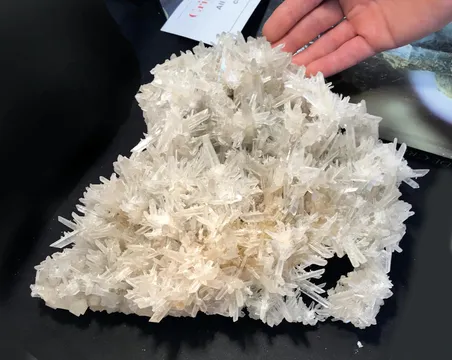
Quartz is the structural backbone of the Mont Blanc northwest-flank assemblage, occurring as rock crystal, smoky quartz, morion, gwindel, open-comb and closed-comb groups, and flattened or serrated alpine crystals from clefts in the granite and gneiss. Productive zones include Argentière, Les Droites, Les Courtes, Talèfre, Leschaux, Col des Cristaux, and Aiguille Verte, where quartz may be associated with chlorite, adularia, albite, titanite, epidote, siderite, and fluorite. The best quartz from this side of the massif is not merely large; it is sculptural, undamaged, and distinctly alpine, with strong luster, clean terminations, smoky zoning, attractive chlorite contrast, or a true gwindel twist. Ordinary pieces are abundant enough as broken points and simple smoky crystals; fine pieces are those that survived frost, pocket collapse, and a long descent from the wall without bruised tips or abraded faces.
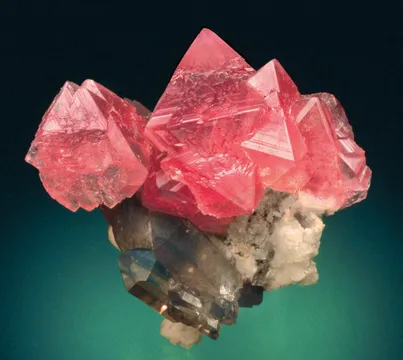
Fluorite is the glory mineral of the Chamonix side of Mont Blanc, famous for octahedral crystals in delicate pink, rose, raspberry-red, and deep red tones, most coveted when perched cleanly on smoky quartz or intergrown with white adularia, albite, and green chlorite. The leading specimen zones are the high Aiguille Verte–Argentière system, Les Droites, Les Courtes, Talèfre, Leschaux, the Périades, and related clefts of the northwest flank. Crystals may be small thumbnails, sharply isolated octahedra of one or two centimeters, or cabinet-scale combinations with fluorite octahedra several centimeters across; the exceptional museum pieces reach a scale and color saturation that place them among the finest alpine fluorites known. Good pieces show natural color, undamaged octahedral edges, pleasing placement, and a convincing alpine association; mediocre pieces are pale, bruised, detached, or aesthetically lost in broken quartz.
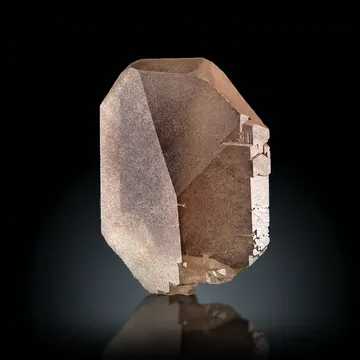
Smoky quartz from the Mont Blanc northwest flank ranges from pale tea-grey to deep brown and near-black morion, its color tied to natural irradiation in the granitic environment and its collector value tied to alpine form. It occurs as single prismatic crystals, clusters, floaters, gwindels, and support crystals for pink to red fluorite, with important occurrences around Argentière, Aiguille Verte, Les Droites, Les Courtes, Talèfre, and Leschaux. Fine specimens combine bright luster with smoky transparency, complex but undamaged terminations, clean separation between crystals, and attractive associations such as chlorite dusting, white adularia, or a well-placed fluorite octahedron. The finest smoky quartz pieces from this locality have a taut, mountain-made look: dark enough to be dramatic, transparent enough to light from within, and complete enough to show that they were collected from a protected cleft rather than recovered battered from moraine.
Feldspar at this locality is represented especially by K feldspar var. adularia and by albite, the pale framework minerals that give many Mont Blanc cleft specimens their contrast and alpine context. Adularia is recorded from Aiguille Verte, the Argentière catchment, Les Courtes, the Périades, Talèfre, Aiguille de Talèfre, and related northwest-flank clefts, commonly as white to translucent, blocky, rhombohedral, or wedge-like crystals associated with smoky quartz, chlorite, titanite, epidote, and fluorite. Albite can be present as white platy to blocky crystals and is particularly important on fluorite specimens where it provides a clean pale matrix. The best feldspar-bearing pieces are those where feldspar is not just “matrix” but part of the composition: sharp, fresh adularia or albite setting off smoky quartz and pink fluorite without overwhelming the main crystals.
Beyond the four market-defining species, the northwest flank has a compact but interesting suite of alpine-cleft and wall-rock minerals. Titanite is a serious mineralogical species here, especially from Les Courtes and the Périades, where recent analytical work has shown Al-rich titanite related to fluid-rock interaction and late quartz-stage crystallization. Rutile var. sagenite is historically important in the Mont Blanc region, its fine golden to reddish needles forming net-like intergrowths with quartz, muscovite, adularia, and anatase in some clefts. Anatase, brookite, epidote, siderite, calcite, muscovite, chlorite, hematite, pyrite, molybdenite, scheelite, beryl, arsenopyrite, galena, sphalerite, chalcopyrite, malachite, brochantite, aurichalcite, cerussite, linarite, monazite-group minerals, fluorapatite, and graphite are all documented from the regional page or its sublocalities. This is not chiefly a type-locality district in the specimen-collector sense; its distinction lies instead in the exceptional quality of a few alpine-cleft species and in historically resonant varietal names and habits such as gwindel quartz and sagenitic rutile.
Mont Blanc northwest-flank specimens demand careful locality scrutiny. Labels may read simply “Mont Blanc,” “Chamonix,” “Aiguille Verte,” “Argentière,” “Talèfre,” “Les Droites,” or “Haute-Savoie,” and older labels may not distinguish between the French northwest flank, the Italian southeast side of Monte Bianco, or Swiss Mont Blanc–Valais occurrences. For serious specimens, the most useful labels include the exact sublocality, the cristallier or finder, the year or approximate period of discovery, and a documented chain through a known dealer, collector, museum, or publication. Red-pink fluorite on smoky quartz from Chamonix is valuable enough that vague “Alpine” labels should be treated cautiously.
The locality is not known for a large, systematic trade in artificial fakes, but assembled, repaired, misattributed, and color-questionable pieces are realistic concerns because the best combinations are expensive. Red and pink fluorite should be assessed under neutral light for natural-looking color distribution, edge wear, glue lines, and suspiciously perfect placement on quartz. Chamonix fluorite commonly has a frosted or slightly complex surface, and small cleavages or edge nicks are common; a pristine, saturated red octahedron on flawless smoky quartz is possible but should carry correspondingly strong provenance. Repairs are not inherently disqualifying on major alpine pieces, but they should be disclosed.
Condition is the major grading issue. Alpine clefts suffer frost wedging, pocket collapse, seismic movement, and repeated freeze-thaw damage, so broken tips, bruised terminations, cleaved fluorite corners, rubbed quartz faces, and detached crystals are common. Moraine-recovered crystals may be naturally transported and abraded. For quartz, inspect terminations and side faces with a loupe; for fluorite, check every octahedral edge because small chips can be visually masked by the frosted surface. Chlorite coatings can be attractive, but heavy chlorite may hide damage or obscure whether the underlying quartz is lustrous.
Fluorite from Chamonix may fluoresce, and at least some fine pink octahedral material is reported as fluorescent under both longwave and shortwave ultraviolet. That said, fluorescence is not the main authenticity test here; color, form, association, and provenance matter more. Red and pink fluorite should be protected from prolonged strong sunlight and unnecessary UV exposure, as fluorite color centers can be light-sensitive in some localities and the strongest Mont Blanc pieces are too important to risk casually. Clean only with restraint: no acids without expert justification, no ultrasonics for fluorite-bearing pieces, and no aggressive mechanical cleaning around adularia, chlorite, and fine cleft minerals.
Market availability is uneven. Smoky quartz and modest quartz clusters from the Mont Blanc area appear regularly, but fine gwindels, morion, and aesthetic smoky quartz with strong Chamonix provenance are scarcer. Good pink fluorite thumbnails and miniatures appear occasionally; cabinet combinations with saturated red fluorite on smoky quartz are rare, expensive, and often remain in long-term collections. Pieces from named finds—especially Aiguille Verte, Argentière, Les Droites, Les Courtes, and the Laurent-related material—belong to the elite tier of modern Alpine collecting.
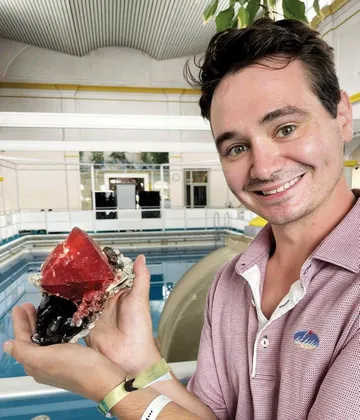
The most famous modern Mont Blanc fluorite story begins with Christophe Peray, an ethnologist and high-altitude cristallier whose life moved between Paris and Vallorcine. Peray had been hunting crystals in the Mont Blanc Massif since childhood, first taken onto the glaciers by his parents when he was about eight. In 1964 his family built a chalet in Vallorcine, and that small village became the base for decades of summer returns to the granite walls above Argentière and Talèfre. His reputation was secured in 2006, when he found the specimen now known as “Laurent” on Aiguille Verte: red fluorite octahedra on smoky quartz, later classified by France’s Commission des trésors nationaux as a bien culturel d’intérêt patrimonial majeur, the first natural-history object to receive that status. Peray named it for Laurent Chatel, his rope partner, who had died in a fall in 2005.
“Laurent” is not merely a pretty specimen. The Muséum national d’Histoire naturelle records it as 20 × 15 × 10 cm, inventory MNHN Inv. 210.1, from Aiguille Verte in the Mont Blanc Massif. It embodies the district’s two signature minerals: red fluorite and smoky quartz, both colored naturally in the granitic environment. In public accounts, the acquisition became a story about heritage, money, and the uneasy transition from traditional crystal hunting to a global specimen market. The Paris museum acquired the specimen in 2010 with corporate patronage; contemporary reports put the price at 250,000 euros or about $300,000. Peray could have sent the piece into the international private market, but the specimen stayed in France.
There was precedent for drama in these mountains. In 1979, Swiss prospectors blasted part of the Walker Spur on the north face of the Grandes Jorasses, one of the great lines of Alpine climbing. The outrage around that event helped push French authorities toward restricting crystal extraction in the Mont Blanc area. What survived from the older culture was tolerated only if it remained traditional: no explosives, no pneumatic drills, no helicopters, no industrial methods. In Chamonix the compromise hardened into declarations, codes of honor, and the obligation to show significant finds to local authorities and the museum. The result is a peculiarly French tension: the activity is both ancient and regulated, cherished and watched.
The daily reality is less romantic than the museum case suggests. Peray once described prospecting with mountaineering axes and ice melters. Cristalliers may spend hours tied into rock, crouched in narrow cavities, melting ice slowly because a careless hammer blow can shatter the crystals inside. In one account from Les Courtes and Aiguille Verte, Peray and Simón Elías moved from Chamonix to Montenvers, crossed the Mer de Glace, climbed ladders toward the Talèfre basin, and reached the Couvercle hut at 8,816 feet. From there, the route to one pocket required hours more. The Col des Cristaux, below the spiky Ravanel and Mummery Aiguilles, was reached at 11,814 feet; above it, dark crystals lay around camp because in a world where every kilo must be carried by a human back, ordinary pieces are simply not worth the descent.
One of the vivid lessons of the place is how close good mineralization can be to total invisibility. At a pocket below the ridge near Les Courtes, Peray explained that a classic climbing route passed only yards higher; thousands of alpinists had gone by perhaps 15 feet away without seeing it. Inside, crystals showed from the mud and roof. Some were already detached by frost and collapse. The cristallier’s work was selection as much as extraction: find the survivors, leave or discard the broken, wrap the good pieces, and carry them down.
Another pocket on the south face of Aiguille Verte lay around 12,795 feet, halfway up a cliff, in a horizontal crack perhaps eight inches wide. Below were roughly 1,500 feet of drop to the glacier. The collectors were not standing in front of a mine face; they were hanging in harnesses while one man prised out crystals and another wrapped the keepers in paper. The prize was red fluorite on smoky quartz, the same general association as “Laurent,” but the larger pieces that day were fractured. The haul was valuable but not miraculous. That distinction—between a good pocket and a life-changing pocket—is central to Chamonix collecting.
The older story is equally strong. William Windham and Richard Pococke came to Chamonix in 1741 and reported that crystal seekers worked in August, striking the rock with picks and listening for a hollow sound that betrayed a cavity. By the early nineteenth century, the influx of tourists, especially English visitors, made crystal selling part of the valley economy. Naturalist shops opened in the village, and Mont Blanc quartz entered the European cabinet world. The profession almost disappeared by the mid-twentieth century, then came back through the skills of guides and alpinists—Roger Fournier, Jean-Paul Charlet, Armand Comte, and others—who brought modern climbing technique to an old mountain craft.
The local vocabulary preserves that continuity. A four is not just any pocket; it is the natural oven-like cavity in the mountain where the crystals waited. A cristallier may mark a new one, return over seasons, work it in hours or over years, and protect its position with the discretion of a mushroom hunter and the seriousness of a climber guarding a route. The best stories from Mont Blanc specimens are therefore not only about the final object. They are about binoculars scanning for quartz veins in steep granite, bivouacs above the glacier, old clothing preferred over expensive alpine shells because crystal work destroys fabric, and the quiet moment when a hand enters mud and comes out holding a clear, smoky, or red-lit piece of the mountain.
Mindat.org — Mont Blanc Massif northwest flank, Auvergne-Rhône-Alpes, France. Regional locality page with Mindat Locality ID 158827, sublocality hierarchy, 31 listed valid minerals, and the note on Chamonix collecting rules introduced in 2008.
Mindat.org — Photo gallery for Mont Blanc Massif northwest flank. Specimen photographs including red fluorite on smoky quartz combinations, smoky quartz gwindels, and locality-specific image records.
Bayle, L.-D., ed. (1999) La Minéralogie du Massif du Mont-Blanc. Le Règne Minéral, Hors Série 5, Les Éditions du Piat, 78 pp. The core French special issue on Mont Blanc mineralogy, with articles on cleft formation, cristalliers, quartz, fluorite, blue beryl, Argentière, and related indices.
Google Books — La minéralogie du massif du Mont-Blanc. Bibliographic record and searchable term index for the 1999 Mont Blanc special issue.
Arlt, T., Asselborn, E., Benz, M., Bouillanne, B., Brandstetter, R., Gnos, E., Leinweber, A., Monistier, G., and Weiss, S. (2020) Mont Blanc. extraLapis 59, Christian Weise Verlag. A modern German-language monograph on Mont Blanc minerals and specimen localities.
Cathelineau, M., and Peiffert, C. (2024) “Al-Rich Titanites from Mont Blanc Alpine Fissures: Evidence of Ti-Nb-Y-REE Mobility during Water–Rock Interactions.” Crystals 14(5), 472. Analytical study of titanites from Mont Blanc alpine fissures, especially Périades and Courtes, with implications for fluid-rock interaction during uplift.
DOAJ record for Cathelineau and Peiffert (2024). Open-access bibliographic and abstract page for the Mont Blanc titanite study.
Egli, D., Mancktelow, N. S., and related authors (2017) “Constraints from 40Ar/39Ar geochronology on the timing of Alpine shear zones in the Mont Blanc–Aiguilles Rouges region of the European Alps.” Tectonics. Structural and geochronological context for the shear zones framing the northwest side of the massif.
Leloup, P. H., Arnaud, N., Sobel, E. R., and Lacassin, R. (2005) “Alpine thermal and structural evolution of the highest external crystalline massif: The Mont Blanc.” Tectonics 24, TC4002. Key paper on the thermal and structural evolution of the Mont Blanc external crystalline massif.
von Raumer, J. F., and Bussy, F. (2004) “Mont Blanc and Aiguilles Rouges: Geology of their polymetamorphic basement.”. Geological guide-style publication covering the basement rocks, granites, and type locality of the Montenvers granite near Mer de Glace.
Jardin des Plantes / MNHN — Fluorite Laurent. Official museum record for the famous Aiguille Verte red fluorite on smoky quartz specimen, including dimensions and inventory number MNHN Inv. 210.1.
MNHN — “Découvrez 5 minéraux remarquables, présentés en Galerie de Minéralogie”. Museum feature identifying “Laurent” as a major cultural-heritage object and one of the notable specimens in the Galerie de Minéralogie.
Mindat.org — Fluorite from Mont Blanc Massif. Occurrence entries and references for fluorite across the massif, including the French northwest flank and Chamonix sublocalities.
Mindat.org — Quartz from Mont Blanc Massif northwest flank. Occurrence entries for quartz, smoky quartz, amethyst, and gwindel quartz from the northwest flank and its sublocalities.
Mindat.org — Smoky Quartz from Mont Blanc Massif northwest flank. Locality occurrences for smoky quartz, including Les Droites, Argentière, Leschaux, Talèfre, and associated references.
Mindat.org — Scheelite from Mont Blanc Massif northwest flank. Occurrence record for scheelite with reference to the Uromine prospecting work in Valais and the Mont Blanc region.
Mont-Blanc : la fièvre des cailloux — Apple TV. A 2024 French documentary, 30 minutes, about Chamonix cristalliers searching for crystals as glacier retreat exposes new ground.
La Montagne des Cristalliers — Netflix. Documentary following four friends hunting crystals in the Mont Blanc range and making an exceptional discovery.
“La Montagne des Cristalliers — Teaser” — Grimpisme / Fred Vionnet. Teaser for a film documenting the working of one of the major crystal pockets discovered in the Mont Blanc Massif.
“Dame Nature | Espace Tairraz Chamonix” — Radio Mont Blanc. Short media feature on the Musée des Cristaux at Espace Tairraz, Chamonix, which displays thousands of crystals and contextualizes the local cristallier tradition.
Mindat.org — Mont Blanc Massif northwest flank, Auvergne-Rhône-Alpes, France — The essential locality database entry for the regional mineral list, hierarchy, and collecting-regulation note.
Mindat.org — Photo Gallery: Mont Blanc Massif northwest flank — Useful visual reference for specimen habits, associations, and labels from the Chamonix side.
Mineraltown — “A brief summary of the mineral occurrences and geology of Monte Bianco” — Collector-oriented overview of the massif, its glaciers, alpine cleft collecting, and cristallier context.
Club de minéralogie de Chamonix — Arrêté du Maire, Code d’honneur, Convention — Primary source for the local collecting declaration, code of honor, and Chamonix rules.
Club de minéralogie de Chamonix — Code of Honor — English-language version of the cristalliers’ code and its obligations.
Club de minéralogie de Chamonix — Cristaux et cristalliers — Concise local explanation of Mont Blanc crystal formation, fours, and high-altitude collecting.
Chamonix.com — Chamonix Mont-Blanc, terre des cristalliers — Strong historical and cultural overview of the Chamonix cristallier tradition.
Chamonix.com — Chamonix Mont-Blanc, land of crystals — English version of the Chamonix tourism article on the crystallier heritage.
Jardin des Plantes / MNHN — Fluorite Laurent — Official museum object page for the famous Aiguille Verte fluorite and smoky quartz specimen.
MNHN — Five remarkable specimens in the Galerie de Minéralogie — Museum feature explaining the heritage importance of “Laurent.”
Wikimedia Commons — Red fluorite on smoky quartz from Aiguille Verte, MNHN — High-resolution photograph of the MNHN “Laurent” specimen.
Wikimedia Commons — Pink fluorite on smoky quartz from Argentière Glacier — Public-domain image of classic Argentière fluorite and smoky quartz.
Wikimedia Commons — Fluorite, smoky quartz, and adularia from Argentière Glacier — Useful visual reference for the pink fluorite–smoky quartz–feldspar association.
Outside — “The Elite Mountaineers Who Hunt for Rare Crystals” — Long-form field narrative on Christophe Peray, Simón Elías, Les Courtes, Aiguille Verte, and the modern cristallier world.
Le Dauphiné Libéré — “Plus cher qu’une émeraude de Colombie” — Contemporary French press coverage of the price, controversy, and museum acquisition context for the Laurent fluorite.
Mindat.org — JQL-7HA fluorite, smoky quartz, chlorite specimen — Record for the celebrated 1999 Frédéric Ancey fluorite and smoky quartz combination from the Grand Montets ridge/Aiguille Verte north face.
Mindat.org — Fluorite with Albite and Quartz, Mont Blanc — Example of a documented pink fluorite miniature with albite and quartz from the regional locality.
Mindat.org — Argentière Glacier locality — Sublocality page with references, including modern apatite reporting and the broader regional context.
Mindat.org — Col des Cristaux locality — Sublocality page for quartz, smoky quartz, gwindel quartz, and chlorite from a classic high collecting area.
Mindat.org — Aiguille Verte locality — Sublocality page documenting fluorite, quartz, and adularia from one of the most important specimen-producing zones.
Mindat.org — Pointe des Périades locality — Sublocality record for fluorite, quartz, smoky quartz, titanite, epidote, albite, adularia, and related cleft minerals.
Mindat.org — Aiguille de Talèfre locality — Sublocality record for quartz, gwindel quartz, adularia, siderite, and titanite.
Cathelineau and Peiffert (2024) — Al-rich titanites from Mont Blanc alpine fissures — Open-access analytical paper useful for advanced collectors interested in titanite and fluid-rock chemistry.


_rose_sur_quartz_fum%C3%A9_1(France).jpg)