Mono County, USA — renowned for Champion Mine rutile on pyrophyllite, with mirror-bright red to dark crystals and mineralogy prized by collectors.
Key facts
Mono County is one of California’s most distinctive collector localities because its best-known cabinet specimens did not come from a conventional precious-metal vein, but from a high-alumina metamorphic andalusite body high on the west flank of White Mountain. The Champion Mine, also known historically as the White Mountain, Jeffrey, Champion Sillimanite, and Champion Spark Plug Company mine, worked an andalusite-rich quartzite deposit developed in intensely aluminous rocks. For collectors, its signature is unmistakable: mirror-bright, deep red to nearly black rutile crystals set in white, cream, tan, or iron-stained pyrophyllite and diaspore, with a secondary suite of phosphate, sulfate-phosphate, and aluminosilicate minerals that is far more sophisticated than the simple “rutile on pyrophyllite” label suggests.
Regional View
Country View
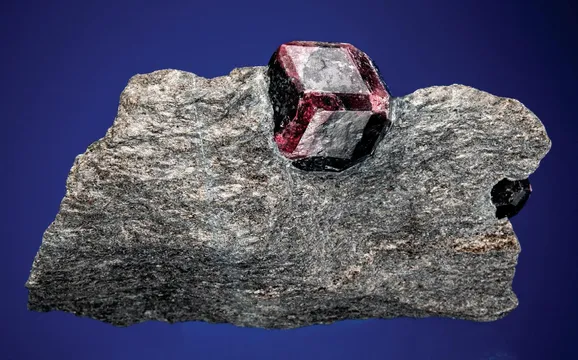
The Champion material is classic American alpine-desert mineralogy: sharp titanium oxide crystals from a mine better known industrially for ceramic raw material. The finest rutiles are chunky, isolated, lustrous crystals with red internal reflections, standing proud of pale pyrophyllite rather than buried in massive altered rock. Their appeal is partly visual—dark, metallic, blood-red rutile against soft white to golden pyrophyllite—and partly historical. The ore went to the Champion Spark Plug Company for refractory and insulating ceramics, while the unusual phosphate suite drew the attention of academic mineralogists, including the description of woodhouseite from the mine.

Photo: Wikimedia Commons
Mono County’s mineral story is broader than White Mountain alone. The Bodie Hills and Masonic district brought gold, silver, tellurium, bismuth, arsenic, copper, and selenium mineralogy into the county’s record; the Pittsburg-Liberty mine is especially important to micromounters as a co-type locality for bodieite and as a source of rare oxidation-zone species. The county therefore occupies an unusual collecting niche: one part classic cabinet rutile locality, one part historic western mining country, and one part modern micro-mineral laboratory.
Search for specimens: View all specimens from Mono County, USA
The collector locality behind most Mono County rutile and pyrophyllite specimens is the Champion Mine on White Mountain Peak in the White Mountains, west of the crest and above Jeffrey Mine Canyon. It was an andalusite mine, not a rutile mine in the economic sense. The worked body is an andalusite-bearing quartz mass enclosed in aluminiferous schistose rock; the quartz-andalusite mass is described as striking roughly northwest and dipping steeply southwest, with altered wall rocks rich in andalusite, diaspore, corundum, pyrophyllite, and muscovite. Pneumatolytic and hydrothermal activity associated with nearby granitic intrusions produced the high-alumina mineral assemblage, while later phosphate-bearing fluids introduced and redistributed unusual Ca, Sr, Ba, Fe, and Al phosphate and sulfate-phosphate species in seams, cavities, and quartz fractures.
The commercial ore at Champion was hand-sorted andalusite-rich rock. Historical descriptions emphasize pods and segregations in massive quartz rather than a broad, easily mined tabular orebody. One reported ore zone was only several feet to a few tens of feet thick, with the more extensive Vulcanus No. 8 body exposed southwest of the main mine across Jeffrey Mine Canyon. Production was modest in tonnage but high in grade: about 20,000 tons of hand-cobbed andalusite rock grading 53 percent or more andalusite is commonly cited for the Champion operation, with the known minable reserves largely exhausted by the 1930s.
Mining began after andalusite became valuable for spark-plug insulators and related ceramics. The Champion Spark Plug Company explored the deposit during the World War I period, built mule trails, camps, and other facilities, and operated the mine through difficult high-desert mountain logistics. Later work continued on a smaller scale, with two camps, a blacksmith shop, laboratory facilities, bunkhouses, cookhouses, and electrical power supplied by a generating plant. C. D. Woodhouse served as mine manager, and D. M. Lemmon, working as chemist and geologist, documented minerals that made the locality scientifically important. The mine closed in the early 1940s as reserves declined and industrial demand shifted.
The specimen-producing zones are better understood by their mine names than by a single “Champion Mine” label. The Diaspore Workings yielded large rutile crystals embedded in diaspore and associated pyrophyllite; the Blackhawk Tunnel produced smaller but brilliant rutile in pyrophyllite seams; the main Vulcanus No. 1 workings are important for woodhouseite, corundum, quartz pockets, and phosphate minerals; and the Vulcanus No. 8 area is noted for scorzalite-lazulite-series material, larger but sparse woodhouseite, svanbergite, unusual quartz, and rare small pockets. A separate phosphate-rich seam above the main camp—the so-called phosphate-pegmatite in collector literature—is a small but remarkable zone carrying augelite, trolleite, apatite-group minerals, natroalunite, barite, diaspore, and related rarities.
Access should not be treated casually. The Champion ground has been described as patented mining ground and long abandoned as an active mine, but land status and permissions must be checked before any visit. The workings are reached by old mule trails rather than maintained collecting roads, and the terrain is steep, loose, high, and exposed. Published collecting accounts describe a base area around 8,700 feet with important sites roughly another 1,000 feet higher on the rim of a natural amphitheater of workings; collapsed tunnels, slides, unstable shale, and old stopes are part of the locality. Many modern specimens on the market are old collection pieces, later field-collected surface or dump pieces, or material recovered from boulders and mine dumps, rather than fresh production from active mining.
Elsewhere in Mono County, the Bodie and Masonic districts represent a different class of mineralization. Bodie is the county’s celebrated gold-silver camp, while the Masonic district in the northern Bodie Hills includes the Pittsburg-Liberty mine, a former gold mine on New York Hill. That mine exploited multiple veins and fault-breccia mineralization in granodiorite and schist and later proved unexpectedly rich in complex secondary Bi-Te-Cu-As-Sb-Se oxysalts. For the thumbnail and cabinet collector, Mono County may mean rutile on pyrophyllite; for the micromounter, it also means bodieite, cannonite, juabite, richelsdorfite, mcalpineite, mixite, and other oxidation-zone species from the Masonic district.
Rutile from Mono County is chiefly the Champion Mine material: sharp, lustrous, blocky to short-prismatic crystals, commonly deep red, reddish black, or nearly black externally, with red internal reflections visible on thin edges or bright broken areas. The best specimens came from pyrophyllite and diaspore-rich zones at the Diaspore Workings and Blackhawk Tunnel, where rutile occurs as isolated, well-formed crystals in pale to iron-stained pyrophyllite seams or embedded in diaspore; crystals up to about 2 inches across have been reported from the Diaspore Workings, while market specimens more often show crystals from thumbnail size to about 1–2 cm, and occasional old pieces carry larger crystals. Good Mono County rutiles are judged by luster, form, contrast, and exposure: a complete, mirror-faced, red-flashing crystal perched on clean white or cream pyrophyllite is far superior to a bruised, half-buried crystal in stained massive matrix.
Pyrophyllite from Mono County is not merely matrix; at the Champion Mine it is a locality-defining aluminosilicate that forms white, cream, tan, golden-brown, or iron-stained radiating masses, sheaves, and platy aggregates in seams through andalusite-bearing rock and altered schist. Published locality notes describe sheaves of plates to about 12 mm, thin seams in the Diaspore Workings, and pyrophyllite-rich veins in the Blackhawk Tunnel that may carry brilliant rutile crystals; attractive pieces show silky to pearly radiating fans, clean separation of blades, and either strong contrast with rutile or associations with muscovite, diaspore, and andalusite. Stand-alone pyrophyllite specimens from Champion are less glamorous than rutile-bearing plates but can be excellent when the sprays are complete, lustrous, and three-dimensional rather than flattened, stained, or massive.
Beyond rutile and pyrophyllite, Mono County’s most important mineralogical name is woodhouseite, CaAl3(PO4)(SO4)(OH)6, first described from the Champion Mine and named for C. D. Woodhouse. Champion also produced andalusite, diaspore, corundum, augelite, lazulite-scorzalite-series material, trolleite, topaz, barite, svanbergite, natroalunite, fluorapatite and hydroxylapatite, strengite, phosphosiderite, goethite after pyrite, quartz, muscovite, tourmaline, and small but desirable phosphate-suite specimens. In the Masonic district, the Pittsburg-Liberty mine is a co-type locality for bodieite, Bi2(TeO3)2(SO4), and has yielded significant micro-specimens of cannonite, mojaveite, juabite, mcalpineite, richelsdorfite, chalcomenite, chalcophyllite, cornwallite, mixite, olivenite, rooseveltite, and related bismuth-tellurium-copper-arsenic oxidation minerals.
Mono County rutile on pyrophyllite is readily recognizable, but mislabelling is common enough to matter. Champion Mine pieces can be confused with Graves Mountain, Georgia material because both localities produce rutile with pyrophyllite; the Mono County pieces tend to have a more high-alumina metamorphic, andalusite-diaspore-phosphate context, while Graves Mountain material is often labelled simply as rutile on pyrophyllite from Georgia and may show different matrix character. Old labels are valuable here: “Champion,” “White Mountain,” “Jeffrey Mine,” “Champion Sillimanite,” “Champion Spark Plug,” “Vulcanus,” “Diaspore Workings,” and “Blackhawk Tunnel” can all refer to parts of the same broader White Mountain collecting area.
The main condition issues are mechanical. Rutile crystals may be bruised on high points, cleaved or contacted where they were pried from pyrophyllite, or partly lost from angular cavities in soft matrix. Pyrophyllite is soft and platy, so matrix edges abrade easily and silky fans can crush or shed flakes. Iron staining is natural and common, especially on material from the Diaspore Workings, but heavy limonite can hide the best pyrophyllite texture and reduce contrast. Avoid aggressive cleaning: pyrophyllite and associated sulfate minerals are not suited to harsh acid treatment or prolonged soaking, and soluble secondary sulfates from old mine environments should be kept dry and stable.
No well-known systematic fake industry is associated with Champion Mine rutile, but assembled or misattributed pieces should still be approached critically. A suspicious specimen would be one where a rutile crystal appears glued into a cavity, sits unnaturally on a freshly broken soft matrix, or lacks the intergrowth and contact relationships normally seen in pyrophyllite or diaspore. Because good rutile crystals are valuable and the locality is no longer an active commercial source, provenance, matrix consistency, and old collection history all carry weight.
The rarity split is sharp. Small rutile-in-pyrophyllite examples appear periodically, especially from older collections, but clean, showy, isolated rutile crystals with strong red translucency and undamaged faces are genuinely scarce. Fine pyrophyllite-only specimens are less expensive but far less often appreciated. Woodhouseite and most Champion phosphate-suite minerals are specialist material; they may be visually modest, but locality-confirmed examples are important to systematic collectors. The Masonic district rarities are mostly micro-minerals and should be bought with analytical confidence whenever possible, especially for bodieite, mojaveite, cannonite, and related Bi-Te-Cu-As species.
The Champion Mine is one of those localities where the romance of a specimen begins long before the crystal reaches the cabinet. The mine sat high on White Mountain, in country steep enough that roads never truly conquered the upper workings. Supplies went in by mule. Ore came out by mule. The old trails, built to carry a working mine rather than weekend collectors, became the arteries of the entire operation. Even decades after closure, field descriptions still found them surprisingly durable, though washed out near Jeffrey Mine Creek and torn in places by slides.
The reason for all that effort was industrial, not ornamental. Andalusite became valuable for spark-plug insulators, and the Champion Spark Plug Company pushed into what was then essentially wilderness. The company built trails, camps, corrals, laboratories, bunkhouses, cookhouses, blacksmith facilities, and eventually an electrified operation supplied by a generating plant on Pine Creek. For collectors accustomed to seeing only a 4 cm rutile on a shelf, the original scale is sobering: every timber, tool, sack of food, and sorted lump of high-grade andalusite had to travel through the same mountain system.
The camp layout has the character of a mining map and a mountaineer’s sketch at once. The workings sit around terrain described almost like a cup: camp at the bottom, specimen-producing workings high around the rim. A collector starting from base camp at about 8,700 feet still had roughly another 1,000 feet of climbing to reach the important sites. The main Vulcanus No. 1 workings were a strenuous climb but rewarded careful eyes with quartz fracture plates of small pale to pinkish woodhouseite crystals. Above them lay the phosphate-rich zone, small in extent but loaded with species that punish haste and reward a hand lens. The Blackhawk Tunnel, one of the great rutile areas, was also hazardous—driven into loose aluminiferous shale and collapsed in several places.
One of the most memorable details from Champion’s collecting lore is sulfur catching fire during blasting. Sulfur occurred in masses within the andalusite body when the mine was active, and blasts could ignite it underground or in broken ore. Today the same species is merely an occasional small yellow crystal in cavities in andalusite-corundum rock, but the image of a refractory-ceramic mine producing burning sulfur amid white quartz and alumina minerals is pure White Mountain strangeness.
The mine also has a human footnote that collectors tend to remember. W. E. Jeffrey, president of the Champion Spark Plug Company, reportedly enjoyed vacationing at the ranch and kept a cabin at the lower camp. One published field account even floated the possibility that his fondness for the place helped keep the operation alive after strict industrial necessity had weakened. Whether or not that fully explains the mine’s longevity, it fits the locality: a spark-plug company, a high mountain ranch, mule trails, rare phosphates, and some of the finest rutile specimens in the United States all bound together in one improbable California story.
The Masonic district, to the north in the Bodie Hills, offers a different frontier episode. Gold was found there in the 1860s, but the real excitement waited until around 1900, when Joseph Green, a 16-year-old from Bodie, found rich gold samples in Masonic Gulch and staked the Jump Up Joe Mine. Soon afterward, the Pittsburg-Liberty mine became the district’s principal producer. A century later, that same mining ground became important again for reasons the early miners could scarcely have imagined: tiny vugs in oxidized dump material held bismuth-tellurium sulfate minerals, including bodieite, a species named for the Bodie Hills and the nearby ghost town whose fame had outlived its ore.