






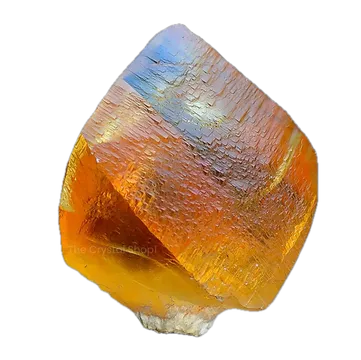
Calcite from Leiping Mine, in the Leiping area of Guiyang County, Chenzhou, Hunan, is one of the unmistakable modern Chinese calcite styles: lustrous, sharp, often translucent to gemmy crystals animated by warm iron-oxide and hematite color. The best specimens do not rely on size alone. They have architecture—wing-like twins, stacked rhombs, spiky scalenohedral sprays, and multi-generation crystals where clear late calcite wraps or caps an older, rust-red included core.
Key facts
Calcite from Leiping Mine, in the Leiping area of Guiyang County, Chenzhou, Hunan, is one of the unmistakable modern Chinese calcite styles: lustrous, sharp, often translucent to gemmy crystals animated by warm iron-oxide and hematite color. The best specimens do not rely on size alone. They have architecture—wing-like twins, stacked rhombs, spiky scalenohedral sprays, and multi-generation crystals where clear late calcite wraps or caps an older, rust-red included core.

Photo: Wikimedia Commons
The locality sits within southern Hunan’s celebrated non-ferrous mineral country, in the broader Nanling and Qin–Hang metallogenic belts. These belts are better known to economic geologists for W-Sn-Cu-Pb-Zn-polymetallic mineralization and to collectors for the astonishing Chinese specimen boom of the late twentieth and early twenty-first centuries. Leiping calcite belongs to that same collector history: material appeared on the international market in quantity around the late 1990s and early 2000s, then diminished into a recycled-collection market where choice pieces are increasingly treated as contemporary classics.
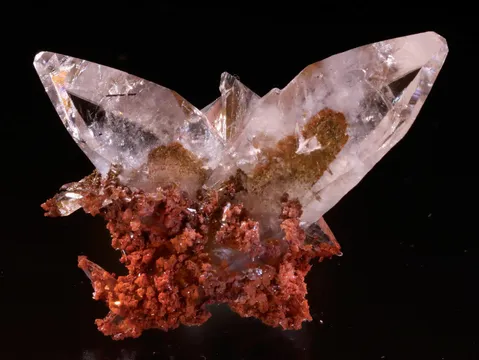
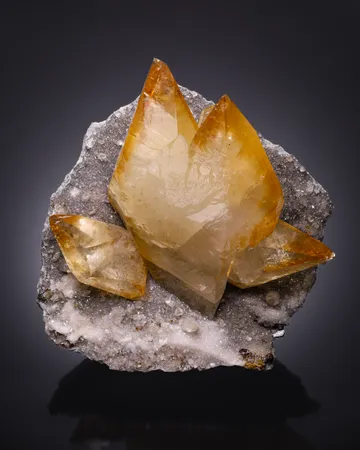
The most famous Leiping-related form is the V-shaped, “butterfly” or “fishtail” twin, especially material attributed to Mine No. 884 in the Leiping area. These twins can be colorless, smoky, golden, or iron-stained, with hematite phantoms lending reddish internal brushstrokes. Other highly desirable forms include robust scalenohedrons with brick-red hematite, rhombohedral clusters with stacked or “pagoda” architecture, and large plates of broad, chunky crystals with pyramidal terminations and visible phantoms.

Photo: Wikimedia Commons
Collectors look for sharp, undamaged terminations; glassy to adamantine luster; clear internal zoning; vivid but natural red hematite inclusions; and displayable composition. In better examples, the attraction is not just the orange or red color but the way the inclusions record growth history: a white or colorless calcite core, an iron-rich red zone, and a later clear overgrowth can all be visible in one crystal.
Search for specimens: View all calcite specimens from Leiping Mine, China
Leiping Mine is listed at Leiping, Guiyang County, Chenzhou, Hunan Province, China, with an estimated position near 26° N, 113° E. In collector usage, “Leiping” can refer both to the named Leiping Mine and to nearby Leiping-area workings such as Mine No. 884 and Xinxin Mine, so labels should be read carefully. Mindat treats Leiping Mine, Mine No. 884, and Xinxin Mine as distinct locality entries under Leiping; specimen labels and dealer descriptions, however, often use the broader Leiping Mine name for material from the same collecting district.
The mineral list for the named Leiping Mine is compact: calcite, hematite, quartz, and smithsonite are recorded. Photo-based associations for calcite from Leiping emphasize hematite most strongly, with quartz and pyrite also reported on specimens. Mine No. 884 is more narrowly documented for calcite and hematite, and it is the source most often connected with the celebrated V-shaped calcite twins attributed to Leiping.
Geologically, the locality lies in southern Hunan’s polymetallic province, within regional belts that host major Mesozoic magmatic-hydrothermal and skarn-related mineralization. For specimen purposes, the Leiping calcites are best understood as open-space hydrothermal calcite growths in an iron-bearing environment: the calcite grew in pockets or vein cavities, while hematite and iron oxides became included, dusted, coated, or concentrated as phantoms during successive growth episodes. The accessible collector literature emphasizes the specimen style far more than mine-scale ore geology, so the precise orebody classification of the Leiping calcite pockets should not be overstated from specimen labels alone.
The collecting history is relatively modern. The classic Leiping and Mine No. 884 calcites entered the market mainly in the late 1990s and early 2000s. Many dealer descriptions from major auction and retail archives repeat the same chronology: the V-twin “butterfly” calcites were recovered around 2000, the spiky and multi-generational habits followed or overlapped in the early 2000s, and the finest examples now tend to come from older collections rather than fresh mining.
Notable finds include gemmy V-twins, hematite-included scalenohedrons, transparent rhombohedral groups with reddish phantoms, and large cabinet plates. One documented Leiping specimen measured 29 x 18 x 6.5 cm and consisted of a broad plate of chunky calcite crystals with pyramidal terminations and visible internal phantoms. Another large Mine No. 884 cabinet specimen, sold at auction in 2025, measured 41 x 22 x 19 cm and carried tapering calcite spikes reported up to 7.5 cm long. These large pieces show that Leiping was not only a miniature or thumbnail locality; it produced serious cabinet specimens with scale, texture, and strong stage presence.
Collecting access should be considered closed or permission-only. This is an active or former mining locality in China, not a public collecting site. Serious collectors should assume that field access requires local permission, mine authorization, and awareness of mine safety conditions. For most collectors outside China, the practical collecting route is the specimen market, especially older dealer stock, auctions, collection dispersals, and carefully attributed pieces from established China-specialist dealers.
Leiping calcite is most admired in four overlapping habits.
The first is the V-shaped twin: a pair of sharp, wing-like crystals forming a “butterfly” or “fishtail” silhouette. These can be colorless to pale golden, smoky, or reddish from hematite. The finest examples are sharp, balanced, translucent to gemmy, and aesthetic from several angles. Some show an X-like complexity where extra crystal growth extends below the main twin.
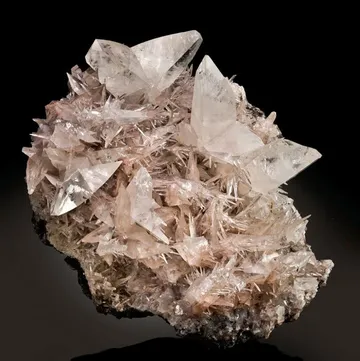
The second is the scalenohedral or spiky style. These specimens can form hedgehog-like aggregates of tapering crystals, often pale gray, colorless, orange, or brick-red. Better examples have needle-sharp terminations, strong luster, and red hematite concentrated toward the bases, edges, or internal zones of the crystals. Crystal sizes in this habit commonly run from about 1 to 4 cm, but documented large examples reach several centimeters longer.
The third is the rhombohedral and nailhead style. These include broad, flattened rhombs, stacked “pagoda”-like groups, and thick, chunky crystals with pyramidal or modified trigonal terminations. Some are orange-red and gemmy; others are smoky gray, silvery, or colorless with red inclusions. Rhombohedral crystals reported from the market commonly range from miniature scale to 4 cm or more on edge.
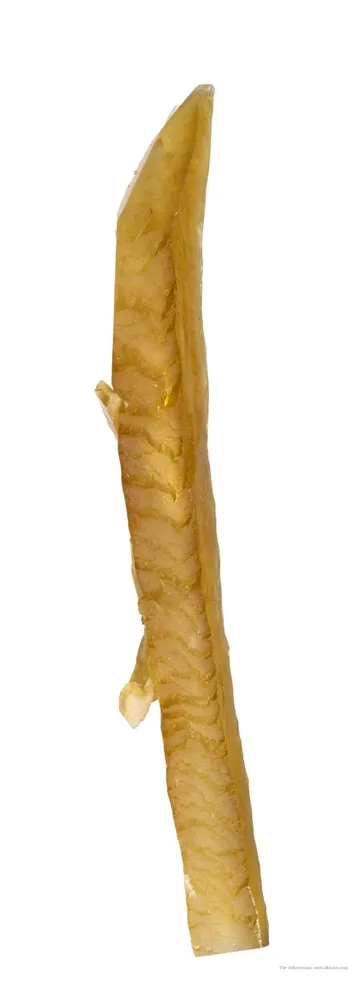
The fourth is the multi-generational phantom style. These are among the most mineralogically engaging Leiping calcites. A specimen may show an early bone-white calcite generation, a later hematite-rich red zone, and a final transparent to translucent clear calcite overgrowth. In the best examples, the outer clear layer is thick enough to reveal the red internal zoning as true phantoms rather than mere surface staining.
Color is a major locality signature. Leiping calcite ranges from colorless and white through pale champagne, honey, smoky gray, orange, brick-red, and reddish brown. The red tones are tied to hematite or iron oxides, often included inside the calcite rather than simply coating the surface. Some specimens show reddish striations or star-like phantoms suspended within otherwise clear crystals. A documented Leiping specimen also showed strong fiery orange fluorescence on side faces under shortwave ultraviolet light, although fluorescence should be treated as a specimen-specific bonus rather than a universal property of the locality.
Associated minerals are not abundant in most display specimens. Hematite is the defining associate and may appear as inclusions, phantoms, red dustings, or iron-rich matrix. Quartz is documented from the named Leiping Mine and appears rarely on specimens. Pyrite is reported in photo-based data, and smithsonite is listed for the locality, though it is not part of the classic calcite aesthetic that made Leiping famous.
Quality is judged first by crystal sharpness and damage, then by clarity, luster, color placement, and composition. The best Leiping pieces are crisp enough that the terminations read clearly from across a case, yet transparent enough to show the internal red architecture. A merely red calcite is not automatically a fine Leiping specimen; the premium material combines hematite color with transparency, symmetry, and a growth form that cannot be mistaken for a generic iron-stained calcite.
Leiping calcite is widely collected but no longer common in top quality. Ordinary examples still appear online, especially small iron-stained calcites and modest rhombic groups, but sharp, balanced V-twins and large undamaged cabinet specimens are much scarcer. Much of the better material circulating today has collection provenance rather than fresh mine provenance.
Authentication is mostly a matter of locality confidence and style recognition. Classic Leiping specimens should show natural calcite luster, believable hematite or iron-oxide zoning, and growth forms consistent with the district: V-twins, spiky scalenohedrons, broad rhombs, pyramidal terminations, stacked growth, or multi-generation phantoms. Because other Chinese calcite localities also produce red, orange, and “chocolate” calcites, labels should not be accepted on color alone. The most convincing pieces have old dealer labels, collection history, minID records, or a specimen style matching well-documented Leiping and Mine No. 884 material.
There is no need to assume that vivid red-orange Leiping calcite has been dyed. The locality is genuinely known for hematite and iron-oxide coloration. Still, calcite in general is vulnerable to artificial coloring, surface coating, acid cleaning, gluing, and repair, and general calcite fakes exist in the broader market. Brightly colored carbonate specimens from any source should be inspected under magnification for dye concentration in cracks, unnatural surface films, glue at attachment points, and color that sits only on broken or porous areas.
Condition is the central issue. Calcite is soft, has perfect rhombohedral cleavage, and Leiping crystals often stand proud on thin matrix plates or as delicate twins. Chipped tips, cleaved side faces, bruised edges, and contacted crystal faces are common. Some specimens have sawed backs or trimmed matrix bases to improve display; this is not inherently fraudulent if disclosed, but it affects value for collectors who prefer fully natural bases. Large plates should be checked for repaired crystals, stabilized matrix, and old impact points along the edge of the plate.
Market availability spans a wide range. Small to modest Leiping calcites can be found in the low hundreds of dollars, and recent online listings have shown examples in roughly the $90 to several-hundred-dollar range. Better cabinet specimens, especially sharp twins or large multi-generational plates, move higher. A large Mine No. 884 cabinet specimen from the Dan Kennedy Collection sold at Heritage Auctions in October 2025 for $2,000, while several MineralAuctions examples in 2023–2024 closed in the mid-hundreds. Exceptional older-label twins, large undamaged display pieces, and specimens from notable collections command premiums well beyond ordinary iron-stained calcite.
The Leiping story is a compact modern specimen-market story: a Chinese mine produces a burst of distinctive calcite around the turn of the millennium, the best pieces scatter through international dealers and private collections, and within a generation the material becomes a recognizable classic.
One specimen description preserved through Wikimedia Commons captures the excitement around the Mine No. 884 material particularly well. The piece, from the Dr. Stephen Smale Collection, measured 8.3 x 5.4 x 4.3 cm and carried a small but pristine twinned calcite only 2 cm from tip to tip, perched among razor-sharp spikes. The description called it part of “the most famous single calcite find of the modern era in China,” a collector’s phrase, certainly, but one that explains why these specimens still have such strong name recognition. The best pieces from that find did not simply look like red calcite; they looked engineered—twin wings, needle points, translucent bodies, hematite accents, and a three-dimensional arrangement that photographs only partly convey.
Another Leiping specimen in the public image record tells a different story: not the butterfly twin, but the oversized plate. At 29 x 18 x 6.5 cm, it was described as a giant plate from a spectacular find, with broad chunky crystals, flashing symmetrical pyramidal tips, and internal phantoms. Some terminations measured 3 cm across. That is the kind of measurement collectors remember, because it separates Leiping from the many localities that produce attractive thumbnails but not commanding cabinet plates.
The modern auction trail adds its own afterlife. A Mine No. 884 cabinet specimen from the Daniel “Dan” R. Kennedy Collection sold in October 2025 measured 41 x 22 x 19 cm and carried calcite spikes reported to 7.5 cm long. By then, the Leiping finds were no longer new discoveries. They were mature classics being re-evaluated through provenance, display quality, and survival condition. The auction description noted minor chatter on some tips—an almost inevitable comment for a large spiky calcite—but the specimen’s scale and sculptural spread show why collectors keep returning to Leiping material even when flashier new Chinese finds enter the market.
A smaller 2024 auction specimen links Leiping to another famous collecting name: Stephen Smale, the mathematician and mineral collector. That calcite, an 11.7 x 8.2 x 3.7 cm cabinet piece, carried a sharp translucent butterfly-twinned group over reddish hematite-included crystals. The description noted one tiny nick, otherwise superb shape, and emphasized that the twin was not merely two wings but had a partial X-form. Such details matter in Leiping collecting. The locality is abundant enough that a generic red calcite is not rare, but a well-balanced, gemmy, multi-directional twin with a major collection provenance becomes a very different object.
.jpg)


