Mid-Continent Mine, USA: Tri-State locality famed for rubyjack sphalerite, metallic galena, chalcopyrite, and amber calcite on chert; prized for vuggy, three-d…
Key facts
Mid-Continent Mine is one of the great collector localities of the Kansas side of the Picher Field, in the Tri-State Mining District of Missouri, Kansas, and Oklahoma. It is not famous because it produced exotic species in profusion; it is famous because it produced the classic Tri-State look at its most recognizable: red-brown to black sphalerite, sharp metallic galena, brassy chalcopyrite, pale pink to buff dolomite, and amber to honey calcite set on chert-rich carbonate matrix. The mine worked a lead-zinc Mississippi Valley-type ore system in the Mississippian Boone Formation, where mineralizing brines exploited fracture, breccia, contact, and replacement zones in cherty limestone. For collectors, that geology matters because the best specimens are vug and open-cavity pieces rather than dull massive ore: clean crystal plates with contrast, relief, and the “old American sulfide” character that made the Tri-State District a staple of mid-20th-century mineral cabinets.
Regional View
Country View
The finest Mid-Continent pieces are emphatically three-dimensional. A good sphalerite specimen shows large, lustrous “rubyjack” crystals on dolomite or chert, often dusted with bright chalcopyrite. A good galena is not merely a lead-gray cube: it may be skeletal, hoppered, or complexly stepped, with a metallic sheen and crisp form. Calcite from the mine can be particularly elegant when it rises as amber scalenohedra above the darker sulfides, and the rarest cabinet conversation pieces are the altered calcite associations in which gypsum or selenite and blue-green copper-zinc sulfate minerals create improbable color over the standard Tri-State sulfide assemblage.
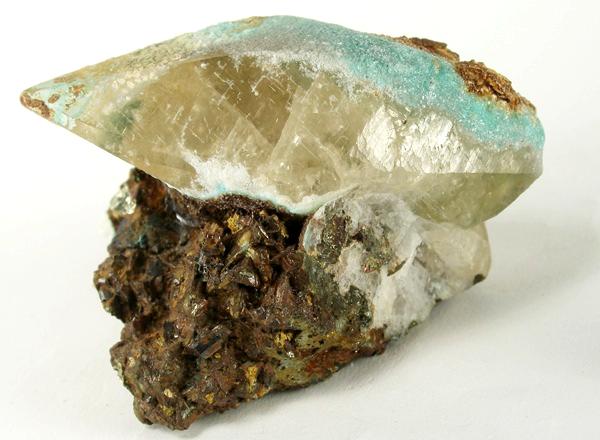
Photo: Wikimedia Commons

Photo: Wikimedia Commons
Search for specimens: View all specimens from Mid-Continent Mine, USA
Mid-Continent Mine lies at Treece, Cherokee County, Kansas, in the Picher Field, only a short distance from the Oklahoma state line. The recorded position is in NE¼ SE¼ SW¼ sec. 11, T35S, R23E, 6th Principal Meridian, with the mine plotted at about 37.00417, -94.86111. It was a former underground lead-zinc occurrence and mine on private fee land, discovered in 1920 and first produced in 1922. The USGS Mineral Resources Data System described the property as a Pb-Zn mine, with lead and zinc as the exploited commodities, and recorded fee ownership by the heirs of Hannah E. Wright in the 1976 data set.
Geologically, the mine belongs to the great Tri-State class of Mississippi Valley-type carbonate-hosted lead-zinc deposits. In the Picher Field, sphalerite and galena occur chiefly in the Boone Formation, a Mississippian sequence of cherty limestone and related carbonate units. The ore was localized by open structure and favorable beds: fractures, breccia fill, tabular disseminations, replacement zones, and contacts between altered carbonate masses and more silicified ground. The classic Picher zoning pattern explains much of the specimen character. Dolomite-rich cores, jasperoid replacement zones, and boulder ground could grade outward into different crystal assemblages; sphalerite was especially strong near the dolomite margin, galena commonly increased just outside it, and chalcopyrite and other copper-bearing minerals were more characteristic of the dolomitic side of the system.
The ore body data recorded for Mid-Continent describe a body about 6 meters thick, 300 meters wide, and 600 meters long, with the top of ore at about 95 meters depth and a minimum depth-to-top of 88 meters. Three ore-body forms were recorded: breccia fill, tabular disseminated ore, and hydrothermal replacement. Primary ore control was fracturing, with a secondary contact-zone control. Wall-rock alteration was described as intense, notably silicification and dolomitization. That is exactly the setting that produced the collectible plates: sulfides and carbonates lining open spaces, chert fragments in the matrix, dolomite crystals carrying tiny chalcopyrite, and calcite perched over darker ore minerals.
Mining in the broader Picher Field began commercially in 1904 and continued through the middle of the 20th century. The district was among the most productive lead-zinc areas in the United States, and the Kansas Treece and Baxter Springs subsites are part of the same historical and environmental story as Picher, Oklahoma. By the late 1950s the last large underground operations in the Picher Field had closed, although smaller operations and scavenging continued into 1970. Mid-Continent’s collector importance is tied especially to the district’s final years, when the mine was worked not only for ore but also as a specimen source. Toward the end of the Tri-State era, Charles “Chink” Enders and his father Red Enders were associated with the mine; Chink Enders became a legendary dealer-guide figure who brought collectors underground and supplied large quantities of Mid-Continent and nearby Picher Field material to the market.
Collectors should treat Mid-Continent as a closed historical locality. The workings are inactive, the district is heavily affected by mine waste, subsidence hazards, contaminated water, and Superfund cleanup, and the surrounding Treece area underwent a federal and state relocation program because of the legacy of lead-zinc mining. Modern access is not a collecting opportunity in the old sense. Land ownership, government controls, fencing, safety risks, and contamination all make casual collecting inappropriate. Provenance now matters: the best specimens are old pieces from miners, dealer stock, or established collections, often with 1950s–1970s labels or later museum/dealer documentation.
The notable specimen finds were cavity and pocket pieces from the underground workings. Period accounts describe large open spaces and abundant crystals in the late 1960s, when collectors could pay a day fee and keep what they found. Plates of sphalerite, galena, dolomite, chalcopyrite, and calcite entered collections in quantity, but the high-end pieces remain distinctive: clean crystal architecture, sharp individual crystals, good contrast between red-brown sphalerite and pale dolomite or calcite, and unusual secondary coatings or pseudomorphs. The much rarer gypsum/selenite after calcite pieces with blue-green ktenasite-like coatings are especially prized because they depart from the standard Tri-State palette while remaining unmistakably Mid-Continent in matrix and association.
Calcite from Mid-Continent is best known as sharp amber, honey, tan, or translucent scalenohedral crystals perched on darker sulfide matrix, commonly with sphalerite, galena, dolomite, chalcopyrite, chert, and locally gypsum or ktenasite-like blue-green coatings; individual documented specimens range from thumbnails and miniatures to cabinet pieces, with crystals several centimeters long and at least one old example described as a 5.5 x 4.5 x 3.5 cm specimen carrying a lustrous amber scalenohedron on sphalerite with chalcopyrite. Ordinary Mid-Continent calcite is simply part of the carbonate gangue, but the collectible pieces show sharp termination, translucency, elevation above the matrix, and strong color contrast; the rarest examples are altered or coated crystals, including gypsum or selenite after calcite and blue-green copper-zinc sulfate-bearing surfaces that have sometimes been historically mislabeled.
Sphalerite is the defining zinc mineral of Mid-Continent and occurs as dark resinous to red-brown “rubyjack” crystals, commonly on dolomite or chert and associated with galena, chalcopyrite, calcite, marcasite, gypsum, and rare ktenasite-bearing coatings. The best pieces show large, lustrous, well-separated crystals rather than compact ore; documented old specimens include an 8.1 x 5.9 x 3.1 cm example with crystals exceeding 4 cm, a size that is impressive even for a Tri-State collector. In the Picher Field zoning model, sphalerite is strongest near the dolomite margin, and Mid-Continent specimens that preserve that relationship—dark or red-brown sphalerite rising from pinkish dolomite and touched with brassy chalcopyrite—are more desirable than massive black fragments or bruised mine-run ore.
Chalcopyrite from Mid-Continent is usually an accessory, but it is one of the minerals that gives the locality its sparkle: small brassy, commonly sharp crystals scattered over pale pink to buff dolomite, on sphalerite, or near calcite. The classic habit is not a giant chalcopyrite specimen but a balanced plate where millimeter-scale golden crystals animate the surfaces of dolomite and darker sulfides; one documented Mid-Continent plate measures 11.4 x 7.2 x 4.6 cm and was described as iridescent chalcopyrite on light pink dolomite, while another 12.0 x 9.7 x 4.3 cm piece carried pyramid-like chalcopyrite crystals to about 7 mm on curving pink dolomite with calcite on the reverse. Good chalcopyrite pieces here are judged by distribution, freshness, and contrast, since scattered bright crystals can make an otherwise ordinary dolomite-sphalerite plate come alive.
Galena from Mid-Continent occurs as metallic gray cubes, cuboctahedral forms, skeletal crystals, hoppered growths, and complex stepped aggregates, typically with sphalerite, calcite, dolomite, chalcopyrite, marcasite, and chert. The best specimens are sharply formed and sculptural rather than merely blocky; a documented 6.7 x 6.3 x 4.9 cm specimen shows a complex skeletal-growth galena crystal with multiple overlapping habits, and other Kansas Tri-State pieces show cuboctahedra enhanced by chalcopyrite dustings or set on brecciated chert. Condition is crucial because galena’s cleavage and soft surfaces readily show bruising; the pieces collectors prize most are lustrous, minimally contacted, and three-dimensional, with enough matrix or associated sphalerite-dolomite-calcite to place them unmistakably in the Mid-Continent/Picher Field suite.
Dolomite at Mid-Continent is both gangue and display mineral, commonly forming pale pink, buff, cream, or light tan curved rhombs and crystal carpets that host sphalerite and bright chalcopyrite. In the Picher Field, dolomitization was central to ore localization, and the collector expression is especially attractive where dolomite forms a soft-colored crystalline ground for dark sphalerite, metallic galena, or golden chalcopyrite. Good dolomite pieces from this mine are not judged by dolomite alone; they are judged by the quality of the mineral stage it frames—sparkling chalcopyrite on pink dolomite, rubyjack sphalerite perched cleanly on dolomite, or calcite rising from a dolomite-sulfide matrix. Chert fragments and brecciation in the back of specimens are common and can be a useful visual clue to Tri-State origin.
Ktenasite is one of the most unusual documented species from Mid-Continent and appears as turquoise to blue-green coatings or fine crusts on calcite and gypsum-bearing specimens, associated with chalcopyrite and sphalerite. Its presence makes sense chemically in a zinc-copper sulfate environment generated by alteration of zinc and copper sulfides, but it is rare at the specimen scale; documented examples include ktenasite and gypsum on scalenohedral calcite crystals to 4.5 cm on sphalerite matrix, and another specimen marketed as a 3.8 x 6.6 x 3.0 cm ktenasite-on-calcite piece with shiny chalcopyrite and dark sphalerite. The finest examples are valued for unmistakable blue-green color, clear association with old Mid-Continent calcite-sulfide matrix, and sound documentation, because historic labels have sometimes called similar coatings “melanterite” or “micro-selenite” when later interpretation points instead to ktenasite-dominant material.
Gypsum from Mid-Continent is chiefly important as selenite or gypsum after calcite on sulfide-rich matrix, not as freestanding desert-style gypsum crystals. The most distinctive pieces preserve scalenohedral calcite form while carrying colorless to white gypsum or selenite overgrowths and, in the best examples, blue-green ktenasite-like inclusions or coatings, all set on sphalerite and chalcopyrite. Documented specimens include an 8.5 cm example from the A. E. Seaman Mineral Museum described as gypsum after calcite pseudomorphs with ktenasite inclusions on sphalerite and chalcopyrite, and a 6.0 x 4.9 x 4.2 cm auctioned example described as selenite after calcite with melanterite on sphalerite and chalcopyrite. Good pieces retain bold calcite shape, visible selenite texture, and sulfide contrast; ordinary or questionable pieces can be difficult because some post-mining sulfate growths and oil-field-water gypsum occurrences in the district complicate interpretation.
Other minerals documented from Mid-Continent include enargite, malachite, marcasite, pyrite, quartz, and the selenite variety of gypsum. Enargite is a noteworthy copper-arsenic sulfide rarity in the district context, while malachite and ktenasite-style coatings represent the more colorful secondary copper alteration on a locality otherwise dominated by zinc-lead-iron sulfides and carbonate-silica gangue. Mid-Continent is not recognized as a type locality in the major published locality records used by collectors, but its rarities matter because they sit on unmistakable Tri-State matrix and often occur on old specimens collected before the area closed to meaningful access.
Mid-Continent specimens are old-locality material, and provenance is a major part of value. Labels from Chink Enders, Red Enders, older Midwestern collections, the George Feist collection, the Harold Urish collection, the Mullane collection, or museum deaccessions and old dealer stock add confidence. Many pieces circulated simply as “Picher,” “Treece,” “Kansas,” “Oklahoma,” or “Tri-State District,” and some were sold in barrels as commercial-grade material; precise Mid-Continent attribution is strongest when supported by an old mine-specific label, a recognized dealer record, or a distinctive documented specimen history.
The main authenticity concern is mislabeling rather than outright fabrication. Because Mid-Continent lies in the Picher Field near the Oklahoma line, specimens may be incorrectly labeled “Picher, Oklahoma” even when the mine is the Kansas Mid-Continent Mine, and some material raised through or sold from Mid-Continent-era dealers may have come from nearby mines. The gypsum/selenite/blue-green coating specimens require extra caution: historic labels have used names such as melanterite, micro-selenite, malachite, chrysocolla, or ktenasite for visually similar coatings. Serious collectors should be comfortable with “as labeled” uncertainty unless a specimen has modern analytical support or a respected published/dealer pedigree.
Condition issues are typical of old sulfide specimens. Galena is soft and cleaves easily, so bruised cube corners, rubbed high points, and broken skeletal edges are common. Sphalerite can chip along sharp crystal edges and may show dull abrasion on exposed faces. Chalcopyrite tarnishes and can lose the bright brassy snap that makes Mid-Continent dolomite plates desirable. Marcasite and pyrite should be watched for instability, especially in humid storage, though not every Tri-State specimen has a problem. Gypsum and ktenasite-bearing pieces are more delicate: avoid washing, prolonged humidity swings, and unnecessary handling of powdery or fibrous coatings.
Market availability is steady but finite. Mid-Continent was productive enough that ordinary sphalerite-dolomite-chalcopyrite pieces and small galena specimens still appear in auctions and dealer inventories. Better pieces—large rubyjack sphalerite crystals, sculptural galena, sharp calcite on sulfide, and any convincing ktenasite or gypsum-after-calcite association—are much less common and are increasingly treated as classic American locality specimens rather than inexpensive old mine material. Size alone is not enough; the market rewards sharpness, contrast, three-dimensional form, old labels, and confidence that the specimen is truly Mid-Continent rather than a generic Tri-State piece.
In the late 1960s, Mid-Continent was still close enough to the mining era that a collector could enter a world now completely gone. George Robinson later recalled making several trips to the mine near Treece when it was being worked by Chink Enders and his father, Red Enders. Red, according to Robinson, was the one with the lease and was less interested in specimens than in salvaging ore—robbing pillars and selling what he could to Eagle-Picher. Chink and a few part-time miners did most of the specimen work, and collectors knew him as the man who could lead them into the old underground.
The arrangement sounds almost unbelievable now: Robinson remembered the collecting fee as $10 per day, keep whatever you found. Underground, Chink kept a jeep, and Robinson rode in it many times. The image is pure Tri-State: a jeep moving through old stopes beneath the Kansas prairie, with chert, dolomite, sphalerite, galena, and calcite glittering from broken ground and open pockets. Robinson emphasized that there was no official “Chink Enders Mine” in the formal sense; most of Chink’s specimens came up through the Mid-Continent main shaft, but not every specimen he sold necessarily came from Mid-Continent itself. With Chink, Robinson wrote, “anything was possible.”
Susan Robinson passed along one of the most vivid collector memories from the district. Her husband George described Mid-Continent collecting in the late 1960s as “fabulous”—crystals everywhere, with open cavities the size of a living room. On one trip he used up 600 pounds of newspaper and had to search for more packing material. The minerals were shipped home in 55-gallon barrels. That single detail explains why ordinary Tri-State specimens were once common in rock shops and why the best Mid-Continent pieces still appear from old collections today: the mine was not just sampled; it was harvested by people who knew they were standing in a closing chapter of American specimen mining.
The ending came quickly. Once large-scale pumping stopped in the district, the water table returned and underground access disappeared. The mine workings flooded, shops closed, headframes vanished, and the specimen barrels became time capsules. Later visitors to the Picher-Treece region found fenced land, warning signs, chat piles, and a landscape defined less by collecting than by cleanup, buyouts, and subsidence. Mid-Continent’s specimens carry that before-and-after contrast strongly: bright sulfide plates from a locality whose underground world can no longer be revisited.