Miandrivazo, Madagascar — a collector locality famed for rock crystal quartz hosting violet-to-blue fluorite octahedra, rare hollow inclusions, and precise loc…
Key facts
Miandrivazo is one of those Malagasy names that carries more weight on mineral labels than it does as a single pin on a map. For collectors, its importance rests above all on a brief, spectacular find of rock crystal quartz containing sharp violet-to-blue fluorite crystals: small octahedra and rare larger clusters suspended just beneath the outer faces of clear quartz prisms. The material appeared on the international market at the 2005 Tucson shows and immediately stood apart from ordinary included quartz. Here the inclusion is not rutile fuzz, chlorite moss, or hematite dust, but discrete, geometric fluorite—often positioned directionally on one side of the quartz, as if a final mineralizing pulse decorated the crystal before the last skin of silica sealed it in.
Regional View
Country View
The name “Miandrivazo” has also created persistent label confusion. In the specimen trade it was used for the fluorite-in-quartz discovery, while later reporting placed the actual mine near Amborompotsy in central Madagascar, reached from the village only by motorcycle or on foot. Older labels may say Miandrivazo, Fianarantsoa Province, Amborompotsy, or simply Madagascar; modern administrative geography places Miandrivazo in Menabe, while Amborompotsy belongs to Ambatofinandrahana District in Amoron'i Mania. For a collector, this is not a trivial clerical point: good documentation should preserve the original trade label while noting the corrected locality history.
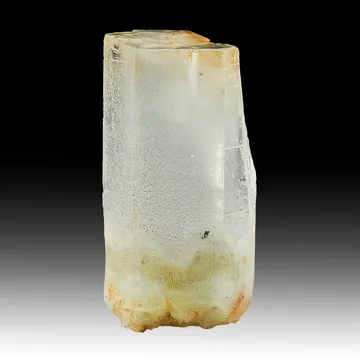
The best specimens have a deceptively simple beauty. A slim, clear, sometimes doubly terminated quartz crystal becomes a transparent display case for vivid blue or purple fluorite octahedra. In top pieces the inclusions are sharp, colorful, isolated enough to read as crystals rather than stains, and positioned so they are visible without heavy backlighting. Some crystals also show hollow octahedral negative spaces where fluorite was later dissolved out along fine cracks, creating a second generation of interest: the crystal that was, and the ghost it left behind.
Search for specimens: View all specimens from Miandrivazo, Madagascar
Collector usage of “Miandrivazo” is best understood in two overlapping ways. First, Miandrivazo is a town and district in Menabe, western Madagascar, an area with documented gold, uranium, smoky quartz, beryl, chrysoberyl, Nb-Ta oxides, bismuth minerals, pyrite, topaz, tourmaline, and related pegmatite or gold-field minerals recorded from sublocalities such as Dabolava, Analadihirina, Maromena, Ankavandra, and the Makay massif. Second, and most relevant to the EarthWonders fluorite-quartz specimens, Miandrivazo was a trade locality name applied to the famous fluorite-in-quartz find later reported near Amborompotsy. That find came from a quartz vein about 80 cm wide cutting quartzite host rocks. The quartz crystals had already grown large and clear before a late fluorite event deposited blue to violet fluorite on selected quartz faces; continued quartz growth then engulfed the fluorite, preserving it as internal crystals.
The fluorite-in-quartz occurrence was not an industrial fluorite deposit. It was a specimen and gem-inclusion pocket in a quartz-vein environment, worked by local miners with hand tools. Production began with the first recovery of included material in late November 2004 and ended abruptly by late February 2005, when a cave-in buried the productive area. The reported total output was modest: about 300 kg of fluorite-included quartz, plus about the same amount of quartz without fluorite inclusions. Most of the included material consisted of single quartz crystals; some were doubly terminated, and crystals reached roughly 23 cm in length. Crystal clusters were much rarer.
The regional Miandrivazo district has a different geological story. Around Dabolava, roughly east to southeast of Miandrivazo, gold mineralization is associated with Proterozoic amphibolite-facies volcano-sedimentary rocks, quartzofeldspathic gneisses, carbonates, granodioritic orthogneisses, and gabbroic intrusions. Studies of the Dabolava gold occurrences describe auriferous quartz veinlets concordant with amphibolite-leucogneiss foliation, as well as thicker quartz veins transposed in shear zones cutting granodioritic orthogneiss. Pyrite and electrum are key phases in the dated gold assemblages, with work indicating more than one mineralizing event. These gold-field quartz veins help explain why “quartz from Miandrivazo” can mean very different things depending on the specimen: smoky quartz and gold-field material from the Menabe district are not the same collector occurrence as the fluorite-included rock crystal that made the name famous among inclusion collectors.
Mining history in the district is likewise mixed. The Dabolava area has long been known for gold, with intensive artisanal exploitation in laterite and basement rocks and significant early twentieth-century alluvial production. The Rafiatokana gold prospect near Ankavandra was reportedly discovered by the French engineer Levat in 1912 as a broad zone of quartz veinlets extending for kilometers, and it was later worked as the Rafiatokana Gold Project by Pan African Mining Corp. in 2009. None of that makes Miandrivazo a specimen-friendly public collecting district today. Collecting access should be treated as private, local, and rights-controlled; old coordinates and regional locality names are not invitations to visit. For the fluorite-in-quartz material, the important productive pocket is historical and was reported buried, so the specimens circulating now are almost entirely from old parcels, dealer stock, collection recycling, and occasional auction reappearances.
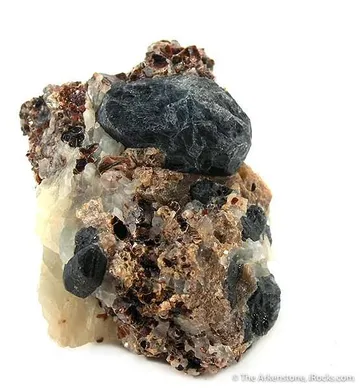
The collector-grade fluorite associated with the Miandrivazo name is most prized not as freestanding cubes but as violet-to-blue octahedral inclusions sealed inside clear quartz; individual fluorite inclusions were reported up to about 7 mm across, with some larger grouped clusters, and many show strong color zoning from light blue to intense violet. They occur mainly in the near-surface growth zones of the quartz and, importantly, only beneath certain crystal faces and usually on one side of the host, a pattern that records late, directional fluorite deposition before the final quartz overgrowth. Good pieces have sharply formed, saturated octahedra visible through transparent quartz, preferably with multiple inclusions at different depths; ordinary pieces are weakly included, cloudy, heavily chipped, or so polished that specimen character is sacrificed. Separate green cubic fluorites sold in recent years as Malaimbandy or Miandrivazo-area material belong to a different central Madagascar fluorite occurrence near the Ambatofinandrahana–Malaimbandy road and should not be confused with the classic fluorite-in-quartz pocket.
Quartz is the host, the showcase, and the reason the locality matters: slim rock crystal prisms, commonly single and occasionally doubly terminated, enclosing blue-to-purple fluorite octahedra near the outer growth zones. Reported crystals range from small gem rough and miniatures to specimens over 20 cm long, though displayable clusters were scarce from the original production. The finest quartz is water-clear enough to reveal the fluorite without polishing, with clean terminations, minimal bruising, and inclusions arranged where they can be seen from the main display face; lesser material may be frosted, cracked, edge-worn, or cut into slabs, cabochons, emerald cuts, and polished points to improve visibility. Negative octahedral cavities, sometimes partly filled with yellow-brown or rust-red epigenetic material, are part of the locality’s diagnostic character and can add interest when they do not dominate the specimen.
Beyond the fluorite-in-quartz pocket, the wider Miandrivazo district has a broad but unevenly collectible mineral record. Dabolava and related gold-field localities are documented for native gold, pyrite, chalcopyrite, bornite, malachite, skutterudite, and native silver at Rafiatokana; pegmatitic localities in the district have yielded beryl, tourmaline, topaz, muscovite variety gilbertite, columbite-tantalite, aeschynite-(Y), and pyrochlore-supergroup material formerly described as betafite. Uranium minerals such as autunite and carnotite are also recorded from district localities, and silicified wood is known from the Makay massif. None of these has eclipsed the fluorite-included quartz in collector recognition, and the Miandrivazo name should not be treated as a single mineralized pocket covering all of these very different occurrences.
The main authenticity issue is not synthetic material but locality discipline. Miandrivazo-label fluorite-in-quartz has been sold under several names, including Miandrivazo, Amborompotsy, and older Fianarantsoa Province wording. A well-documented specimen should ideally preserve the original label and add a note that the classic material was reported near Amborompotsy, not at the town of Miandrivazo itself. Be wary of vague “Madagascar fluorite in quartz” labels when the piece lacks the typical features: clear rock crystal, blue-to-violet octahedral fluorite, inclusions concentrated near the outer growth zone, and possible fluorite-shaped negative cavities.
Condition must be judged with a loupe and with side lighting. These are slender quartz crystals, often handled and resold for two decades, so edge chatter, bruised terminations, and small contact marks are common. Internal fractures can either help reveal the inclusion history or detract from transparency; surface-reaching cracks are especially important because they allowed some fluorite inclusions to dissolve away, leaving empty octahedral casts or loose trapped remnants. Polishing is not inherently fraudulent—much of the material was deliberately cut or polished for gem and inclusion study—but polished faces, recut points, and slabs should be priced as lapidary/inclusion specimens rather than untouched cabinet minerals.
Top natural specimens are now genuinely scarce. The original pocket was short-lived, reported production was limited, and a considerable amount of material was cut into gems, polished points, slabs, and cabochons. Market appearances today are intermittent: small polished stones and gem pieces appear more often than fine unpolished crystals, while cabinet-size, doubly terminated quartz with multiple vivid fluorite octahedra can perform strongly at auction. For valuation, clarity and inclusion quality matter more than sheer size. A large cloudy quartz with vague purple dots is less desirable than a smaller, clean crystal displaying sharp, saturated octahedra in an undamaged viewing window.
Fluorescence claims should be handled carefully. The classic Miandrivazo/Amborompotsy fluorite-in-quartz material is collected for visible inclusions, not for daylight fluorescence. Green cubic fluorite from central Madagascar, commonly associated with Malaimbandy or the Ambatofinandrahana–Malaimbandy road occurrence, may show daylight blue zoning or a Rogerley-like response, but that is a different specimen category. Do not let fluorescence marketing blur the distinction between green fluorite clusters and the older violet-blue fluorite inclusions in quartz.
At Tucson in 2005, when truly new Malagasy specimen sensations were not easy to come by, a small discovery of included quartz suddenly gave dealers and inclusion specialists something unfamiliar to crowd around. At the Clarion Hotel, Frederic Gautier of Little Big Stone Co. in Antananarivo was offering rock crystal that looked, at first glance, like ordinary clear quartz—until light caught the interior. Suspended beneath the surface were tiny blue and violet fluorite crystals, many of them with clean octahedral form. In a market used to quartz with needles, veils, phantoms, and garden-like chlorite, this was startlingly architectural: crystals inside crystals, each fluorite octahedron preserved like a miniature mineral specimen in a transparent case.
The deposit itself was not glamorous. The productive vein was reported to be only about 80 cm wide and to cut quartzite host rock. Reaching the mine from Amborompotsy required a motorcycle or walking because the road was too poor for easier transport. Local miners worked the vein with hand tools through the first months of the find. The pocket’s entire collecting history was compressed into a few months: included quartz was first recovered in late November 2004, and by the end of February 2005 a large cave-in had buried the productive area. That abrupt ending became part of the locality’s mystique. Dealers expected more; collectors waited for a second wave; the rich supply never came.
The numbers explain why good pieces vanished so quickly into collections. The reported production was about 300 kg of fluorite-included quartz and another 300 kg of quartz without fluorite. Most pieces were single crystals, only a few were clusters, and much of the material was immediately divided into categories for specimens, cutting rough, polished points, faceted stones, slabs, and cabochons. One reported faceted quartz weighed 21.68 ct and displayed three large blue fluorite inclusions; the largest cut stone known to the original reporter at the time was believed to be about 100 ct. For mineral collectors, that lapidary success was bittersweet: every handsome polished point or faceted gem meant one fewer natural crystal survived as a specimen.
Under the microscope, the story became even better. The fluorite was not randomly scattered through the quartz. It sat near the outer zones, beneath selected crystal faces and often on only one side of the host. That directional placement showed that the fluorite came late, during the final stage of quartz growth. Some inclusions had later been reached by hairline cracks and partially dissolved. In a few cases a tiny fluorite crystal remained loose inside its own fluorite-shaped chamber, free to move but trapped forever within the quartz. In others the fluorite disappeared completely, leaving a colorless octahedral void or a cavity dusted with yellow-brown debris. The result is one of Madagascar’s most memorable small mineral dramas: growth, entombment, damage, dissolution, and preservation, all visible in a single clear crystal.