A collector's guide to Mexquitic de Carmona Municipality, Mexico: its geology, mining history and notable minerals, illustrated with the 22 specimens documented from this locality on EarthWonders.
Key facts
Mexquitic de Carmona, just west-northwest of the city of San Luis Potosí, is one of those deceptively small localities whose importance is far larger than its outcrop. To most collectors it means one thing above all: fluor-buergerite, the ferric, fluorine-dominant tourmaline species first described from cavities in rhyolite near Mexquitic. The specimens are classic old-Mexico material—dark bronze-brown to nearly black prismatic tourmalines, commonly lustrous and sharply terminated, set in pale rhyolitic to feldspathic matrix with quartz, opal, feldspar, and mica-group minerals. The best pieces have a distinctive metallic-bronze glow in strong light, a scatter of stout trigonal prisms over matrix rather than isolated broken crystals, and enough relief from the host rock to show the species’ habit clearly.
Regional View
Country View
The collecting story is part of the attraction. Fluor-buergerite was originally introduced to science and the specimen trade simply as “buergerite,” named in honor of MIT crystallographer Martin J. Buerger. The 2011 tourmaline-supergroup nomenclature revision recognized the Mexican type material as fluorine-dominant, making fluor-buergerite the correct species name and leaving “buergerite” as a legacy label encountered on older specimens. For serious collectors, a Mexquitic label is not merely a place name; it identifies the type locality and the benchmark material by which this uncommon tourmaline is recognized.
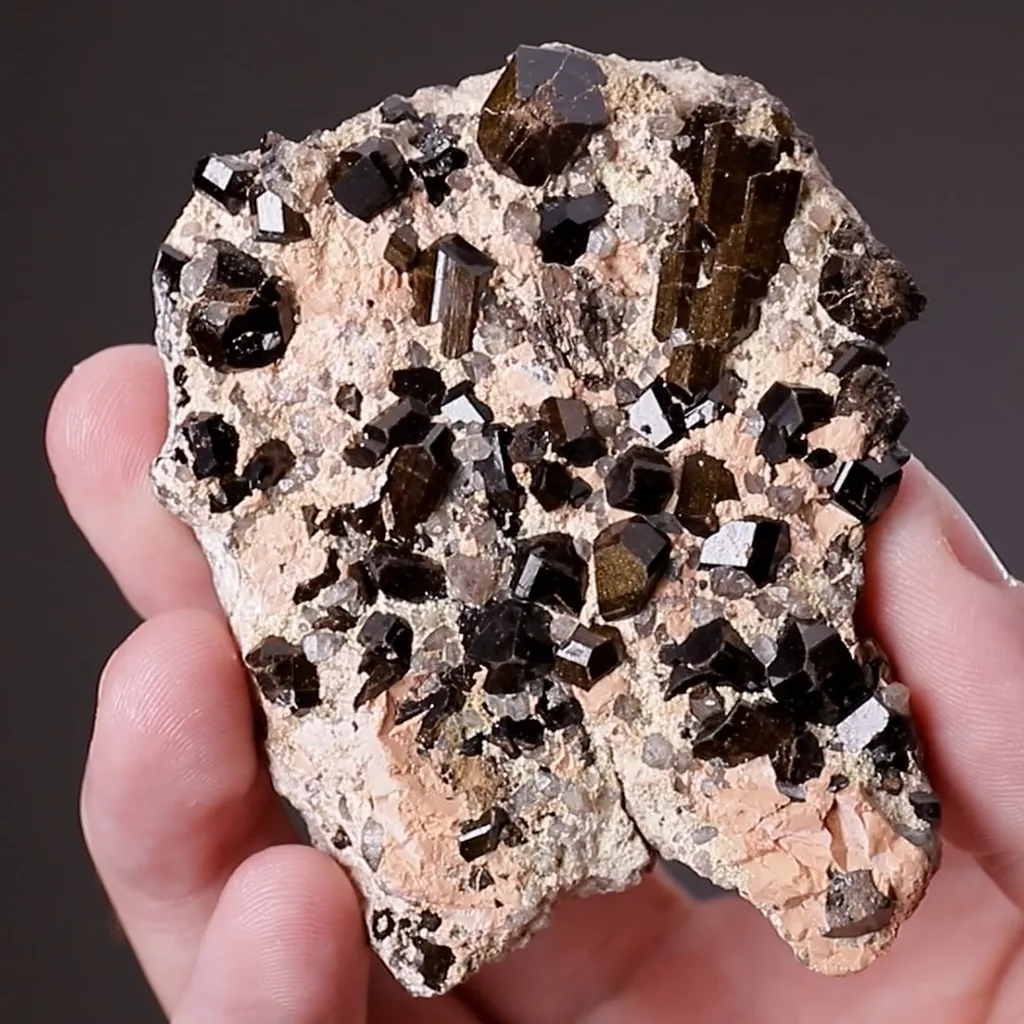
Photo: EarthWonders
Search for specimens: View all specimens from Mexquitic de Carmona Municipality, Mexico
The fluor-buergerite occurrence is an outcrop locality rather than a conventional mine. The mineral is recorded from argillized rhyolite at approximately 22°16′ N, 101°07′ W, within a municipality dominated by Cenozoic volcanic rocks. Regional work by the Servicio Geológico Mexicano places Mexquitic de Carmona in the central-western part of San Luis Potosí, close to the state capital, with a municipal area of about 882.4 km2 and a mean elevation near 2,020 m. The broader bedrock picture is a mixture of sparse Upper Cretaceous marine sedimentary rocks and much more extensive Oligocene–Miocene volcanic units, including rhyolitic tuff, rhyolite, latite, basaltic andesite, and rhyolitic ignimbrite.
For collectors, the essential host is rhyolite. The original mineralogical descriptions treat the fluor-buergerite as probable pneumatolytic material formed in cavities in rhyolite, with quartz, potassic feldspar, plagioclase, biotite, and muscovite as associated minerals. That setting is quite different from the pegmatitic and metamorphic tourmaline occurrences familiar to most collectors. Here the tourmaline is tied to a volcanic environment, with dark ferric crystals perched on or partly embedded in pale, altered, rhyolitic matrix. Later locality records add albite, possible andesine, possible kaolinite, opal, quartz, agate, chalcedony, and K-feldspar to the documented assemblage.
No ore body comparable to a vein mine or replacement deposit is documented for the fluor-buergerite occurrence. It is best understood as a small, localized mineralized cavity system in altered rhyolite. In the wider municipality, government inventory work records a history of metallic, nonmetallic, dimension-stone, and aggregate resources, but these are not the specimen source that made the name Mexquitic famous. The municipal inventory notes potential or production involving tin, zeolite, kaolin, phosphorite, pumicite, optical calcite, rhyolitic tuff “cantera,” and construction aggregates. Thin hematite and cassiterite veinlets in volcanic units were worked artisanally on a small scale by gambusinos, while many stone and aggregate workings are small open cuts, prospects, or abandoned operations tied to road-building and local construction.
This distinction matters when reading labels. A specimen marked “Mexquitic, San Luis Potosí” usually refers to the fluor-buergerite occurrence, not to a named underground mine with a documented level, stope, or pocket number. The best old specimens appear to have circulated as a limited lot beginning in the 1960s, and dealer and collector accounts repeatedly describe the source as a one-time find whose precise collecting point was long poorly known. More recent specimen records indicate that the place was later sought out again by collectors connected with Dr. Miguel Romero, but the occurrence remains a limited and locality-sensitive source, not a public commercial collecting site.
Collecting access today should be approached conservatively. Mexquitic de Carmona is a populated municipality with private land, local quarries, roads, farms, and scattered volcanic outcrops. The historic fluor-buergerite occurrence is not documented as an open fee-collecting locality, and serious field work would require landowner permission, local guidance, and respect for Mexican mineral and land-use regulations. For most collectors, specimens will continue to come from old collections, dealer stock, estate dispersals, and carefully documented recent recoveries rather than casual field collecting.
Fluor-buergerite from Mexquitic de Carmona is the locality’s defining mineral: dark brown, chocolate-bronze, clove-brown, to nearly black trigonal-prismatic crystals, generally subcentimetric to about 1–2 cm on collector specimens, with exceptional crystals reported up to several centimeters in the mineralogical literature. The crystals occur in and on altered rhyolitic matrix with quartz, feldspar, opal, and mica-group minerals; many are short, stout, sharply terminated prisms, though divergent sprays and doubly terminated crystals are also known. Good pieces show bright vitreous luster, clean terminations, strong bronze internal reflections or schiller-like flashes, and an aesthetic distribution of crystals over the pale matrix; ordinary pieces tend to be dark, crowded, partly embedded, or chipped, and older labels may still read simply “buergerite,” the pre-2011 name for what is now recognized as the fluorine-dominant species.
“Tourmaline” from Mexquitic de Carmona is, in collector practice, almost always the historic buergerite/fluor-buergerite material rather than the broad rainbow suite implied by the tourmaline group name. These are ferric, dark bronze-brown to black tourmalines in rhyolite cavities, not gem elbaite pegmatite crystals; their appeal lies in rarity, type-locality status, and the unusual volcanic association. Specimens marketed under the generic tourmaline heading should be judged by the same criteria as fluor-buergerite: sharp trigonal prisms, undamaged terminations, luster, visible bronze translucency at thin edges, and credible old Mexquitic provenance, especially when accompanied by pre-renaming labels from established collections.
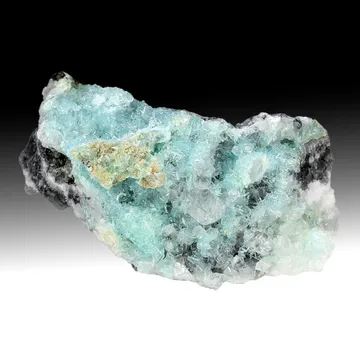
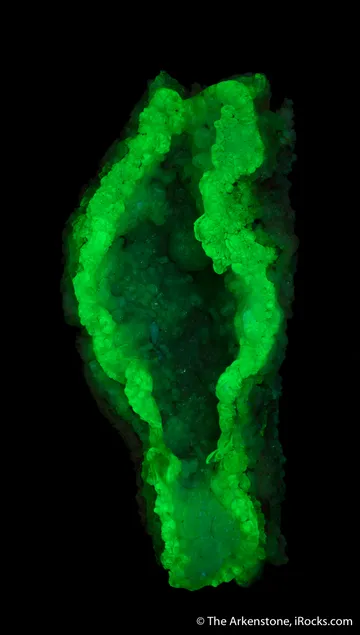
The supporting assemblage is sparse but diagnostically important. Albite, possible andesine, K-feldspar, quartz, chalcedony, agate, opal, possible kaolinite, and biotite are documented from the occurrence, with muscovite noted in the original association for the species. Agate or chalcedony crusts may occur as a younger silica coating on fluor-buergerite and feldspar, and locality records note brilliant green shortwave ultraviolet fluorescence for some agate. Fluor-buergerite itself is the type-locality mineral of consequence here; the other species provide matrix, paragenetic context, and useful clues to authenticity rather than forming the main collecting target.
The primary authenticity issue at Mexquitic is nomenclature, not widespread fakery. Older labels reading “buergerite” are normal and often desirable, because the species entered collections under that name for decades before the 2011 tourmaline-supergroup revision formalized fluor-buergerite for the fluorine-dominant type material. A modern label should ideally say fluor-buergerite, but an old “buergerite” label from Mexquitic should not be treated as an error in the ordinary sense; it is part of the species’ history.
The more serious risk is vague locality attribution. “San Luis Potosí tourmaline,” “Mexican black tourmaline,” or “Mexquitic?” is not equivalent to a solid Mexquitic fluor-buergerite provenance. The correct material has a very particular look: dark ferric tourmaline prisms on altered rhyolite or feldspathic rhyolitic matrix, commonly with quartz or opal. Loose black tourmaline crystals without matrix, pegmatitic schorl-like pieces, or labels that drift between “tourmaline,” “buergerite,” and unrelated Mexican localities deserve scrutiny. Analytical confirmation may be justified for expensive or matrix-free specimens, since tourmaline nomenclature depends on site occupancies, valence, F/OH/O dominance, and chemistry that cannot be reliably assigned by eye.
Condition is critical. The crystals are hard, but their exposed terminations and prism edges chip readily, and the pale altered matrix can be friable. Many crystals are naturally dark enough that damage is easy to miss until the specimen is tilted under bright, low-angle light; fresh chips tend to interrupt the glossy bronze-brown faces with dull, lighter broken spots. Good examples have multiple intact terminations, minimal bruising on prominent crystals, and a balanced distribution over matrix. Pieces with a single sharp crystal may still be important if the crystal is isolated, bright, and well terminated, but dense clusters with many damaged tips should trade at a discount.
Fluorescence belongs mainly to the silica coatings, not to the tourmaline’s visual identity. Reported agate on fluor-buergerite and feldspar can fluoresce brilliant green under shortwave ultraviolet light, a useful bonus for display and verification of the silica overgrowths. Handle ultraviolet examination sensibly, and avoid cleaning methods that attack soft alteration products or loosen friable matrix. Ordinary washing should be minimal; strong acids, aggressive ultrasonic cleaning, and repeated wetting of porous altered rhyolite are poor choices.
Market availability is intermittent. EarthWonders currently records a small number of Mexquitic fluor-buergerite and tourmaline entries, and the broader market tends to offer examples sporadically from old collections rather than in steady production. Miniatures and small cabinet specimens with subcentimeter to centimeter crystals are the norm. Larger, rich, aesthetic plates with many lustrous undamaged crystals and old provenance can command a substantial premium, particularly when tied to named collections or published specimens.
The best-known Mexquitic story begins not with a mine map but with a disappearing locality. Collector lore says that a miner brought a lot of the dark bronze tourmaline crystals to the Tucson show in the 1960s. The material was recognized as unusual, entered the trade as buergerite, and then the trail went cold: the finder reportedly died without passing on the exact source. For decades, that tale gave Mexquitic specimens an aura unlike ordinary mine-run classics. They were not just rare; they were the surviving evidence of a place that collectors could name only broadly.
That story is still repeated in dealer records, but it has acquired a second chapter. Some modern specimen descriptions say the occurrence was later relocated by a team working at the request of Dr. Miguel Romero. That does not make Mexquitic common—far from it—but it helps explain why a few fresher-looking, well-documented specimens have appeared alongside old-stock pieces. The tension between “lost locality” and “rediscovered occurrence” is part of the collecting culture around these specimens. A careful label can be as important as the crystals themselves: 1960s Tucson lot, old “buergerite” label, Rock Currier provenance, Romero-era rediscovery, or a published collection reference each tells a different chapter of the same locality.
Mexquitic’s wider history gives the name another resonance in San Luis Potosí. Government historical summaries trace the settlement to San Miguel Mexquitic, a late-sixteenth-century Huachichil-region outpost associated with Captain Miguel Caldera. From Mexquitic, early miners set out toward Cerro de San Pedro, the famous silver-gold camp whose development helped lead to the founding of San Luis Potosí itself. The municipality’s modern name also memorializes Damián Carmona, the republican soldier remembered for the stark battlefield phrase, “Cabo de turno, estoy desarmado.” It is a long arc from colonial mining routes to a twentieth-century tourmaline type locality, but Mexquitic has been tied to mineral country for centuries.
Donnay, Gabrielle; Ingamells, C. O.; Mason, Brian (1966), “Buergerite, a new species of tourmaline,” American Mineralogist, 51(1–2), 198–199 — The original description of buergerite from near Mexquitic, the foundation reference for the species now known as fluor-buergerite.
Tippe, Armin; Hamilton, Walter C. (1971), “A neutron diffraction study of the ferric tourmaline buergerite,” American Mineralogist, 56(1–2), 101–113 — Structural work on the ferric tourmaline using Mexquitic material.
Dunn, Pete J. (1976), “Buergerite, uniformity of composition,” American Mineralogist, 61(9–10), 1029–1030 — A short but important note on the compositional consistency of buergerite material.
Tsang, T.; Thorpe, A. N.; Donnay, G.; Senftle, F. E. (1971), “Magnetic susceptibility and triangular exchange coupling in the tourmaline mineral group,” Journal of Physics and Chemistry of Solids, 32(7), 1441–1448 — Includes magnetic susceptibility data for a Mexquitic buergerite sample.
Henry, Darrell J.; Novák, Milan; Hawthorne, Frank C.; Ertl, Andreas; Dutrow, Barbara L.; Uher, Pavel; Pezzotta, Federico (2011), “Nomenclature of the tourmaline-supergroup minerals,” American Mineralogist, 96(5–6), 895–913 — The IMA-approved nomenclature framework that formalized fluor-buergerite as the correct name for the fluorine-dominant species.
Cook, Robert B. (2013), “Connoisseur’s Choice: Buergerite (Fluor-buergerite): Mexquitic, San Luis Potosí, Mexico,” Rocks & Minerals, 88(5), 442–447 — A collector-focused treatment of Mexquitic fluor-buergerite and its specimen significance.
McKeown, David A. (2008), “Raman spectroscopy, vibrational analysis, and heating of buergerite tourmaline,” Physics and Chemistry of Minerals, 35(5), 259–270 — Raman and heating study using buergerite material tied to the Mexquitic type-locality suite.
Smithsonian Contributions to the Earth Sciences, “A Catalog of the Type Specimens in the Mineral Collection, National Museum of Natural History” — Records buergerite type material NMNH 122200 from Mexquitic, San Luis Potosí, acquired through Brian Mason.
Handbook of Mineralogy: Buergerite — Concise mineral data summary including habit, optical properties, chemistry, occurrence in rhyolite cavities, associations, and type-material repositories.
Mindat locality page: Fluor-buergerite occurrence, Mexquitic de Carmona Municipality — Best compact locality record, with coordinates, host-rock note, mineral list, and reference trail.
Mindat mineral page: Fluor-buergerite — Species data, type-locality status, nomenclature notes, and locality list.
Mindat fluor-buergerite gallery — Useful visual comparison set for judging typical crystal size, color, matrix, and presentation.
Servicio Geológico Mexicano / Consejo de Recursos Minerales: Inventario físico de los recursos minerales del municipio Mexquitic de Carmona — Government geological inventory covering the municipality’s volcanic units, mineral resources, quarries, and access context.
Handbook of Mineralogy: Buergerite PDF — Quick technical reference for fluor-buergerite’s habit, properties, occurrence, associations, and type material.
Webmineral: Buergerite mineral data — Additional crystallographic, optical, and physical-property data, plus an illustrated Mexquitic specimen.
Minerals.net: Buergerite — Collector-oriented overview emphasizing Mexquitic as the classic source of collectible material.
Mineral Auctions: Fluor-buergerite type-locality specimen, Mexquitic de Carmona — Market record with specimen dimensions, crystal-size description, provenance notes, and auction result.
Fabre Minerals / Expominerals: Fluor-buergerite specimen EG46Y8 — Dealer archive entry for a published Mexquitic specimen with old John S. White and Luther Thomas provenance.
EarthWonders specimen record: Fluor-Buergerite, Mexquitic de Carmona Municipality — Example of a modern market record with sharp crystals on pale matrix and current locality attribution.
EarthWonders specimen record: Fluor-Buergerite Tourmaline, Mexquitic de Carmona Municipality — Useful note on legacy “buergerite” labeling and the later rediscovery story associated with Dr. Miguel Romero.