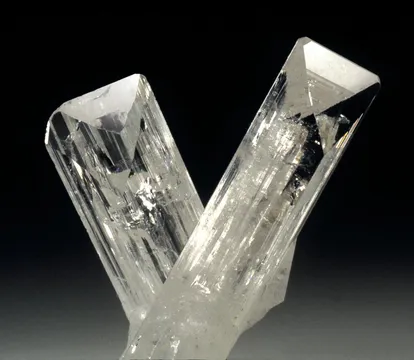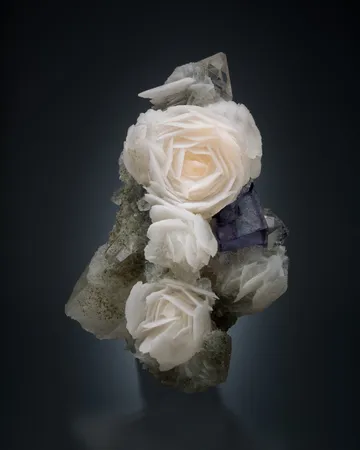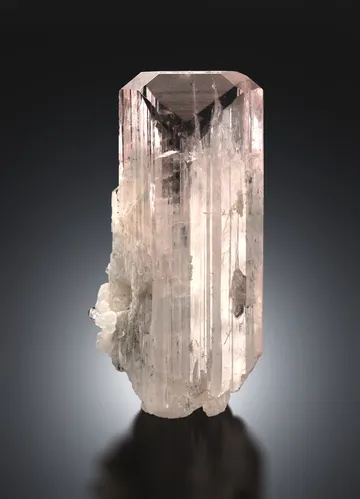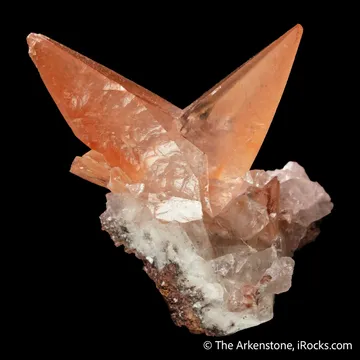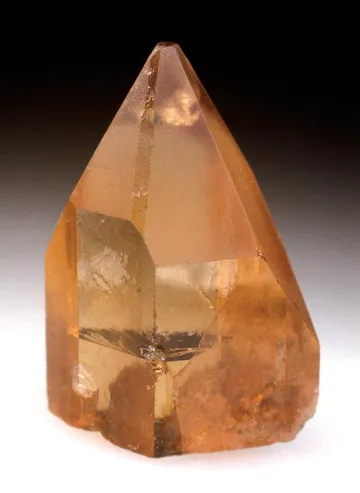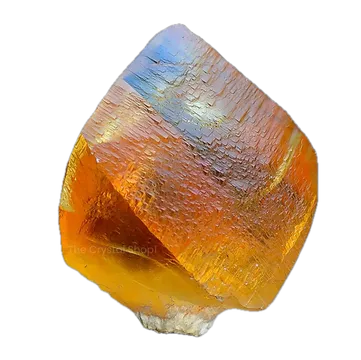
Calcite from Charcas, Mexico features flattened hexagonal rhombohedra, pink-to-red fluorescence, and sculptural poker-chip forms from a Pb-Zn-Cu-Ag district.
Key facts
Charcas calcite is one of the great immediately recognizable Mexican calcite styles: flattened, sharply hexagonal rhombohedra stacked like a pile of white-to-gray poker chips, often with satiny or pearly broad faces and glassier edge faces. Good examples have a sculptural, almost architectural quality — single fat disks, stepped stacks, V-shaped clusters, columnar growths, or matrix-free “floaters” that seem too deliberate to be accidental. The classic palette is colorless, white, cream, gray, slightly smoky, and occasionally pinkish; many specimens show a pink to red fluorescence that is part of the locality’s appeal for UV collectors.

Photo: Wikimedia Commons / Rob Lavinsky, iRocks.com
The locality is not a single little collector’s pocket but a long-lived mining district in the Charcas municipality of San Luis Potosí. Modern mine descriptions place the Charcas complex northwest of the town of Charcas, at high elevation on the Mexican Mesa Central, and describe it as a polymetallic skarn, vein, and carbonate-replacement system producing zinc, lead, copper, and silver-bearing concentrates. The three principal modern underground mines are San Bartolo, Rey-Reina, and La Aurora, with mineralization controlled by intrusive contacts, faults, veins, mantos, and replacement bodies in carbonate rocks and associated sedimentary units.
That geological setting explains the specimens. Calcite at Charcas is not an isolated cave mineral; it grew in a vigorous Pb-Zn-Cu-Ag hydrothermal environment alongside danburite, quartz, datolite, sphalerite, pyrite, chalcopyrite, cinnabar, and a remarkable suite of borates. Collectors often think first of Charcas danburite — rightly so — but the district’s calcite is just as distinctive in habit. A fine Charcas poker-chip calcite can be identified across a room.

Photo: Wikimedia Commons / Rob Lavinsky, iRocks.com
Historically, Charcas belongs to the old silver-mining fabric of north-central Mexico. The district’s colonial history reaches back to the 16th century, while 20th-century industrial mining began in 1911. In specimen culture, however, Charcas became especially famous over the last several decades, when old Mexican collections, dealer stocks, and mine recoveries established the “poker-chip” calcite habit as a classic. The best pieces combine size, clean geometry, damage-free edges, and a sculptural composition that still looks natural rather than merely large.
Search for specimens: View all calcite specimens from Charcas, Mexico
Charcas lies in the state of San Luis Potosí, north of the state capital, in the east-central part of Mexico’s Mesa Central. The modern Charcas mining complex is an active underground operation within the IMMSA/Southern Copper/Grupo México mining system. The complex includes the San Bartolo, Rey-Reina, and La Aurora underground mines and a flotation plant producing zinc, lead, and copper concentrates with important silver content.
Geologically, Charcas is a carbonate-hosted polymetallic district with skarn, vein, narrow-vein, and replacement mineralization. Published mine descriptions emphasize Jurassic-Cretaceous carbonate rocks, Late Triassic shale and sandstone, and a complex intrusive history involving monzogranite, granodiorite, and granite dikes. The ore occurs as replacement sulfides in carbonate rocks and as fracture-filling veins, with important structures including the Leones and Santa Isabel vein systems and faults that helped localize irregular to tabular replacement bodies. The economic sulfide suite is dominated by sphalerite, galena, chalcopyrite, pyrite, and associated silver minerals; calcite and quartz are part of the gangue and specimen-forming assemblage.
The district has a deep mining history. Southern Copper’s modern technical reporting states that the Charcas complex was discovered in 1573 and that 20th-century operations began in 1911. Other historical summaries place the founding of the town of Charcas in 1574 and the first vein discoveries in the area in 1583. Early mining focused on near-surface oxidized silver-bearing ores; by the late 19th century, the oxidized ores had largely given way to deeper sulfide ores as the main industrial target. The General Shaft near San Bartolo operated from 1926 to 1983, and San Bartolo is described as one of the smaller mines in the district.
Collectors should treat Charcas as an active industrial mining district, not a casual collecting site. Underground access is controlled by the operator, and specimens that reach the market generally come through miners, dealers, old collections, or authorized channels rather than public field collecting. The modern mine is still a working zinc-lead-copper-silver operation, so access, safety, and legal permission are central issues. For specimen buyers, this means provenance often depends on old labels, dealer history, and comparison with well-documented Charcas habits.
La Aurora deserves special attention in modern locality descriptions because it is described as the newest deposit in the district and as having a boron-rich skarn. That boron-rich setting helps explain why Charcas is so admired not only for calcite and danburite but also for datolite, nifontovite, borcarite, cahnite, fedorovskite, roweite, and related unusual species in parts of the district. Calcite is the common carbonate thread running through this more exotic mineral story.
The signature Charcas calcite habit is the flattened rhombohedron that presents as a hexagonal disk — the famous “poker-chip” form. Individual crystals may be stout and tabular, thinly compressed, or stacked in stepped parallel growths. The best examples show crisp hexagonal outlines, broad satiny faces, and sharper glassy edge faces. Some specimens form opposing clusters or V-shaped sculptural groups; others are matrix-free groups of stacked disks, columnar arrangements, or single large floater-like crystals.
Size varies widely. Small-cabinet and miniature specimens with 2–5 cm disks are common enough to define the locality style, while better cabinet pieces can carry disks around 6–8 cm across. Exceptional old specimens have been documented with very large single hexagonal crystals exceeding 15 cm across and overall specimen sizes above 20 cm. Those large pieces are uncommon and are much more convincing when the edges are clean and the form remains sharp rather than bulky and bruised.
Color is usually restrained: water-clear to milky white, cream, pale gray, smoky gray, silvery gray, or softly pearlescent white. Some specimens show two-toned zoning, with transparent bodies and milky terminations, or vertical gray-and-white banding in parallel growths. Pink calcite from Charcas exists and is sought after when the color is natural-looking and the crystals are well defined, but the classic collector image of the locality remains the white-to-gray poker-chip cluster.
Luster is an important quality factor. Broad faces may be satiny, waxy, porcelaneous, or pearly, while edge and modification faces can be more vitreous. Many good specimens are partly translucent; the most desirable pieces combine this translucency with sharp geometry rather than simple mass. The finest Charcas calcites do not need vivid color — their value is in habit, scale, symmetry, and the way stacked crystals create movement.
Fluorescence is another Charcas calling card. Numerous documented specimens show pink, neon-pink, reddish-pink, or red fluorescence under ultraviolet light, sometimes noted under shortwave UV and sometimes under longwave UV. In calcite, that response is commonly associated with manganese activation, and some Charcas pieces are cataloged as manganese-bearing calcite. Fluorescence alone does not make a specimen fine, but on a sharp poker-chip cluster it adds a second display mode.
Associated minerals are especially useful for confirming the locality and understanding the district. Danburite is the most famous partner, occurring as colorless to pale pink prismatic crystals, often with calcite attached. Quartz, including citrine and rare amethystine material, is common in the broader district. Datolite, sphalerite, chalcopyrite, pyrite, cinnabar, hemimorphite, and goethite are documented associations, and the borate suite at San Bartolo and Rey-Reina includes nifontovite, borcarite, cahnite, fedorovskite, and roweite. On combination pieces, calcite may appear as cream rhombohedra wrapping danburite, as small scalenohedra on danburite groups, or as white rhombohedra contrasting with hemimorphite or sulfides.
Quality is judged by geometry first. A collector should look for crisp, undamaged hexagonal outlines; visible stacking; pleasing orientation; translucency; attractive luster contrast; and a composition that displays naturally from more than one angle. A single large disk can be excellent if sharp and clean, but many Charcas calcites gain their charm from rhythm — repeated disks, stair-stepped growth, or a wing-like V arrangement. Matrix-free pieces are not a flaw at this locality; many classic examples are valued precisely because the crystals grew free enough to show their form all around.
Charcas calcite is available on the collector market, but the best examples are increasingly old-collection pieces. Modern auction and dealer records repeatedly describe sharp poker-chip calcites from Charcas as old classics, often from collections assembled in the 1960s through the 1980s or dispersed from well-known calcite and Mexican-mineral collections. Small examples and modest old pieces still appear, but large, undamaged, sculptural specimens are much less routine.
Condition is the main practical issue. Calcite has perfect rhombohedral cleavage and Mohs hardness 3, so Charcas disks commonly show bruised rims, tiny cleaves, contacted backs, broken attachment points, or dull spots on exposed edges. A matrix-free “floater” may be highly desirable, but it should still be checked carefully around the perimeter. Broad poker-chip faces can hide subtle cleavage bruises until the specimen is tilted in strong light.
Because the classic habit is so distinctive, authenticity concerns usually center less on “is it calcite?” and more on locality accuracy, color, and condition. Undamaged old labels, recognized collection provenance, and comparison with documented Charcas habits are valuable. Similar flattened calcites occur elsewhere, and generic “Mexico” calcite should not automatically be upgraded to Charcas without supporting evidence. For Charcas, a convincing specimen typically shows the compressed hexagonal rhombohedral habit, the right white-gray-cream palette, compatible associations, and a provenance trail.
No well-documented, locality-specific epidemic of faked Charcas calcite is established in the sources reviewed. General calcite fakery does exist in the broader market, especially dyed or painted material sold as more colorful carbonate species, and any unusually bright pink, orange, or saturated specimen deserves scrutiny. Natural Charcas calcite may fluoresce pink to red, but fluorescence is not proof of locality and dyed material may also react oddly under UV. Look for color concentrated in cracks, surface residues, unnatural uniformity, or dye bleeding during cleaning.
Avoid acid cleaning unless you know exactly what you are doing. Calcite reacts with acids, and even mild acids can etch luster and soften the crisp satin-to-glassy contrast that makes Charcas material attractive. Water, mechanical cleaning, and conservative dust removal are safer. The broad faces also scratch easily, so wrapping and storage should prevent abrasion from harder minerals in the same drawer.
Market desirability falls into several tiers. Common small stacks with minor bruising remain accessible. Sharp miniatures with strong form and fluorescence are more desirable. Cabinet pieces with 5–8 cm disks, clean edges, and sculptural stacking command more attention. Large, old, damage-free poker-chip groups — especially those with major collection provenance, floater character, or unusual two-toned zoning — are the premium Charcas calcites.
On September 28, 1981, a University of Toronto graduate student field trip went underground at Charcas. The visit, organized by A. James Macdonald, produced the sort of practical ore notes that make an old mine come alive: sample 051 was a loose piece from near Stope 4-156, showing disseminated sulfide mineralization in sericitized intrusive rock, with 0.5 to 4 mm grains of pyrite, galena, sphalerite, and chalcopyrite, plus white calcite in abundant silica. Another sample, taken in situ from the Queen Stope, held sphalerite and galena with maximum grain sizes of about 8 mm and 20 mm respectively, set with finer chalcopyrite and pyrite in a quartz-calcite matrix. For a collector used to seeing polished locality names on labels, those details matter: Charcas calcite came from a working ore system of stopes, sulfides, and industrial geology, not from an isolated decorative pocket.
San Bartolo has its own quieter legend. It is one of the smaller mines in the district, sitting near the old General Shaft, but a note in Jean des Rivières’ 2024 account records one major cinnabar find there in 1960. That single line explains why cinnabar appears as more than an accidental name in Charcas associations. It also gives San Bartolo a particular flavor among the district’s mines: a place where common carbonate gangue, industrial sulfide ore, and unexpected mercury mineralization all intersected.
The modern collector story of Charcas is also the story of old collections re-entering the market. Dealer records show poker-chip calcites from the Tom Wolfe Calcite Collection, the Mary and Gardner Miller Calcite Collection, the Evan Jones Mexico Collection, the Dan Brock Collection, the Consie Prince Collection, and other named holdings. Some pieces are remembered for improbable scale — a 21.7 x 16.0 x 6.7 cm specimen with a single huge hexagonal crystal about 16.5 x 15.7 cm, for example — while others are remembered for personality: V-shaped clusters, hollow limbs, glassy transparent bodies with milky terminations, and red-to-pink fluorescence that transforms a quiet white specimen under ultraviolet light.