A collector's guide to Mauldin Mountain, USA: its geology, mining history and notable minerals, illustrated with the 50 specimens documented from this locality on EarthWonders.
Key facts
Mauldin Mountain is one of the signature American wavellite localities: a pair of road-material quarries cut into the hard, dark Bigfork Chert on the south flank of Mauldin Mountain in Montgomery County, Arkansas. To collectors, its importance is not that it was ever a great ore producer—it was not—but that quarrying exposed a remarkably specimen-rich secondary aluminum-phosphate system. In fractures, bedding-plane partings, vugs, and brecciated chert seams, phosphate-bearing fluids deposited wavellite, planerite, variscite, crandallite, turquoise, quartz, and iron oxides in an assemblage that has become inseparable from the collector mythology of the Ouachita Mountains.
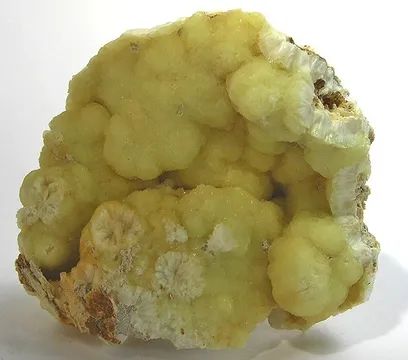
The locality’s best specimens have a look that is instantly recognizable: pea-green to apple-green, mint-green, yellow-green, or blue-green wavellite spheres and hemispheres sitting on black to dark gray chert, often with a sparkling fibrous surface and a radiating internal structure visible where a ball is broken. The finest pieces are not merely green coatings; they are sculptural cabinet specimens with isolated complete balls, clustered hemispheres, botryoidal crusts, or lustrous radial “eyes” lining cavities. Planerite may coat or partially veil the wavellite in paler turquoise-green films, and drusy variscite gives some pieces an additional fine crystalline texture.
Regional View
Country View
Mauldin Mountain belongs to the broader Arkansas phosphate story, in which the Ouachita Mountains supplied some of the finest wavellite and variscite specimens known. Earlier collectors knew Arkansas wavellite chiefly from localities around Avant and Dug Hill, but the development of the Mauldin Mountain county quarry in the 1970s shifted attention sharply toward Montgomery County. By the 1980s, Mauldin Mountain material had become important enough for Arthur E. Smith Jr. to devote a Mineralogical Record article to its aluminum phosphates, and later writers treated Mauldin Mountain wavellite as a connoisseur-level classic.

Photo: Wikimedia Commons

Photo: Wikimedia Commons
Search for specimens: View all specimens from Mauldin Mountain, USA
Mauldin Mountain is in west-central Arkansas, near Mount Ida, in the Ouachita Mountains. The collecting locality normally meant by “Mauldin Mountain” is the Mauldin Mountain Quarries, including the Montgomery County Quarry or County Pit and the adjacent State Pit. The locality is recorded at about 34°35′43″ N, 93°41′53″ W, on the south side of Mauldin Mountain. Older collector labels may read simply “Mauldin Mt.,” “County Pit,” “County Quarry,” “County Gravel Pit,” “Montgomery County Quarry,” or “State Pit,” and all of those labels can refer to closely related parts of the same quarry complex.
Geologically, the essential host is Bigfork Chert, an Ordovician siliceous unit of the Ouachita Mountains. The rock is dark, fine-grained, hard, and locally highly fractured. Mauldin Mountain specimens come from secondary phosphate mineralization along open fractures, bedding planes, joints, and vugs in the chert. The phosphate minerals are not an orebody in the mining sense; they are low-temperature secondary minerals deposited in open spaces and on fracture walls. Their occurrence is controlled by permeability—where the chert was cracked, brecciated, or opened along bedding, wavellite and associated aluminum phosphates could grow as radial aggregates, crusts, coatings, or crystal-lined cavities.
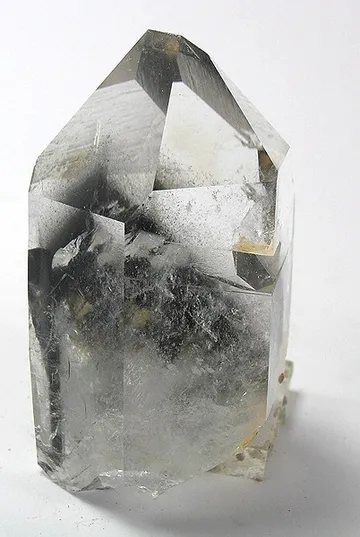
The classic Arkansas phosphate assemblage at Mauldin Mountain includes wavellite, planerite, variscite, crandallite, turquoise, quartz, and goethite. Wavellite is the dominant collector species, but planerite is especially important because Mauldin Mountain material played a role in later work clarifying the turquoise group and the identity of many “turquoise-like” Arkansas coatings. Variscite occurs as green drusy coatings and small crystals; crandallite is a whitish to buff secondary phosphate, in some cases representing alteration or replacement relationships within the phosphate assemblage. Quartz is common as part of the siliceous host and as vein or cavity material, while goethite and other iron staining can color the matrix and fracture surfaces.
The quarries were opened and used for road material rather than for mineral specimens. Published accounts describe two adjacent quarries, operated by state and county interests, with the eastern county quarry being the more important mineral locality. Montgomery County reportedly began developing a chert quarry at Mauldin Mountain in 1974 for aggregate and road-fill material. As fresh chert was broken, cavities and seams were exposed, and collectors quickly realized that the locality was producing unusually large, colorful, and well-developed wavellite specimens. Through the late 1970s, 1980s, and 1990s, Mauldin Mountain became a primary Arkansas wavellite source, visited by private collectors and dealers who arranged access when fresh rock was available.
The most famous producing areas are remembered by collectors as the County Pit and State Pit, with old labels sometimes distinguishing an “Old County Pit,” “County Pit,” “State Pit,” “rock pile,” or “new find.” The best pockets yielded not just flat green films but three-dimensional wavellite-lined openings, balls on chert, and cabinet pieces showing complete, isolated spherules. A reported late-1990s State Pit find was important enough to be written up in Mineral News, and one large specimen from that find was acquired for the Houston Museum of Natural Science by Joel Bartsch, then its president. That episode helped cement Mauldin Mountain’s standing as a world-class wavellite locality rather than merely a regional Arkansas collecting spot.
Access today must be treated cautiously. Older guidebooks and field-trip accounts describe public or semi-public collecting at the quarry, and many specimens in circulation were self-collected when the county pit was active or locally accessible. More recent locality notes and collector reports indicate that the quarry area has been closed, restricted, leased, or on residential/private property at different times. Serious collectors should not assume that historic access still applies. Permission from the landowner or current operator is essential, and specimens now reaching the market are commonly old-stock pieces, estate material, or material recovered when access was available.
Mauldin Mountain wavellite is prized for spherical to hemispherical radial aggregates, botryoidal crusts, cavity linings, and occasional divergent crystal groups on dark Bigfork Chert. Colors range from colorless and white through yellow and yellow-green to the classic apple-, pea-, emerald-, mint-, and blue-green tones that made Arkansas wavellite famous; vanadium is generally cited as the coloring agent in the green Arkansas material. Individual balls on collectible specimens commonly run from a few millimeters to around 1–2 cm, with the best pieces displaying complete, lustrous, undamaged spherules isolated on contrasting dark matrix or densely sparkling across a vug. Broken balls reveal the diagnostic radial fibrous structure, but condition matters: sharply formed complete spheres, intense color, bright luster, attractive spacing, and minimal bruising separate top Mauldin Mountain specimens from ordinary green crusts. Associations here include quartz, planerite, variscite, crandallite, and iron oxides, and planerite-coated wavellite is a distinctive Mauldin Mountain combination.
Other documented Mauldin Mountain minerals include planerite, variscite, crandallite, turquoise, quartz, and goethite. No type-locality mineral species are known from Mauldin Mountain itself, but the locality is scientifically important for planerite and the turquoise-group problem: many Arkansas blue-green coatings historically called “turquoise” proved to be planerite or related turquoise-group material. Planerite at Mauldin Mountain forms pale green to blue-green coatings, crusts, and botryoidal or mamillary surfaces, sometimes coating wavellite. Variscite is a notable rarity here because Arkansas is one of the few regions where variscite occurs as recognizable green crystals or drusy coatings rather than only massive lapidary material. Crandallite appears as whitish, tan, or buff phosphate material and may mimic or replace wavellite textures, while true turquoise is far less prominent than planerite and should not be assumed without analysis.
Mauldin Mountain material is widely available enough that small specimens are not rare, but excellent pieces are much scarcer than casual market listings suggest. Common specimens show green wavellite crusts, partial balls, bruised botryoids, or small sprays on dark chert. Fine specimens show bright, complete, lustrous spheres or hemispheres, preferably with strong color and good contrast against black or gray matrix. Large cabinet plates with undamaged balls, isolated spherules, rich blue-green color, or planerite-over-wavellite relationships are much harder to replace.
Condition is the main collecting issue. Wavellite aggregates are fibrous and brittle; individual balls chip, flatten, abrade, or break away from the matrix. A broken ball is not automatically a defect if it reveals attractive radial structure and the rest of the specimen is strong, but missing tips, crushed faces, dull abrasion, and heavily coated or chalky surfaces reduce value. Matrix pieces can be tough, sharp, and splintery, so trimming must be done with care. Ultrasonic cleaning is a poor choice for delicate spheres; gentle brushing and water are safer, and acids or aggressive chemical cleaning should be avoided.
The most persistent identification problem is not outright fakery but mislabeling. Blue-green Arkansas phosphate coatings from Mauldin Mountain have historically been sold or labeled as turquoise, variscite, planerite, or wavellite with varying accuracy. True turquoise is documented in the district but is not the usual green coating on Mauldin Mountain specimens; planerite is commoner and easily confused with turquoise by appearance alone. Variscite may also be confused with planerite where it occurs as green druse. For ordinary display specimens, a traditional label may be acceptable, but for high-value “turquoise,” “variscite,” or unusual planerite combinations, analytical confirmation is desirable.
No well-established, locality-specific market in dyed or artificially enhanced Mauldin Mountain wavellite has been documented in the mineralogical literature. That said, the intense green color of genuine Arkansas wavellite has encouraged broad, sometimes sloppy marketing. Be cautious of pieces advertised with vague “Arkansas green phosphate” labels, “turquoise” claims, or locality attributions that drift between Avant, Dug Hill, Mauldin Mountain, and general “Montgomery County.” Provenance matters: an old label from a known Arkansas collector or dealer, especially one naming County Pit, State Pit, or Mauldin Mountain Quarries, adds value and confidence.
Fluorescence should not be used as a primary test for Mauldin Mountain identification. Some associated materials or matrices may react under ultraviolet light, and some dealer listings mention UV response, but planerite descriptions in the mineralogical literature describe it as not fluorescent. Visual habit, matrix, association, and—where important—X-ray or chemical testing are more reliable than UV behavior.
The Mauldin Mountain story begins as a road-metal story. Montgomery County needed hard rock; collectors got a classic mineral locality. When quarrying opened fresh Bigfork Chert in the 1970s, the rock did not simply break into dull aggregate. It opened into seams and cavities lined with green phosphate balls—larger, more sculptural, and more vividly colored than much of the earlier Arkansas wavellite then familiar from Dug Hill and Avant. The quarry quickly drew collectors and dealers, and the “County Pit” label began appearing on specimens across the country.
One of the most memorable old-stock stories centers on Clyde Hardin, a collector whose Arkansas material later entered the market in quantity. Accounts of his collection describe him as having had a world-class Magnet Cove suite, but also as a regular Mauldin Mountain wavellite collector. After his death in 2002, his private collection reportedly went to a Texas dealer, while the bulk material—enough to fill a 14-foot trailer—was sold to a Utah dealer. That kind of detail explains why Mauldin Mountain can still appear in fresh-looking batches decades after the best quarry production: much of the supply has been moving through collections, flats, and estate lots rather than coming from newly blasted rock.
The late-1990s State Pit find gave the locality a second burst of collector fame. Mineral News reported on the new Mauldin Mountain wavellite in 1999, and the find was said to have reached “world class status” when Joel Bartsch, president of the Houston Museum of Natural Science, bought a large “killer” specimen for the museum. The language is pure mineral-show vernacular, but the event mattered: a museum acquisition by a major institution helped confirm what field collectors already knew—that the best Mauldin Mountain wavellite could stand beside the finest examples of the species worldwide.
There are also quieter field moments in the locality’s afterlife. Collectors in the 2000s described hearing that the old county quarry had been closed because of overuse, then being told locally that people still walked in when gates were open or when operators tolerated surface collecting. Those stories should not be read as permission today; they are part of the locality’s transition from active county quarry to restricted classic site. They also capture the awkward reality of many American specimen localities: a place can be famous in collections long after its legal and practical access has become uncertain.