Massachusetts, USA – diverse mineral belts yield garnets, goshenite, pyromorphite, wulfenite, rhodonite, and iconic Chester/Loudville localities, prized for lo…
Key facts
Massachusetts is not a single-species collecting state; it is a compact cross section through several New England mineral provinces. Its collector appeal comes from the way very different geologic environments are packed into a small area: high-grade Appalachian schists and gneisses in the western uplands, mica and beryl pegmatites around Hampshire and Worcester counties, manganese-rich metamorphic ores in the Hawley belt, oxidized lead-barite veins at Loudville, and basaltic trap-rock quarries along the Mesozoic Connecticut Valley rift system. The result is a specimen history that feels broader than the state’s size: black to wine-red almandine garnets, colorless beryl that gave goshenite its name, classic green pyromorphite and orange wulfenite from one of the oldest lead districts in North America, massive pink rhodonite from the state-gem locality at Plainfield, and the corundum-diaspore-margarite assemblage of the Chester emery mines.
Regional View
Country View
For serious collectors, Massachusetts specimens are valued less for abundance than for locality character. The best pieces tend to have unmistakable signatures: a Russell garnet is a sharp, dark, substantial trapezohedron with a nineteenth-century New England pedigree; a Red Embers garnet is a glowing red crystal in gray graphite schist, prepared so light passes through the stone; a Loudville specimen shows quartz with green pyromorphite, yellow-orange wulfenite, galena, barite, or cerussite; a Chester emery specimen is dense, aluminous, and historically important, often carrying corundum, diaspore, margarite, magnetite, chloritoid, or amesite. The state is also unusually strong in “name minerals”: cummingtonite was originally named from Cummington, amesite from the Chester emery mines, and goshenite from Goshen.

Photo: Wikimedia Commons

Photo: Wikimedia Commons
Search for specimens: View all specimens from Massachusetts, USA
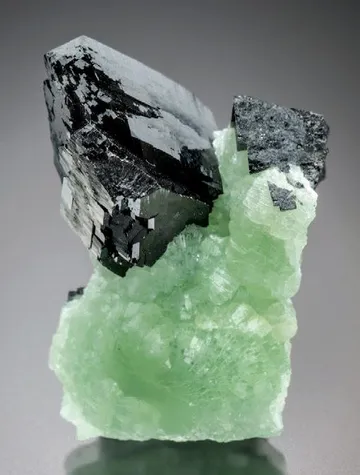
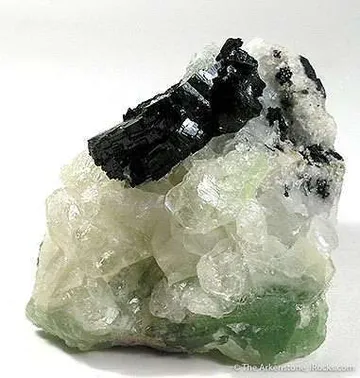
Massachusetts mineral collecting is best understood as a set of overlapping belts rather than as one deposit type. Western Massachusetts is dominated by Paleozoic metamorphic rocks of the northern Appalachian system—schists, gneisses, amphibolites, quartzites, and associated intrusive bodies—cut by pegmatites and local ore zones. These rocks host garnet, staurolite, kyanite, sillimanite, tourmaline, beryl, feldspar, muscovite, quartz, and graphite-rich layers. Farther east, the Nashoba, Avalon, and Merrimack terranes add another suite of deformed crystalline rocks and pegmatitic or granitic environments. In the Connecticut Valley, Mesozoic rifting produced basaltic trap rocks and sedimentary basins; quarrying in those basalts yielded the state’s best babingtonite, prehnite, datolite, calcite, apophyllite-group minerals, and local quartz varieties.
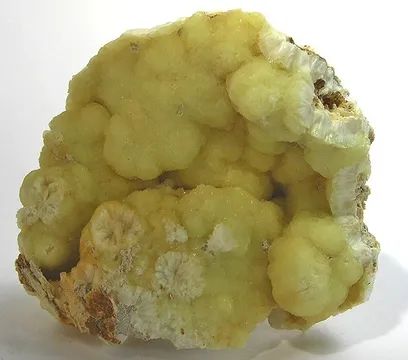
The Loudville or Manhan lead mines, on and near the Manhan River in the Easthampton–Southampton–Westhampton area, are classic oxidized base-metal vein deposits. The primary vein material is quartz and barite with galena, sphalerite, chalcopyrite, and related sulfides; the collector minerals are largely supergene alteration products formed after oxidation of the lead-bearing ore. Pyromorphite, wulfenite, cerussite, anglesite, barite, quartz, galena, and minor copper secondaries give Loudville its appeal. The best specimens are small by world standards but exceptionally desirable for New England: green pyromorphite crusts and barrel-shaped crystals on quartz, orange to yellow wulfenite plates, bright galena in quartz, and vuggy lead-mineral associations that reward careful trimming and microscope work.
The mining history at Loudville is among the oldest in North America. Lead mineralization was reported in the late seventeenth century, and by 1680 the district was already being worked for galena. The early miners wanted smeltable lead sulfide, so oxidized material carrying the now-prized pyromorphite and wulfenite was discarded onto the dumps. The mine was reopened in later periods, including work associated with Ethan Allen near the end of the eighteenth century, and it saw intermittent nineteenth-century activity for lead and some silver before the Manhan Silver Lead Mining Company failed in 1865. Collecting on the historic dumps continued for generations, but modern access has changed sharply: the Hartnett Manhan Memorial Forest area has been restricted because of unsafe digging, erosion, and private-land concerns. Treat Loudville as closed unless current written permission is obtained from the land manager.
The Betts Manganese Mine at Plainfield represents a very different deposit type: a metamorphosed manganese-iron ore body in the Hawley mineral belt. The principal manganese minerals documented there include rhodochrosite, kutnohorite, rhodonite, tephroite, sonolite, spessartine, alleghanyite, caryopilite, and manganese oxides, with accessory rutile, garnet, pyrite, pyrrhotite, chalcopyrite, baryte, gypsum, calcite, and amphiboles. Historically the mine was worked for manganese ore, with rhodochrosite as an important ore mineral, and the dumps became the main source of Massachusetts rhodonite for collectors and lapidaries. Today the property is part of Earthdance, where limited fee collecting is permitted by advance arrangement; it remains the most reliable legal destination in the state for visitors who want to dig Massachusetts material themselves.
The Chester emery mines near Chester in Hampden County are one of the state’s most important scientific and historical mineral districts. Emery here is a corundum-rich abrasive rock associated with magnetite, spinel, diaspore, margarite, chloritoid, paragonite, amesite, talc, serpentine-related rocks, and aluminous metamorphic assemblages. The district includes several named workings, including the Old Mine, Melvin, Wright, Macia, Sackett, and Snow mines. The Old Mine, close to Route 20, was the earliest and longest-worked complex and included extensive underground levels; other workings combine open cuts, collapsed areas, and underground mine features. The deposit has been interpreted in more than one way, from stratabound metamorphic enrichment to tectonic or hydrothermal concentration along a major structural horizon with ultramafic slivers. For collectors, Chester’s importance is not based on cabinet aesthetics alone but on history, type-mineral significance, and the rare aluminous assemblage preserved in the dumps.
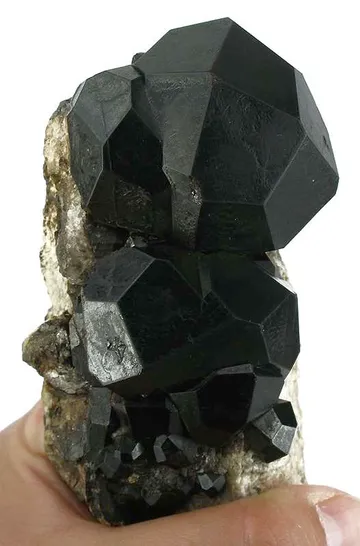
The almandine story is split between two classic styles. At Russell, large black to dark red trapezohedral almandines were recovered from a granite or pegmatitic vein in the late nineteenth century and entered old collections as “Russell garnets.” They are much larger and more sculptural than the average garnets found in Massachusetts schist, and top examples with intact matrix are prized. At the Red Embers Mine in Erving, translucent almandine-dominant garnets occur in graphite-rich schist with dravite; skilled preparation removes matrix from behind the crystals so that they glow red when backlit. That locality is privately owned and closed to casual collecting, but its distinctive prepared plates have become among the most recognizable modern Massachusetts specimens.
Quartz is everywhere in Massachusetts, but collectible quartz is strongly locality-dependent. Loudville quartz forms milky, smoky, amethystine, and mixed-color crystals and clusters, especially desirable when associated with pyromorphite, wulfenite, galena, barite, or cerussite. Pegmatites around Goshen, Chesterfield, and other western and central Massachusetts localities yield quartz with feldspar, muscovite, beryl, tourmaline, and garnet. Trap-rock quarries and basaltic environments have produced amethyst, drusy quartz, chalcedony, calcite, prehnite, datolite, and babingtonite associations. The state has many common vein-quartz occurrences, but true collector pieces need sharp terminations, honest locality documentation, and either attractive color or a meaningful association.
Massachusetts almandine ranges from ordinary garnetiferous schist to some of the most distinctive garnet specimens in New England, with the collector-grade material led by Russell and Erving. Russell garnets are large, dark red-black to nearly black trapezohedral crystals, sometimes several centimeters across, historically recovered from a granite or pegmatitic vein and valued when the crystals remain sharp, three-dimensional, and naturally seated on matrix. Red Embers Mine material from Erving is more modern and more dramatic in presentation: burgundy to red almandine-dominant garnets in fine graphite-rich schist with dravite, often 5–15 mm but visually powerful because the graphite is carefully relieved behind the crystals so they transmit a cherry-red glow under backlighting. Good Massachusetts almandine is separated from ordinary schist garnet by crystal sharpness, undamaged faces, matrix contrast, locality documentation, and, in the Red Embers material, clean preparation that enhances translucency without overcutting the graphite plate.
Massachusetts quartz is most collectible when it carries the fingerprint of a named district rather than appearing as anonymous vein material. Loudville is the standout for association specimens: milky, smoky, clear, and amethystine quartz crystals occur with galena and the oxidized lead suite, especially green pyromorphite, yellow-orange wulfenite, cerussite, anglesite, and barite; small vugs can be far more valuable under magnification than they first appear in the field. Pegmatitic quartz from Goshen, Chesterfield, and related western Massachusetts localities is typically tied to feldspar, muscovite, beryl, tourmaline, and garnet, while trap-rock occurrences add amethyst, drusy quartz, and quartz with zeolite-style associations. The best Massachusetts quartz specimens have undamaged terminations, visible luster beneath iron staining, attractive smoky or amethyst color where present, and, above all, a meaningful matrix or secondary-mineral association that fixes the piece to Loudville, a pegmatite, or a basalt quarry rather than to generic New England quartz.
Other Massachusetts minerals give the state unusual depth for a small New England collecting region. Amesite is a type-locality mineral from the Chester emery mines, occurring there as pale green chloritic plates associated with diaspore and the emery assemblage. Cummingtonite was originally named in 1824 for Cummington, although modern amphibole nomenclature makes historic “cummingtonite of Dewey” material a nomenclatural and analytical issue rather than a simple field label. Goshenite, the colorless variety of beryl, takes its name from Goshen in Hampshire County. Rhodonite from the Betts Mine at Plainfield is the Commonwealth’s official gemstone and remains the state’s best-known lapidary mineral. Babingtonite, Massachusetts’ official state mineral, is best known from the Lane & Son traprock quarries at Westfield, where black crystals with prehnite, datolite, quartz, calcite, and other basalt-vug minerals created one of the classic New England trap-rock assemblages. Loudville adds pyromorphite, wulfenite, cerussite, anglesite, galena, sphalerite, chalcopyrite, barite, and fluorite; Chester adds corundum, diaspore, margarite, paragonite, magnetite, spinel, chloritoid, and talc; Betts adds rhodochrosite, kutnohorite, tephroite, sonolite, spessartine, rutile, and manganese oxides.
Massachusetts specimens require careful locality discipline. The state has many garnetiferous schists and quartz veins, and ordinary field pieces are often over-labeled as classic localities. A “Russell garnet” should look like the historic material: large, dark, sharply formed almandine crystals, typically trapezohedral, with a pedigree or old label if possible. Many Russell garnets were reportedly buffed or darkened historically, even with shoe polish, and some show repairs; this does not automatically make a specimen undesirable, but it must be disclosed and priced accordingly. Red Embers garnets are also preparation-dependent: air abrasion and back-side graphite removal are normal for the locality, but overly sculpted plates, exposed saw cuts, or loose garnets reset into graphite should be viewed skeptically unless the provenance is strong.
Loudville specimens should be handled as lead-mine material. Galena, pyromorphite, wulfenite, cerussite, and anglesite all contain lead, so avoid creating dust, do not acid-clean mixed lead secondary specimens casually, wash hands after handling, and keep small fragments away from children and pets. Quartz from Loudville may tolerate more conventional cleaning than the lead secondaries, but green and orange microcrystals can be damaged or detached by aggressive chemical treatment, ultrasonic cleaning, or careless brushing. The best collecting-era Loudville pieces are often small and vuggy; trimming can easily destroy the value if it removes the only pyromorphite, wulfenite, or cerussite pocket.
Betts Mine rhodonite is commonly massive and partly coated with black manganese oxides. That dark exterior is not a flaw; it is often how the best pink interiors announce themselves. For lapidary material, look for saturated pink to raspberry color, compact texture, limited fracturing, and attractive black manganese veining. For mineral specimens, rhodochrosite, spessartine, rutile, pyrite, and uncommon manganese silicates require patient inspection and good light. Material collected under Earthdance rules is currently obtainable, but the take-home volume and access conditions are controlled; older, well-labeled pieces from the active mining and early collecting periods remain preferable for reference suites.
Chester emery specimens are often dense, dark, and visually subtle. Their value lies in correct identification and historical context. Corundum, diaspore, margarite, chloritoid, amesite, spinel, magnetite, and paragonite may occur in intergrown masses where hand-specimen identification is difficult; analytical labels, old collection tags, or comparison with documented Chester material add real value. Because the old underground workings are hazardous and some areas are regulated for safety and wildlife concerns, modern collecting should be limited to legal dump collecting with current permission and should never involve entering adits, collapsed stopes, or unstable openings.
Market availability is uneven. Betts rhodonite and recent Red Embers garnet plates appear most regularly, though top Red Embers pieces with multiple glowing garnets are increasingly selective material. Loudville pyromorphite and wulfenite circulate in old collections and occasional dealer inventories but fine pieces are much less common since access restrictions tightened. Russell garnets with real age, size, and matrix are scarce and can command strong prices. Chester emery specimens are available mainly to locality specialists, with aesthetic diaspore or well-documented amesite and corundum pieces being more desirable than anonymous chunks of emery.
The Loudville story begins with a trade that sounds more like frontier folklore than mining history: the location of the lead deposit was reportedly exchanged for a cow. Robert Lyman is credited with discovering the mineralization in 1678, and within two years lead was being recovered from what became one of the earliest lead mines in North America. The early miners were not chasing green pyromorphite or orange wulfenite; they wanted galena, the gray sulfide ore that could be smelted. The oxidized material, the very part of the deposit that later collectors would prize, was thrown aside as waste.
About a century later, the mine reentered history under a much louder name. Ethan Allen, remembered for Fort Ticonderoga, was involved with work at the Manhan River mine near the end of the eighteenth century. Lead from the district has long been associated with Revolutionary-era use, and the image is hard to forget: a wooded Massachusetts riverbank, old quartz and galena vein material, and lead being turned toward the Continental cause. In 1810, Benjamin Silliman of Yale visited and studied the property. Silliman described the six- to eight-foot vein as “magnificent,” not only for its ore but for the “perfect and beautiful” crystals to be found among the dump rubbish. That sentence captures Loudville perfectly: an ore mine that became, almost by accident, a mineral locality.
The modern collector’s Loudville is a place of small finds and sharp eyes. One field account describes working both sides of the Manhan River, with one collector crossing on rocks and another wading through ankle- to knee-deep water. The obvious finds were galena pieces in massive quartz, but the more memorable discoveries were tiny: 1–2 mm pyromorphite crystals tucked into a small vug, and later, after cleaning at home, several thin yellow wulfenite panes noticed in a dirt-filled cavity. The cavity itself looked cubic, as if a galena crystal had once occupied it before oxidation remade the pocket.
The most repeated Loudville collecting tale centers on a 1999 discovery: a six-inch specimen covered with fine pyromorphite. Individual clusters from that find were only millimeters across, but for Loudville that is exactly the scale at which excellence lives. The district’s best specimens are not giant international showpieces; they are concentrated New England histories in miniature, where a hand lens reveals hoppery green pyromorphite, glassy cerussite, yellow wulfenite, and quartz that once enclosed galena.
At Russell, the garnet story has its own accidental beginning. The famous Russell garnets are said to have been found during excavation for a fire hydrant around 1885 by Daniel Clark and F. S. Johnson. The find produced large, sharp almandine crystals that were extraordinary for Massachusetts, and specimens entered old private and institutional collections. Some were later polished, buffed, or cosmetically darkened in the fashion of the day, a reminder that nineteenth-century collectors often had very different ideas about “improving” a mineral specimen. Today that history is part of their identity: a Russell garnet is not merely a garnet from Massachusetts, but a survivor of one of the state’s great accidental mineral discoveries.
Chester’s emery mines add another kind of story: the moment when a local iron prospect became a nationally important abrasive deposit. Dr. Charles T. Jackson and Dr. Lucas examined the Chester material in the nineteenth century and recognized that what had been treated as an iron ore prospect was rich in emery, the corundum-bearing abrasive then largely imported from the eastern Mediterranean. At a time when industry needed abrasives for polishing, grinding, arsenals, and gun manufacture, Chester offered a domestic source. The mines grew from wooded hill workings into a named district of open cuts, underground levels, dumps, collapsed sections, and specialized mineral assemblages. For collectors, the romance of Chester is not glitter but consequence: amesite, diaspore, corundum, margarite, paragonite, magnetite, and emery tied to a small Massachusetts town that briefly mattered to American industrial mineral supply.