






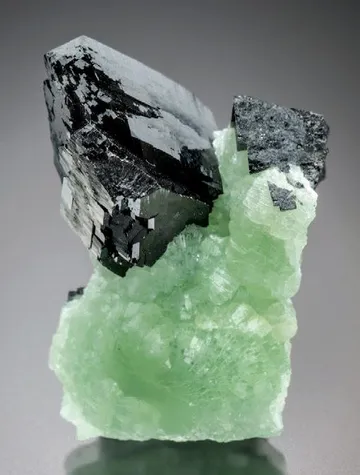
Lane & Son Traprock quarries, USA, Massachusetts locality famed for jet-black babingtonite on pale green prehnite, datolite, calcite, and quartz.
Key facts
Lane & Son Traprock quarries, better known to collectors simply as Lane’s Quarry, is one of the essential American traprock localities: a working basalt quarry complex on the Westfield–West Springfield line in Hampden County, Massachusetts, in the Early Jurassic Holyoke Basalt of the Hartford rift basin. Its fame rests on minerals that crystallized in fissures, seams, amygdules, and open cavities in the dark traprock—especially lustrous black babingtonite on pale green prehnite, large glassy datolite, calcite, quartz, epidote, apophyllite-group minerals, and a small but historically important suite of alteration silicates. For collectors, the classic Lane look is unmistakable: jet-black to greenish-black babingtonite blades and wedge-like crystals standing in sharp relief on knobby pea- to mint-green prehnite, sometimes joined by white or colorless calcite, pale yellow-green datolite, or drusy quartz.
Regional View
Country View
The quarry has been known mineralogically for more than a century. Early-twentieth-century work on its datolite was substantial enough to draw crystallographic study by Whitlock, Kraus and Cook, and Earl V. Shannon; Shannon’s later papers described the quarry’s datolite abundance and the chloritic to stilpnomelane-like alteration minerals of the traprock seams. Babingtonite, now the mineral emblem of Massachusetts, gives Lane’s Quarry a second layer of identity: the locality is a defining source for fine American babingtonite, and older examples remain a benchmark for East Coast traprock collecting.

Photo: Wikimedia Commons

Photo: Wikimedia Commons
Search for specimens: View all specimens from Lane & Son Traprock quarries, USA
Lane & Son Traprock quarries are a group of aggregate quarries in Westfield and West Springfield, Hampden County, Massachusetts, developed in the Holyoke Basalt, a dark, fine-grained Early Jurassic basalt unit of the Newark Supergroup in the Hartford Basin. The broader geological setting is the chain of Mesozoic rift basins that formed as eastern North America began to split during the opening of the Atlantic. In collector terms, that means a hard traprock host cut by joints, fissures, shear zones, and amygdaloidal cavities—exactly the sort of environment in which late-stage hydrothermal and low-temperature secondary minerals can form attractive crystals.
The quarry is not an ore mine in the usual sense. Its commercial product is crushed traprock for construction aggregate, road metal, and related uses; the mineral specimens come from discontinuous cavity systems, seams, and veins opened by quarrying. The mineralization is best understood as a low-temperature secondary assemblage introduced or reorganized along fractures and voids in basalt. Quartz commonly lines openings early; calcite fills and caps many seams; prehnite forms botryoidal crusts, rounded aggregates, and casts or pseudomorphs after earlier anhydrite; datolite forms pale green to nearly colorless crystals and crystal groups; babingtonite appears as sharp black to greenish-black crystals on prehnite, quartz, calcite, and datolite-bearing matrix. The same fissure systems also yielded chloritic material, diabantite, stilpnomelane, and the golden ferric alteration product historically called chalcodite.
Commercial quarrying began in 1891 under John S. Lane and Sons, making the operation one of the longest-lived quarry enterprises in the Connecticut Valley. Historical quarry nomenclature divided the workings, going north from the Boston & Albany Railroad, into No. 1–1a, No. 2–2a, No. 3–3a, and No. 4; that old numbering is still useful when reading Shannon’s early descriptions of individual mineral pockets and alteration seams. The active quarrying exposed fresh basalt faces and repeatedly created opportunities for collectors and mineralogists to inspect new seams. That is why the locality has such a dense early publication record: the quarry was not a one-pocket curiosity, but a productive industrial exposure where mineralized zones could be examined as work advanced.
The most famous early production was datolite. By the first decades of the twentieth century, Westfield datolite crystals were already widely distributed in collections and known for unusual size, clarity, and crystallographic complexity. The datolite occurred in a dipping vein reported as about two feet wide, with crystals described in older accounts as reaching fist size. Later collector attention shifted heavily toward babingtonite, especially specimens where lustrous black crystals sit cleanly on pale green prehnite. Finds from the 1940s and older collections are particularly valued, and modern market appearances often emphasize provenance from major collections such as those of F. John Barlow, Chet Lemanski, George Loud, George Elling, Dr. Richard Gaines, and other East Coast collectors.
Collecting access today must be treated as private industrial quarry access, not as an open rockhounding site. The property has operated as a working quarry, and any collecting has historically depended on explicit permission or organized visits. Serious collectors should not enter, park, sample dumps, or approach active faces without current authorization from the operator. Besides the legal issue, the locality is an active or recently active traprock quarry environment, with high walls, loose blocks, blasting history, heavy equipment, and unstable piles—conditions that are incompatible with casual unsupervised collecting.
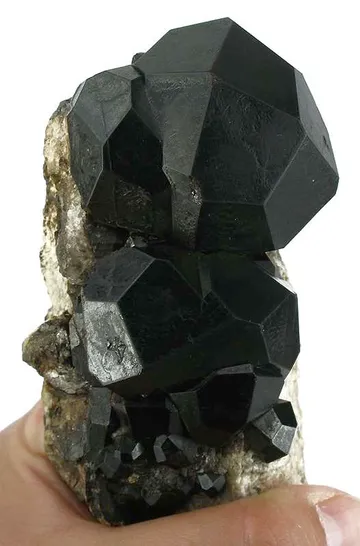
Babingtonite from Lane & Son is the locality’s signature collector mineral: sharp, lustrous black to dark greenish-black crystals, commonly wedge-shaped, bladed, tabular, or prismatic, set on pale green prehnite, drusy quartz, white to colorless calcite, and locally datolite. Typical collectible crystals are millimetric to about 1 cm, but fine pieces with crystals around 1.5–2 cm are known, and exceptional examples have been described with still larger individual crystals; the best specimens show isolated, undamaged crystals with bright striated faces, clean terminations, strong contrast against mint-green prehnite or pale calcite, and an undistracting basalt matrix. Ordinary pieces may have scattered etched black aggregates or partially contacted crystals in seams, while top Lane babingtonites have the visual authority of a miniature classic: black, glossy, sharply crystallized, and immediately recognizable as western Massachusetts traprock material.
Prehnite at Lane & Son is much more than background matrix: it forms the green stage on which most of the locality’s finest babingtonite and datolite specimens perform. The common habit is botryoidal, reniform, granular, or knobby pea- to sea-green crusts lining cavities, but distinct rounded crystal aggregates occur and are desirable because individual prehnite crystallization is less common than massive or botryoidal coverage here. The most distinctive Lane prehnites are pseudomorphs and casts after anhydrite, including stalactitic-looking mint-green forms with rectangular or hollow remnants of the earlier sulfate geometry; attractive specimens may carry black babingtonite, pale yellow-green to colorless datolite, white apophyllite-group crystals, calcite, epidote, or quartz. The finest prehnites combine fresh green color, translucency, undamaged rounded surfaces or complete pseudomorph form, and crisp associated crystals rather than merely serving as rough green seam filling.
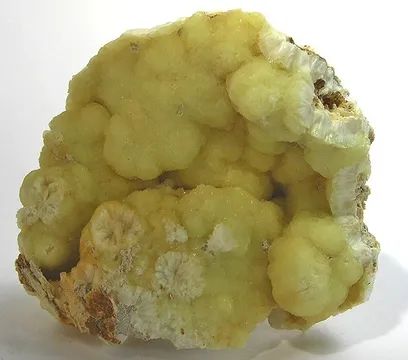
Datolite is the other great Lane mineral and may be the most historically important species from the quarry: pale green to nearly colorless crystals and groups, sometimes large, lustrous, and gemmy enough to yield facetable material. Calcite occurs as white, colorless, translucent, rhombohedral, and cleavage masses, at times with good display crystals; quartz lines seams and vugs as clear to white druse and small crystals, with chalcedony and amethyst also reported; epidote appears as small lustrous dark green crystals or drusy coatings; apophyllite-group and stilbite-subgroup minerals add the zeolite-family flavor familiar from eastern traprock localities. Rarer or more specialized records include sphalerite, galena, chalcopyrite, malachite, chrysocolla, hematite, pigeonite, anhydrite, clinochlore variety diabantite, stilpnomelane, and chalcodite, the last a historically important golden ferric alteration product related to stilpnomelane rather than a modern, widely collected display species.
The principal authenticity concern with Lane material is not laboratory treatment but locality accuracy. The visual association—black babingtonite on green prehnite from basalt—is shared by several classic eastern North American traprock localities, including Roncari Quarry in East Granby, Connecticut, and the New Jersey traprock quarries at Prospect Park and Paterson. A Lane attribution is most secure when the specimen carries an old label, a well-documented collection history, or a recognizable association such as Lane datolite with prehnite and babingtonite. Be cautious with vague labels reading only “Westfield,” “Lane Quarry,” or “Massachusetts traprock,” because similar Westfield/Hampden material, adjacent or nearby quarries, and other Connecticut Valley traprock localities can be confused in older collections.
No broad, locality-specific tradition of manufactured fakes or routine treatments is associated with Lane babingtonite or prehnite. The more realistic problems are repairs, trimming, missing crystals, sawn backs, and pocket-wall contacts. Babingtonite crystals can be sharply terminated but exposed; look carefully for bruised tips, sheared bases, resin-darkened matrix, and contact zones where a once-larger pocket plate was broken down. Good Lane babingtonites often have high luster and sharply striated faces, so dull, rounded, or powdery black masses should not be valued like complete crystals. Prehnite casts after anhydrite are especially prone to broken projecting forms and edge bruising, while datolite crystals should be checked for termination dings, cleavage damage, and hidden contacts where a crystal was attached to the pocket wall.
Rarity varies strongly by quality. Small reference pieces of prehnite, quartz, calcite, or scattered babingtonite have circulated for decades, but aesthetic matrix specimens with multiple lustrous babingtonites, large undamaged datolite crystals, or complete prehnite-after-anhydrite pseudomorphs are not common. Fine Lane babingtonite is increasingly an old-collection market mineral; the best pieces tend to surface through estate dispersals, regional collections, or specialist dealers rather than as abundant new production. Datolite is likewise sought after: large, glassy, pale green Lane crystals are famous enough that even imperfect examples attract attention, and clean cut-and-rough datolite sets are genuinely unusual.
Handling is straightforward but should be respectful. Babingtonite, prehnite, datolite, quartz, and calcite are stable display minerals under normal indoor conditions, but the older chloritic and stilpnomelane-rich seam material can be friable, and calcite is easily scratched or attacked by acids. Prehnite pseudomorphs with hollow interiors should not be soaked or ultrasonically cleaned. Avoid aggressive water cleaning on specimens with clayey green alteration minerals, loose calcite, or delicate drusy quartz, and keep labels with the specimen; for Lane material, provenance can be as important as an extra millimeter of crystal size.
One of the most vivid Lane episodes comes from Earl V. Shannon’s work in the quarries during the period when the locality was still actively revealing its mineralogical personality. Shannon lived in Springfield between February 1918 and April 1919 and visited the Westfield quarries frequently, observing the datolite and its associated minerals in place rather than only as loose specimens on dealers’ tables. His later writing makes clear that Lane was already a locality of scale: not a few curious crystals, but thousands of datolites from a quarry system large enough to test ideas about crystal habit, mineral sequence, and alteration.
In the extreme southeastern corner of the No. 2a quarry, Shannon found a narrow fissure rising from the quarry floor. The basalt beside it had been changed for one to three feet into a sandy, friable material—deep green when wet, pale grayish green when dry. Partway up the wall the fissure opened into a filled cavity two to four inches wide. Its walls carried a lining of prismatic quartz crystals averaging about 5 mm long, then a thick green clayey mineral, and finally translucent calcite with a strong tendency toward twinning. The green material behaved almost like a living thing after removal: saturated with water and frozen when collected, bright deep green at first, then shrinking as it dried, cracking throughout, and in many cases falling apart spontaneously. Shannon recovered about 6 kilograms of it, enough for repeated analyses; the material proved to be diabantite.
Another seam, this time on the face of the No. 4 quarry, looked similar at first but told a different chemical story. It contained abundant clayey green material over an early crust of calcite crystals with unusual trigonal form; the last major mineral again was calcite, including broad translucent masses with cavities lined by nearly cubic rhombohedrons. This second green mineral was not diabantite at all but stilpnomelane, darker and more bluish, with a submetallic luster and enough toughness when dry to resist easy grinding. In the same quarry, Shannon later encountered golden, metallic-looking scales on quartz beneath epidote, prehnite, and calcite—surfaces so bright that he compared their appearance to commercial gilt paint. Those golden coatings proved to be the ferric alteration product historically known as chalcodite, a tiny but memorable mineralogical flourish in an otherwise dark basalt quarry.
The datolite story is equally rich. In the first major crystallographic wave, Ward’s Natural Science Establishment obtained Lane datolite crystals collected by R. F. Jones, and Kraus and Cook examined forty-seven crystals for their 1906 paper. The crystals came from cracks and crevices in Lane’s Trap Quarry, described then as halfway between Springfield and Westfield, and many had reportedly been collected during the preceding two years. Their clarity and size made them suitable for careful goniometric study. By the time Shannon wrote his 1921 monograph, only about seventy Westfield crystals had been studied in the earlier literature, yet twenty-three new crystal forms had already been recognized—a remarkable number, and one reason the quarry’s datolite occupies a larger place in mineralogical literature than many prettier but less studied occurrences.

.jpg)