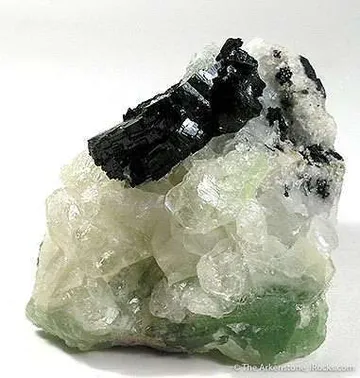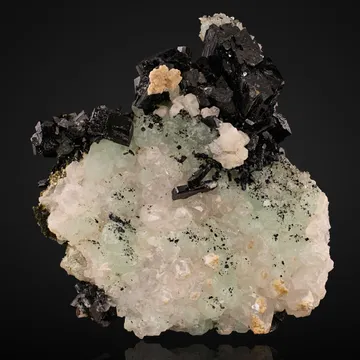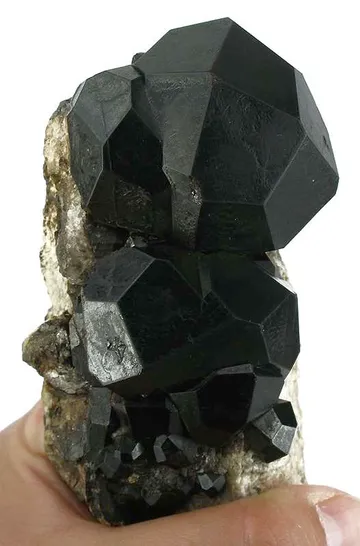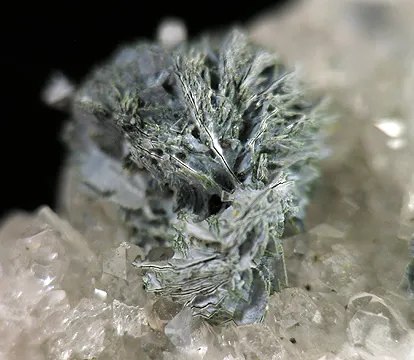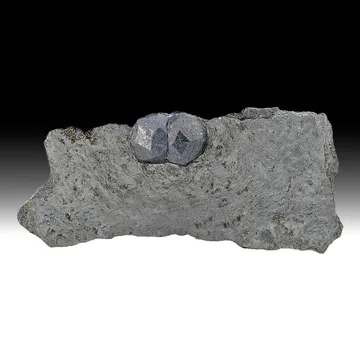
Babingtonite from Westfield, Massachusetts - defining American locality with jet-black euhedral crystals on traprock, strong contrast, and historic quarrying.
Key facts
Lane & Son Traprock Quarries at Westfield is one of the defining American localities for babingtonite: the place collectors picture when they think of lustrous black crystals rising from pale prehnite, white calcite, and quartz-lined basalt cavities. The best Westfield pieces are not merely species examples; they are classic New England traprock specimens, valued for the stark contrast between jet-black babingtonite and soft green or white matrices, for sharp terminations, and for the old labels that tie them to more than a century of quarrying in the Connecticut Valley.

Photo: Wikimedia Commons
The setting is a working traprock quarry complex in the Early Jurassic Holyoke Basalt, part of the Newark Supergroup in the Hartford basin. Commercially, the rock is quarried for aggregate; mineralogically, the appeal lies in cavities, seams, and altered zones where late-stage fluids deposited quartz, calcite, prehnite, datolite, chlorite-group minerals, epidote, and babingtonite. That basalt-cavity environment gives Lane specimens their familiar architecture: dark crystals perched on a pocket wall rather than isolated, free-floating crystals.
Westfield babingtonite also carries special historical weight. Charles Palache’s 1936 paper on babingtonite and epidote from Westfield treated the quarry as an important occurrence and explicitly contrasted the beauty of the Westfield material with the nearby Holyoke occurrence. The species later became Massachusetts’ official state mineral, named by the General Court in 1981, and the official state description emphasizes the same traits collectors prize in Lane material: jet-black color and brilliant submetallic luster.
Collectors look for clean, lustrous, euhedral crystals with crisp wedge-like or bladed forms; strong black-on-green or black-on-white contrast; undamaged terminations; and intact basalt matrix that reads unmistakably as a traprock pocket. Large, balanced combination specimens are the prize. Small pieces with one or two sharp crystals are still desirable, but the great Westfield examples are cabinet or small-cabinet compositions where babingtonite is visually dominant and the associated minerals enhance rather than crowd it.
Search for specimens: View all babingtonite specimens from Lane & Son Traprock Quarries, Westfield, Massachusetts, USA
Lane & Son Traprock Quarries, often shortened on labels to Lane’s Quarry, is a group of quarries at Westfield in Hampden County, Massachusetts, close to the West Springfield town line. The quarry complex works the Holyoke Basalt, an Early Jurassic basalt unit of the Newark Supergroup. In quarry language this is “trap rock”: dense, dark igneous stone suitable for crushed aggregate, asphalt, and road construction. In mineral-collector language, it is a basalt pocket locality.
The quarry is not a mine for babingtonite. It is an aggregate operation that happens to intersect mineralized cavities and fissures. That distinction matters. Specimens come from the same blasting and crushing cycle that produces commercial stone, so fine material appears episodically when the right pocket is exposed, and it disappears just as quickly if not recognized and saved. The great Lane specimens are therefore products of both geology and timing: cavities had to exist, blasting had to open them, and someone had to see the crystals before the rock went to the crusher.
The locality was started in 1891 by John S. Lane and Sons and is recorded as one of the oldest continuously operating quarry operations in the Connecticut Valley. The quarries are also recorded as contiguous, or effectively so, with the Hampden Quarry in West Springfield, which explains why some old or dealer labels may use closely related quarry names for specimens from the same working quarry belt.
The mineral suite is broader than babingtonite. Recorded species include anhydrite, apophyllite-group minerals, babingtonite, calcite, chalcodite, chalcopyrite, chrysocolla, clinochlore including diabantite, datolite, epidote, galena, hematite, malachite, pigeonite, prehnite, quartz including amethyst and chalcedony, sphalerite, stilbite-subgroup minerals, and possible stilpnomelane. Datolite and babingtonite are the two collector headliners. Westfield datolite has its own classic status, with old descriptions noting a roughly two-foot vein and crystals reaching fist size; babingtonite gives the locality its darker, more dramatic traprock aesthetic.
Access must be treated as private quarry access, not casual rockhounding. The quarry is an active industrial site, and the practical route for collectors has historically been permission, organized club access, or acquisition from old collections and the specimen market. Unauthorized entry into an active quarry is unsafe and inappropriate; the same fresh blasting that creates collectible pockets also creates unstable walls, heavy equipment traffic, and rockfall hazards.
Production of collectible babingtonite appears in several waves rather than as a continuous mineral-specimen output. Palache’s 1936 work was based on material brought back by Harvard students from a spring 1935 visit. A notable market specimen was recorded as mined in 1946. Another fine combination specimen was documented as self-collected in 1940 by Earle C. Sullivan. Later specimens entered major private collections, museum collections, and the modern market under labels from collectors such as F. John Barlow, Ernie Schlichter, Charlie Key, Bob Werner, Howard Belsky, and others.
Lane babingtonite is typically black to very dark greenish black, with a bright vitreous to submetallic luster when fresh and undamaged. The crystals are euhedral and commonly appear as bladed, prismatic, wedge-ended, or tapering crystals. Many of the best examples show sharp terminations and striated faces; some are doubly terminated. The most attractive pieces use the basalt cavity itself as a natural stage: babingtonite crystals project from prehnite, calcite, or quartz lining, rather than appearing as loose fragments.
Size varies widely. Small crystals of a few millimeters are common in modest examples. Good miniatures and small cabinets may carry crystals around 8 mm to 1.3 cm. Fine examples reach roughly 2 cm, and one well-known photographed specimen from the locality carries a largest babingtonite crystal group listed at 2.2 x 1.8 x 0.7 cm on a 5.3 x 3.6 x 2.4 cm matrix. Larger overall matrix specimens are known, including pieces in the 10 cm-plus range, but in those cases the quality depends less on the size of the rock than on the placement, luster, and survival of the babingtonite crystals.
The classic associations are prehnite, calcite, and quartz. Prehnite is often pale to mint green and may be botryoidal, knobby, spherical, or stalactitic; it provides the strongest color contrast with black babingtonite. Calcite can be white, colorless, pale greenish, or golden, and it may provide an excellent clean background for isolated black crystals. Quartz occurs as druzy linings or crystalline layers on basalt matrix. Datolite is a major Lane mineral in its own right and appears in the same broader cavity mineralization, though the most iconic babingtonite specimens are more often described with prehnite, calcite, and quartz.
Other recorded associates matter for paragenesis and authenticity. Chlorite-group minerals, diabantite, epidote, apophyllite-group minerals, chalcodite, chalcopyrite, hematite, sphalerite, and related cavity minerals all fit the Westfield traprock setting. Palache’s paragenetic lists show babingtonite appearing in several sequences, including quartz-chlorite-calcite-babingtonite, chlorite-calcite-babingtonite, calcite-babingtonite, and quartz-prehnite-babingtonite-calcite. Those sequences match what collectors see in hand specimens: babingtonite is a late, sharply crystallized occupant of prepared cavity surfaces, often following or accompanying the minerals that make the contrasting matrix.
Quality is judged by luster first, then form, isolation, contrast, and condition. A single brilliant, undamaged, well-terminated black crystal on white calcite can outrank a busier specimen with many bruised or dull crystals. The finest Lane pieces have a composed look: babingtonite is well separated, the matrix is stable and proportional, the green prehnite or white calcite reads clearly, and no distracting trimming scars or broken crystals dominate the display face.
The chief authenticity issue with Lane babingtonite is locality discipline. “Lane Quarry” can be confusing because Massachusetts has more than one Lane-labeled traprock locality in mineral literature and collections; Lane & Son Traprock Quarries at Westfield should not be confused with Lane Quarry at Northfield in Franklin County. Labels using “Hampden Quarry” also require context, because the Westfield Lane workings and the Hampden Quarry in West Springfield have been described as contiguous. A credible old label, collection history, or dealer record is especially valuable for better specimens.
No distinctive treatment is expected or desirable for Lane babingtonite. The practical concern is not enhancement but assembly, trimming, and misattribution. Collectors should inspect whether the babingtonite is naturally attached to the matrix, whether calcite has been acid-etched in a way that left loose or undercut crystals, and whether old repaired crystals have been stabilized. Detached black blades glued to prehnite or calcite would be a serious problem in any classic babingtonite specimen, though specific documented fakes tied to this locality are not a recurring theme in the published locality record.
Condition is critical because babingtonite crystals are exposed and brittle enough to lose tips and edges. Check terminations under magnification. Look for bruising on the high points, especially on crystals standing proud of calcite or prehnite. On calcite-rich pieces, examine whether the matrix is cleaved, etched, or powdery. On prehnite-rich pieces, look for abrasion on rounded prehnite surfaces and for fractures through the basalt backing. Quartz-lined cavities can be tougher, but sharp babingtonite terminations are still vulnerable.
Rarity is strongly tiered. Small representative Lane babingtonites appear occasionally. Attractive old-time examples with one or a few sharp crystals are scarce but obtainable. Major matrix specimens with multiple undamaged, lustrous crystals over 1 cm, strong contrast, and old provenance are genuinely uncommon and can disappear into regional or U.S. systematic collections for decades. Market records show a wide spread: modest auction pieces have sold in the low hundreds, while historically important or highly aesthetic examples have been described by specialist dealers as major U.S. classics with valuations in the low thousands.
The best buying strategy is to be selective. Do not buy the locality name alone. Demand sharpness, luster, and a matrix that helps the specimen. A Lane babingtonite with one fine, undamaged crystal and a clear old label is preferable to a larger, duller plate of broken black shards. For a serious New England suite, the ideal specimen shows the whole traprock story at once: black babingtonite, green prehnite, white calcite or quartz, basalt matrix, and provenance that can survive the next generation of labels.
In 1920, Earl V. Shannon described fieldwork at the Lane company quarries with the eye of a mineralogist watching an active quarry reveal its secrets a wall at a time. He had visited the quarries repeatedly during the previous year, noting that they were already well known to mineralogists for “many superb specimens of datolite.” After a dozen days of careful observation, he had enlarged the species list and caught something more subtle than a showy pocket: the anatomy of alteration in the trap.
The most vivid episode came in January, in the extreme southeastern corner of the No. 2a quarry. There, a narrow fissure rose from the quarry floor. On each side of it, the traprock had been altered for one to three feet into a sandy, friable material that was deep green when wet and pale grayish green when dry. Shannon interpreted the effect as hydrothermal alteration by ascending waters, not ordinary surface weathering. About two-thirds of the way up the wall, the fissure widened into a filled cavity only two to four inches across. Its walls were lined with prismatic quartz crystals averaging 5 mm long. Over and around the quartz sat a thick green clayey mineral, and the remaining space was filled with translucent calcite.
The material behaved almost like a living thing once collected. It came out saturated with water and frozen, bright deep green in color. On drying it shrank markedly, cracked throughout, and many specimens fell apart spontaneously. Shannon recorded that roughly 6 kilograms of the green mineral were obtained. The whole episode is a useful reminder that Lane’s beautiful cabinet specimens came from chemically active, sometimes delicate fracture systems—not from simple empty holes in inert basalt.
Palache’s 1936 note begins with another field moment: Harvard students visiting the well-known Westfield trap quarry in the spring of 1935 returned with specimens that justified a closer look. From those pieces, Palache drew out a sequence of pocket mineralization rather than treating the minerals as isolated curiosities. His lists read like shorthand for a traprock cavity wall being built in stages: quartz and calcite; calcite alone; datolite alone; calcite, datolite, and prehnite; quartz, chlorite, epidote, and prehnite; chlorite, calcite, and babingtonite; calcite and babingtonite; quartz, prehnite, babingtonite, and calcite. Those combinations are still exactly what collectors hope to see when they turn over an old Westfield specimen.
A later collecting record gives the locality a more personal texture. One small-cabinet combination specimen with babingtonite, prehnite, calcite, and quartz was documented as self-collected by Earle C. Sullivan in 1940. It carried 1.3 cm bladed babingtonite crystals, translucent mint-green prehnites to 1.7 cm, golden calcites to 2.2 cm, and a crystalline quartz layer over basalt. The piece entered the Lemanski collection catalog, later appeared on the market, and was described as the sort of specimen a collector might not see again for decades. That is the Lane story in miniature: a working quarry, one fortunate pocket, a collector on the right day, and a specimen that kept accumulating history long after it left the basalt wall.
Another specimen, recorded as mined in 1946, captures the immediate postwar era of American mineral collecting. The piece was a miniature, 4.80 x 4.23 x 3.55 cm, made of glossy dark bluish-black prismatic babingtonite interspersed with pale green prehnite and some white crystalline material between the black and green points. Its description called it a “baby boomer,” but the date matters more than the phrase: 1946 Lane material is old enough now to be a historical object as well as a mineral specimen.
Modern provenance trails continue that pattern. A 2026 auction specimen from the Bob Werner collection carried several dark greenish-black, lustrous babingtonite crystals on white to colorless calcite, with the largest babingtonite group about 2.0 cm. Another historic miniature traced from F. John Barlow to Paul Stahl and back to market, carrying five isolated black crystals from about 1.3 to 2 cm, was described as a major eastern U.S. babingtonite classic. The crystals and their matrices matter, but so do the names: Barlow, Werner, Sullivan, Schlichter, Key. Lane babingtonites are now collected as mineral specimens and as pieces of American collecting genealogy.