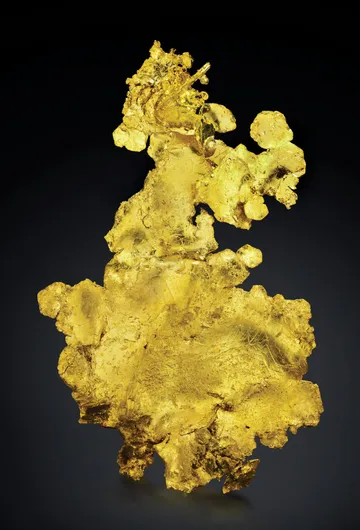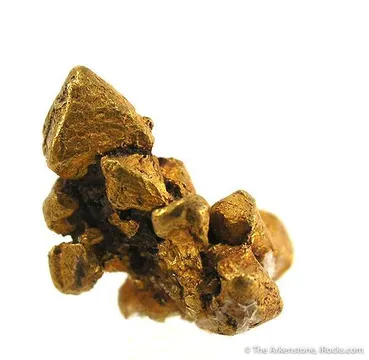
Colorado Quartz Mine, USA - premier locality for sculptural native gold in quartz, prized for high luster, crystal form, and 3D specimens.
Key facts
The Colorado Quartz mine is one of the defining modern localities for crystallized native gold. Despite its name, it is not in Colorado: it lies in Mariposa County, California, in the western foothills of the Sierra Nevada, north of the old Gold Rush town of Mariposa. The mine belongs to the southern end of the East Gold Belt of the broader Mother Lode region, but its fame rests less on bullion production than on the rare survival of gold as sculptural, well-crystallized mineral specimens. Here, gold was not merely disseminated through quartz ore; in the best pockets it grew as bright yellow arborescent aggregates, skeletal octahedra, leaves, wires, and thick crystalline masses in white quartz, clay, calcite, and oxidized pocket fillings.
Geologically, the locality is a pocket-gold mine tied to the Colorado Dike, a mafic intrusive body altered to greenstone within graphitic slate of the Briceburg Formation. Narrow “floor” veins of milky quartz cut the dike and concentrate the collectible gold close to the greenstone-slate contact. The mine’s great specimens are therefore products of a very specific geometry: thin quartz stringers, small clay- or oxide-filled vugs, brittle dike rock, slate contact zones, and enough open space for gold to crystallize rather than simply smear through ore.
Regional View
Country View
For collectors, Colorado Quartz specimens occupy an elite tier because they combine three attributes that rarely coincide in native gold: high luster, visibly developed crystal form, and dramatic three-dimensional composition. The best examples are not shapeless lumps or ordinary high-grade ore. They are miniature sculptures: gold rising like flame from white quartz, branching into ragged octahedral trees, forming combs and skeletal plates, or standing as freestanding masses with enough matrix to prove origin without overwhelming the metal. Several of the mine’s named pieces—the “Dragon,” the “Pocket Piece,” “El Fuego,” and “Bristle Cone”—have become reference points for what a world-class gold specimen can be.

Photo: Wikimedia Commons
Search for specimens: View all specimens from Colorado Quartz mine, USA
The Colorado Quartz mine is in the Colorado area of the Whitlock and Colorado mining districts, Mariposa County, California, approximately 11 miles north of Mariposa. Mindat records it under the formal locality name “Colorado Mine (Colorado Quartz Mine; Colorado Quartz claim), Colorado, Colorado Mining District, Whitlock Mining District, Bagby-Mariposa-Mount Bullion-Whitlock Mining District, Mariposa County, California, USA,” with coordinates near 37° 33′ 20″ N, 119° 58′ 19″ W. Older mining records place the workings near Long Canyon Creek and Colorado School, on private and partly patented ground.
The deposit is best understood as a gold-bearing fissure vein and pocket-vein system in a narrow structural corridor. The bedrock at the mine is silty graphitic slate of the Briceburg Formation, a unit correlated regionally with the Mariposa Formation and generally regarded as Late Jurassic in age. Into this slate was intruded the Colorado Dike, a mafic body later hydrothermally altered to greenstone rich in chlorite and epidote. Published descriptions give the dike a northwest strike, about N50°W, and a steep dip approaching vertical; the dike is roughly 3 to 7 meters thick in the mine area and crosses the patented mine ground.
The specimen-producing veins are the so-called “floor” veins: narrow, braided quartz stringers, commonly only a few centimeters to a few tens of centimeters thick, that cut across the altered dike and locally extend into the slate wall rock. The crucial collecting point is that the gold pockets occur at, or very close to, the contact between the greenstone dike and the slate. Most pockets are small—on the order of hand-sized vugs rather than great caverns—and are filled or partly filled with clay, calcite, oxidized arsenopyrite, iron and manganese oxides, or mixtures of these materials. In the best cases the clay protected delicate gold growths that would have been destroyed by conventional ore mining.
The historical mine record begins in the nineteenth century. A patent application for the property was filed on February 1, 1875, by John A. Bataille, a merchant associated with the town of Colorado, Mariposa County. Early production records are incomplete, and much of the early gold-bearing material was treated as ore, not saved as mineral specimens. MRDS-derived records describe the mine as a past gold producer and note work during the 1915 period, including a 500-foot adit level, raises, a winze, stoping, and later references to an inclined shaft and drift. The mine reportedly produced from 1915 to 1938, with late-1920s ore production of about 2,500 tons at period values around $10 to $11 per ton, while total historic production was probably modest compared with major Mother Lode mines.
The specimen era began much later. After a change of ownership in the 1970s, new work along the Colorado Dike encountered the kind of pocket gold that earlier miners may have missed, overlooked, or simply melted. By the mid-1970s the mine was recognized among collectors as a source of attractive crystallized gold, and by 1982 Anthony R. Kampf and Peter C. Keller had published the locality as a modern source of crystallized gold in The Mineralogical Record. Larry Lehto later reopened the mine, and in 1994 John Emmett joined as an investor; renewed work on deeper levels led to the discovery of highly important specimen pockets, including the pocket associated with the “Pocket Piece.” The legendary “Dragon” was discovered in February 1998 in a new zone reached from the 140-foot level area, and its recovery and preparation became a milestone in modern mineral specimen conservation.
Modern work has been episodic and specimen-driven, often using careful blasting, hand extraction, metal detectors, and conservation-minded preparation rather than simple ore removal. Later owners David Varabioff and Anthony Fraser used the name Dragon Gold Mining Company, a direct nod to the mine’s most famous specimen. Recent finds have continued to reinforce the locality’s reputation: examples collected by the newer ownership in 2017 and later have appeared in specimen databases, dealer records, auction listings, and video documentation. Access should be regarded as private; this is not a casual field-collecting locality, and collectors should assume that collecting requires owner permission or acquisition through the mineral market.
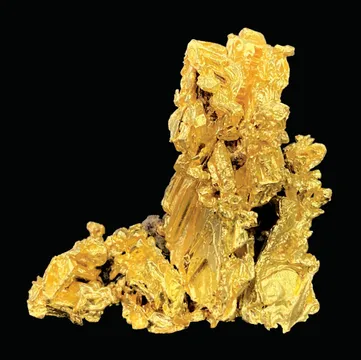
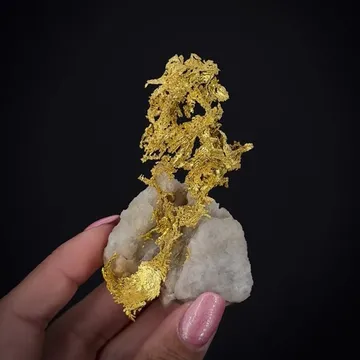
Gold from the Colorado Quartz mine is the mineral that made the locality famous: bright yellow to rich yellow-orange native gold in skeletal octahedral crystals, arborescent aggregates, leaves, wires, and thick crystalline masses, most characteristically perched on or partly enclosed by white to milky quartz. Published work describes the gold as forming in small clay-, calcite-, oxide-, and altered-arsenopyrite-filled pockets in narrow floor veins near the greenstone-slate contact of the Colorado Dike, with crystals reported to at least about 0.6 cm and specimens ranging from thumbnails to major cabinet pieces. The best Colorado Quartz golds are not merely heavy; they are architectural—balanced, three-dimensional, lustrous, and visibly crystallized, with gold rising free of the matrix rather than lying as dull seams in quartz. Classic pieces may show hoppery or skeletal octahedral faces, branching “tree” structures, flame-like profiles, and strong contrast against clean white quartz, while ordinary pieces are more massive, less lustrous, more damaged, or visually buried in matrix.
Quartz at the Colorado Quartz mine is not a secondary footnote but the essential stage on which the gold formed. It occurs as white to milky vein quartz in narrow floor veins that cut the Colorado Dike and locally enter the Briceburg slate, with pocket linings ranging from euhedral to anhedral crystals; in specimen terms, it is prized when it forms a clean, compact pedestal that makes the native gold stand out in relief. Colorado Quartz matrix pieces are most desirable when the quartz is bright, minimally stained, naturally proportioned, and not so bulky that it distracts from the gold, though some great specimens also preserve altered pocket material, clay ghosts, limonite, or calcite that help tell the story of their recovery. Quartz-only specimens from the mine are far less important to collectors than gold-on-quartz pieces, but the texture, trimming, and cleanliness of the quartz matrix often determine whether a gold specimen reads as a world-class display piece or simply as rich ore.
The documented mineral assemblage is comparatively small and reflects the mine’s narrow, pocket-vein character rather than broad polymetallic diversity. Mindat and published references list ankerite, arsenopyrite, calcite, chlorite-group minerals, galena, limonite, pyrite, pyrrhotite, wad, quartz, and native gold. Arsenopyrite is especially relevant as an altered and crumbly pocket constituent associated with gold-bearing cavities; calcite and clay are common pocket fillings; limonite and manganese oxides mark oxidized vugs and fracture surfaces. The locality is not celebrated as a type locality for new species; its mineralogical importance is instead the exceptional preservation and aesthetic crystallization of native gold in quartz.
Colorado Quartz gold is both highly desirable and highly locality-sensitive. The first authenticity issue is geographic mislabeling: “Colorado Quartz” refers to a mine in Mariposa County, California, not to the state of Colorado. Labels should ideally specify Colorado Quartz mine, Colorado/Whitlock district, Mariposa County, California, and older labels may use “Colorado Mine,” “Colorado Quartz claim,” or simply “Colorado Quartz.” Because the Colorado Dike continues through adjacent or nearby specimen localities—including the Artru and Mockingbird mines—well-documented provenance matters, especially for loose gold, repaired specimens, or pieces without original labels.
The second issue is preparation history. Colorado Quartz specimens can be natural, cleaned, etched, trimmed, repaired, or reconstructed from pieces recovered together from a pocket. This is not hypothetical: the “Dragon” itself is famous partly because its recovery, cleaning, and repair were documented in detail. Professional preparation may include mechanical removal of quartz, air-abrasive work, careful trimming, and brief hydrofluoric acid etching to remove silica films. None of this automatically makes a specimen undesirable; on the contrary, some of the greatest gold specimens in the world required expert preparation. But serious buyers should distinguish between simple cleaning, exposed gold on a trimmed quartz base, repaired pocket pieces, and composite or poorly documented assemblies.
Condition must be evaluated under magnification and from all sides. Native gold is soft, malleable, and easily bent; thin leaves, wires, and arborescent branches can be crushed, folded, or brightened by careless handling. The highest-value pieces preserve sharp crystal faces, natural terminations, luster, and undisturbed branching. Look for smeared high points, flattened edges, unnatural joins, glue lines, sawed quartz that dominates the base, and acid-rounded quartz surfaces. Conversely, some matrix trimming is normal and can be beneficial when it reveals the gold while retaining a believable pocket context.
Market availability is better than for many classic gold localities because the mine has produced specimens in the modern collecting era, but truly great Colorado Quartz pieces remain rare. Small gold-on-quartz specimens and loose crystallized gold appear periodically, while major cabinet specimens with strong aesthetics, good provenance, and minimal condition issues are infrequent and expensive. Named or published pieces, specimens tied to recognized pockets, and pieces formerly in important collections command strong premiums.
The first great story of Colorado Quartz is a story of recognition. For much of its mining life, the property was simply another Mariposa County gold mine: a vein, an adit, raises, a winze, a stope, and ore that could be mined for dollars per ton. Early miners did not work with today’s specimen values in mind. Beautiful crystallized gold was often treated as bullion waiting to be liberated, and much of what might now be museum material was almost certainly crushed or melted. That is what makes the modern rediscovery so consequential. By the 1970s and 1980s, collectors had begun to understand that a crystallized gold specimen could be worth far more intact than as metal.
The 1994 season was one of the mine’s great turning points. Larry Lehto brought John Emmett into the project, and the mine was worked more actively for specimens. Bulldozing and metal detecting in an open cut produced several exceptional pieces, including a pair of intergrown gold crystals later celebrated in the Mineralogical Record’s Ikons series. That specimen, only 2.9 cm across, became important out of all proportion to its size because of its crystal quality: compact, well-formed, and elegant enough to pass through major hands before reaching the Gene and Roz Meieran collection. The same modern era produced the “Pocket Piece,” a gold-rich specimen said to contain about 40 ounces of gold, and helped establish the mine as a locality where a small pocket could change the topography of the gold-specimen market.
Then came the “Dragon.” In February 1998, a new zone produced a gold specimen so sculptural that it rapidly escaped the category of mineral specimen and entered that of icon. The piece was recovered by the mining group of Larry Lehto, Noble Sparks, Bryan Lees, and John Emmett. Early photographs showed detached pocket gold masses before repair, with the largest curved mass already suggesting the animal form that would give the specimen its name. The finished piece later measured 22.9 cm and entered the Houston Museum of Natural Science, where it became one of the most famous gold specimens in the world.
The drama of the “Dragon” did not end when it came out of the mine. Its preparation became a landmark in conservation-minded mineral work. Willie Hawes, working for Collector’s Edge Minerals, used a pneumatic PaleoTool stylus—technology more familiar from fossil preparation than mineral cleaning—to remove opaque quartz while watching the gold under 10- to 15-power magnification. Small amounts of hydrofluoric acid were used briefly to clear silica films and refine the quartz surfaces. The preparation revealed two gold “legs” on the matrix base, and pre-work photographs helped match the main gold mass back to its original position. The point was not to invent a form but to restore a pocket specimen that had come apart during recovery. That distinction—documented repair rather than fantasy construction—became part of why the specimen remains so important.
Even the surface map of the mine reads like a collector’s treasure chart. Along the pink trace of the Colorado Dike are names that have acquired almost mythic force among gold collectors: Pocket Piece, Bristle Cone, El Fuego, and the Dragon. The map also notes the Mockingbird mine only about 1,500 feet away, reinforcing how tightly clustered the great Mariposa gold-specimen mines are along the same structural trend. In an ordinary mining district, such names might mark ore shoots. At Colorado Quartz, they mark moments when a pocket produced something memorable enough to be named.
The mine’s more recent chapter shows how alive the locality remained after its classic era. David Varabioff and Anthony Fraser adopted the Dragon Gold Mining Company name in direct homage to the famous 1998 specimen. In 2017, gold-on-quartz material collected by the new co-owners entered the collector record, including specimens found with the aid of metal detectors. A later Goldbay video documented the complete journey of a 17-ounce specimen, from blast to signal to careful extraction and cleaning, giving collectors a rare look at what modern pocket-gold mining actually looks like: not romantic panning in a stream, but controlled underground work where one detector tone in broken quartz and greenstone can signal a museum-grade discovery.