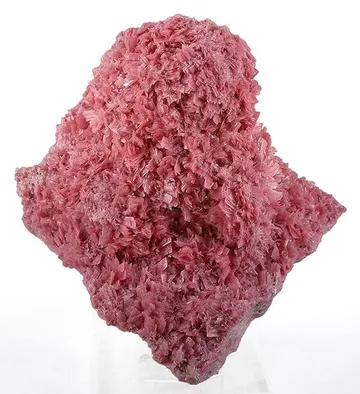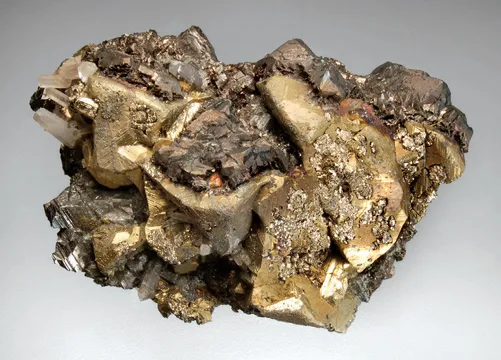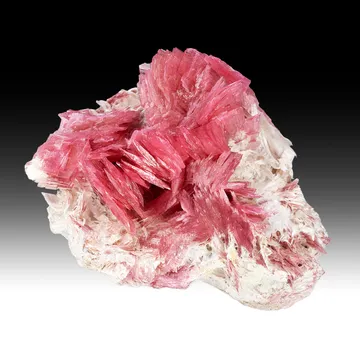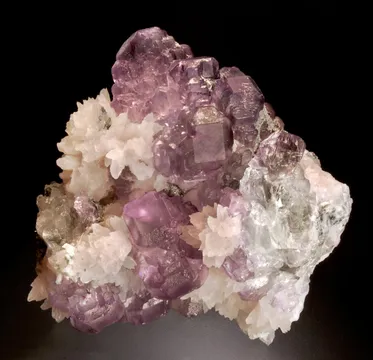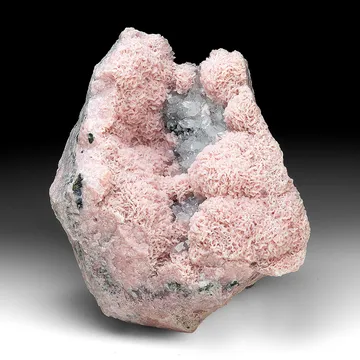
Manuelita Mine, Peru — premier locality for rhodochrosite on dark sulfide, with quartz and calcite, yielding vivid pink rhombohedra prized by collectors.
Key facts
Manuelita is one of the collector landmarks of the Morococha district: an underground silver-zinc-lead-copper mine in the high Central Andes of Junín, close to the mining town of Morococha and the great Toromocho porphyry system. Its specimens are not products of a simple “rhodochrosite mine” in the gem-shop sense; they are the attractive gangue and open-space crystallization of a zoned Cordilleran polymetallic system, where quartz, rhodochrosite, barite and calcite accompany sphalerite, galena, chalcopyrite and silver-bearing sulfosalts in veins, mantos and replacement bodies. That ore geology is precisely what gives Manuelita specimens their character: pink carbonate rhombs riding on dark, metallic sulfide matrix, often edged or dusted by quartz and pyrite.
Collectors know Manuelita above all for rhodochrosite. The best pieces are cabinet-size to large miniature plates and knobs of lustrous pink to salmon-pink rhombohedra, sometimes with visibly stepped, mosaic-like or polycrystalline faces. Good Manuelita rhodochrosite is generally not the gem-transparent, cherry-red style of Sweet Home or Uchucchacua; its strength is different: saturated rose color, crisp rhombic geometry, strong contrast against black sphalerite or brassy pyrite, and a distinctly Peruvian ore-specimen presence. The locality also produced massive and banded rhodochrosite used for cabochons and carvings, making it important to both mineral and lapidary collectors.
Regional View
Country View
The mine lies within the Morococha mining unit, a long-worked district whose deposit styles include epi- to mesothermal Ag-Zn-Pb-Cu veins, stratiform replacement mantos, skarn bodies near intrusive contacts, and the adjacent quartz-porphyry-hosted Toromocho copper-molybdenum system. Manuelita’s collector specimens are most naturally understood as vein and replacement-cavity material from the lead-zinc-silver side of that system, where late carbonate and quartz filled openings left in the evolving sulfide ore.

Photo: Wikimedia Commons
Search for specimens: View all specimens from Manuelita Mine, Peru
Manuelita Mine is recorded at Morococha District, Yauli Province, Junín, Peru, about 2 km from Morococha along the road to La Oroya. The mine is part of the larger Morococha underground operation, situated on the eastern side of the Western Cordillera at roughly 4,500–4,550 m elevation. The district is structurally dominated by the Yauli Dome, a broad anticline cut by late intrusive rocks and by mineralized northeast to east-northeast fracture systems. The main host sequence is a thick Paleozoic to Mesozoic package of schists, volcanic rocks and carbonate sediments, intruded by Upper Tertiary stocks; receptive carbonate horizons are especially important where veins intersect them, producing replacement mantos and chimney-like bodies.
The ore system is a classic central Peruvian porphyry-related polymetallic district. The Toromocho Cu-Mo porphyry occupies the central part of the camp, and outward from it the district grades through copper-rich zones into Zn-Pb-Ag and Ag-rich Pb-Zn zones. In the Manuelita and neighboring mine areas, the collector assemblage reflects the base-metal vein and replacement environment: sphalerite and galena as principal ore minerals, pyrite as a common sulfide associate in specimens, and quartz plus rhodochrosite as the most desirable cavity-filling gangue. Barite is also a recorded mineral from the mine, and quartz includes amethyst as a listed variety.
Historically, Morococha is one of Peru’s old mining camps. Mining in the region began before the Spanish conquest, and district production has been continuous since the late nineteenth century. Between 1915 and 1918, much of the district was reorganized under Cerro de Pasco Mining Company. By 1924 the camp was producing mainly copper ore at about 1,500 tonnes per day, and from 1929 to 1934 the 11.5 km Kingsmill Tunnel was driven to drain the workings above the 4,020 m elevation. That tunnel remains a defining piece of Morococha infrastructure and is directly relevant to Manuelita, because the Yauli, or Manuelita, production shaft connects downward toward the Kingsmill drainage level.
The modern corporate history is layered. The Gubbins family operated Morococha-area mines through companies including Minera Santa Rita and Minera Yauli, later consolidated into Sociedad Minera Corona. Pan American Silver entered agreements in early 2004 to acquire its controlling interest in Compañía Minera Argentum, which held the Anticona and Manuelita mining units and related assets, and production under Pan American began with effect from July 1, 2004. Morococha was placed on care and maintenance in early 2022 after the closure of the Amistad processing plant. In September 2023, Alpayana acquired Pan American’s 92.3% interest in Compañía Minera Argentum, and Alpayana reports that Morococha restarted operations in 2024 with underground production focused on zinc, lead, silver and copper.
For collectors, Manuelita has had several recognizable specimen pulses. Material from 2001–2002 includes salmon-pink rhodochrosite on matrix, with crystals reported to about 1 cm. Specimens dated 2005 and 2006 show some of the classic bright rhombohedral style, including pink rhombs with quartz along the edges and examples showing internal color zoning. A 2007 large cabinet specimen from the Dr. William Logan collection is especially notable for a stepped “mosaic” or “vortex” habit, with vivid pink rhombs reportedly to 1.7 cm on edge across an 11.9 cm plate. Later material from 2008 emphasized zoned rhodochrosite on pyrite and sphalerite. A well-publicized March 2019 find, labelled by dealers as from a deep Manuelita level, produced vivid pink rhombohedral crystals with pronounced polycrystalline surfaces, commonly in the 0.4–1.1 cm range, on quartz, sphalerite and pyrite-bearing matrix.
Access today should be understood as access to an active industrial underground mine, not a recreational collecting site. Specimens reach the market through miners, mine personnel, dealers and old collections; casual collecting in the workings or on company ground is not appropriate without permission from the mineral-rights holder and the operator. Because Morococha is active again under Alpayana, fresh mineral-specimen recovery is possible in principle, but specimen availability is controlled by underground development, safety practice, permissions, and whether pockets happen to be preserved rather than mined as ore.
Manuelita rhodochrosite occurs chiefly as rhombohedral crystals and druses on sulfide-rich matrix, commonly pink, salmon-pink, rose-pink or, in the best pieces, a more vivid and uniform pink than the ordinary output from the mine. Individual crystals in documented specimens are commonly a few millimetres to about 1.4 cm, with exceptional described rhombs to 1.7 cm on edge; larger cabinet specimens can reach roughly 30 cm as groups, though most market pieces are thumbnails, miniatures and small cabinets. The characteristic associations are quartz, sphalerite, pyrite and locally galena or barite, and the strongest specimens show sharp rhombs with lustre, little bruising, appealing color zoning or stepped polycrystalline growth, and strong contrast against black sphalerite or brassy pyrite. The 2005–2008 pieces, the 2007 “mosaic/vortex” style, and the vivid deep-level 2019 material form the core of the modern collector reputation.
Quartz at Manuelita is important less as a stand-alone species than as the architectural partner that sharpens the rhodochrosite display: small colorless to milky crystals commonly skirt the edges of pink rhombs, dust their faces, or form a low sparkling ground over sulfide matrix. Mindat photo data show quartz as the most frequent photographed associate of Manuelita rhodochrosite, and dealer records describe water-clear quartz points, white microcrystalline coatings, and larger opaque crystals sharing matrix with rhodochrosite, sphalerite and pyrite. The best quartz-bearing Manuelita pieces are those in which quartz frames rather than buries the rhodochrosite—adding sparkle, depth and contrast without obscuring the pink carbonate; ordinary pieces become less desirable when late quartz forms a dull sugary crust over already modest color or damaged rhombs.
Sphalerite is both an ore mineral and a collector associate at Manuelita, usually appearing as lustrous black to greenish-brown or resinous crystals and masses beneath or beside rhodochrosite. Documented specimens show sphalerite crystals to about 1.1 cm with slight translucency in some examples, commonly intergrown with pyrite and carrying small rhodochrosite rhombs plus quartz points. As a display mineral from this mine, sphalerite succeeds when it provides a sharp, glossy, dark base for pink rhodochrosite rather than a massive, visually dead ore matrix; the finest combinations balance crystal definition in both species, with brassy pyrite or clear quartz adding a third contrast. Stand-alone sphalerite from Manuelita is much scarcer on the collector market than the rhodochrosite combinations, and the best pieces are judged by sharpness, lustre, separation of crystals, and the quality of the carbonate overgrowth.
Beyond the three principal EarthWonders species, Manuelita has a concise but meaningful recorded mineral list: galena, barite, quartz including amethyst, rhodochrosite and sphalerite. Pyrite is very common in documented specimen associations even though it is most often encountered in the collector record rather than as a listed valid species on every locality summary. No valid type-locality mineral is recorded from Manuelita itself in the principal public mineralogical databases; the important “rarity” of the mine is therefore not a new-species story, but a locality-style story—pink rhodochrosite on dark polymetallic ore from one of Peru’s classic central Andean mining districts.
Manuelita specimens are generally robust-looking but not indestructible. Rhodochrosite is a carbonate with perfect rhombohedral cleavage, so exposed crystal corners and stepped growth surfaces chip readily. The common damage pattern is peripheral bruising on rhomb edges, flattened contact zones where a druse was attached to vein walls, or dull patches where late quartz or handling has abraded the crystal faces. On high-grade pieces, inspect the highest rhombs and the outer rim under good light; small edge chips disappear easily in photographs of pink, polycrystalline surfaces.
Authenticity problems are usually questions of attribution rather than elaborate fakery. Morococha has several rhodochrosite-producing localities—Manuelita, Santa Rita and Austria Duvas among them—and old labels may say only “Morococha” or may use older department naming conventions. Some market labels also confuse “Manuelita,” “Santa Manuelita,” and broader Morococha material. A specific Manuelita attribution is strongest when backed by an old dealer label, collection history, MinID record, or a distinctive specimen style matching documented finds. Pale pink carbonate from the district can also invite confusion with manganese-bearing calcite; analytical confirmation matters most for unusually pale, massive or non-rhombohedral material, while sharp rhombohedral MnCO3 on the classic sulfide-quartz matrix is less ambiguous.
Treatments are not a major documented issue for Manuelita rhodochrosite, and there is no well-established literature of systematic fakes from the mine. Cleaning, however, can affect value. Acid cleaning is risky because rhodochrosite effervesces slowly in acids and can lose lustre or sharpness; avoid aggressive chemical treatment, and be cautious with any specimen whose carbonate faces look unnaturally matte, rounded or etched. Ultrasonic cleaning is also inappropriate for many pieces because the rhombs can separate along cleavage or along weak contacts with sulfide matrix.
Fluorescence is not a principal buying point, but at least one dealer-documented Manuelita rhodochrosite on pyrite showed minor fluorescence under both longwave and shortwave ultraviolet light. Treat that as an incidental curiosity, not a diagnostic guarantee. Store pieces away from repeated moisture and sulfur-rich fumes; sphalerite and pyrite associations are usually stable, but mixed sulfide matrix benefits from dry, ventilated display conditions.
Market availability fluctuates. Old Manuelita pieces from the 2001–2008 period appear in collections, auctions and dealer archives, while the 2019 deep-level find supplied a modern wave of sharp pink miniatures and small cabinets. Even so, really fine pieces are not abundant: cabinet plates with vivid color, undamaged rhombs, clean composition and strong sulfide contrast are much harder to replace than small drusy examples. Large lapidary or massive rhodochrosite is a separate market from crystallized Manuelita specimens and should be valued differently.
One of the most telling Manuelita stories is visible in the labels rather than in a mine diary. A specimen photographed for Mindat and later mirrored on Wikimedia is described as an 8.2 x 6.5 x 6.4 cm knob from the 2001–2002 finds, one side covered with opaque salmon-colored rhodochrosite crystals to about 1 cm. It is not a flamboyant, gemmy piece; it is a dense, workmanlike Andean cluster, the kind of specimen that shows how much of Manuelita’s identity comes from volume and texture as much as transparency. The rhombs crowd the matrix, a rose crust over ore, and the effect is unmistakably Morococha.
The mid-2000s pieces brought a more refined aesthetic. Dealer labels from February 15, 2006 record small but elegant rhombohedral crystals with exceptional color and lustre, with quartz tucked around the edges. Another 2006 specimen carried stronger zoning: darker pink at the centers of the rhombs, then alternating paler and deeper bands toward the edges, a mineralogical growth record written in shades of rose. By July 2006, specimens of around 7.4 cm were being described with rhodochrosite crystals to 1.4 x 1.3 cm partly coated by white microcrystalline quartz—a combination that can either enrich or weaken a piece, depending on whether the quartz adds sparkle or smothers the carbonate.
The 2007 “mosaic” or “vortex” plate is one of the locality’s memorable collector objects. It measured 11.9 x 9.4 x 3.8 cm and carried lustrous, vivid pink rhombs to 1.7 cm on edge in a stepped-growth style striking enough to earn its own descriptive vocabulary. The specimen passed through the W. S. Logan collection as number X 48-7 and was illustrated in Logan’s self-published 2013 book, Rhodochrosite — Crystals of Drama and Nuance. For Manuelita, where many examples are small druses or rounded knobs, a cabinet plate with individual rhombs that large and sculptural is exactly the kind of piece that changes how collectors remember a locality.
Then came the March 2019 material, repeatedly labelled from the deep Manuelita workings. The language in dealer records is consistent: sharp rhombohedral crystals, vivid pink color, bright faces, and very marked polycrystalline growth on the rhomb surfaces. Some pieces were small miniatures with main crystals around 1 x 0.7 cm; others were 7 cm-class druses with crystals nearer 0.6 cm but unusually lively color. Several descriptions emphasize that the 2019 material was better than the previously common Manuelita output. That is often how a classic locality renews itself—not by producing an entirely different mineral, but by giving collectors the same species in a cleaner, brighter, more sharply crystallized chapter.