Ihovitra, Madagascar — a small quartz locality famed for colorless to milky crystals with mint-green fuchsite phantoms, prized for ghostly interiors and Itremo…
Key facts
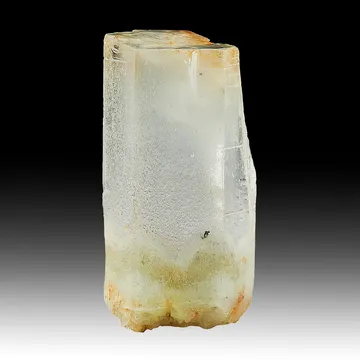
Ihovitra is a small but instantly recognizable quartz locality in the Itremo area of west-central Madagascar, in Ambatofinandrahana District, Amoron'i Mania. For collectors, its importance rests on a narrow, elegant specialty: colorless to milky, prismatic quartz crystals carrying sharply placed mint-green internal phantoms of fuchsite, the chromium-bearing variety of muscovite. The locality is recorded as a group of quarries rather than a major industrial mine, and its specimens belong mineralogically to the quartz-rich, mica-bearing metamorphic country of the Itremo Massif, where quartzite, mica schist, and marble dominate the regional bedrock. Ihovitra pieces are not valued for a long species list; they are valued because the best crystals look as though a pale green ghost crystal has been suspended just below a transparent termination.
The name itself has become part of the collecting story. Specimens have circulated as Ihovitra, Ivohitra, Iovitra, and Anovitra, with Ihovitra now the common database and marketplace spelling, while Iovitra is best treated with caution as a trade-label variant. Historically, the locality was known to mineral collectors before the broad market surge of about 2010–2013, but it was those show years that made the material familiar internationally: small cabinet clusters and loose thumbnails with clean glassy tips, white to milky lower prisms, and internal fuchsite sheets that outline former quartz growth faces. A later 2018 find is especially noted in the trade for crystals with clearer terminations and phantoms placed close to the tips.
Regional View
Country View
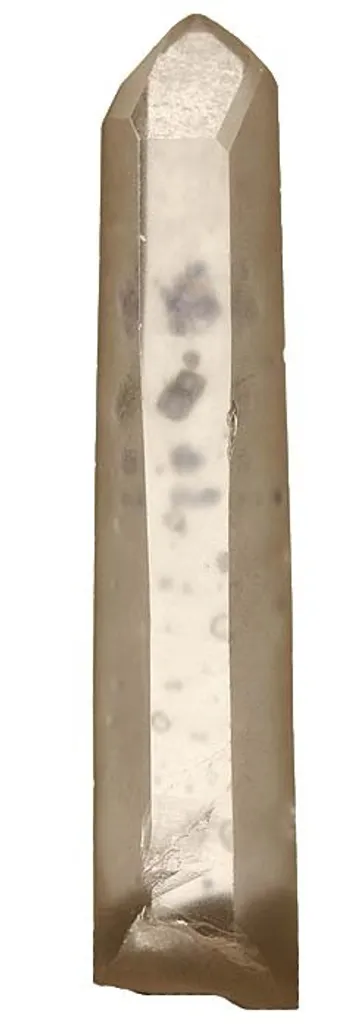
At first glance the finest Ihovitra quartz can be mistaken for a simple chlorite-phantom quartz from one of Madagascar’s many quartz occurrences. Under closer inspection, however, the locality’s best pieces show a more delicate mica-like internal texture: thin, patchy, sheeted to cloud-like green concentrations that follow phantom planes, often clustered just below the pyramidal terminations. The color is usually not emerald-deep; it is a cool mint green, strongest where the fuchsite is concentrated along a former crystal face and more ethereal where the inclusions disperse into the prism.

Photo: Mineral Auctions / The Arkenstone
Search for specimens: View all specimens from Ihovitra, Madagascar
Ihovitra lies in the Itremo commune, roughly west of Ambatofinandrahana in Madagascar’s central highlands. The locality is best understood as a specimen-producing quartz pocket and quarry area within the Itremo Massif rather than as a conventional ore mine. The broader Itremo geological setting is a metamorphosed sedimentary sequence: quartzite, mica schist, and marble formed from ancient shallow-water sediments and later deformed during the Neoproterozoic to Cambrian tectonic history of Madagascar. That setting matters to collectors because it supplies both the silica-rich environment for quartz growth and the chromium-bearing mica responsible for the locality’s signature green phantom inclusions.
The mineralization at Ihovitra is simple and visually precise. The collectible material consists of quartz crystals, singly or in clusters, that grew in open space and captured fuchsite-bearing material along temporary crystal-growth surfaces. The resulting phantoms are not separate green quartz crystals; they are inclusion-rich zones inside later overgrowths of quartz. In good pieces the phantom is geometrically legible, aligned below the termination, and visible through a clean outer quartz shell. Matrix examples occur on pale, fine-grained quartzitic or sandstone-like rock; many specimens in the trade, however, are detached single crystals or small floater-like groups.
No large formal mining operator is well documented for Ihovitra specimens. Published mineralogical records connect the locality with Polychrom France material in the 2008 Madagascar issue of Le Règne Minéral, while later market records describe small-scale, remote, artisanal production and a supply that became notable internationally around 2010–2013. The best-known early show material included miniature and small cabinet clusters with colorless to translucent quartz crystals several centimeters long, carrying mint-green phantom zones just below the tips. A 2012 Munich Show appearance is repeatedly cited by dealers as an important moment for the locality’s recognition, and later auction descriptions describe only a handful of productive finds rather than sustained large output.
A distinct 2018 find is notable because the phantoms were positioned especially close to transparent terminations, making the green internal architecture more visible than in much of the earlier material. Those crystals tend to show a milky shaft below a clearer tip, with the fuchsite phantom perched high in the crystal. Recent market availability is largely from dispersed older stock, dealer inventories, and collection releases rather than abundant new production. Small loose crystals remain obtainable, but large, undamaged, sharply phantom-bearing clusters with strong color and balanced aesthetics are scarce.
Collecting access should be treated as restricted and local. Ihovitra is not documented as a public fee-collecting site, and serious acquisition is normally through Malagasy mineral dealers, show material, established international dealers, or older private collections. As with many Madagascar localities, precise pit locations, ownership, and permissions are not transparent from trade labels alone; a specimen with an old dealer label or a minID-style record is more useful than one sold simply as “Madagascar fuchsite quartz.”
Quartz from Ihovitra is typically colorless to milky white, prismatic, and lustrous, with the locality’s best crystals showing transparent pyramidal terminations and an internal green phantom outlined by fuchsite flakes or micro-clusters. Documented specimens range from thumbnails around 2.5–4 cm to small cabinet and cabinet clusters exceeding 10 cm across, with individual crystals commonly in the 3–6.5 cm range on notable pieces. The most desirable examples are not merely greenish quartz; they show a clean outer quartz shell, a crisp phantom set high in the crystal, strong mint-green color without muddy staining, and minimal chipping on the terminations and prism edges. Clusters on pale quartzitic matrix are especially attractive when several crystals repeat the phantom pattern in parallel, while detached singles are judged by sharpness, transparency, and how well the internal phantom can be read from multiple viewing angles.
Fuchsite is the identity-defining inclusion mineral at Ihovitra, occurring not as large collectible mica books but as fine chromium-bearing muscovite inclusions inside quartz. In the best pieces it appears as fresh mint-green flakes, sheet-like concentrations, patchy veils, and evenly distributed micro-clusters along former quartz growth faces, creating phantom planes just below the terminations. Analytical work has been important here because the green inclusions were long sold or discussed under several names, including celadonite, chlorite, and fuchsite; Raman and later SEM-EDS work support fuchsite as the principal green inclusion in the characteristic Ihovitra material. Collectors should value brightness, internal placement, and sharp phantom geometry over sheer quantity of green material: a thin, well-positioned fuchsite phantom in a clear quartz crystal is generally better than a cloudy, muddled inclusion mass that obscures the crystal.
Other minerals documented from Ihovitra are few but important. Muscovite is represented chiefly by its fuchsite variety, and pumpellyite-subgroup inclusions have been reported in association with the fuchsite-bearing quartz, including brown radial clusters in a studied polished quartz sample. Celadonite and chlorite have appeared historically on labels or in discussions, but the better current interpretation is that these are erroneous or unconfirmed identifications for the classic green phantom material. Ihovitra is not a verified type locality for any mineral species; its rarity is not taxonomic breadth, but the unusual, analytically studied fuchsite-and-pumpellyite inclusion assemblage preserved inside quartz.
The primary authenticity issue for Ihovitra is labelling, not obvious treatment. Specimens have circulated under Ihovitra, Ivohitra, Iovitra, and Anovitra, and the locality can be blurred with broader “Itremo,” “Ambatofinandrahana,” or simply “Madagascar” labels. A precise old label matters. The green inclusions have also been miscalled celadonite or chlorite; those names should be treated skeptically unless supported by analysis. For the characteristic Ihovitra material, fuchsite is the defensible identification, with pumpellyite-subgroup inclusions documented in at least some studied quartz.
No specific, well-documented treatment or artificial manufacture is established for Ihovitra fuchsite-in-quartz specimens, and the inclusion pattern is difficult to fake convincingly because it follows internal phantom planes inside natural quartz growth. Still, collectors should be wary of vague “green phantom quartz from Madagascar” without locality data, of dyed or surface-coated quartz being offered metaphysically as fuchsite quartz, and of pieces where green material is only external staining rather than internal inclusion. A loupe should show that the green material lies inside the quartz, often as flaky mica-like particles or thin planes, not as paint, glue, oil, or a removable surface coating.
Condition is central. The crystals are often slender and easily nicked at termination edges, prism corners, and attachment points. Many loose crystals are complete enough for study but have small chips; cabinet clusters may hide contacted or broken crystals among more aesthetic points. The best pieces combine glassy terminations, strong internal green phantoms, and little damage beyond the natural base. Because the visual effect depends on transparency, avoid specimens with heavy bruising, etched dullness, or pervasive milky clouding that prevents the phantom from reading clearly.
Fluorescence is not the selling point here. Handle these as inclusion specimens: avoid harsh acids or aggressive ultrasonic cleaning, both of which can exploit fractures and loosen delicate clusters. Simple dust removal, gentle water cleaning when necessary, and stable display away from abrasion are enough. Marketwise, thumbnails and small miniatures continue to appear, including recent dealer and auction offerings, but fine early clusters and the 2018-style near-tip phantom crystals are much less common. The locality is mature rather than exhausted from a collector’s standpoint: available, but selective buying is rewarded.
Ihovitra locality page, Mindat — The principal online locality record, documenting the name variants Ihovitra, Ivohitra, Iovitra, and Anovitra; the locality’s status as a group of quarries; the quartz-fuchsite assemblage; and the history of disputed green-inclusion identifications.
Thomas, Laurent. 2008. “Les découvertes minéralogiques de Polychrom France.” Le Règne Minéral, 14(80), 53–55 — The key early published reference tying Ihovitra quartz and fuchsite to the special Madagascar issue Aventures Minéralogiques à Madagascar.
Renfro, Nathan. 2009. “Lab Notes: Pumpellyite in Quartz.” Gems & Gemology, 45(3), 211–212 — GIA’s Raman microspectroscopy report identifying the green inclusions as fuchsite and the brown radial clusters as pumpellyite in a 6.64 ct polished quartz crystal from Madagascar.
Farfan, Gabriela A., and Jeffrey E. Post. 2019. “Quartz from Madagascar with Fuchsite Phantom Inclusions.” The Journal of Gemmology, 36(8), 698–699 — Smithsonian-linked analytical work on rough and cut fuchsite-phantom quartz from Ihovitra/Anovitra/Iovitra/Ivohitra, including SEM-EDS confirmation of Cr-rich muscovite.
Inzana, J., Kusky, T., Higgs, G., and Tucker, R. 2003. “Supervised classifications of Landsat TM band ratio images and Landsat TM band ratio image with radar for geological interpretations of central Madagascar.” Journal of African Earth Sciences, 37, 59–72 — A useful regional geology paper describing the Itremo Group as the Quartzo-Schisto-Calcaire sequence of quartzite, pelite, and marble.
Tucker, Robert D., Roig, Jean-Yves, Macey, P. H., Delor, C., Amelin, Y., Armstrong, R. A., Rabarimanana, M. H., and Ralison, A. V. 2007. “Neoproterozoic nappes and superposed folding of the Itremo Group, west-central Madagascar.” Gondwana Research, 12(4), 356–379 — A structural and geochronological framework for the Itremo region, relevant to understanding the metamorphic host setting.
Rasoamalala, V., Salvi, S., Béziat, D., Ursule, J.-Ph., Cuney, M., de Parseval, Ph., Guillaume, D., Moine, B., and Andriamampihantona, J. 2014. “Geology of bastnaesite and monazite deposits in the Ambatofinandrahana area, central part of Madagascar: An overview.” Journal of African Earth Sciences, 94, 128–140 — Not an Ihovitra specimen paper, but a strong regional source for the Ambatofinandrahana–Itremo geological setting.
1713809 on Vimeo — Weinrich Minerals — A rotating specimen video of a thumbnail quartz crystal from Ihovitra with green fuchsite-lined phantom inclusions.
Untitled on Vimeo — Weinrich Minerals — A specimen video associated with Weinrich Minerals specimen 1712039, showing a loose gemmy Ihovitra quartz crystal with a fuchsite-lined phantom.
Mindat: Ihovitra, Itremo, Ambatofinandrahana District, Amoron'i Mania, Madagascar — Best single reference for locality hierarchy, name variants, mineral list, and the fuchsite-versus-celadonite/chlorite issue.
Mindat: Fuchsite from Ihovitra — Focused occurrence entry for fuchsite at Ihovitra, with references to Thomas 2008 and Renfro 2009.
Mindat: Celadonite from Ihovitra — Useful because it documents celadonite as an erroneous report for the green inclusions.
GIA: Fall 2009 Gems & Gemology PDF — Contains Nathan Renfro’s “Pumpellyite in Quartz” lab note, a key analytical reference for fuchsite and pumpellyite inclusions.
Smithsonian Research Online: “Quartz from Madagascar with Fuchsite Phantom Inclusions” — Bibliographic record for the 2019 Journal of Gemmology article by Gabriela A. Farfan and Jeffrey E. Post.
The Journal of Gemmology PDF, Volume 36(8), 2019 — Full issue containing the fuchsite-phantom quartz note and analytical discussion.
Mineral Auctions: Quartz with Fuchsite inclusions, Iovitra Mine — A useful market record for a large cabinet piece, with dimensions, sale date, and description of early material around 2010.
Mineral Auctions: Quartz with Fuchsite Phantoms, Ihovitra/Iovitra/Ivohitra — A well-photographed small example showing the soft green phantom style typical of the locality.
Crystal Classics: Quartz with Muscovite var. Fuchsite inclusions — Dealer record summarizing the circa 2010–2013 market emergence and later scarcity of older-stock specimens.
Weinrich Minerals: Quartz with Fuchsite #1712039 — Recent dealer example of a small loose crystal with a green fuchsite-lined phantom.
Weinrich Minerals Auction: Quartz with Fuchsite #1713809 — Recent auction record documenting continued low-level market availability of thumbnail material.