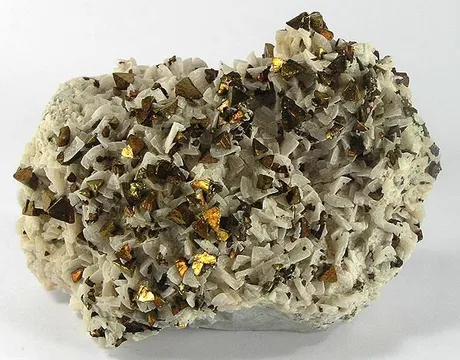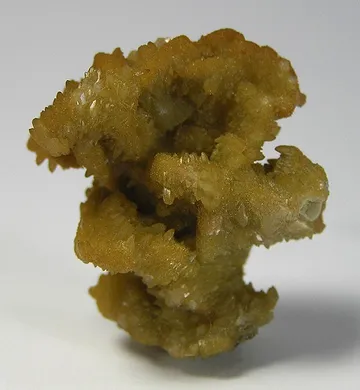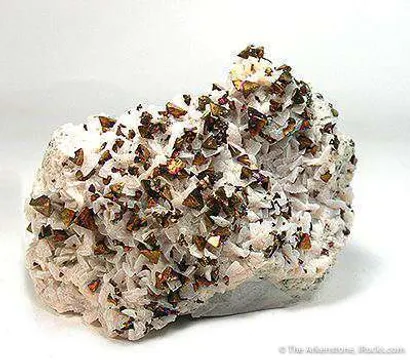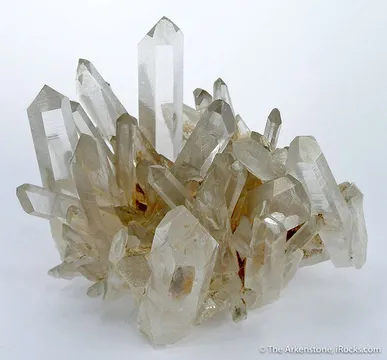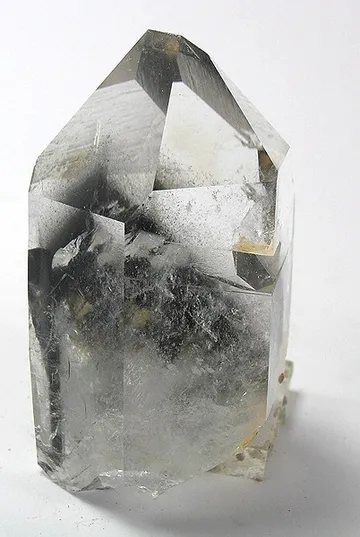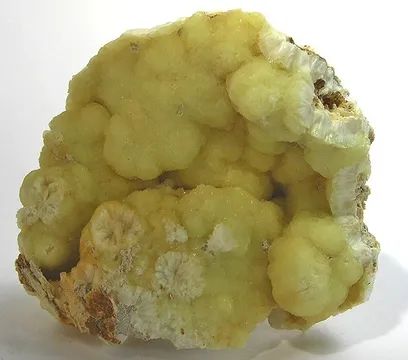
Magnet Cove, USA - classic American locality known for titanium-rich minerals (brookite, rutile, perovskite); striking crystals on quartz attract collectors.
Key facts
Magnet Cove is one of the classic American localities where geology and specimen mineralogy are inseparable. Set in Hot Spring County, Arkansas, just east of Hot Springs in the Ouachita Mountains, it is an eroded Cretaceous alkaline-carbonatite intrusive complex punched into folded Paleozoic sedimentary rocks. To the collector, that means an unusually titanium-rich system: rutile, brookite, anatase, perovskite, titanite, schorlomite-group garnets, niobium-bearing oxides, rare barium titanosilicates, fluorapatite, aegirine, eudialyte, sodalite, magnetite, and an extraordinary suite of microminerals occur in a compact area only a few miles across.
Its fame rests first on titanium minerals. The black, lustrous brookite once called “arkansite” is the most widely recognized specimen type: sharp, metallic crystals perched on smoky or milky quartz, usually from altered novaculite and quartz-rich contact-zone material around the intrusive rim. Rutile is equally important, especially the cyclic sixling and eightling twins, reticulated groups, and rutile paramorphs after brookite. Perovskite, particularly from carbonatite and calcite-rich zones such as Kimzey Calcite Quarry and Perovskite Hill, adds another distinct look: glossy black to brownish-black crystals in pale calcite with monticellite, apatite, magnetite, and related Ti-Zr garnets.
Regional View
Country View
Magnet Cove’s best specimens have a look that is hard to confuse with other localities. Brookite is typically opaque, jet-black, sharp, and highly lustrous, often more architectural than transparent alpine brookite; the quartz is commonly smoky, etched, clay-stained, or partly coated, giving the pieces a dark, earthy contrast. Rutile appears as compact twinned “flowers,” striated black crystals, or skeletal and reticulated aggregates rather than the slender red needles familiar from quartz inclusions. Perovskite and kimzeyite-bearing specimens are usually more matrix-oriented, with black crystals or grains set in calcite, carbonatite, or altered alkaline rock. Serious micromounters value the locality just as highly as cabinet collectors, because some of Magnet Cove’s rarest minerals occur only as tiny crystals in miarolitic cavities, vugs, and weathered Ti-rich rock.
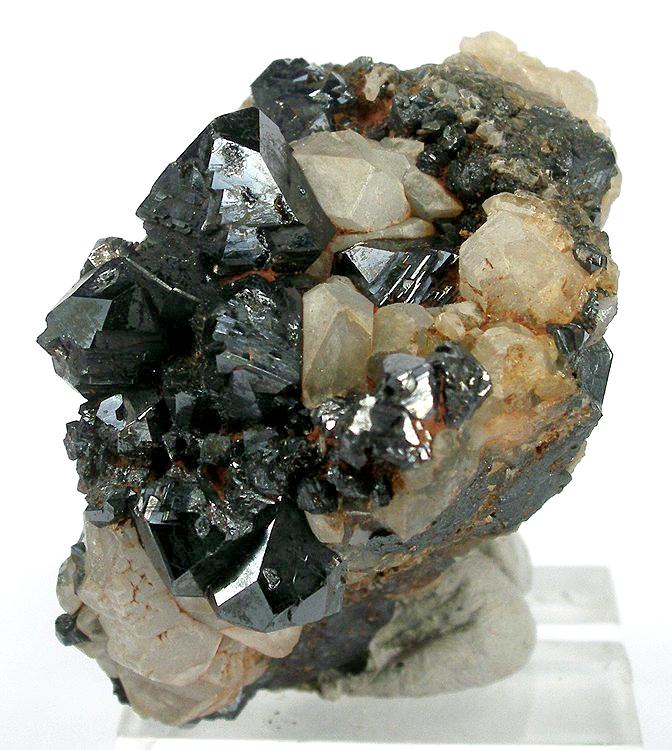
Photo: Wikimedia Commons

Photo: Wikimedia Commons
Search for specimens: View all specimens from Magnet Cove, USA
Magnet Cove is an alkaline-carbonatite complex exposed as an elliptical basin roughly three miles across in its long northwest-southeast dimension and about five square miles in area. The basin shape is not a volcanic crater in the modern sense; the rocks now exposed represent an intrusive complex emplaced at depth and later unroofed by erosion. The surrounding country rocks are folded Paleozoic units of the Ouachita belt, including Arkansas Novaculite and Stanley Shale. Around the intrusion, resistant rim rocks and adjacent novaculite form the surrounding ridges, while weathered igneous rocks and alluvium occupy much of the basin floor.
The igneous architecture is unusually varied for such a small district. The outer parts include light-colored nepheline syenites and related feldspathic rocks; the inner rim includes phonolite-trachyte; the interior is dominated in large part by ijolite and related mafic alkaline rocks; and late carbonatite bodies occur near the center of the cove. Smaller dikes, pegmatitic segregations, jacupirangite, garnet-pseudoleucite syenite, eudialyte-nepheline syenite pegmatite, nepheline syenite pegmatite, and altered xenolithic material all add to the mineralogical complexity. This is why specimens from Magnet Cove should not be thought of as a single “mine look”: a brookite-on-quartz from altered novaculite, a rutile eightling from a Ti-rich vein, a perovskite in calcite-carbonatite, and a delindeite micromount from Diamond Jo Quarry are products of related but distinct microenvironments.
The titanium mineralization is commonly described in two broad deposit styles. One consists of feldspar-carbonate-rutile veins and altered igneous rock within the intrusive complex; this is the setting of the historic rutile operations, including the Magnet Cove Rutile Company and related Titanium Corp. of America workings. The other consists of brookite-quartz and related Ti-bearing veins in thermally altered Arkansas Novaculite along or near the intrusive margin; the Hardy-Walsh, Christy, and modern Moses Hill/Rutherford-style brookite-quartz material belongs to this broader contact-zone family. In these rocks, Ti-rich fluids from the cooling alkaline-carbonatite system interacted with silica-rich novaculite and sandstone, producing smoky quartz, brookite, rutile, anatase, taeniolite, pyrite, siderite, iron oxides, and clay-rich residual zones.
Mining at Magnet Cove was small compared with major industrial titanium districts, but historically important. Rutile was mined from open pits from 1932 to 1944, yielding about 5,400 tons of concentrate. The ore was attractive because rutile is a high-grade TiO2 mineral, but Magnet Cove’s rutile-brookite deposits also carry niobium, which complicated metallurgy and helped prevent large-scale development. U.S. Bureau of Mines investigations in the 1940s examined the Magnet Cove Rutile Company property and the Christy deposit; the Christy body, in altered novaculite, was reported as a broad brookite-bearing clay and novaculite deposit rather than a conventional hard-rock vein mine. Later assessments recognized substantial Ti-bearing material remaining in the district, but Arkansas has no current titanium-mineral production from Magnet Cove.
Several individual sites are important to collectors. The Kimzey Calcite Quarry, also called Calcite Hill, exposed carbonatite and calcite-rich rock with fluorapatite, monticellite, magnetite, pyrite, perovskite, and kimzeyite. Diamond Jo Quarry, on the southern side of the complex, is a key micromineral locality in nepheline syenite and garnet-pseudoleucite syenite, with miarolitic cavities carrying pectolite, barite, labuntsovite, delindeite, lourenswalsite, kassite, sphalerite, pyroxenes, and other rare phases. Cove Creek exposures show jacupirangite and a suite of crosscutting dikes. The old rutile deposits produced classic twinned rutile and rutile-brookite material. The novaculite contact-zone deposits—historically including Hardy-Walsh and Christy, and in more recent collector language Moses Hill or Rutherford-type workings—are the source of the best modern brookite on smoky quartz.
Access today is the most important practical issue. Magnet Cove is not an open public collecting district. Most historic occurrences are on private land, abandoned industrial properties, quarry land, or sites where collecting requires explicit permission. Older guidebooks describe roadcuts, creek exposures, and quarry faces that were accessible to earlier generations of collectors, but that should not be taken as permission today. Modern brookite-quartz material has reached the market from organized digs and private work at Moses Hill/Rutherford-type deposits, and collectors should confirm current ownership, rules, and safety conditions before planning any trip. The locality rewards careful fieldwork, but it is not a casual public rockhound stop.
Brookite is the signature collector species of Magnet Cove, historically known as “arkansite” before crystallographic and chemical work placed it firmly as brookite. The best pieces show opaque, brilliant metallic-black, orthorhombic crystals perched on smoky, milky, or colorless quartz, with individual brookite crystals commonly in the millimeter to centimeter range and exceptional old specimens reported with crystals around 1–1.6 cm. The classic setting is the contact-zone system where Ti-rich fluids entered altered Arkansas Novaculite or sandstone near the intrusive rim, producing quartz first and brookite later on quartz faces; Christy, Hardy-Walsh, and the modern Moses Hill/Rutherford-style material are the names most often encountered on labels. Good Magnet Cove brookite is judged by sharpness, luster, isolation on contrasting quartz, undamaged terminations, and visible placement rather than by sheer size; ordinary pieces are loose black crystals in clay, crowded coatings, or dull, iron-stained aggregates with little crystal definition.
Magnet Cove rutile is prized for cyclic twinning: compact sixling and especially eightling twins with striated, lustrous black to brownish-black faces are among the district’s most distinctive specimen forms. Rutile also occurs in feldspar-carbonate-rutile veins in the intrusive complex, in rutile-brookite associations, in reticulated groups from cavities and weathered Ti-rich rock, and as paramorphs after brookite; older descriptions also note rutile accompanying brookite on quartz in the contact-metamorphic sandstone/novaculite environment, though in lesser abundance than brookite. The finest pieces are complete, symmetrical twins with crisp re-entrant angles and bright faces, ideally free of heavy iron crusts or broken arms; commoner examples are contacted, partial, massive, clay-coated, or require magnification to show their structure.
Quartz at Magnet Cove is important not because the alkaline igneous rocks are quartz-rich—they are generally silica-undersaturated—but because silica was locally remobilized from sandstone and novaculite during contact metamorphism and hydrothermal alteration. Near Magnet and in the altered novaculite contact zones, solutions produced smoky, milky, and colorless quartz crystals, in some cases as parallel aggregates and, in the finest specimens, as the matrix for sharp black brookite. Crystals can range from small vug linings to substantial smoky crystals, with Arkansas Geological Survey descriptions noting smoky quartz crystals up to about a foot long in the brookite-bearing assemblage. Collector-quality quartz from Magnet Cove is therefore judged by its association: a sharp, lustrous brookite or rutile perched cleanly on smoky quartz is far more locality-defining than an isolated quartz crystal without Ti minerals.
Perovskite from Magnet Cove belongs chiefly to the carbonatite, calcite-rich, and mafic alkaline assemblages rather than the brookite-quartz novaculite veins. It occurs as glossy black to dark brownish-black crystals, commonly described in older literature as showing combinations of cube and octahedron-like forms, associated with calcite, monticellite, carbonate-fluorapatite, magnetite, pyrite, biotite, vesuvianite, and kimzeyite at places such as Kimzey Calcite Quarry and Perovskite Hill. Magnet Cove perovskite is also notable chemically because niobium can substitute into the structure, making it part of the district’s broader Ti-Nb story. The most desirable specimens have discrete, sharp, lustrous crystals set off against pale calcite or carbonatite matrix; massive black grains in calcite are geologically interesting but less competitive as display specimens unless the label, association, or micromineral content is exceptional.
Beyond the four display species above, Magnet Cove is a type-locality and rare-species district of national importance. Kimzeyite, a zirconium-rich garnet named for the Kimzey family, was described from carbonatite at Magnet Cove in association with apatite, monticellite, calcite, perovskite, magnetite, biotite, pyrite, and vesuvianite. Delindeite and lourenswalsite, two barium titanosilicates, were described from tiny crystals in miarolitic cavities at Diamond Jo Quarry. The same quarry and related alkaline rocks have yielded noteworthy labuntsovite, kassite, pectolite, barite, sphalerite, sodalite, fluorite, pyroxenes ranging toward aegirine-acmite compositions, and fine micromount material. Older accounts also emphasize lodestone and octahedral magnetite, eudialyte to about one inch, acmite crystals reported up to 18 inches in pegmatitic rock, green vesuvianite, schorlomite and andradite-group garnets with fluorapatite, mica books, leucite or pseudoleucite, molybdenite-coated pyrite, anatase, monazite-group rare-earth minerals, taeniolite, and unusually fine kolbeckite.
Magnet Cove labels deserve close reading. A specimen simply labeled “Magnet Cove” may come from very different geological settings: a brookite-quartz contact-zone pocket, the Magnet Cove Rutile Company deposits, Kimzey Calcite Quarry, Diamond Jo Quarry, Perovskite Hill, Cove Creek, Jones Mill Quarry, or another small historic occurrence. For serious collections, the sublocality matters. “Brookite on quartz, Moses Hill/Rutherford deposit” is not the same collecting story as “rutile, Magnet Cove Rutile Company,” and “perovskite, Kimzey Calcite Quarry” should not be collapsed into a generic Magnet Cove label.
The most common historical mislabel is “arkansite.” It is not a separate approved species; in the Magnet Cove context it refers to brookite. Old labels reading “arkansite” are attractive historically and should be preserved with the specimen, but the mineral name on a modern catalog record should be brookite. Rutile paramorphs after brookite and brookite-rutile intergrowths are another area where misidentification occurs, especially when black TiO2 crystals have dull surfaces or altered edges. Fine cyclic rutile twins, brookite, and perovskite can all look black and lustrous to the unaided eye, so crystal form, associations, and, where necessary, analytical confirmation matter.
Condition issues are typical of specimens formed in clay-rich, weathered, or contact-zone rock. Brookite on quartz often carries iron staining, clay seams, pocket bruising, small contact marks, and broken quartz tips. The brookite crystals themselves can be deceptively sharp but brittle; heavy brushing, ultrasonic cleaning, and acid cleaning are risky on mixed quartz-brookite pieces unless the specimen has been tested carefully. Drying and repeated gentle rinsing are often safer for clay removal than aggressive chemical treatment. Rutile twins are frequently contacted or incomplete because the crystals were recovered from residual material or broken vein rock. Perovskite in calcite requires extra caution: calcite matrix reacts with acids, and the visual appeal of these specimens often depends on preserving the pale carbonate contrast around small black crystals.
Fluorescence is not the main reason collectors buy Magnet Cove specimens, but some sodalite/hackmanite-bearing material from the district is of fluorescent interest, and rare-earth or radioactive-associated minerals occur in the broader alkaline suite. Micromount collectors should treat unknown vug material as potentially mixed and fragile. Avoid unnecessary soaking of delicate barium titanosilicates, zeolites, pectolite sprays, clay-rich aggregates, or weathered carbonatite; many of the best Magnet Cove species are tiny and can be lost in cleaning before they are ever identified.
On the market, Magnet Cove brookite on smoky quartz is the most available and recognizable modern material, especially in small cabinet and miniature sizes. Superb old-time brookite with large, lustrous, isolated crystals remains scarce. Fine rutile eightlings are classic and not continuously abundant; complete, sharp, aesthetic examples have a much stronger collector following than crude masses. Perovskite from Kimzey and related sites is much less common in attractive hand specimens, and high-quality kimzeyite, delindeite, lourenswalsite, and other rare-species material is specialized, often micromount-scale, and usually moves through advanced collector networks rather than general retail channels.
Magnet Cove’s name begins with an object that behaves like a magic trick: lodestone in the soil. Early settlers noticed that plows and tools picked up naturally magnetic magnetite from the fields, and the cove’s magnetite bodies were strong enough to interfere with compass work. Kenneth Landes, writing after his 1929 visit, noted that the magnetite bodies could affect the magnetic needle and may help explain irregular section lines in the area. That is not collector folklore; it is part of the place’s identity. The basin-like topography gave “Cove,” and the lodestone gave “Magnet.”
The brookite story is even better. In 1846, Charles Upham Shepard announced what he believed was a new titanium oxide mineral and named it “arkansite” for Arkansas. Within only a few years, crystallographers and chemists were already challenging the name. W. H. Miller, J. D. Whitney, Teschemacher, C. Rammelsberg, and Damour Des Cloizeaux all played parts in recognizing that arkansite was not a new species but brookite. The name, however, stuck to labels and collector language. Even now, a nineteenth- or early twentieth-century label reading “Arkansite, Magnet Cove” has a historical charge that a corrected modern label cannot quite replace.
Landes’s 1929 field visit gives a rare glimpse of collecting before roads, fences, quarry restrictions, and modern liability concerns changed the district. He traveled with Professor G. L. Knight and was guided by J. W. Kimzey of Magnet, who directed them to the best collecting spots. Landes described discontinuous bedrock, cultivated basin floors, wooded ridges, and fresh exposures along the state highway. He saw coarse alkaline pegmatite blasted near Cove Creek bridge, with black prismatic aegirine, white microcline, greenish nepheline, bright pink eudialyte, and brownish-yellow astrophyllite. The descriptions read like the field notes of someone arriving just as a classic locality was opening, not closing.
The Kimzey family became inseparable from the science of the district. Kimzeyite, described in 1961 by Charles Milton, Blanche L. Ingram, and Lawrence V. Blade, was named for that family because of its long association with Magnet Cove mineralogy and specimen preservation. The type material was not a showy gem crystal but a dark brown zirconium-rich garnet in carbonatite with apatite, monticellite, calcite, perovskite, magnetite, biotite, pyrite, and vesuvianite. It is a reminder that Magnet Cove’s greatest mineralogical contributions are often hidden in complex matrix rather than presented as easy display pieces.
A second name story belongs to Henry deLinde, the owner of Diamond Jo Quarry and an important amateur mineralogist. When delindeite and lourenswalsite were described in 1987, the authors wrote that deLinde had preserved a unique mineral locality and provided specimens and field guidance. The two minerals were not cabinet pieces: delindeite occurs as tiny pinkish-gray spherulitic aggregates up to about 1 mm, and lourenswalsite as extremely thin, fragile plates in rosettes. Yet those specks established Diamond Jo Quarry as one of the significant rare-species localities in the American alkaline-rock record.
The mining stories are equally concrete. At the Christy deposit in 1948, the Bureau of Mines tried three drilling methods—diamond drilling, bucket drilling, and a Baker cable-coring tool—because the ore was not a clean hard-rock body but brookite-bearing novaculite, quartz, limonite, and red clay that was difficult to core. The Baker tool proved most effective, reaching 150 feet with 80 to 100 percent core recovery. The reported ore body was about 900 feet long, 500 feet wide, and more than 141 feet deep, with deeper holes bottoming in ore. For collectors, that explains why much Magnet Cove brookite is found in clay-rich residual material rather than tidy crystal-lined cavities.