






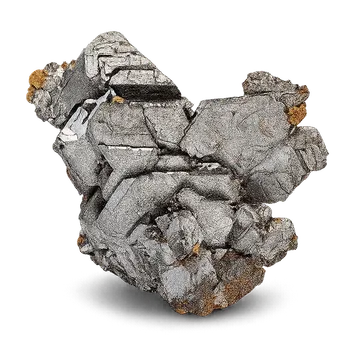
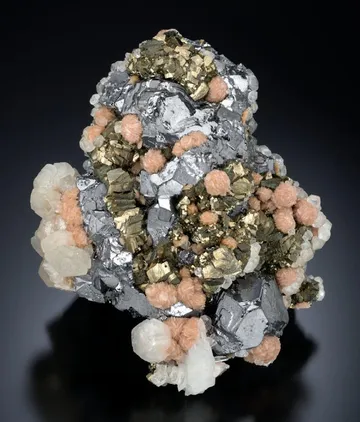
Galena from Madan Ore Field, Bulgaria — architectural cubic and cuboctahedral crystals with mirror-bright luster, prized for 3D form and Rhodope locality.
Key facts
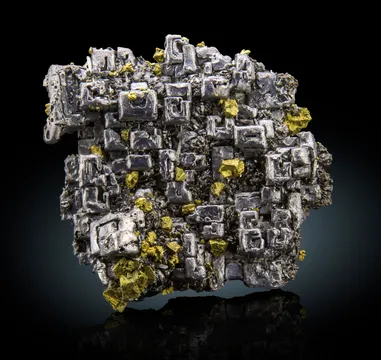
Galena from the Madan Ore Field is one of the defining European sulfide classics: bright lead-gray crystals from a large Oligocene Pb-Zn system in the Central Rhodopes, commonly set against pale quartz, black to brown sphalerite, yellow chalcopyrite, pyrite, calcite, and Mn-rich carbonates. The best pieces are not just “good galena”; they are unmistakably Madan—architectural, metallic, and often sculptural, with habits ranging from sharp cubes and cuboctahedra to skeletal, hoppered, platy spinel-twinned, and partly dissolved “cavernous” forms.

Photo: Lech Darski / Wikimedia Commons
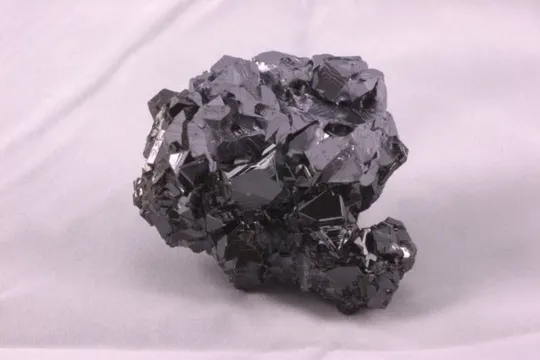
The district’s mineralogical personality comes from its setting: veins, stockworks, and carbonate-replacement skarn bodies developed in gneisses, amphibolites, mica schists, and marbles of the Rhodope Massif. Hydrothermal fluids moved along major fault zones, reacted with marble horizons, and opened cavities where galena, sphalerite, quartz, pyrite, chalcopyrite, and carbonates could crystallize freely. This open-space growth is essential to the collectible character of Madan galena; many specimens show real three-dimensional crystal geometry rather than massive ore texture.

Photo: Rob Lavinsky, iRocks.com / Wikimedia Commons
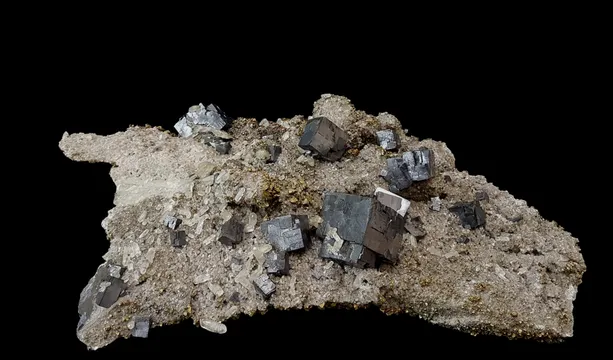
For collectors, the visual appeal is the contrast: mirror-bright metallic galena against pale quartz needles, dark sphalerite, or carbonate matrix. Fine Madan specimens can be surprisingly lively under light, with bright reflections from cubic or cuboctahedral faces and a strong sense of depth when crystals rise cleanly above the matrix. The most sought-after examples are well-balanced cabinet and small-cabinet pieces with sharp galena, minimal bruising, and recognizable mine attribution—especially Septemvri, Krushev Dol, Borieva-Petrovitsa, Gyudyurska, and related deposits within the Madan field.
The locality is historically important as both a mining district and a specimen-producing province. Madan has supplied ore on an industrial scale since the 20th century, but it also yielded material that mineralogists have used to study unusual galena morphologies: whiskers, pillars, skeletal crystals, platy twins, and dissolution forms. Few lead-zinc districts have contributed such a broad range of galena crystal habits to both scientific literature and the collector market.

Search for specimens: View all galena specimens from Madan Ore Field, Bulgaria
The Madan Ore Field lies in Smolyan Province, southern Bulgaria, in the Central Rhodope Mountains, north of the Greek border. It is the largest and most important of the Central Rhodope Pb-Zn ore fields and is part of a regional belt that also includes Laki, Davidkovo, and Thermes. The field occupies the southwestern part of the Central Rhodope Dome, where Oligocene hydrothermal mineralization is structurally controlled by major fault zones.
The ore bodies occur in three principal forms. Veins are the most widespread: steep, fault-controlled quartz-sulfide bodies, commonly 1–2 m wide but locally wider, and ranging from hundreds of meters to kilometers in strike length. Stockworks occur as networks of sulfide veinlets and disseminations in altered rock. Carbonate-replacement bodies formed where ore-bearing structures intersected marble horizons, producing skarn-related ore ledges, irregular replacement masses, and open cavities lined by well-crystallized sulfides and gangue minerals.
The main ore minerals throughout the field are galena and sphalerite, with pyrite and chalcopyrite as frequent associates. Gangue species include quartz, calcite, manganocalcite, rhodochrosite, dolomite, rhodonite, and johannsenite, with Mn-rich skarn mineralogy becoming especially important in replacement bodies. The Karaaliev Dol–Petrovitsa fault zone is one of the district’s major ore-localizing structures, hosting important deposits including Osikovo, Mogilata, Karaaliev Dol, Petrovitsa, Yuzhna Petrovitsa, and Erma Reka.
Mining in the Madan region reaches far back into antiquity. Local accounts and municipal histories connect early lead mining with Thracian activity in the 5th–4th centuries BC, followed by Roman, Byzantine, Ottoman, and modern industrial phases. In the 20th century, systematic exploration and industrial development transformed Madan into one of Bulgaria’s principal non-ferrous mining centers. The Bulgarian-Soviet mining company GORUBSO, founded in 1950, became central to large-scale lead-zinc mining in the district.
Modern production history is substantial. Published geological work records more than 100 million tonnes of ore produced from the Madan field since 1940, with average grades around 2.54 wt% Pb and 2.1 wt% Zn, plus silver and copper by-products. Older summaries describe dozens of mines and deposits in the district, though only a smaller number remained active in recent decades. Specimen-producing names familiar to collectors include Krushev Dol, Petrovitsa, Gyudyurska, Borieva, Septemvri or Deveti Septemvri, and Erma Reka.
Collecting access should be treated as restricted. Madan is a working and historically industrial mining district, not a casual field-collecting site. Underground workings, active concessions, closed adits, old stopes, flooded passages, and fault-zone collapses make unauthorized entry dangerous and inappropriate. Most collector specimens reach the market through miners, local dealers, older collections, and professional specimen dealers rather than through open public collecting. Visitors interested in the mining heritage should use official museum access, especially the Spoluka underground mining museum and the Rhodope Crystal Hall in Madan.
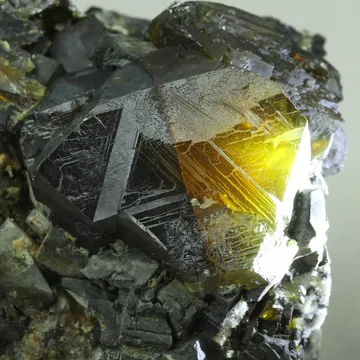
Notable finds include skeletal and cavernous galena from Septemvri and related workings, sharp cuboctahedral galena on quartz from Gyudyurska, spinel-law twinned platy galena from Krushev Dol, and combination specimens with sphalerite, chalcopyrite, quartz, pyrite, and calcite from several mines. Madan is also celebrated for gemmy low-iron sphalerite, especially cleiophane, and those sphalerite finds often occur with small bright galena crystals that add contrast and locality character.
Madan galena is most often lead-gray to bright silver-gray, with a high metallic luster on fresh faces. Sharp cleavage and high density are typical of the species, but the locality’s real distinction lies in crystal habit. Good examples show cubes, cuboctahedra, modified cubes, octahedral components, skeletal or hoppered crystals, platy spinel twins, elongated growths, and partly dissolved forms with softened or cavernous surfaces. Some pieces appear “melted” at first glance, but the effect is not literal melting; it reflects growth, dissolution, regeneration, or etching in open cavities.
The most collectible crystals are typically from a few millimeters to several centimeters. Cabinet specimens may carry galena crystals around 1–3 cm across, while larger plates can show many crystals distributed across quartz, sphalerite, or carbonate matrix. Miniature and small-cabinet pieces with one or several dominant galena crystals are especially desirable when the crystals are isolated, bright, and undamaged. Large ore-rich specimens exist, but the best display pieces are usually those where the galena is elevated and well framed by contrasting matrix.
The skeletal habit is a signature of the locality, especially in Septemvri material. These crystals retain edges, ribs, and outer geometry while the interior is open or partly etched away, producing boxy, hollow, architectural forms. Natural skeletal galena from Madan is highly collectible, but it is also the habit most often associated with authenticity concerns, so quality and provenance matter.
Krushev Dol is especially noted for thin, platy, highly lustrous galena twins on quartz, including spinel-law twinned crystals that stand upright like metallic blades. Such specimens are visually different from the blockier cuboctahedral Madan style: they are flatter, sharper-edged, and more angular, often scattered over a bed of white or pale quartz. Well-preserved examples with multiple upright plates can be exceptionally dramatic.
Borieva and Petrovitsa material can include sharp galena with quartz, chalcopyrite, pyrite, calcite, and sphalerite; some Borieva specimens show skeletal or hoppered crystals. Gyudyurska is known among collectors for lustrous cuboctahedral galena on quartz, including major pocket material that entered the market through miners and dealers. Septemvri is the name most strongly associated with skeletal galena, greenish quartz, cleiophane, and old stope material.
Associated minerals are an important part of the locality’s appeal. Quartz is the most common visual partner, ranging from white to colorless, sometimes pale green where chloritic inclusions are present. Sphalerite may be dark brown to black, honey-brown, yellow-green, or gemmy cleiophane; its contrast with galena is one of Madan’s best aesthetics. Chalcopyrite adds brassy yellow highlights, pyrite adds sharp golden cubes or modified crystals, and calcite or manganocalcite can give a pale carbonate base. Rhodochrosite and Mn-rich carbonates occur in the broader district but are not automatically present on galena specimens.
Quality factors are straightforward but unforgiving. Look for bright luster, crisp crystal edges, well-defined cubic or cuboctahedral geometry, attractive associations, and a stable matrix. On skeletal specimens, look for natural-looking internal surfaces rather than uniformly abraded hollows. On platy twins, look for complete plates standing freely without rubbed edges. On combination pieces, contrast matters: silver galena against white quartz, black sphalerite, or yellow chalcopyrite gives the strongest display.

The main authenticity issue for Madan galena is the reported artificial production or enhancement of skeletal-looking galena by sandblasting, particularly for material attributed to Septemvri. Natural skeletal galena unquestionably occurs in the district, and it has been described by dealers, collectors, and researchers, but the style is desirable enough that manipulated pieces require scrutiny.
Under magnification, natural skeletal galena should show coherent crystallographic surfaces, growth or dissolution textures, and consistent relationships to the surrounding quartz or matrix. Suspect pieces may show unnaturally uniform hollowing, matte abraded interiors, softened crystal edges, trapped abrasive grit, or surfaces that do not match the luster and texture of protected areas. A good provenance chain, old collection label, mine-specific attribution, or dealer guarantee is especially valuable for skeletal material.
Condition is another important issue. Galena is soft, heavy, and has perfect cleavage, so corners chip easily and crystal faces can show bruising, rubs, or cleavage flashes from handling. Madan specimens often combine galena with delicate quartz needles, cleiophane, chalcopyrite, or calcite, and these associations can be more fragile than the galena itself. On old specimens, check for repaired matrix, reattached crystals, and trimmed bases that cut through important visual elements.
Because galena is PbS, prudent handling is simple: wash hands after handling, avoid producing dust, and keep specimens away from small children. Stable, fresh galena is not a hazardous display mineral when treated normally, but broken material, powder, or repeated handling without washing is poor practice.
Madan galena is available on the market, but quality varies widely. Common cabinet combinations of galena with sphalerite, quartz, pyrite, calcite, or chalcopyrite appear regularly. Fine skeletal crystals, undamaged platy spinel twins, large sharp cuboctahedral plates, and pieces with strong mine attribution are much scarcer. The best specimens are bought for form and condition rather than sheer size; a small, perfectly composed skeletal galena or bright galena-on-quartz miniature can be more desirable than a larger massive sulfide plate with bruised crystals.
One of the best modern field narratives from Madan begins not with crystals, but with weather and labor. In March 2012, Tomasz Praszkier of Spirifer Minerals traveled from Poland to Madan with his friend and preparation specialist Jurek. The Rhodope Mountains had just endured one of their snowiest and coldest winters in half a century, and there was still snow on the ground. When they arrived, they found that nobody was working at Krushev Dol or Borieva: the miners were on strike over unpaid wages. Praszkier wrote that the mine owner had not paid workers for three to four months, and even when wages came, the full amount was not paid. The visiting collectors stayed for a while with the protesters in the main square.
The mineral news that drew them there was a remarkable pocket at Krushev Dol, about 15 meters across, which had produced exceptional cleiophane with associated quartz, small lustrous cuboctahedral galena, and sometimes chalcopyrite. The find was important because good cleiophane had been better known from Septemvri, while Krushev Dol had not previously produced it at that level. The pocket yielded hundreds of good specimens; many were large blocks weighing 10–40 kg before trimming, and the clean, sharp sphalerite crystals reached up to 2 cm. The best pieces had the sort of contrast collectors love: yellowish, brownish, yellow-green, or green cleiophane perched on white quartz, with small metallic galena crystals adding structure and sparkle.
By the time Praszkier arrived, the big Krushev Dol pocket was finished, and the strike made a mine visit impossible. He and his Bulgarian contacts nevertheless acquired what he estimated was around 1000 kg of the top material from the find, much of it still needing serious trimming and cleaning. Around the same period, Krushev Dol also produced sharp, lustrous spinel-law twinned galena with quartz, including a museum-size piece described as outstanding.
The same trip included a very different kind of Madan experience: a descent into the long-closed 9th September mine. The mine had many entrances scattered across the surrounding mountains, and local diggers sometimes entered old stopes where pockets remained exposed. Praszkier, Jurek, and their companions entered through one of the adits, walked a long tunnel, and descended to lower levels. Some workings were sound, but fault zones had collapsed and other passages were partly flooded. He explicitly warned that it was not a good idea for amateurs.
After several kilometers underground, they reached stopes rich in pockets. In the first mineralized area they found cavities with quartz and skeletal galena—natural skeletal galena, not the sculptured material sometimes seen on the market. Some cavities reached about 0.5 m. Nearby they visited a cleiophane zone with green quartz, a style typical of the mine, where smaller pockets contained small gem crystals. Later they moved through additional stopes and climbed to upper levels into a vast stope area known for galena and calcite specimens. The day ended with a long, complicated walk back to the surface, exhaustion, and the simple luxury of a hot shower.
Another Madan episode comes from Gyudyurska. During the 2012 visit, Praszkier obtained photographs of an important 2010–2011 pocket from that mine. The pocket had produced sharp, extremely lustrous cuboctahedral galena on quartz, including museum-size specimens. Its scale is the unforgettable detail: it was large enough that eight people could collect inside at the same time. Photographs showed galena in situ on the pocket walls, fresh specimens being removed, and collectors working in the cavity.
Madan’s mining story is older and broader than any single pocket. The Spoluka mine, now preserved as an underground museum, was once part of the district’s industrial life. It produced lead, zinc, gold, silver, copper, and cadmium and was operated by GORUBSO. It was worked out around 1972 and opened as a museum in 2023. Visitors now walk about 140 m underground beneath an entrance dated 1961, passing rails, wagons, safety equipment, pneumatic systems, a vertical shaft, a ventilation chimney, and a mine yard. A short distance away, the Crystal Hall, opened in 1984, preserves the collector-facing legacy of the region: crystals from the mines that made Madan famous well beyond Bulgaria.
Ivan K. Bonev, “Crystal habit of Ag-, Sb- and Bi-bearing galena from the Pb-Zn ore deposits in the Rhodope Mountains,” Geochemistry, Mineralogy and Petrology, 45, 1–18, 2007 — Key paper for Madan and Rhodope galena morphology, trace elements, and the relationship between cubic, octahedral, cuboctahedral, skeletal, tabular, whisker, and twinned habits.
Ivan K. Bonev, “Non-equilibrium highly anisometric crystals and whiskers of galena,” Mineralogical Magazine, 57, 231–240, 1993 — Describes unusual galena whiskers and anisometric crystals from the Gradishte hydrothermal Pb-Zn deposit in the Madan district.
Ivan K. Bonev and Clive M. Rice, “Single crystal galena pillars as highly anisometric dissolution forms,” Mineralogical Magazine, 61, 377–386, 1997 — Describes cylindrical and conical galena “pillars” interpreted as anisotropic dissolution forms related to skeletal crystals.
Rossitsa D. Vassileva, Radostina Atanassova, and Ivan K. Bonev, “A review of the morphological varieties of ore bodies in the Madan Pb-Zn deposits, Central Rhodopes, Bulgaria,” Geochemistry, Mineralogy and Petrology, 47, 31–49, 2009 — Important review of veins, stockworks, and replacement skarn-ore bodies in the Madan district.
Peter Marchev and Robert Moritz, “Isotopic composition of Sr and Pb in the Central Rhodopean ore fields: Inferences for the genesis of the base-metal deposits,” Geologica Balcanica, 35, 49–61, 2006 — Discusses Pb isotope analyses of galena and pyrite and Sr isotope analyses of barite from Madan and Laki.
Hantsche et al., “Metasomatism and cyclic skarn growth along lithological contacts: Physical and geochemical evidence from a distal Pb-Zn skarn,” Lithos, 2021 — Detailed study of skarn growth and fluid-rock interaction at the Petrovitsa deposit in the Madan ore field.
Yves Moëlo, “Pseudo-cubic trigonal pyrite from the Madan Pb-Zn ore field,” European Journal of Mineralogy, 35, 333–346, 2023 — Although focused on pyrite, this paper gives a useful modern geological overview of the Madan district and identifies Krushev Dol, Petrovitsa, and Gyudyurska as important specimen-producing mines.
Museum of Mining – Madan, Rhodope Crystal Hall — Records the municipal mining museum and the Rhodope Crystal Hall, which holds a 581-specimen mineral collection from the region.
“Bulgarian mineral collections and specimens in the fund of the National Museum of Natural History at the Bulgarian Academy of Sciences,” Historia naturalis bulgarica, 1996 — Notes a regional collection from the Madan metal mines in the National Museum of Natural History, with galena druses prominently represented.
Mindat: Madan ore field, Smolyan Province, Bulgaria — Core locality page with mineral list, deposit overview, maps, references, and collector notes.
Mindat: Galena from Madan ore field — Galena-specific occurrence page with associated minerals, photo data, and references.
MINBULFOS: Madan Ore Field geological map and information — Concise geological summary of the district, ore-body types, major fault zones, and main mineral assemblages.
Madan Travel: Information about the city of Madan — Local historical overview of mining from antiquity through modern GORUBSO development and museum tourism.
Madan Travel: Spoluka Mining Museum — Official tourism page for the preserved Spoluka underground mine and its history.
European Route of Industrial Heritage: Spoluka Mining Museum — Industrial-heritage overview with details on GORUBSO, the 140 m underground route, and the Crystal Hall.
Spirifer Minerals: Trip to Madan, Bulgaria — Field report with vivid collector notes on Krushev Dol, Septemvri, Gyudyurska, skeletal galena, cleiophane, and underground collecting conditions.
Turnstone: Galena from Madan, Bulgaria — Collector-oriented discussion of Madan galena habits, “melted” or cavernous surfaces, and relevant literature.
Wikimedia Commons: Madan ore Field category — Useful open-image gallery of Madan galena and associated minerals.
Wikimedia Commons: Krushev Dol Deposit category — Open-image gallery with numerous Krushev Dol galena, quartz, calcite, and sulfide specimens.
_z_kalcytem_-_Madan,_Rhodope_Mts,_Smolyan_Oblast,_Bulgaria.jpg)


