






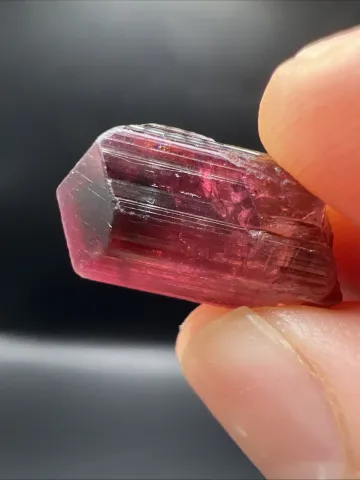
Madagascar locality guide: central highlands pegmatites yield tourmaline, spodumene, beryl and rarities; prized for color zoning and cross-sections.
Key facts
Madagascar is not a single mineral locality so much as a mineralogical continent in miniature: an island-sized archive of high-grade Precambrian basement, Pan-African tectonics, rare-element pegmatites, marble-hosted borate systems, hydrothermal quartz fields, gem gravels, and lateritic workings. For collectors, its strongest identity is the suite of granitic pegmatites in the central highlands—especially the Antsirabe–Betafo, Sahatany, Manandona, Ambatofinandrahana, and Camp Robin areas—where lithium, boron, beryllium, cesium, tantalum, and fluorine concentrated into pockets capable of producing color-zoned tourmaline, liddicoatitic tourmaline slices, rubellite, elbaite, londonite-rhodizite, hambergite, danburite, spodumene, pezzottaite, beryl, feldspar, and a long roster of rarities.
The most instantly recognizable Madagascar specimens are tourmalines: gemmy reds and greens, polychrome crystals, and sawed cross sections whose trigonal internal zoning can look architectural rather than organic. The country’s liddicoatite and fluor-liddicoatite tradition is especially important because the great Madagascar material trained several generations of collectors to value tourmaline not only as a prism but as a revealed cross section—star bands, nested triangles, smoky rims, cranberry cores, and sudden changes in color recorded one growth pulse at a time.
Regional View
Country View
Historically, Madagascar occupies a special place in modern mineral collecting because its gem pegmatites were described early and repeatedly by French mineralogists, then re-entered the international market in waves through dealers, lapidaries, scientific collectors, and later Malagasy artisanal mining networks. Alfred Lacroix’s early twentieth-century work on lithium-tourmaline pegmatites remains foundational; later, Anjanabonoina, Sahatany, Antsongombato, Sakavalana, and Camp Robin became names that serious collectors learned to distinguish rather than collapse into the vague label “Madagascar.”
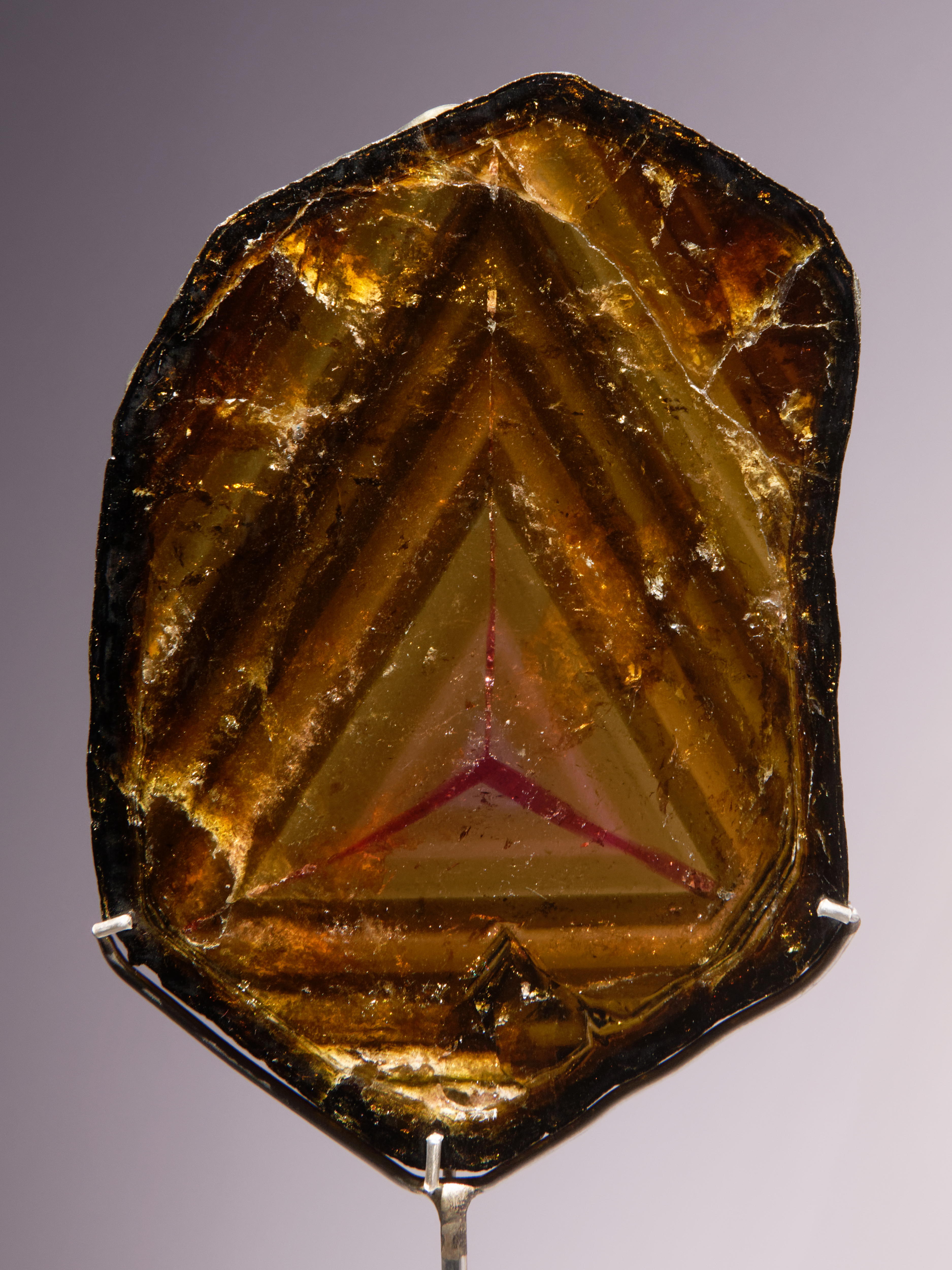
Photo: Wikimedia Commons
The island also matters beyond tourmaline. Andilamena has supplied distinctive quartz, including Japan-law twins, amethyst, smoky quartz, and scepter forms. Southern Madagascar is the type-region for grandidierite and hibonite, while central Madagascar supplied pezzottaite, londonite, béhierite, schiavinatoite, vránaite, and other minerals that make the island a recurring name in formal mineral descriptions. Few countries combine such specimen appeal with such a deep type-mineral record.

Photo: Wikimedia Commons
Search for specimens: View all specimens from Madagascar
For collectors, “Madagascar” on a label most often points to three overlapping specimen provinces. The first is the central-highland rare-element pegmatite belt, including the Antsirabe–Betafo district, the Sahatany Valley near Ibity, Manandona Valley occurrences, Ambatofinandrahana-area pegmatites, and the later Camp Robin mining area between the Ambatofinandrahana and Ambohimahasoa districts. These are chiefly rare-element granitic pegmatites, many of them LCT-type or transitional systems, emplaced into metamorphic basement that includes gneiss, schist, quartzite, and marble. The second is the Andilamena quartz district in Alaotra-Mangoro, better known to collectors for quartz habits than for rare-element pegmatite suites. The third is southern Madagascar, where boron-rich pegmatites, aluminous metamorphic rocks, and related high-grade terranes produced grandidierite, hibonite, kornerupine-group specimens, and other borosilicate and oxide rarities.
The central pegmatites are the heart of the classic specimen story. In the Sahatany Valley, the pegmatite field lies south of Antsirabe and is best known for lithium-bearing tourmalines, spodumene, beryl, quartz, danburite, hambergite, béhierite, rhodizite-londonite, pollucite, hafnian zircon, topaz, apatite, and associated feldspars. Manjaka, Tsarafara, Maharitra, Ilapa, and nearby pegmatites have produced matrix specimens as well as rare species of scientific interest. The deposits are typically small by industrial standards but mineralogically intense, with zoned pegmatites, miarolitic cavities, replacement assemblages, and contact-zone minerals where pegmatites interact with carbonate-rich country rocks.
Anjanabonoina is the classic name for Madagascar liddicoatite and liddicoatitic tourmaline. The mine lies west-southwest of Antsirabe in the Betafo region, on a highland hill near Ikaka Mountain. Published descriptions place the historic deposit in an aplite-pegmatite field, with pegmatites and kaolinized zones cutting quartzite, schist, and marble of the Itremo Group. The famous tourmaline pockets yielded red and polychrome material in large quantities, especially during twentieth-century mining, and the site became the primary reference point for Madagascar’s color-zoned tourmalines.
Mining history here begins long before the modern specimen market. European reports of Madagascar gem minerals go back to the sixteenth and seventeenth centuries, but serious pegmatite mineralogy developed much later. A large rubellite crystal from the Mount Ibity area reached the Paris museum world in 1890, and by 1893 Alfred Grandidier had located colored tourmaline in situ in the Betafo region. Alfred Lacroix’s 1908 and 1910 publications on lithium-tourmaline pegmatites and Madagascar tourmaline crystallography set the scientific frame for the country’s later fame.
The modern Anjanabonoina story includes organized mining by Société Germadco, associated with Eckehard Petsch, after the ground was acquired around 1970 and production resumed in the early 1970s. By the mid-1970s, the operation had built access, housing, and support infrastructure, and more than a hundred workers were active on the hill. Major pockets are documented from 1972, 1978, 1984, and 1991. The 1978 pocket was extraordinary, reportedly yielding about 2.6 tonnes of red and polychrome tourmaline, with some crystals reaching approximately 20 kg; the 1984 pocket produced about 2 tonnes of similar material. These events explain why older Madagascar tourmaline slices, carvings, and fragments still circulate in quantity even when fine complete crystals on matrix remain scarce.
Later, Fretosoa Company, an Italian-Malagasy venture involving Federico Pezzotta and colleagues, re-evaluated and explored Anjanabonoina in 1995–1996. After that period, the mine was not maintained as a controlled modern operation. Published accounts describe stolen equipment, collapsed or destroyed workings, surface digging by local people, and access difficulties severe enough that authors advised against travel to the area because of security and logistics. Today, collector access to such sites should be treated as effectively restricted unless arranged through legitimate land, mineral-rights, and local authorities; Madagascar mineral collecting is not a casual roadside activity.
Antsongombato and nearby Betafo–Manandona pegmatites are most famous for rhodizite-londonite and related borates. These small but highly evolved pegmatites are remarkable for cesium and boron enrichment, and some contain miarolitic cavities with londonite-rhodizite, pink tourmaline, blue apatite, pollucite, béhierite, schiavinatoite, and quartz. In specimen terms, Antsongombato is one of the great Madagascar rare-mineral names: small crystals can carry exceptional scientific and market weight when they are gemmy, sharp, and credibly labeled.
Camp Robin is a later chapter. The name refers not just to one village but to a broad rare-element miarolitic pegmatite field extending roughly northeast–southwest for about 40 km in the central highlands, with more than a dozen worked localities known for multicolored tourmaline. It entered the specimen trade after discovery in August–September 2005 and quickly produced significant tonnage of tourmaline. Camp Robin specimens tend to be smaller than the giant Anjanabonoina slices and prisms, but the best pieces can be sharply crystallized, gemmy, internally red to brown or green, and attractive as complete crystals rather than lapidary sections.
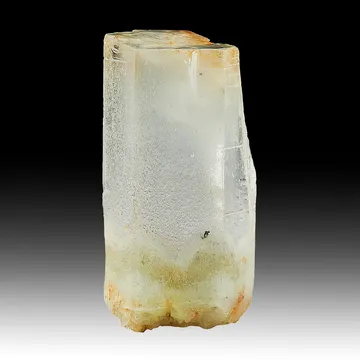
The Andilamena quartz district is a different collecting experience. It is not primarily a liddicoatite locality but a quartz locality, producing twinned and scepter crystals, rock crystal, smoky quartz, and amethyst. The best-known material includes Japan-law twins from north of Andilamena and amethyst/smoky scepters from the Andilamena Quartz Quarries around the Andranotokana Massif. Collector-grade pieces are valued for crisp habit, undamaged twin geometry, scepter development, clean luster, and interesting phantoms or iron-oxide inclusions.
Mining and export today remain shaped by Madagascar’s combination of artisanal production, remote localities, formal mining law, and mineral-export paperwork. The Malagasy customs authority lists mineral substances, fine pearls, gemstones, and precious metals among goods requiring export conformity documentation from the mining administration. For collectors, this means that serious purchases should come with a reliable chain of custody and legal export documentation where applicable, particularly for rare species, gemstones, and historically sensitive material.
Madagascar liddicoatite and fluor-liddicoatite are best represented by the Anjanabonoina tradition and by related central-highland pegmatites, where crystals occur as stout to elongated trigonal prisms, broken gem fragments, matrix specimens with albite or quartz, and—most famously—sawed and polished slices cut perpendicular to the c-axis. Fine pieces show complex color zoning: cranberry red, pink, purple-red, olive to bluish green, yellow-brown, smoky brown, and colorless zones arranged as nested triangles, three-rayed stars, and oscillatory bands. Anjanabonoina produced very large crystals, which is why old slices measuring several centimeters across are commoner than intact, aesthetic complete crystals; Camp Robin and Sahatany-area material more often appears as smaller gemmy crystals or crystal sections. The best examples are not merely colorful but legible: good transparency, sharp zoning, strong contrast, minimal fracturing, and a credible locality label separate important Madagascar pieces from ordinary polished tourmaline slices.
Madagascar quartz has several collecting personalities, but the Andilamena district gives the most recognizable specimen material: Japan-law twins, pale rock crystal, smoky quartz, amethyst, and smoky-over-amethyst scepter forms from the Andilamena Quartz Quarries and nearby undisclosed sites. Specimens may be colorless to milky, gray smoky, purple, or zoned between amethyst and smoky quartz, with hematite and goethite contributing reddish, brown, or included effects in some pieces. In the pegmatite districts, quartz is also the essential matrix and pocket mineral for tourmaline, béhierite, feldspar, danburite, and rare borates. Quality hinges on form: intact twin wings on Japan-law pieces, balanced scepter heads, glassy luster, clean terminations, strong purple or smoky zoning, and enough matrix or association to anchor the specimen to a real Madagascar locality rather than a generic quartz bin.
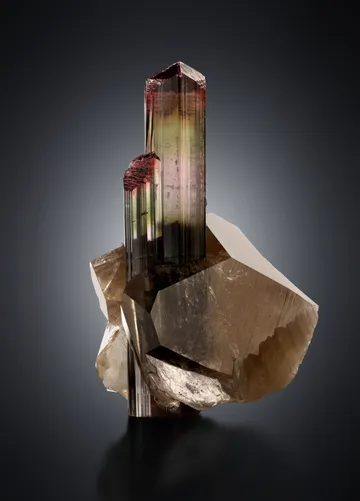
Tourmaline is Madagascar’s signature collector mineral, with classic material from Anjanabonoina, Sahatany Valley, Betafo–Manandona pegmatites, Ambatofinandrahana-area deposits, and Camp Robin. The range includes black schorl, pink to red rubellite, green verdelite, watermelon and polychrome elbaite-liddicoatite series crystals, dravite-uvite compositions in contact zones, and liddicoatitic tourmaline where calcium-rich chemistry was developed in evolved pegmatite environments. Habits run from stout striated prisms to slender gem crystals, broken but intensely colored fragments, and matrix specimens with quartz, albite, cleavelandite, microcline, spodumene, londonite-rhodizite, or rare borates. The best Madagascar tourmalines combine color architecture with specimen integrity: undamaged terminations, transparency under backlighting, crisp prism faces, attractive matrix, and a label that distinguishes Anjanabonoina, Sahatany, Camp Robin, or another specific field rather than settling for country-only provenance.
Madagascar amethyst is best known from Andilamena, especially the Andilamena Quartz Quarries of the Andranotokana Massif, where crystals may occur as purple amethyst, smoky-amethyst combinations, scepters, and clusters associated with quartz, goethite, and hematite. The locality’s most appealing pieces are not simply purple points; they are sculptural quartz specimens in which a colorless or smoky first-generation crystal carries a later amethyst cap, scepter head, phantom, or iron-influenced zoning. Good examples show saturated but natural-looking violet color, transparent windows, well-defined growth stages, undamaged terminations, and a clear relationship between amethyst and smoky quartz rather than a flat, commercial-looking purple wash. Large, sharp, undamaged prismatic groups from Madagascar are much less common than small points and broken material, so locality-specific quality pieces should be treated as real mineral specimens rather than decorative commodity amethyst.
Other Madagascar minerals of high collector and scientific importance include londonite from Antandrokomby and related Betafo–Manandona pegmatites; rhodizite-londonite series crystals from Antsongombato, Ampanivana, Manjaka, and nearby localities; béhierite from Manjaka; schiavinatoite from Antsongombato; vránaite from the Manjaka pegmatite; pezzottaite from the Sakavalana pegmatite near Ambatovita; grandidierite from Andrahomana and later southern deposits; hibonite from the Tranomaro–Esiva area; bityite from the Bity/Sahatany region; and gem minerals such as beryl, morganite, aquamarine, spodumene var. kunzite, spessartine, danburite, hambergite, apatite, zircon, and feldspar. Madagascar rewards collectors who care about locality precision: the difference between “Madagascar tourmaline” and “Manjaka, Sahatany Valley” or “Anjanabonoina, Betafo District” is often the difference between a pretty object and a mineralogical document.
Madagascar labels deserve scrutiny because the country is broad, mineralogically complex, and commercially active. “Madagascar” alone is acceptable for inexpensive decorative quartz or common polished goods, but for significant tourmaline, liddicoatite, pezzottaite, londonite-rhodizite, béhierite, grandidierite, or hibonite, a serious specimen should carry a more specific locality. Names to preserve include Anjanabonoina, Sahatany Valley, Manjaka, Tsarafara, Antsongombato, Antandrokomby, Ampanivana, Sakavalana, Ambatovita, Camp Robin, Andilamena, Tranomaro, Esiva, and Andrahomana.
The largest identification issue is tourmaline nomenclature. Much old Madagascar material was sold simply as liddicoatite, but modern tourmaline nomenclature and analytical work show that visual appearance is not enough. Elbaite, liddicoatite, fluor-liddicoatite, and mixed-zone crystals can overlap in color, habit, refractive properties, and density; some single crystals contain more than one tourmaline species in different zones. For a high-value specimen, “liddicoatitic tourmaline” or “liddicoatite/fluor-liddicoatite series” may be more honest than an unsupported species claim unless microprobe, LA-ICP-MS, or other quantitative chemical data exist.
Polished Madagascar liddicoatite slices raise a second concern: surface filling and lapidary residues. Published gemological work notes that paraffin wax was used on some slices before polishing to keep residues out of surface irregularities, and that wax may not be completely removed from fractures afterward. This does not make the material fake, but it matters for disclosure and valuation. Inspect slices under magnification for filled fractures, polishing drag, chips on the rim, and repaired cracks, especially in large, thin sections.
Quartz from Madagascar has its own treatment and marketing problems. Natural amethyst, smoky quartz, citrine, and amethyst-smoky combinations all occur in the trade, but quartz is also easily altered by irradiation and heat. Bright yellow “Madagascar citrine,” lemon-yellow points, unusually uniform color in polished quartz, or bulk material with no locality detail should be treated cautiously. On true Andilamena amethyst and smoky-amethyst specimens, habit and locality are often more convincing than color alone: look for natural zoning, growth relationships, matrix, and a dealer who can distinguish Andilamena from generic Madagascar quartz.
Condition is especially important for Madagascar pegmatite specimens. Tourmaline crystals commonly show repaired breaks, bruised terminations, etched or corroded faces, and damage from extraction in weathered kaolinized pegmatite. Rubellite and liddicoatitic crystals may be beautiful under backlight but fractured in hand. Quartz can have bruised twin edges and chipped scepter heads. Londonite-rhodizite is hard but small, and yellow color in the series may be light-sensitive; display pale yellow to yellow-green rhodizite-londonite specimens away from strong sunlight.
Rarity varies sharply by species and quality. Madagascar quartz and common tourmaline remain available; fine locality-specific crystals on matrix are much less common. Good liddicoatite slices are available as old stock, but exceptional large slices with clean star zoning, strong color contrast, and minimal cracking are increasingly selective. Complete, undamaged liddicoatite or fluor-liddicoatite crystals from Anjanabonoina or Camp Robin are far rarer than polished sections. Pezzottaite, béhierite, schiavinatoite, vránaite, grandidierite, and hibonite should be treated as specialist minerals where documentation, analytical confidence, and provenance are central to value.
Legal export also matters. Madagascar requires conformity documentation for exported mineral substances, gemstones, and precious-metal categories. Collectors buying in-country or through recent direct imports should expect proper paperwork rather than informal assurances, especially for rare species, gem rough, and higher-value parcels.
In 1890, a large rubellite from the Mount Ibity area reached the Muséum national d’Histoire naturelle in Paris through the circle of Alfred Grandidier. That single crystal helped redirect serious attention inland. Early explorers had looked near river mouths and coastal areas and found little to match the rumors of gem wealth; the central highlands, not the beaches, held the pegmatite story. By 1893, Grandidier had located colored tourmaline in situ in the Betafo region west of Antsirabe, and the scientific map of Madagascar gem minerals began to acquire names that collectors still use.
Alfred Lacroix then gave the island’s lithium-tourmaline pegmatites their first great literature. In 1908 he published on the minerals of Madagascar’s lithium-tourmaline pegmatite veins, and in 1910 he illustrated a slice of polychrome tourmaline from Anjanabonoina. What he noticed was not just color but geometry: three red bands meeting at 120 degrees, the unmistakable trigonal architecture that later made Madagascar slices famous. A century later, collectors still hold these slices to the light for the same reason Lacroix drew them: they are crystals that tell their growth history in cross section.
The Anjanabonoina pockets are among the great production stories in pegmatite collecting. Société Germadco resumed mining in the early 1970s; by 1974 the operation had more than 100 workers on the hill, with roads, housing, and a school built for miners and families. Then came the pockets. The 1978 pocket alone yielded about 2.6 tonnes of red and polychrome tourmaline, including crystals up to roughly 20 kg. In 1984, another pocket produced about 2 tonnes. The 1991 pocket is less completely documented, but one reported sale from that find involved 600 kg of red tourmaline. These were not dainty cavities opened for one cabinet specimen at a time; they were giant, weathered pegmatite chambers whose output fed lapidaries, museums, dealers, and collectors around the world.
One of the most vivid lapidary moments in the Madagascar story belongs to Idar-Oberstein cutter Karl Heinz Becker, who wrote in 1971 about a 70-pound tourmaline crystal that produced multicolored slabs. Richard T. Liddicoat visited Becker’s shop shortly after the crystal was sliced and photographed the progression of patterns from the base toward the termination. It is hard to imagine a better origin scene for the mineral later named in Liddicoat’s honor: a dark prism opened one wafer at a time, each cut exposing another arrangement of triangles, rims, stars, and color bands.
The Sakavalana pezzottaite discovery had a different tempo. In November 2002, a new purplish pink cesium-lithium beryl-group mineral appeared from a granitic pegmatite near Ambatovita. By July 2003, researchers traveled to the mine: about 160 km of paved road from Antsirabe to Ambatofinandrahana, then roughly 140 km of rough dirt track to Mandrosonoro, then another 25 km toward the workings. Even in the dry season, the trip could take about 14 hours and was slowed by vehicle breakdowns. The mine sat on a low hill a few kilometers from Ambatovita, with miners living in huts above the workings. Only a few dozen kilograms of gem rough were produced, and the deposit was already nearly exhausted by the time the mineral had fully entered the literature.
Southern Madagascar offers an equally memorable grandidierite episode. The mineral was first described from the cliffs of Andrahomana on the southern coast and became one of the great rare blue-green borosilicates. When C. Mignot visited the type locality in 1960, he was unable to find additional grandidierite because the small pegmatite had been depleted. More than a century after Lacroix’s original work, a new gem-quality deposit was discovered in May 2014 near Tranomaro, about 60 km northwest of Cape Andrahomana. Access required a paved road from Tolanaro to Amboasary Atsimo, a rough 50 km road north to Tranomaro, and then half a day on foot to the deposit. At the mine, about a dozen miners used spades and pickaxes to dig open-air corridors and holes as deep as 15 m through weathered pegmatite veins separated by only 30 cm to a few meters.
Even organized scientific field work in Madagascar has carried the flavor of expedition rather than excursion. The 2001 Field Course on the Rare Element Pegmatites of Madagascar warned participants to expect long drives into remote areas, poor roads, camping, limited amenities, and endemic malaria. The itinerary moved through Sahatany, Antsongombato, Ambalamahatsara, Betroka, Ilakaka, Isalo, and Fianarantsoa, combining pegmatite science with the reality of field travel on the island. It was limited to 40 participants; the mineralogy may have been world-class, but the logistics were never casual.
Alfred Lacroix, “Les minéraux des filons de pegmatite à tourmaline lithique de Madagascar,” Bulletin de la Société française de Minéralogie, 31, 1908, pp. 218–247 — Foundational French paper on Madagascar lithium-tourmaline pegmatites.
Dona M. Dirlam, Brendan M. Laurs, Federico Pezzotta, and William B. Simmons, “Liddicoatite Tourmaline from Anjanabonoina, Madagascar,” Gems & Gemology, 38(1), 2002, pp. 28–53 — Essential modern treatment of Anjanabonoina history, geology, mining, gemology, color zoning, and treatments.
Peter J. Dunn, Daniel E. Appleman, and Joseph E. Nelen, “Liddicoatite, a new calcium end-member of the tourmaline group,” American Mineralogist, 62, 1977, pp. 1121–1124 — Original mineralogical description of liddicoatite as a calcium-rich tourmaline end member, based on Madagascar material.
Dunn, Nelen, and Appleman, “Liddicoatite, a new gem tourmaline species from Madagascar,” Journal of Gemmology, 16(3), 1978 — Gemological announcement and discussion of the new Madagascar tourmaline species.
William B. Simmons, Federico Pezzotta, Alexander U. Falster, and Karen L. Webber, “Londonite, a new mineral species: The Cs-dominant analogue of rhodizite from the Antandrokomby granitic pegmatite, Madagascar,” The Canadian Mineralogist, 39, 2001, pp. 747–755 — Type description of londonite and important synthesis of rhodizite-londonite localities in the Betafo–Antsirabe region.
Brendan M. Laurs et al., “Pezzottaite from Ambatovita, Madagascar: A New Gem Mineral,” Gems & Gemology, 39(4), 2003, pp. 284–301 — Definitive gemological and locality paper on pezzottaite from the Sakavalana pegmatite near Ambatovita.
Laurs et al., “Pezzottaite from Ambatovita, Madagascar: A New Gem Mineral,” Mindat reference entry — Useful bibliographic record for the GIA pezzottaite paper, including DOI and full author list.
Cempírek et al., “Vránaite, ideally Al16B4Si4O38, a new mineral related to boralsilite, from the Manjaka pegmatite, Sahatany Valley, Madagascar,” American Mineralogist, 101, 2016, pp. 2108–2117 — Type description of vránaite from Manjaka.
Masaryk University publication record for Cempírek et al. 2016 vránaite paper — Concise publication metadata and abstract-style description for the Manjaka vránaite work.
GIA, “A New Deposit of Gem-Quality Grandidierite in Madagascar,” Gems & Gemology, Fall 2016 — Detailed modern account of grandidierite geology, type locality context, Tranomaro discovery, access, and mining.
GIA, “New Deposit of Pezzottaite from Madagascar,” Gem News International, Spring 2025 — Recent report of a new Madagascar pezzottaite occurrence reportedly from the Sahatany Valley.
Pezzotta and Simmons, “Field Course on the Rare Element Pegmatites of Madagascar,” Technical Program and Field Trip Guidebook, June 11–22, 2001 — Field-course reference for the Antsirabe–Betafo, Sahatany, Ambatofinandrahana, Betroka, and Ilakaka pegmatite and gem districts.
“Fluor-liddicoatite from Anjanabonoina, Ambohimanambola, Madagascar,” Vimeo — Specimen video showing a Madagascar fluor-liddicoatite crystal from the Anjanabonoina pegmatite field.
“Liddicoatite with Albite,” PEANUTS MINERALS specimen video — Dealer video of a red liddicoatite with albite labeled from the Anjanabonoina pegmatites, useful for seeing transmitted color and matrix contrast.
Mindat: Sahatany Valley, Ibity, Antsirabe II District, Vakinankaratra, Madagascar — Key locality page for one of Madagascar’s most important rare-element pegmatite fields.
Mindat: Camp Robin area, Madagascar — Locality page for the post-2005 multicolored tourmaline field commonly seen in the modern specimen market.
Mindat: Tourmaline from Camp Robin area — Photo-linked occurrence entry showing associations with quartz, smoky quartz, albite, and londonite-rhodizite series.
Mindat: Andilamena Quartz Quarries amethyst occurrence — Useful entry for Madagascar amethyst, smoky quartz, and Andilamena quartz associations.
Mindat: Andilamena District — Regional page documenting Andilamena quartz localities and references.
Wikimedia Commons: Liddicoatite Madagascar MNHN Minéralogie — Museum photograph of a polished Madagascar liddicoatite slice showing trigonal zoning.
Wikimedia Commons: Liddicoatite and microcline from Ampanodiana South pegmatite — Matrix specimen photograph tying Madagascar liddicoatitic tourmaline to feldspar-bearing pegmatite.
Wikimedia Commons: Quartz from Andilamena, Madagascar — Image and description of Japan-law twinned quartz from north of Andilamena.
GIA: Liddicoatite Tourmaline from Anjanabonoina, Madagascar — Best single source for Anjanabonoina liddicoatite, mining, locality history, and gemological identification.
GIA: Liddicoatite—Vibrant Gem Honors Father of Modern Gemology — Short accessible overview of liddicoatite’s name, identity, and Madagascar importance.
Cambridge Core: Mn-bearing purplish-red tourmaline from the Anjanabonoina pegmatite, Madagascar — Technical tourmaline chemistry paper that reinforces why Madagascar liddicoatite labels need analytical care.
Mindat: Londonite mineral page — Locality and reference page for londonite, including Madagascar type-locality and related occurrences.
Canadian Mineralogist PDF: Londonite, a new mineral species — Primary article on londonite from Antandrokomby and related Madagascar pegmatites.
Mindat: Béhierite mineral page — Mineral page for béhierite, including type locality at Manjaka and biographical context for Jean Béhier.
Mindat: Béhierite from Manjaka — Occurrence entry documenting the type-locality association with quartz, elbaite, albite, feldspar, rhodizite, apatite, and danburite.
GIA: Pezzottaite from Ambatovita, Madagascar — Definitive article on the discovery, mining, and gemology of pezzottaite from Sakavalana.
GIA: New Deposit of Gem-Quality Grandidierite in Madagascar — Best overview of grandidierite geology, historic Andrahomana context, and the Tranomaro discovery.
Malagasy Customs: Prohibitions and restrictions — Official customs page documenting export requirements for mineral substances, gemstones, and precious metals.
USGS: Madagascar country mineral information — Government overview of Madagascar mineral commodities, production references, and mineral-sector context.

_(33859157084).jpg)
