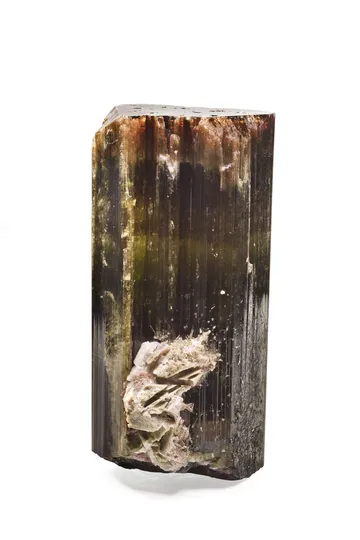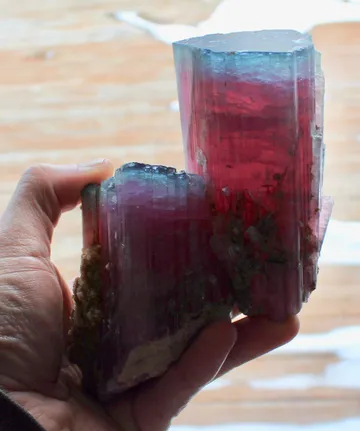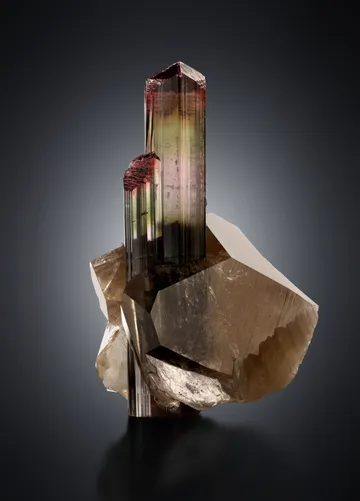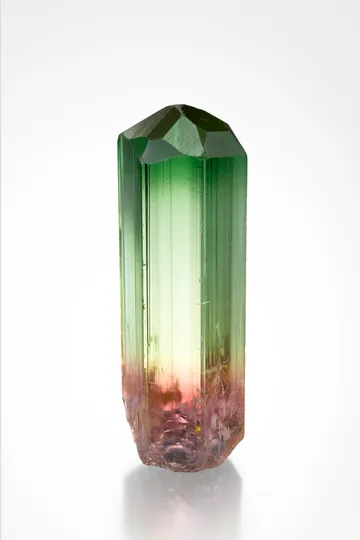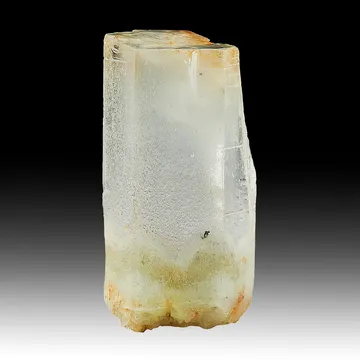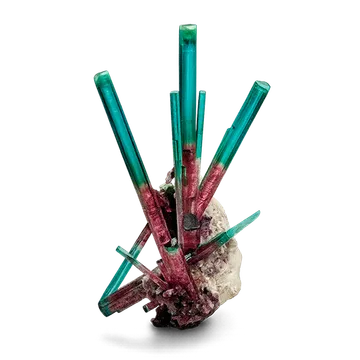
Madagascar is one of the great names in tourmaline collecting, not because it produced the most tourmaline, but because it produced some of the most visually distinctive tourmaline ever cut, polished, and held to the light. The classic Malagasy material is the calcium-rich lithium tourmaline long known to collectors as liddicoatite: thick crystals and slices with triangular growth sectors, radiating three-rayed red stars, watermelon-like cores, yellow-green rims, smoky brown skins, and stacked oscillatory zones that look more architectural than accidental.
Key facts
Madagascar is one of the great names in tourmaline collecting, not because it produced the most tourmaline, but because it produced some of the most visually distinctive tourmaline ever cut, polished, and held to the light. The classic Malagasy material is the calcium-rich lithium tourmaline long known to collectors as liddicoatite: thick crystals and slices with triangular growth sectors, radiating three-rayed red stars, watermelon-like cores, yellow-green rims, smoky brown skins, and stacked oscillatory zones that look more architectural than accidental.

Photo: Wikimedia Commons
For collectors, the word “Madagascar” on a tourmaline label often needs a second question: which tourmaline? The island’s pegmatites have yielded elbaite, fluor-elbaite, fluor-liddicoatite, liddicoatite sensu stricto, dravite-rich zones, and chemically intermediate crystals. Much of the historic material was sold simply as “liddicoatite,” and that name remains deeply embedded in the market. Modern nomenclature is more exacting: many classic “liddicoatites” are fluor-liddicoatite, while some analyzed Malagasy material is true OH-dominant liddicoatite and some red material proves to be elbaite. In hand specimen, even an experienced collector usually cannot settle that distinction by eye alone.
The heart of the story is central Madagascar, especially the Anjanabonoina pegmatites west-southwest of Antsirabe and the Sahatany Valley pegmatite field near Ibity. These are rare-element granitic pegmatites emplaced into the Proterozoic crystalline basement and associated metasedimentary rocks of the Itremo region. Their mineralogy is the collector’s dream version of a complex pegmatite system: lithium tourmalines with quartz, albite var. cleavelandite, microcline including amazonite, spodumene var. kunzite, beryl var. morganite, spessartine, hambergite, danburite, phenakite, scapolite, native bismuth, and rare borates such as rhodizite-londonite in the broader Malagasy pegmatite province.
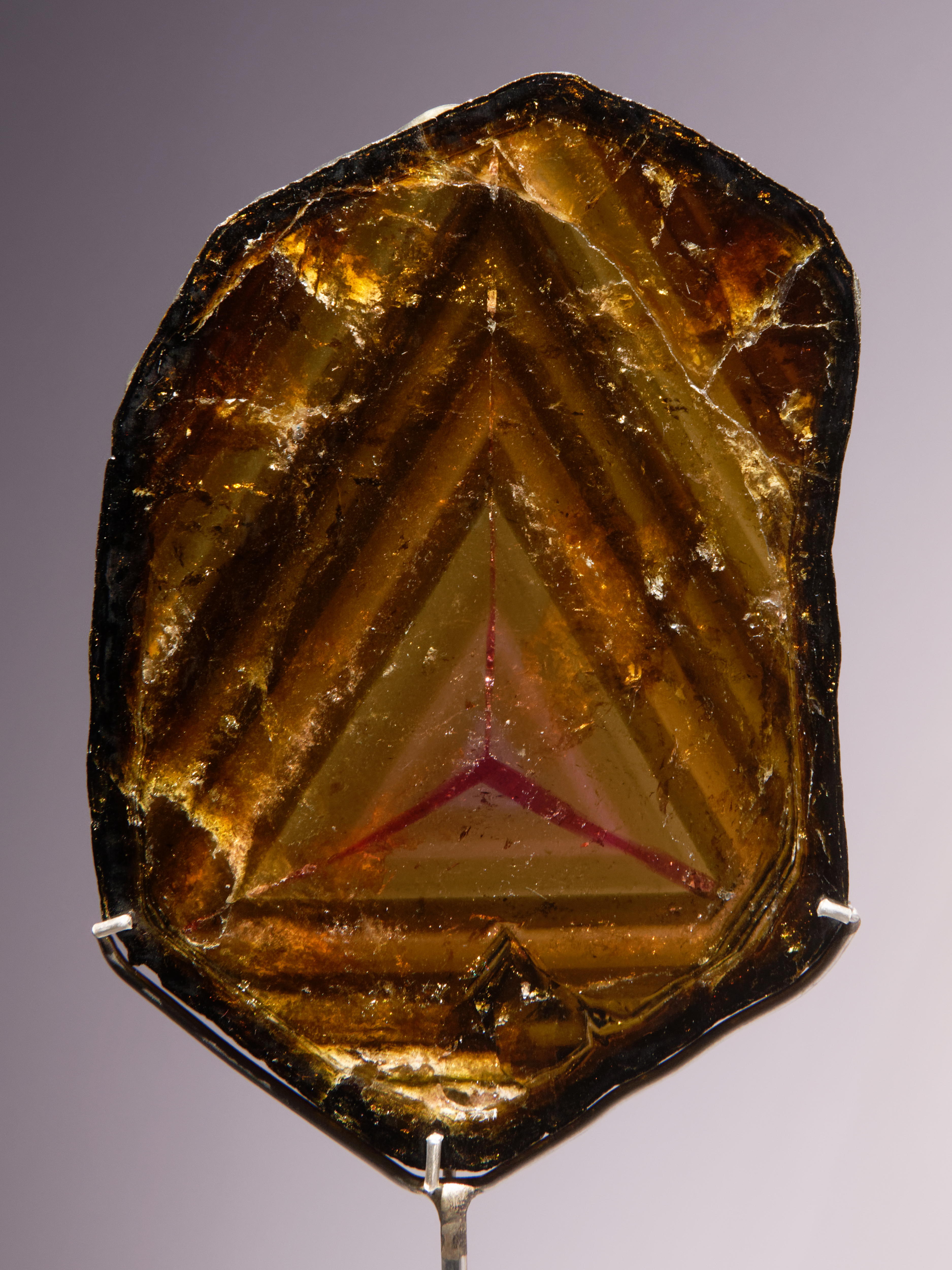
Photo: Wikimedia Commons
The visual signature that made Madagascar famous is best seen in slices cut perpendicular to the c-axis. A dull, nearly black-skinned crystal may reveal, once cut, a luminous interior of pink, red, green, yellow, brown, blue-green, and colorless bands. The most sought-after slabs show a sharp triangular core, concentric outer zoning, and the classic three-rayed red star sometimes compared to a Mercedes emblem. Fine intact crystals on matrix are much rarer than slices, because the large dark crystals were historically valued for what they contained inside rather than for pristine external form.

Photo: Wikimedia Commons
The finest Madagascar tourmalines reward the collector who likes complexity. They are not merely “pink tourmaline” or “green tourmaline”; they are geological records, frozen in layers, of evolving melt and fluid chemistry. The best pieces have both mineralogical depth and lapidary drama: a cabinet crystal with gemmy red windows, a thick slab with a crisp red trigonal star, or a carefully polished old slice whose geometry can be read like a growth map.
Search for specimens: View all tourmaline specimens from Madagascar, Madagascar
Madagascar’s classic tourmalines come from rare-element granitic pegmatites, especially the central highland pegmatite fields around Antsirabe, Betafo, Ibity, and the Sahatany Valley. These pegmatites belong to the broader Pan-African geological framework of Madagascar’s crystalline basement, where late to post-tectonic granitic magmatism generated pegmatite systems enriched in lithium, boron, fluorine, calcium, rare alkalis, and other elements favorable for colorful tourmaline growth.
Anjanabonoina is the most historically important locality for Madagascar’s liddicoatite–fluor-liddicoatite–elbaite tourmalines. The deposit lies west-southwest of Antsirabe, on a hill near Ikaka Mountain, in an area of pegmatite dikes and eluvial deposits. The pegmatites intrude quartzites, schists, and marbles of the Itremo Group. The association with calcium-bearing metasedimentary rocks is important: the calcium needed for calcium-rich lithium tourmalines was likely supplied, at least in part, by interaction with carbonate-bearing host rocks and late-stage fluids.
At Anjanabonoina, the main pegmatite system is exposed over a substantial hillside area, with dikes reported in the range of a few meters to more than ten meters thick. Weathering is deep, feldspar is commonly kaolinized, and much early production came from eluvial material derived from the breakdown of pegmatite bodies. That weathered setting explains why large tourmaline masses could be recovered from surface and near-surface workings, and why many historic crystals have abraded, etched, or darkened exteriors.
The mining history begins in earnest at the end of the nineteenth century and early twentieth century. A large rubellite crystal from the Mount Ibity area reached the National Museum of Natural History in Paris in 1890. By 1893, colored tourmaline was known in situ in the Betafo region. Anjanabonoina itself was reportedly discovered in 1894 by Emile Gautier, with more intensive work beginning under Léon Krafft in the early 1900s. Alfred Lacroix’s early twentieth-century work placed Madagascar’s tourmalines into the mineralogical literature, especially the polychrome slices and their unusual trigonal zoning.
The strongest early mining pulse at Anjanabonoina came between 1920 and 1925, when about 80 workers were reportedly active and large quantities of multicolored tourmaline and morganite were recovered. Mining ceased by about 1930 after only the eluvial portion of the deposit had been substantially exploited. From the 1930s into the 1960s, work was limited and local.
The modern collector market owes much to the renewed attention of the 1960s and 1970s. Eckehard Petsch of the Julius Petsch Jr. company in Idar-Oberstein visited the mine area in 1967, recognized the significance of the old dumps and incompletely worked pegmatites, and later operated through Société Germadco. Roads, housing, and a school were established, and renewed mining began in the early 1970s. The 1970s production supplied large dark crystals that, once sliced, became some of the iconic Madagascar liddicoatite slabs in European and American collections.
Production has always been episodic. Reported major Anjanabonoina pockets occurred in 1972, 1978, 1984, and 1991. The 1978 pocket was exceptional, yielding tonnes of red and polychrome tourmaline, with individual crystals weighing up to roughly 20 kg. The 1984 pocket produced another large quantity of similar material along with other gem minerals. Later exploratory work in the mid-1990s included deep shafts and a long subhorizontal tunnel that reached pegmatite core zones, but mining declined after the deaths of key personnel and the collapse or destruction of workings.
Access to historic Anjanabonoina is not casual collecting. The old route from Antsirabe involved road travel to Ambohimanambola, a track toward the mine, and, in later conditions, a difficult journey by foot. The locality has been described as accessible only in the dry season, with security and health concerns. Modern collectors should treat Madagascar tourmaline as a market-acquired specimen category rather than a field-collecting destination unless working through fully legal, local, professional channels.
The Sahatany Valley adds another important chapter. Pegmatites around Ibity, including localities such as Estatoby, Tsarafara, Tamponilapa, Manjaka, and related workings, have produced gemmy elbaite-liddicoatite-series tourmalines, hambergite, spodumene, danburite, and rare borates. These are generally elbaite-subtype pegmatites, locally affected by interaction with calc-silicate rocks and marbles. Collector specimens from Sahatany may show sharper crystals than many Anjanabonoina slices, with pink, green, yellow, red, and multicolored zoning, sometimes on quartz or feldspar matrix.
Madagascar should therefore be understood not as a single mine locality but as a family of pegmatite occurrences. Anjanabonoina is the great historic source of large polychrome slices and classic dark-skinned crystals. Sahatany is the source of many gemmy crystals, matrix pieces, and scientifically important tourmaline assemblages. Other central and south-central localities, including Antaboaka, Jochy, Alakamisy Itenina, Malakialina, Maroandro, Vohitrakanga, Antandrokomby, and Camp Robin, appear in specimen labels and the literature, but locality precision varies widely in the trade.
The best-known Madagascar tourmalines are stout prismatic crystals, often with trigonal symmetry expressed by prism, rhombohedron, and scalenohedron faces, and commonly striated parallel to the c-axis. In slices, however, the crystal’s internal architecture matters more than its outer shape. The classic cross-sections show triangular sector zones, narrow concentric outer bands, oscillatory zoning, and, in the most famous examples, a red to pink three-rayed star.
Color is the glory of the locality. Madagascar material ranges from red and purplish red through cranberry, raspberry, pink, orangy pink, yellow, yellow-brown, green, bluish green, brownish green, pale blue, colorless, and nearly black. Many crystals combine several of these colors in a single individual. The dark outer skin, so common on large Anjanabonoina crystals, can mislead the eye; a specimen that appears almost black in reflected light may transmit red, green, honey-yellow, or smoky olive when backlit or cut.
The most typical collector forms are:
At Anjanabonoina, large crystals are a special feature. Historic reports describe tourmalines commonly weighing up to around 20 kg in major pockets, and one crystal recovered by Eckehard Petsch reportedly measured about 80 cm tall and 32 cm in diameter. A doubly terminated crystal illustrated in the literature weighed 17.8 kg and measured 33 cm tall by 22 cm wide. Such masses explain why Madagascar became so strongly associated with polished slices: the crystals were large enough to yield dramatic slabs rather than only small gemstones.
Associations are a major clue to locality and geological setting. Classic Anjanabonoina pocket assemblages include quartz, microcline including amazonite, albite var. cleavelandite, dravite–elbaite–liddicoatite-series tourmaline, spodumene var. kunzite, native bismuth, spessartine, beryl var. morganite, hambergite, danburite, phenakite, and scapolite. In Sahatany Valley pegmatites, collector associations may include quartz, feldspar, albite, hambergite, spodumene, danburite, and rare borate species; at some localities tourmaline also records interaction with calc-silicate or marble host rocks.
Quality in Madagascar tourmaline is judged differently depending on form. For slices, the key factors are symmetry, color contrast, thickness, polish quality, translucency, and the sharpness of the triangular or star pattern. A slice with a crisp central triangle, fine outer banding, and a strong red star is far more desirable than a muddy slab with weak zoning. For crystals, transparency, termination quality, matrix, color when backlit, and freedom from repairs are critical. True gemmy matrix crystals from Madagascar are much scarcer than slices and tend to be competed for aggressively.
Size alone is not enough. A large dark chunk with no visible zoning is far less collectible than a smaller slice with clean geometry and lively color. Conversely, an uncut crystal with obvious gemmy red or green windows and good form can be much more desirable than a polished slab, because intact crystals were historically sacrificed to reveal interiors.
The scientific characteristics are just as complex as the appearance. Madagascar lithium tourmalines can occupy the elbaite–liddicoatite–fluor-liddicoatite compositional neighborhood, and zones within a single crystal may not all be the same species. Calcium, sodium, fluorine, hydroxyl, lithium, aluminum, iron, and manganese vary across growth zones. That is why a specimen sold as “liddicoatite” may be fluor-liddicoatite, elbaite, liddicoatite, or a zoned combination unless quantitative analysis has been performed.
Madagascar tourmaline is a locality category where label precision matters. “Madagascar liddicoatite” is a traditional collector phrase, but not a guaranteed species determination. Without electron microprobe, LA-ICP-MS, single-crystal structure refinement, or comparable analytical work, many specimens are best described conservatively as “tourmaline,” “elbaite-liddicoatite series,” or “fluor-liddicoatite/liddicoatite group tourmaline” depending on supporting evidence. A label naming Anjanabonoina, Sahatany Valley, Tsarafara, Estatoby, Camp Robin, or Antandrokomby is more useful than a country-only label, but even mine-level labels can be inherited from old trade parcels and should be weighed against appearance, provenance, and associated minerals.
The most important authenticity issue is not synthetic material; it is identity and provenance. Madagascar slices are widely recognizable, and many are natural, but polished slabs can be difficult to tie to a specific pegmatite unless they came with old collection history. Similar-looking polychrome tourmaline slices exist from other countries, though the large-scale triangular and star zoning of classic Malagasy material remains distinctive. Be cautious with vague labels such as “old Madagascar liddicoatite” when no mine, dealer history, or collection provenance accompanies an expensive piece.
Treatments deserve attention. The gem literature records little documented heat or irradiation treatment specifically for Madagascar liddicoatite-type tourmaline, but that does not mean all tourmaline is untreated. A scientific study of purplish-red Anjanabonoina tourmaline showed that heating in air at high temperature can intensify color by changing manganese valence, although that work was experimental rather than evidence of a routine market treatment for specimens. For collector pieces, the more immediate concern is repair, filling, coating, waxing residue, and polishing.
Fractures are common. The same large crystals that yield stunning slices often contain partially healed fractures, feathers, negative crystals, strain patterns, tubes, and mineral inclusions. These are not automatically defects; they are part of the material. But in polished slices, open cracks can be waxy, resin-filled, or incompletely cleaned after lapidary work. Inspect under strong transmitted light and oblique light. Look for differences in luster along cracks, cloudy fill, bubbles, excess polish compound, or unnatural surface gloss inside fractures.
Condition problems differ by specimen type. Slices may have edge chips, saw marks on one face, uneven polish, fractures reaching the rim, or repaired breaks. Crystals may have contacted or cleaved terminations, etched skins, broken prism faces, or reattached fragments. Matrix pieces from Madagascar are especially worth checking carefully because gemmy tourmaline crystals on cleavelandite or quartz are rare enough that repairs are economically tempting.
Rarity is stratified. Small Madagascar slices are available on the market with some regularity. Good patterned slices are scarcer, especially those with sharp trigonal stars, saturated red-pink zones, and clean translucency. Large old Anjanabonoina slabs with vivid geometry are significantly rarer. Fine complete crystals, especially transparent red or multicolored crystals on matrix, are rarer still. Truly top-tier matrix liddicoatite or fluor-liddicoatite from Madagascar is a high-end specimen category, not a casual by-the-flat commodity.
Current market availability is dominated by old production, recycled collection material, and sporadic newer finds. Anjanabonoina’s historic pulses are long past; much material seen today traces back to older mining, old lapidary stock, or specimens that have circulated through European and American collections. Sahatany and other Malagasy localities still appear in dealer inventories, but fine, well-documented pieces are not abundant. When a good Madagascar tourmaline appears with strong locality information, good photography, and a clear condition report, serious collectors notice.
The history of Madagascar tourmaline begins with the kind of detail mineral collectors love: a single large rubellite crystal carried out of the Mount Ibity area and brought to Paris in 1890. Three years later, colored tourmaline was known in place in the Betafo region. Alfred Lacroix, working from the great French mineralogical tradition, recognized that these were not merely colorful pebbles from an exotic colony but a major pegmatite province. By 1910 he had illustrated a slice of polychrome tourmaline from Anjanabonoina and described the three red bands meeting at 120 degrees. That little geometric observation became one of the signatures by which collectors still recognize Madagascar liddicoatite slices more than a century later.
Anjanabonoina’s early mining had the rhythm of a boom locality. The deposit was reportedly discovered in 1894 by Emile Gautier, then worked intensively by Léon Krafft in the early 1900s. The great early pulse came between 1920 and 1925: 80 workers on the hill, large quantities of multicolored tourmaline, and exceptional morganite coming out of the eluvial ground. By 1930 the operation was done, even though the miners had largely explored only the weathered eluvial portion along the eastern slope. For decades afterward, the hill was more legend than mine.
Then, in 1967, Eckehard Petsch made the trip that reopened the story. He had heard of the strange color-zoned tourmalines and, with help from Madame Liandrat of Antananarivo, Léon Krafft’s daughter, traveled toward the abandoned workings. The journey involved nearly two days of walking. At the old dumps he found tourmaline crystals and realized that the deposit was not exhausted in the way the market had assumed. The conclusion was obvious to a miner and dealer from Idar-Oberstein: the old hill still had something to say.
The renewed 1970s operation was not a romantic scratch in the dirt. Société Germadco built roads, housing, and a school for miners and families, then began working dumps and eluvial deposits downslope from the pegmatites. By 1974 more than 100 workers were on site. Tunnels entered the hill; some reached lengths of 100 to 200 m. In the field photographs from that period, one sees miners at pegmatite faces and later exploration workings cutting through deeply weathered rock. A 1995–1996 Fretosoa exploration tunnel was driven by hand from the northeastern side of the deposit; at 160 m from the surface, the walls showed small kaolinized pegmatite veins cutting weathered quartzite, with candles used for illumination.
The scale of the pockets is difficult to reconcile with the polished slices in shop trays. Madagascar tourmaline is often encountered as palm-sized slabs, but the parent crystals could be monstrous. One crystal recovered by Petsch was reported at 80 cm tall and 32 cm across. Another illustrated doubly terminated crystal weighed 17.8 kg and measured 33 cm tall by 22 cm wide. The largest reported pocket, in 1978, yielded about 2.6 tonnes of polychrome and red tourmaline crystals, some up to 20 kg apiece. The 1984 pocket yielded about 2 tonnes of similar tourmaline. From the 1991 find, Federico Pezzotta was told of a single sale of 600 kg of red tourmaline.
The lapidary story is equally vivid. Gerhard Becker, who purchased much of the tourmaline coming through Julius Petsch Jr. in Idar-Oberstein, helped commercialize the cutting of these dark crystals into polished slices. One of his 1971 articles bore the irresistible title “70 pound tourmaline crystal produces multicolored slabs.” Richard T. Liddicoat happened to visit Becker’s shop shortly after that crystal was sliced. He photographed the changing patterns revealed from base toward termination: not simply a gem being cut, but a crystal being opened like a serial cross-section through its own growth history.
The locality also has a harder edge. After the 1979 change in Malagasy mining law required foreign mining companies to pass into Malagasy control, the operation changed hands. A later pocket in 1984 was exported by a Bulgarian partner, who soon had to leave Madagascar amid problems with the company and local people. The mid-1990s exploration work recognized that important gem-bearing core zones remained, but activity halted after the 1997 deaths of Randrianarisolo Benjamin, the mine engineer, and Fretosoa chief Giuseppe Tosco. Equipment was stolen. Tunnels and pits collapsed or were destroyed by later local digging. What had once been an organized operation with roads and a school was reduced to sporadic surface work, sometimes only in the rainy season when enough water collected for washing.
This is why a fine old Madagascar tourmaline carries more than color. A slice with a red star may have begun as a dark 20 kg crystal in kaolin clay; it may have passed through a Malagasy hillside camp, Idar-Oberstein saws, and a European lapidary shop before arriving in a collector’s drawer. A matrix crystal from Anjanabonoina or Sahatany may represent the rarer path: a piece valued as a mineral specimen before a saw could turn it into slabs. The best examples preserve both stories at once—the geology of growth and the human history of deciding whether to cut or keep.
Dunn, P. J., Appleman, D. E., and Nelen, J. A. (1977), “Liddicoatite, a new calcium end-member of the tourmaline group,” American Mineralogist, 62, 1121–1124. The original species description naming liddicoatite in honor of Richard T. Liddicoat.
Dunn, P. J., Appleman, D. E., Nelen, J. A., and Norberg, J. A. (1978), “Liddicoatite, a new gem tourmaline from Madagascar,” Journal of Gemmology, XVI(3), 153–160. Early gemological treatment of the Madagascar material, including discussion of Smithsonian type specimen material.
Dirlam, D. M., Laurs, B. M., Pezzotta, F., and Simmons, W. B. (2002), “Liddicoatite Tourmaline from Anjanabonoina, Madagascar,” Gems & Gemology, 38(1), 28–53. The essential modern locality article for Anjanabonoina: history, geology, production, zoning, gemology, and treatments.
Wilson, W. E. (1989), “The Anjanabonoina Pegmatite, Madagascar,” The Mineralogical Record, 20(3), 191–200. A classic locality paper cited in Mindat’s Anjanabonoina occurrence record.
Ertl, A., Hughes, J. M., Prowatke, S., Ludwig, T., Prasad, P. S. R., Brandstätter, F., Körner, W., Schuster, R., Pertlik, F., and Marschall, H. (2006), “Tetrahedrally coordinated boron in tourmalines from the liddicoatite-elbaite series from Madagascar,” American Mineralogist, 91, 1847–1856. Crystal-chemical study of colorless Madagascar tourmalines in the liddicoatite-elbaite series.
Lussier, A. J., Abdu, Y., Hawthorne, F. C., Michaelis, V. K., Aguiar, P. M., and Kroeker, S. (2011), “Oscillatory zoned liddicoatite from Anjanabonoina, central Madagascar. I. Crystal chemistry and structure by SREF and 11B and 27Al MAS NMR spectroscopy,” The Canadian Mineralogist, 49(1), 63–88. Detailed structural and spectroscopic work on oscillatory-zoned Anjanabonoina material.
Bosi, F., Celata, B., Skogby, H., Hålenius, U., Tempesta, G., Ciriotti, M. E., Bittarello, E., and Marengo, A. (2021), “Mn-bearing purplish-red tourmaline from the Anjanabonoina pegmatite, Madagascar,” Mineralogical Magazine, 85, 242–253. A modern multi-analytical study showing that an alleged purplish-red liddicoatite from Anjanabonoina was elbaite, and documenting the manganese-related color behavior.
Gadas, P., Novák, M., Vašinová Galiová, M., and Pezzotta, F. (2023), “Chemical composition of tourmalines from the Manjaka pegmatite and its exocontact, Sahatany Valley, Madagascar,” Journal of Geosciences, 68, 185–202. Important study of Sahatany Valley tourmaline chemistry, pegmatite zoning, and exocontact mineralization.
Rizzo, F., Bosi, F., Tempesta, G., and Agrosì, G. (2023), “Compositional Variation and Crystal-Chemical Characterization of a Watermelon Variety of Tourmaline from Anjanabonoina, Central Madagascar,” Crystals, 13(8). Recent work focused on watermelon-type Anjanabonoina tourmaline and its compositional variation.
Mindat occurrence record: Liddicoatite from Anjanabonoina pegmatites, Ambohimanambola, Betafo District, Vakinankaratra, Madagascar. Useful for locality hierarchy, references, and the caution that some alleged liddicoatite from Anjanabonoina has been shown analytically to be elbaite.
Mindat occurrence record: Fluor-liddicoatite from Anjanabonoina pegmatites, Ambohimanambola, Betafo District, Vakinankaratra, Madagascar. Current locality and reference anchor for fluor-liddicoatite at Anjanabonoina.
Wikimedia Commons: “Liddicoatite from Anjanabonoina, Madagascar,” Caillois Donation / MNHN exhibition photograph. Museum-displayed polished slice showing the dramatic transmitted-light character of Anjanabonoina material.
Wikimedia Commons: “Liddicoatite-Albite-216417.jpg,” Rob Lavinsky / iRocks.com specimen from Anjanabonoina. Representative cranberry-red liddicoatite on cleavelandite from the classic locality.
“Liddicoatite Tourmaline with Quartz” — Wilensky Minerals — Video of a 7.1 cm Madagascar liddicoatite with quartz from Anjanabonoina, emphasizing the rarity of gem-quality matrix crystals from this material.
“Liddicoatite Tourmaline” — EarthWonders specimen media — Marketplace specimen page with images and video of a gemmy strawberry-red Anjanabonoina tourmaline measuring 6.2 cm tall.
GIA: “Liddicoatite Tourmaline from Anjanabonoina, Madagascar” — The indispensable in-depth article for history, geology, production, crystal chemistry, gemology, and collecting context.
GIA PDF version of the Anjanabonoina article — Full illustrated PDF of the classic 2002 Gems & Gemology paper.
Mindat: Fluor-liddicoatite mineral data — Current mineralogical data, nomenclature notes, type-locality context, and locality references for fluor-liddicoatite.
Mindat: Anjanabonoina fluor-liddicoatite occurrence — Locality-specific page for fluor-liddicoatite at Anjanabonoina with references and photo links.
Mindat: Anjanabonoina liddicoatite occurrence — Locality-specific page for liddicoatite at Anjanabonoina, including references and the important warning about analyzed elbaite material.
GIA: “Liddicoatite: Vibrant Gem Honors Father of Modern Gemology” — Accessible overview of liddicoatite’s color zoning, Madagascar connection, and naming history.
Bosi et al. 2021, Mineralogical Magazine: Mn-bearing purplish-red tourmaline from Anjanabonoina — Important modern paper for collectors concerned with species identification and manganese-related red coloration.
Gadas et al. 2023, Journal of Geosciences: Tourmalines from the Manjaka pegmatite, Sahatany Valley — Technical study of Sahatany Valley tourmaline chemistry and pegmatite–host rock interaction.
Wikimedia Commons: Fluor-liddicoatite image category — Useful image gallery for comparing Malagasy fluor-liddicoatite crystals and slices.
Wikimedia Commons: Minerals of Anjanabonoina pegmatites — Locality-specific image category with tourmaline and associated pegmatite minerals.