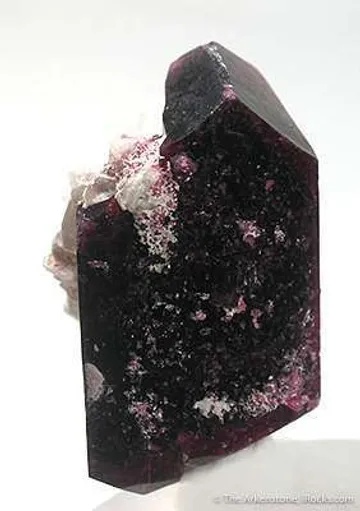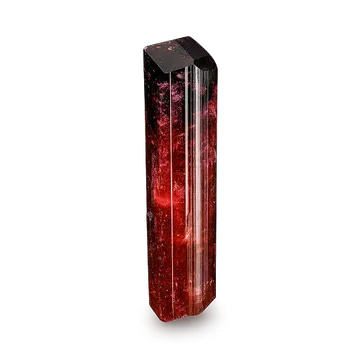
Liddicoatite - cross-sectional tourmaline with star bands and a rainbow palette; Madagascar’s Anjanabonoina source; prized by collectors for form and labeling.
Key facts
Madagascar liddicoatite is the tourmaline that made collectors think in cross-sections. The great visual signature is not simply color but geometry: slices cut perpendicular to the c-axis may reveal triangular zones, nested growth bands, and the famous three-rayed star that collectors often compare to a Mercedes-Benz emblem. In fine examples the palette can move through cranberry red, pink, violet, olive green, yellow-brown, smoky brown, colorless, and bluish green in a single crystal. The best pieces have the startling look of a geological stained-glass window: color laid down in pulses, planes, rims, and sectors as the pegmatite fluid changed during growth.
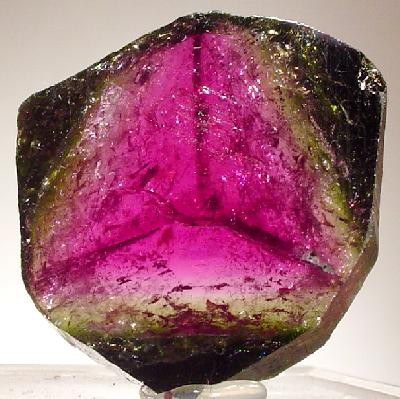
Photo: Wikimedia Commons
The classic source is the Anjanabonoina pegmatite area near Ambohimanambola, west-southwest of Antsirabe in Madagascar’s central highlands. For much of the twentieth century this was the preeminent world locality for the material historically traded and studied as liddicoatite. It produced both complete crystals and large broken masses that were ideal for slicing, and the locality became the benchmark against which polychrome liddicoatitic tourmaline from other countries is still compared.
Mineralogically, the story has become more precise than the old trade name. Liddicoatite is the calcium-rich lithium tourmaline species with the ideal formula Ca(Li2Al)Al6(Si6O18)(BO3)3(OH)3(OH). Much classic Madagascar material long called liddicoatite is fluorine-dominant at the W site and is now properly treated as fluor-liddicoatite, Ca(Li2Al)Al6(Si6O18)(BO3)3(OH)3F, or more cautiously as liddicoatitic tourmaline unless analytical work has been done. Collectors still use “liddicoatite” as the familiar market shorthand, but serious labeling should distinguish confirmed liddicoatite, fluor-liddicoatite, elbaite, dravite, and mixed-zone crystals where the chemistry is known.
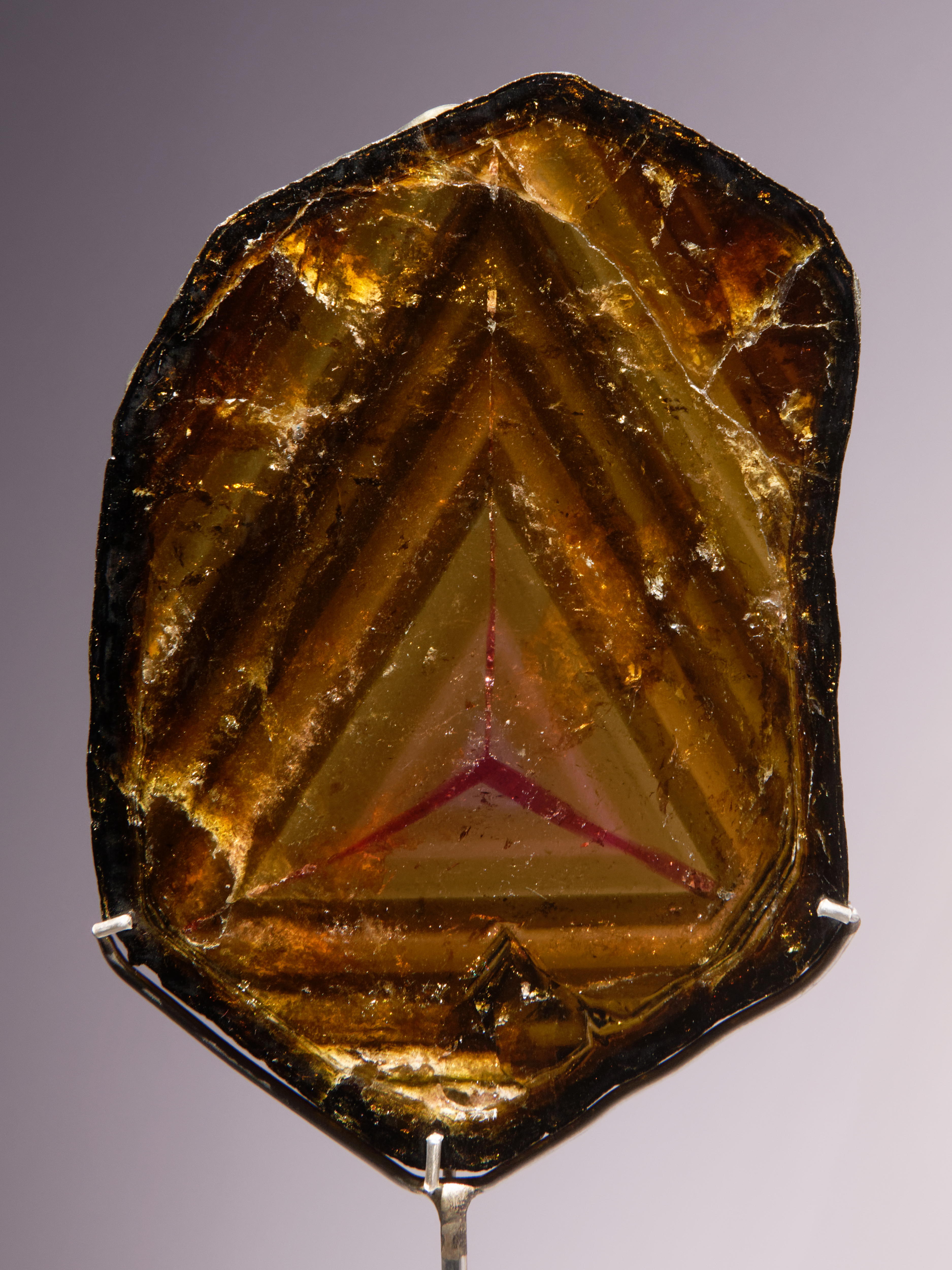
Photo: Wikimedia Commons
The geological setting explains why Madagascar pieces are so distinctive. Anjanabonoina belongs to a rare-element pegmatite system emplaced into the Itremo Group, a metamorphic sequence containing quartzites, schists, and marbles. The presence of calcium-rich host rocks is important: calcium available during late-stage crystallization helped stabilize liddicoatitic tourmaline in gem pockets. These were not ordinary small miaroles. Some cavities were large enough to yield tourmaline crystals weighing many kilograms, and some crystals carried a dark outer skin that concealed brilliant internal zoning until a saw revealed the cross-section.
Historically, Madagascar liddicoatite sits at the intersection of French colonial mineralogy, Idar-Oberstein lapidary work, GIA research, and high-end mineral collecting. Alfred Lacroix illustrated and described Madagascar tourmaline slices in the early twentieth century; later, German cutting houses and American gemologists helped popularize the sliced form. The species name honors Richard T. Liddicoat of GIA, and the material from Madagascar is inseparable from that history even though modern tourmaline nomenclature has refined the species boundaries.
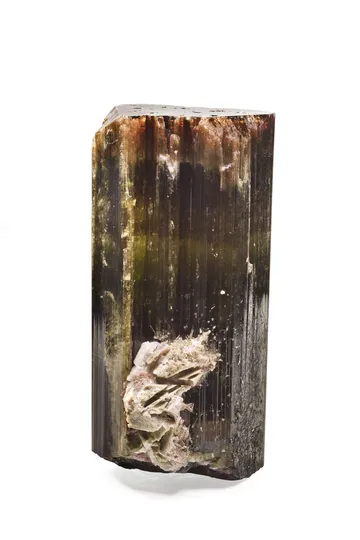
Collectors look for several things at once: strong body color, a crisp trigonal or star pattern, transparency through the slice, minimal fractures, and a clean polish. In crystals, the priorities shift to complete terminations, glassy luster, sharp trigonal morphology, distinct color zoning visible through the prism, and matrix association with feldspar, quartz, cleavelandite, or other pegmatite minerals. The finest unsawn crystals are rare because the very feature that made the material famous—spectacular internal zoning—has often tempted cutters to sacrifice crystals for slices.

Photo: Wikimedia Commons
Search for specimens: View all liddicoatite specimens from Madagascar
The name most closely tied to Madagascar liddicoatite is Anjanabonoina, in the Ambohimanambola area of the Betafo District, Vakinankaratra Region. The mine area lies about 55 km west-southwest of Antsirabe on a hill at roughly 1,400 m elevation, east of Ikaka Mountain. The old access route ran from Antsirabe toward Ambohimanambola, then along a track built during the Germadco mining period; by the early 2000s that track was described as no longer passable by vehicle, leaving a two-day approach on foot in the dry season.
The deposit is an aplite-pegmatite system exposed over roughly 800 × 300 m in the historic mining area and extending south-southwest for about 2 km. The pegmatites dip gently north-northwest, range from about 2 to 12 m thick, and intrude quartzite, schist, and marble of the Itremo Group. They are deeply weathered and kaolinized in places, especially where eluvial deposits were worked. The gem pockets occur in rare but sometimes very large cavities surrounded by kaolin clay.
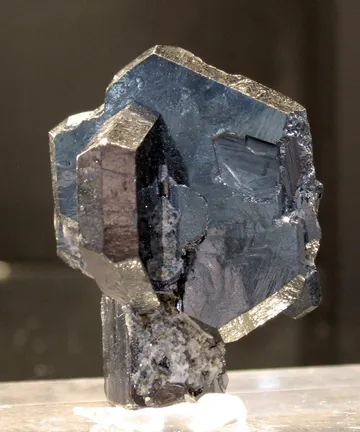
The pocket assemblage at Anjanabonoina is the kind that makes pegmatite collectors pay attention: quartz, microcline including amazonite, albite as cleavelandite, dravite-elbaite-liddicoatite tourmaline, spodumene as kunzite, native bismuth, spessartine, beryl as morganite, hambergite, danburite, phenakite, and scapolite. That mixture places the deposit among Madagascar’s great rare-element pegmatites, with characteristics that bridge LCT and NYF affinities. In plain collector terms, the same geological complexity that produced calcium-lithium tourmaline also produced the diverse accessory minerals that make Anjanabonoina specimens so desirable.
Mining history began in earnest after the area was reportedly discovered in 1894 by Émile Gautier. Léon Krafft worked it intensively in the early 1900s, and the greatest early activity came between 1920 and 1925, when about 80 workers were on site. Operations ended in 1930 after miners had mainly explored the eluvial material along the eastern slope. Limited local digging continued into the 1960s.
A second major chapter began when Eckehard Petsch of the Julius Petsch Jr. Company learned of the unusual color-zoned tourmalines and visited the abandoned mine area in 1967 after a difficult journey that reportedly included nearly two days of walking. His Madagascar company, Société Germadco, acquired the deposit in 1970, built roads, housing, and a school, and began mining in 1972 from dumps and eluvial deposits downslope from the pegmatites. By 1974 more than 100 workers were present. Germadco later mined the pegmatites themselves, driving tunnels that reached 100–200 m in length.
Production figures give a sense of the scale. By 1912, Anjanabonoina had produced 1,675 kg of colored tourmaline. Production declined in the following decade, but nearly 1,700 kg was mined between 1920 and 1925. After a quiet period from 1950 to 1970, Germadco recovered several thousand kilograms of red and polychrome tourmaline during the 1970s. Later discoveries in the 1980s and early 1990s added further tonnage, though records are less precise.
The most famous pocket years at Anjanabonoina were 1972, 1978, 1984, and 1991. The 1978 pocket was probably the largest documented in the modern literature, yielding about 2.6 tonnes of red and polychrome tourmaline crystals, some up to 20 kg each. The 1984 pocket produced about 2 tonnes of similar material, along with other gems. The total output of the 1991 pocket is not known, but one reported sale from that find involved 600 kg of red tourmaline.
The largest tourmaline crystal recovered by Eckehard Petsch was reported as 80 cm tall and 32 cm in diameter. Another published Anjanabonoina specimen, a doubly terminated crystal weighing 17.8 kg, measured 33 cm tall and 22 cm wide. Such dimensions explain why many Madagascar liddicoatite specimens entered the market as slices rather than intact crystals: a dark, weathered-looking prism could hide spectacular internal color architecture.
Fretosoa Company, an Italian-Malagasy joint venture led in part by Federico Pezzotta, re-evaluated Anjanabonoina in 1995–1996. The work included four shafts about 45–55 m deep and a 185 m subhorizontal tunnel that reached the pegmatite core zone. Geological modeling suggested that significant gem-bearing core material remained unmined, but the project halted after the 1997 deaths of Randrianarisolo Benjamin and Fretosoa chief Guiseppe Tosco. With organized control gone, equipment was stolen and tunnels and pits were damaged or collapsed. Since then, production has been small and sporadic, mainly from local miners using hand tools and rainwater for washing.
Madagascar liddicoatitic tourmaline is not limited to Anjanabonoina. Chemically studied or historically cited localities include Antaboaka, Jochy, Lacamisinten or Alakamisy Itenina, Malakialina, Maroandro, the Sahatany Valley, Vohitrakanga, and Camp Robin-area deposits such as Valozoro. The collector market also sees material attributed to places in the Manapa and Betafo pegmatite fields. Still, Anjanabonoina remains the reference locality for the classic large polychrome slices and the most important historical source.
Madagascar liddicoatite is most recognizable when cut across the c-axis. In that orientation, the crystal’s trigonal symmetry becomes visible as triangular color fields, straight planar boundaries, narrow concentric rim zones, and three-rayed stars. The zoning may be sharp or diffuse, symmetrical or slightly distorted, and in some examples it changes dramatically from one slice to the next along the same crystal.
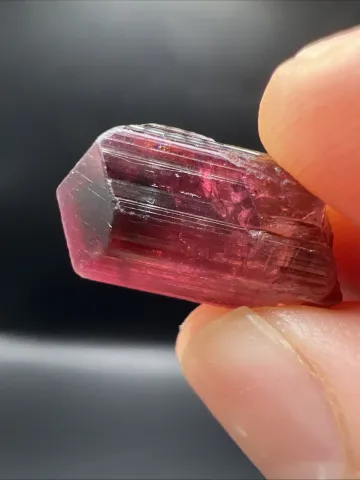
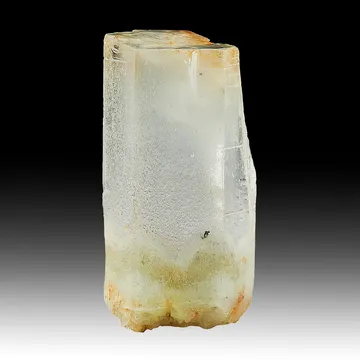
In crystals, the habit is prismatic tourmaline, commonly striated parallel to the c-axis, with trigonal terminations and in some cases a dark rind or “skin.” Fine crystals may be transparent to translucent, with red, purple, pink, caramel, green, brown, or yellow zones visible through the prism. Others are visually dark until backlit or sliced. The most desirable crystals are complete, lustrous, and unsawn, especially if color zoning is visible without sacrificing the specimen.
Color range is broad. Documented Madagascar material includes pink to purplish red, orangy pink to pinkish orange, yellowish green to bluish green, brownish green to brownish yellow, greenish blue, black, colorless, violet, pale blue, and smoky brown tones. Homogeneous red to violetish red Anjanabonoina tourmalines were historically faceted, with stones approaching 40 ct reported from early accounts. Modern collectors, however, most strongly associate the locality with multicolored slices and large polychrome crystals.
Typical specimen sizes vary widely by form. Small cabinet crystals of a few centimeters occur from several Madagascar pegmatite fields. Slices commonly range from thumbnail to cabinet size; published GIA study slices measured from 1.5 × 1.9 cm to 5.0 × 7.0 cm, while large display slices and museum cross-sections can be much larger. Historic crystals from Anjanabonoina reached extraordinary dimensions, with many crystals from major pockets weighing kilograms rather than grams.
Associated minerals are a significant part of locality attribution and specimen appeal. At Anjanabonoina, liddicoatitic tourmaline occurs with quartz, microcline including amazonite, albite-cleavelandite, dravite, elbaite, spodumene as kunzite, native bismuth, spessartine, morganite, hambergite, danburite, phenakite, and scapolite. In other Madagascar pegmatite fields, collectors may see liddicoatitic tourmaline with quartz, feldspar, cleavelandite, or rare borates such as londonite-rhodizite group minerals.
Internal features are common and important for both beauty and condition assessment. Madagascar material often contains partially healed fractures, feathers, fluid inclusions, negative crystals, needle-like tubes, albite inclusions, small tourmaline inclusions, xenotime, and strain patterns visible under crossed polarizers. Needle-like tubes are especially common in green zones. In slices, these features can add depth, but they can also reduce transparency and structural integrity.
Quality is judged differently depending on whether the specimen is a crystal, slice, gem, or carving. For slices, the best pieces show a clean, centered star or triangle, bright contrasting colors, strong translucency, even thickness, a high polish, and no distracting cracks, chips, glue lines, or cloudy filler. For crystals, collectors prefer complete terminations, sharp edges, high luster, strong color zoning, transparency, minimal bruising, and an old or well-documented locality pedigree. For faceted gems, the premium is on clarity, saturation, attractive parti-color arrangement, and laboratory confirmation if the stone is being sold specifically as liddicoatite rather than simply tourmaline.
The main authenticity issue is species identity. Liddicoatite, fluor-liddicoatite, elbaite, dravite, and rossmanite cannot be reliably separated by eye, refractive index, or ordinary gem testing. Triangular zoning is a strong locality-style clue, not a species determination. Quantitative chemical analysis is required, and individual growth zones within a single crystal can differ: some Madagascar specimens contain both liddicoatite or fluor-liddicoatite and elbaite in different sectors or rims. A dealer label that says “liddicoatite” should be read as a trade or historical term unless supported by analysis.
Modern nomenclature adds another layer. The original Madagascar “liddicoatite” type material was later recognized as fluorine-dominant and is now fluor-liddicoatite under the tourmaline-supergroup scheme. The OH-dominant species liddicoatite was re-established in 2025 with neotype material from the Dolní Rožínka pegmatite in the Czech Republic. This does not make the Madagascar material unimportant; it means that serious labels should specify “fluor-liddicoatite,” “liddicoatitic tourmaline,” or “tourmaline, liddicoatite-elbaite series” when that is the accurate analytical or historical description.
Treatments and assemblies matter particularly for slices. Madagascar tourmaline slices with natural fractures have commonly been stabilized with resin, and fractured slices have also been mounted or assembled as doublets with glass or plastic. Wax or oil has been identified in some slices, apparently connected to lapidary practice: paraffin wax may be used before polishing to prevent polishing residues from collecting in surface irregularities, and it may not fully leave fractures after heating or boiling. A collector should inspect the edges, fracture network, surface sheen, and any suspiciously uniform clarity under magnification and, when appropriate, UV and immersion.
Common condition issues include healed and open fractures, chips along thin slice edges, polishing scratches, uneven thickness, old glue, and impact bruises on prism edges or terminations. Large crystals are often dark, heavily included, or externally worn, and an apparently complete prism may be less transparent than photographs suggest unless shown with strong transmitted light. On matrix specimens, look carefully at contact points: tourmaline crystals may be repaired, reattached, or mounted on cleavelandite or feldspar.
Rarity depends on form. Small slices and commercial polished pieces from old stock are available, though fine patterns are much less common than ordinary slices. Good complete crystals are significantly scarcer. Large, gemmy, unsawn Anjanabonoina crystals with strong zoning and intact terminations are major pieces. Matrix specimens with well-placed red crystals on cleavelandite, quartz, or feldspar are also desirable, especially with old collection provenance.
Current market availability is strongest in three categories: old Madagascar slices, specimen crystals labeled from Anjanabonoina or Sahatany-area sources, and mixed-label “liddicoatite/fluor-liddicoatite” material from the broader Vakinankaratra and Camp Robin regions. High-end examples appear intermittently rather than continuously. The best pieces often come from older collections, because modern Anjanabonoina production has been limited by difficult access, hazardous workings, security concerns, and the collapse of organized mining.
The first unforgettable Madagascar liddicoatite story is a moment with a saw. Gerhard Becker, who purchased much of the tourmaline handled by the Julius Petsch Jr. Company, helped commercialize the cutting of these crystals into polished slices. One of his accounts appeared under the irresistible 1971 title “70 pound tourmaline crystal produces multicolored slabs.” Richard T. Liddicoat happened to visit Becker’s shop shortly after that crystal was sliced, and he photographed the changing internal patterns from the base toward the termination. It is hard to imagine a more fitting scene for the mineral that would later bear his name: Liddicoat himself watching the hidden architecture of a Madagascar tourmaline emerge one wafer at a time.
Anjanabonoina’s modern mining history has a frontier quality. When Eckehard Petsch first reached the abandoned workings in 1967, the approach reportedly required nearly two days of walking. He found tourmaline crystals in old dumps and recognized that the deposit had not been exhausted. By 1970 his company, Société Germadco, had acquired the ground; by 1972 mining had resumed; by 1974 more than 100 workers were on the hill. Roads, housing, and a school were built for the miners and their families. The site moved, in a few years, from a nearly forgotten highland locality to one of the great modern sources of red and polychrome tourmaline.
The numbers from the major pockets are still startling. The 1978 pocket at Anjanabonoina yielded about 2.6 tonnes of red and polychrome tourmaline, with individual crystals up to 20 kg. In 1984 another pocket produced about 2 tonnes. The 1991 find remains less fully documented, but one reported sale alone involved 600 kg of red tourmaline. These were not merely collector-size pockets; they were industrial-scale cavities in a gem pegmatite, capable of filling sacks with material that today would be sorted carefully, photographed, analyzed, and fought over at shows.
The landscape around the mine also tells a cautionary story. After years of local hand digging, the area contained hundreds of dangerous pits, some reportedly as much as 40 m deep. Rainy seasons destroyed roads and structures from earlier campaigns, and miners had to carry stones on foot to sell in Ambohimanambola and Betafo. In 1991, the discovery of another large pocket triggered unrest in which several miners were killed. The glamour of the polished slice—the crisp star, the glowing rim—has always been tied to a hard and sometimes violent mining reality.
The Fretosoa campaign of 1995–1996 reads like a serious attempt to bring geological order to a chaotic old deposit. The team drove four shafts 45–55 m deep and a 185 m subhorizontal tunnel into the deposit. In one published photograph from the tunnel, small kaolinized pegmatite veins crosscut weathered quartzite 160 m from the surface, with candles visible along the left side for illumination. The work produced enough structural data for a three-dimensional model and suggested that a significant portion of the gem-bearing core zone remained. Then, in 1997, the deaths of Randrianarisolo Benjamin and Guiseppe Tosco halted the project. Equipment was stolen; tunnels and pits collapsed or were destroyed by local mining. A scientifically promising campaign ended as another unfinished chapter in the mine’s long history.
There is also a quieter cultural afterlife to these stones. A famous polished slice collected by Alfred Lacroix is preserved at the Muséum national d’Histoire naturelle in Paris; the museum notes that it was among the early slices prepared there and that Lacroix published an image of the slice in 1922. Other tourmaline slices cut and polished by Lacroix were later set by the Parisian jeweler Jean Vendome into his 1975 “Arbre aux tourmalines.” Few minerals move so naturally between geological study, museum display, and jewelry art. Madagascar liddicoatite does.