Longyan, China - a mineral district famed for pale to canary-yellow calcite on dark limestone, clear drusy quartz, and blue-violet fluorite crystals prized by…
Key facts
Longyan is not a single neat specimen mine in the old European sense; it is a mineral district label used by collectors for several productive mines in southwestern Fujian, at the interior edge of one of South China’s most important Mesozoic metallogenic belts. The city lies in a country of carbonate strata, volcanic basins, granites, porphyry intrusions, skarns, and polymetallic veins, and that complexity is exactly why the label has become familiar on modern Chinese specimens. For ore geologists, the area includes major iron, tin-tungsten-polymetallic, manganese, lead-zinc, copper-molybdenum, and gold-copper systems. For collectors, the name most often means a sharply contrasting suite of calcite, quartz, and fluorite: pale to canary-yellow or “sandwich” calcite on dark limestone or quartz matrix, clear to snowy drusy quartz, and green to blue-violet fluorite in cubes, modified cubes, octahedra, and polycrystalline spherical growths.
The district’s geological importance is anchored by intrusive and hydrothermal activity of Early to Late Cretaceous age superimposed on older sedimentary and volcanic successions. At Zhongjia, a quartz-porphyry-related tin-polymetallic system has inner-contact veinlet-disseminated Sn-W mineralization, outer-contact vein-style polymetallic ore, and skarns. At Makeng, skarn iron mineralization is one of the great Fe systems of eastern China. At Zijinshan, Longyan hosts a giant porphyry-epithermal Cu-Au-Mo-Ag system that is economically far more famous than the cabinet specimens carrying the broader “Longyan” label. The better display specimens, however, have a very different character from ore samples: crisp pale calcite on black-grey limestone, glassy yellow rhombs, small druzy quartz stalactitic forms, and fluorite with blue-violet or green zoning perched against white quartz.
Regional View
Country View
Collector history here is recent and a little messy, which is common for fine Chinese material that reaches the market before mine names have settled in the literature. The 2017–2018 calcite-quartz-fluorite pieces were marketed from Longyan Prefecture, with one supplied mine name reported but not verified by the dealer. By 2022, “sandwich calcite” from the Zhudi lead-zinc mine area in Liancheng County had become a recognizable Longyan look: flattened hexagonal-tabular calcite crystals with pale pink or translucent centers between milky white outer zones, commonly on dark grey limestone and strongly orange under long-wave ultraviolet light. More recent market entries also use “Longyan Mine” for bright canary-yellow calcite rhombs, quartz-calcite combinations, and fluorite-calcite floaters. The best approach is to treat Longyan as a precise prefecture-level regional label unless the specimen has a narrower mine name supported by reliable provenance.

Photo: MChMinerals
Search for specimens: View all specimens from Longyan, China
Longyan is a prefecture-level city in southwestern Fujian Province, bordering the mineral provinces of Guangdong and Jiangxi, and collector labels may refer either to the city-level region or to mines within its counties and districts. The most specimen-relevant sublocalities include the Zhongjia Mine in Xinluo District, the Liancheng mining districts including the Zhudi lead-zinc mine area and Liancheng Mn deposit, and the broader Shanghang-Zijinshan ore field. These are not one deposit type but a cluster of related and overlapping ore environments developed in a region of Paleozoic carbonate rocks, metasedimentary basement, Mesozoic granites, volcanic rocks, porphyry intrusions, faults, breccias, and hydrothermal alteration.
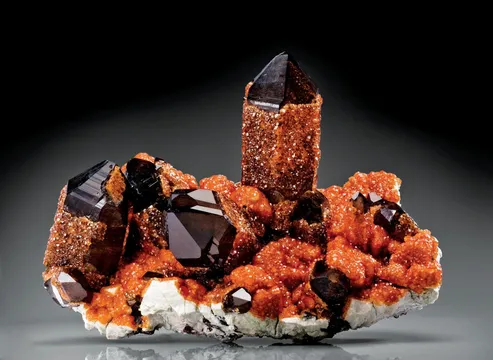
The Zhongjia Mine is the cleanest geological match for the quartz-fluorite-calcite-polymetallic theme. It is described as a tin-polymetallic deposit related to a quartz porphyry intrusion, with veinlet-disseminated Sn-W mineralization in the inner contact zone and vein-type polymetallic ore bodies in the outer contact zone. Skarns are also recorded in the area, and the mine has been worked for tin and iron. Zircon dating of the quartz porphyry gave an age of 98.5 ± 1.7 Ma, placing it in late Early Cretaceous Yanshanian magmatism and linking it to the marginal part of the South China W-Sn-polymetallic province. Its mineral list is a very useful warning to collectors that the pretty calcite-quartz-fluorite pieces are only the aesthetic edge of a much more complex ore system: cassiterite, wolframite-group minerals, topaz, bismuthinite, stannite, chalcopyrite, sphalerite, galena, pyrite, pyrrhotite, magnetite, hematite, diopside, and andradite are all part of the documented assemblage.
The Liancheng side of Longyan is especially important for the calcite material that has circulated as “sandwich calcite.” Dealer records identify the Zhudi lead-zinc mine, Zhudi Village, Miaoqian Town, Liancheng County, as the source of flattened prismatic calcite crystals with hexagonal outlines and striking internal zoning. These sit on dark grey limestone and fluoresce richly orange under long-wave UV. The same county also hosts the Liancheng manganese deposits, with recorded calcite, rhodochrosite, alabandite, hausmannite, braunite, pyrolusite, nsutite, coronadite, cryptomelane, chalcophanite, quartz, opal, galena, sphalerite, pyrite, chalcopyrite, and pyrargyrite. That manganese-lead-zinc association explains why Longyan labels can describe very different-looking specimens even when they are all geographically correct.
Makeng, near Longyan city, is a major skarn Fe-Mo-Pb-Zn system rather than the main source of modern cabinet calcite-fluorite aesthetics. It is nevertheless crucial for understanding the district. Published studies describe it as a large to giant skarn-type magnetite deposit hosted mainly in Paleozoic carbonate sequences, with skarn minerals such as garnet and pyroxene and ore minerals dominated by magnetite with molybdenite and subordinate sulfides. The Makeng literature also illustrates the broader southwestern Fujian pattern: carbonate units, intrusive rocks, skarn alteration, and long-lived magmatism combining to produce large ore systems.
The Zijinshan ore field in Shanghang County is the economic heavyweight of Longyan mineralogy. It is a porphyry-epithermal Cu-Au-Mo-Ag system in a small fault-bounded volcanic basin, with a high-sulfidation epithermal Au-Cu deposit at Zijinshan, porphyry Cu-Mo mineralization at Luoboling, low-sulfidation Ag-polymetallic mineralization at Yueyang, and related transitional copper deposits. Zijinshan itself is developed around a dacite porphyry pipe and volcanic dome complex, with pervasive silicification, sericite and clay alteration, hydrothermal breccias, and fissure-controlled veins. Its collector minerals are not typically the clean calcite-fluorite showpieces of the Longyan market, but it supplies the district’s suite of interesting ore-mineral names: digenite, covellite, bornite, enargite, anilite, djurleite, geerite, yarrowite, spionkopite, zunyite, alunite, pyrophyllite, native gold, electrum, and copper-silver-bismuth-tin sulfosalts.
Mining access for collectors should be regarded as commercial and indirect. Zhongjia is listed as an iron mine that has been mothballed, Makeng and Zijinshan are industrial operations, and the Liancheng lead-zinc and manganese districts are working or historically worked mining areas rather than open collecting localities. The specimens seen by collectors have entered the market through mine production, local pickers, and Chinese dealer channels; casual field collecting access should not be assumed. For high-value pieces, the best locality information is not simply “Longyan,” but a chain of ownership that explains whether the specimen is from Zhongjia, Zhudi/Liancheng, a “Longyan Mine” commercial find, or a broader Fujian source marketed under an imprecise regional name.
Calcite is the species that put modern Longyan specimens in front of collectors: the district has produced elongated scalenohedra with pinacoidal terminations on white quartz and pale green fluorite, complex transparent to translucent calcite groups with visible inclusions and crystals to about 5 cm on cabinet pieces, flattened hexagonal-tabular “sandwich” calcites from the Zhudi lead-zinc mine area with translucent or pale pink centers between milky white outer zones on dark limestone, and later canary-yellow rhombohedral groups sold as Longyan Mine material. Good Longyan calcite is judged by crisp geometry, undamaged exposed edges, strong luster, attractive spacing on contrasting dark or quartz-rich matrix, visible internal zoning rather than chalky opacity, and fluorescence: the best sandwich material gives a saturated orange long-wave response, while some yellow rhombic pieces show different long-wave and short-wave reactions and even short-wave phosphorescence.
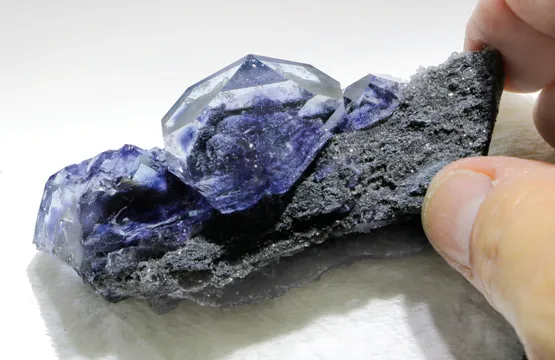
Quartz from Longyan is usually a supporting actor rather than the headline species, but it is often what makes the calcite and fluorite specimens work visually: 2017 calcite-fluorite pieces were described with elongated calcite crystals standing on a white quartz matrix, a large photographed Longyan specimen measured 24 x 19 x 14 cm and carried small grey quartz tips beneath dark blue-violet fluorite cubes and flat calcite rhombs, and a later dealer specimen from the Longyan-Sanming junction area had a bright snow-like crust of sparkling druzy quartz across the matrix with a central ball of green fluorite cubes and late calcite. Better quartz-bearing pieces show clean drusy sparkle, sharp miniature points rather than sugary bruised crust, and a strong compositional role—framing yellow or white calcite, highlighting green or blue fluorite, or forming a small stalactitic quartz feature among larger calcite rhombohedra.
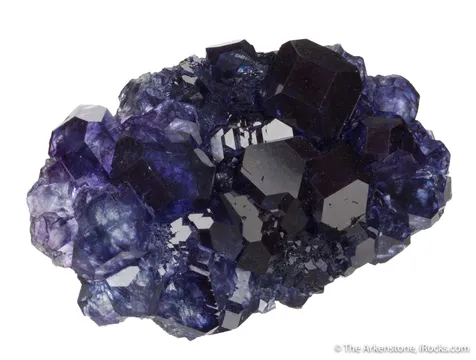
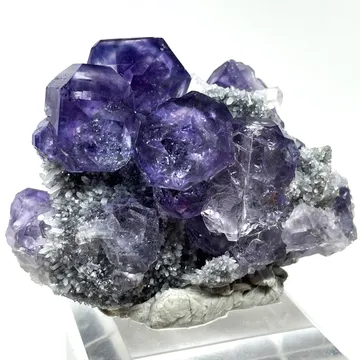
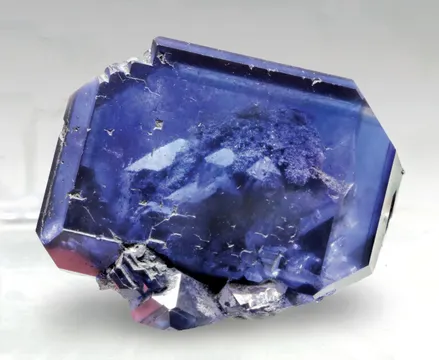
Fluorite from Longyan appears in several distinct modern guises: clear green fluorite associated with elongated calcite on white quartz, dark blue-violet cubes scattered over grey quartz tips, polycrystalline green spherical aggregates made of intergrown cubes, and small-cabinet floaters with complex octahedron-cube-dodecahedron forms showing bluish-purple and greenish colors. The best specimens have enough transparency to show zoning or internal color concentration, a balanced contrast with white quartz or pale calcite, and intact corners on the exposed fluorite crystals; ordinary examples tend to be opaque, chipped, visually crowded, or sold with a loose “Fujian” or “Longyan” label that does not clarify whether the piece is from Longyan proper, Liancheng, Zhongjia, or a nearby Fujian fluorite occurrence.
Longyan is more a district of ore-field diversity than a type-locality showcase for display minerals. Beyond calcite, quartz, and fluorite, verified Longyan records include the Zhongjia tin-polymetallic and skarn assemblage of cassiterite, wolframite-group minerals, topaz, malayaite, bismuthinite, stannite, magnetite, hematite, and andradite; the Liancheng manganese and lead-zinc suite with rhodochrosite, hausmannite, braunite, alabandite, pyrolusite, nsutite, coronadite, cryptomelane, chalcophanite, sphalerite, galena, and pyrargyrite; and the Zijinshan ore-field suite with native gold, electrum, digenite, covellite, bornite, enargite, anilite, djurleite, geerite, yarrowite, zunyite, alunite, pyrophyllite, and numerous copper-silver-bismuth-tin sulfosalts. Most of those are research or ore-mineral species rather than common cabinet specimens, but they give the Longyan label its real geological depth.
The main collector problem with Longyan is not a known wave of artificial fakes, but locality precision. “Longyan,” “Longyan Mine,” “Longyan Prefecture,” “Zhudi lead-zinc mine,” “Liancheng,” “Zhongjia,” and sometimes even broader “Fujian” labels are not interchangeable. The problem is made worse by the speed with which Chinese finds reach the market: one well-known 2017 calcite-quartz-fluorite occurrence was offered with a supplied mine name that the dealer explicitly did not regard as verified, so the safer label remained Longyan Prefecture, Fujian Province. For serious cataloguing, keep the exact wording of the original label and avoid “upgrading” a generic Longyan specimen to a named mine unless the specimen has reliable supporting provenance.
Condition matters greatly. The white sandwich calcites have broad exposed tabular edges that can bruise, and a small chip on a clean white edge is immediately visible. Yellow rhombohedral calcites and elongated scalenohedra should be inspected for etched-looking contact points, broken tips, and repaired matrix contacts. Fluorite from the district is commonly modified, intergrown, or polycrystalline; distinguish natural stepped growth and etched regrowth from impact damage. On specimens where fluorite forms a ball of intergrown cubes or sits as a floater, check the underside and the high points for bruised cube corners.
UV response is a legitimate part of Longyan calcite’s appeal. Sandwich calcite from Zhudi/Liancheng is noted for strong orange long-wave fluorescence, while some Longyan Mine yellow calcite has been reported as reacting differently under long-wave and short-wave UV and as phosphorescent under short-wave UV. Do not assume every Longyan calcite behaves the same way: ask which wavelength was used, whether the photograph was under 365 nm long-wave, 254 nm short-wave, or another LED band, and whether the color shown is fluorescence, phosphorescence, or camera overexposure. Calcite should also be kept away from acids and cleaned gently; iron-stained matrix and dark limestone can hide fragile microcrystalline quartz and small accessory crystals.
Market availability is moderate but episodic. Fine sandwich calcites appeared as a new discovery around 2022 and are still encountered, though the best matrix plates and undamaged tabular groups move quickly. Yellow Longyan Mine calcites and quartz-calcite combinations have appeared on the market more recently, usually as miniatures to cabinet specimens. Fluorite-calcite-quartz pieces are less common in high grade, especially with transparent color-zoned fluorite and clean contrast. Prices vary widely with size, sharpness, fluorescence, and how convincing the provenance is; a clean, documented, aesthetic Longyan specimen is worth more than a larger but vaguely labeled Fujian piece.
At Tucson 2018, a little burst of Longyan material appeared with exactly the kind of uncertainty that makes modern Chinese mineral collecting both exciting and difficult. The specimens were not generic calcites: they carried strongly elongated scalenohedral crystals, pinacoidal terminations, fine oriented growth striations, inclusions near the base, white quartz matrix, and clear green fluorite. The dealer had been given a mine name—rendered as Khen Zhi Kou—but chose not to make that the official locality because it had not been checked. That decision is worth remembering. It left the specimens with a broad but honest label: Longyan Prefecture, Fujian Province. In a market where a confident but wrong mine name can follow a specimen for decades, that restraint is part of the story.
The next memorable Longyan moment came with the “sandwich calcites.” In 2022, a Spanish dealer update and the Mineralogical Record’s online report drew attention to cabinet-size calcites from a new Longyan discovery. They were sharp and clean-looking, either as loose groups or well-spaced crystals on dark matrix. What made them distinctive was the internal layering: pale pink centers caught between snow-white outer zones in flattened hexagonal-tabular crystals. Under long-wave ultraviolet light they glowed orange. At roughly the same time, dealer pages tied matching material to the Zhudi lead-zinc mine at Zhudi Village in Liancheng County, and individual specimens were recorded from about 3.5 cm to more than 11 cm across. This was not a giant pocket by Chinese standards, but it was enough to create a recognizable locality style almost overnight.
Longyan’s third modern face is the more sculptural calcite-quartz-fluorite association. One documented Mindat specimen is a very large 24 x 19 x 14 cm plate weighing 3.2 kg: dark grey siliceous matrix lined with small grey quartz tips, dark blue-violet fluorite cubes, and flat rhombohedral calcite. Another market specimen from the Longyan-Sanming junction area was described as a 15 x 11 x 7 cm, 770 g combination with a sparkling snow-like drusy quartz coating, a central ball of green fluorite cubes, pagoda-style calcite, and yellow blades of a zeolite mineral. These are the pieces that make Longyan attractive beyond species collecting: they have architecture, contrast, and enough mineralogical complexity to reward a long look.