Fujian, China - a collector-focused locality known for fluorite cubes on quartz (blue-violet), Nanping rare-metal pegmatites, and related minerals.
Key facts
Fujian is best read by collectors not as a single mine district but as a compact province where several very different specimen worlds overlap: late-Mesozoic hydrothermal fluorite veins and carbonate-hosted pockets, rare-metal LCT pegmatites at Nanping, miarolitic granite cavities around Tongbei, and the altered volcanic rocks that produced Shoushan carving stone. The province sits in southeastern China’s Cathaysia Block, a belt repeatedly affected by granitic magmatism, volcanism, faulting, and hydrothermal circulation. That geologic restlessness is exactly why Fujian labels can mean such different things on the market: tanzanite-blue to violet fluorite on white quartz from the Yongchun–Dehua area, smoky quartz and orange spessartine from Tongbei, Cs- and Be-rich phosphate rarities from Nanping, or waxy clay-mineral ornamental stone from Shoushan near Fuzhou.
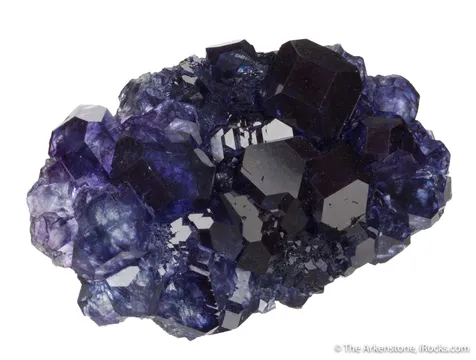
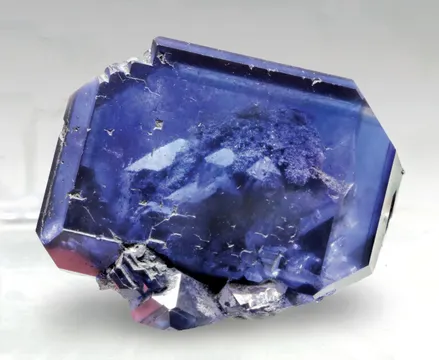
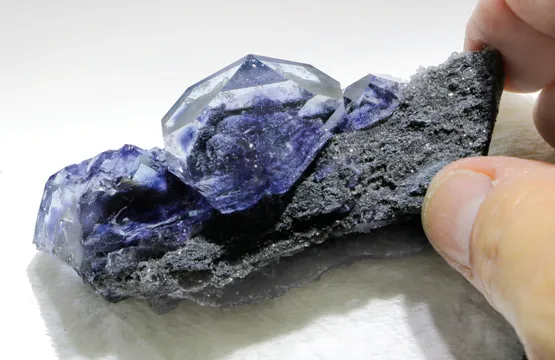
For specimen collectors today, the best-known Fujian pieces are fluorites: modified cubes and cubo-octahedral forms, many with stepped, etched, beveled, or “sugared” surfaces, in colors ranging from pale mint and sea-green to deep violet-blue. Good examples are most attractive when the fluorite is perched cleanly on a white quartz druse or cream calcite matrix, with enough transparency to show phantom zoning or blue-violet cores. The best Fujian fluorite specimens have the glossy architectural quality of a Chinese modern classic, but the locality data deserve care: material long sold as “Xia Yang” or “Xiayang” has been refined in recent collector databases, and some famous tanzanite-colored pieces are now tied to nearby Dehua County limestone workings rather than the Xia Yang Mine itself.
Regional View
Country View
Fujian’s deeper historical importance is mineralogical rather than merely decorative. Nanping No. 31 pegmatite, in the Nanping pegmatite field, is one of China’s important rare-metal pegmatites and the type locality of nanpingite, strontiohurlbutite, and minjiangite. Those species are not cabinet showpieces in the way Xia Yang fluorite is; they are mostly microscopic to millimetric scientific minerals. But they make Fujian a serious reference province for collectors who care about type-locality material, pegmatite evolution, and late-stage Be-Sr-Ba-Cs phosphate chemistry.

Photo: Wikimedia Commons
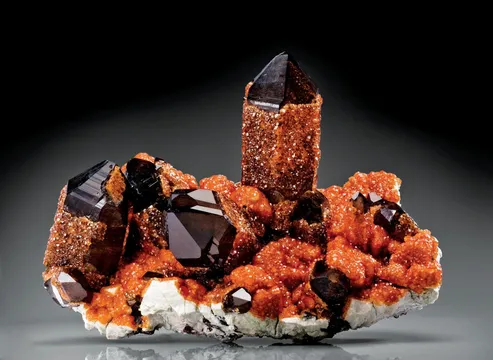
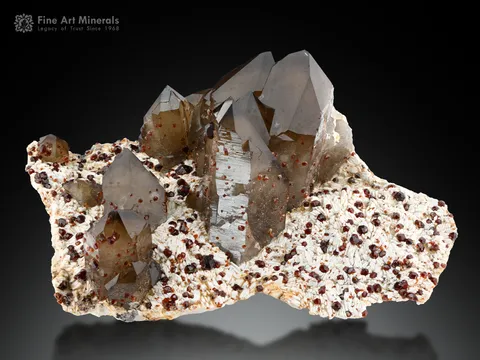
The Wushan/Tongbei spessartines add another layer to the province’s appeal. These are miarolitic-granite specimens: orange to reddish-orange spessartine crystals, commonly small but brilliant, scattered across smoky quartz and pale feldspar. Rare fluorite associations from the same field show pale green to nearly colorless fluorite sharing the feldspar matrix with garnet. For a cabinet collector, Fujian can therefore mean either the crisp blue-violet geometry of modern fluorite or the fiery orange sparkle of a pegmatite pocket specimen—and both are genuinely part of the province’s collector identity.
Search for specimens: View all specimens from Fujian, China
The collector material sold simply as “Fujian fluorite” is dominated by the Quanzhou-area fluorite occurrences around Yongchun County and nearby Dehua County. The Xia Yang Mine at Xia Yang, Yongchun County, is an active mine locality in modern mineral databases, and it is documented for fluorite, quartz, and calcite. Nearby Haixia Limestone Mine at Meihu Town, Dehua County, is also documented for fluorite and has become important in sorting out labels for the vivid blue-violet “tanzanite fluorite” material. The two localities are close enough that vague “Fujian,” “Xiayang,” “Yongchun,” and “Dehua” labels can be difficult to audit without a dealer’s original mine information.
The fluorite deposits belong to the broader fluorite metallogenic pattern of southeastern China, where low- to medium-temperature hydrothermal fluids moved through faulted volcanic, granitic, and carbonate terranes. Studies of Fujian fluorite deposits such as Nanzhou show structurally controlled fluorite mineralization in the Wuyi fluorite belt, with ore-forming fluids of the NaCl-H2O system, low salinity, and homogenization temperatures commonly in the 140–200 °C range. That setting is consistent with the collector specimens: fluorite deposited in open spaces and fractures, commonly with quartz, calcite, and locally pyrite, rather than in massive high-temperature skarn pockets.
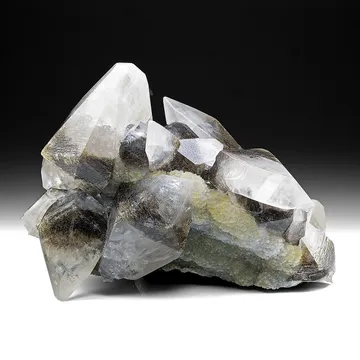
The Xia Yang–Dehua collector suite is visually recognizable. Fluorite occurs as modified cubes, beveled cubes, octahedral or cubo-octahedral crystals, stepped forms, and etched or frosted crystals. Quartz commonly appears as a white to clear drusy crust, a “sugar” coating, or small prismatic crystals on which fluorite is set. Calcite may be white, cream, honey, or colorless, occurring as blocky, rhombohedral, flattened, or scalenohedral crystals. Some pieces are complete thumbnail to miniature groups; others are cabinet plates with fluorite crystals scattered over a quartz bed. The best examples are cleanly crystallized, undamaged, and three-dimensional, with the fluorite standing proud of the matrix rather than buried in quartz or calcite.
Mining history is much clearer for the rare-metal pegmatites of Nanping than for the specimen fluorite pockets. The Nanping rare-metal pegmatite deposit was identified during regional geological mapping in the 1960s and later became known as a large LCT-type Nb-Ta-Li-Sn-Be pegmatite system. The No. 31 pegmatite is a highly evolved, internally zoned dike with quartz-albite-muscovite outer zones, saccharoidal albite, spodumene-bearing zones, montebrasite-rich zones, and a blocky quartz-K-feldspar core. It has been mined for Nb-Ta, and published sources record Ninning Tantalum-Niobium Mining Co. as a joint venture connected with Nanping tantalum-niobium development in the late 1990s, with underground production reported from 2000.
Nanping is not a casual specimen-collecting locality in the sense of open-pocket collecting. Its importance lies in scientifically documented mineralogy: columbite-group minerals, cassiterite, beryl, spodumene, montebrasite, hurlbutite, hydroxylherderite, strontiohurlbutite, minjiangite, nanpingite, and numerous phosphates and alteration products that record the late magmatic and hydrothermal evolution of an LCT pegmatite. For specialist collectors, a good Fujian label may therefore mean a microprobe-confirmed species in a rare-metal pegmatite assemblage rather than a display specimen.
The Tongbei–Wushan district in Yunxiao County, Zhangzhou, is a separate collector province within Fujian. There, miarolitic cavities in late Cretaceous aluminous A-type granite produced orange spessartine, smoky quartz, microcline or other feldspar, muscovite, helvine-group minerals, topaz, and rare fluorite. Specimen production entered the international market around the late 1990s and early 2000s, initially under confused locality names before the Tongbei/Yunxiao source was widely recognized. The best pieces show smoky quartz crystals generously sprinkled with orange spessartine on a pale feldspar base, and rare fluorite-bearing pieces are prized because fluorite is not the normal centerpiece of that locality.
Current collecting access should be assumed restricted. These are active or former mines, quarries, industrial deposits, and privately or state-controlled workings, not public fee-collecting sites. Serious collectors should buy through reputable dealers, preserve any older labels, and record whether a specimen is from Xia Yang Mine, Haixia Limestone Mine, Yongchun, Dehua, Tongbei, Wushan, Nanping, or simply Fujian Province. In this province, the difference between a precise and a vague label can be the difference between a reference specimen and an attractive but unresolved Chinese fluorite.
Fujian fluorite is best known from the Quanzhou-area Xia Yang–Yongchun and nearby Dehua occurrences, where modern specimens show modified cubic to cubo-octahedral crystals, beveled edges, stepped or etched faces, and colors ranging from pale green and blue-gray to saturated violet-blue “tanzanite” tones. Most collector pieces are thumbnails to small-cabinet specimens, with individual crystals commonly in the centimeter range and cabinet plates reaching roughly 10–13 cm in better dealer examples. Associations are central to value: white quartz druse gives the fluorite its classic sugary contrast, while cream to white calcite and occasional pyrite add relief. The finest pieces are clean, dimensional, transparent enough to show color zoning or phantom structure, and accurately labelled; ordinary pieces tend to be flatter plates, heavily quartz-coated crystals, pale color, or obvious bruising along edges and cleavages.
Quartz in Fujian has two quite different collector expressions: the drusy white to clear quartz that accompanies Xia Yang–Dehua fluorite and calcite, and the smoky quartz of the Wushan/Tongbei miarolitic granite pockets. In the fluorite suite, quartz forms sparkling “sugar” crusts, small clear points, or white matrix plates that frame green, blue, or violet fluorite; the best pieces use quartz as a clean reflective stage rather than as a smothering overgrowth. At Wushan, smoky quartz crystals are documented to reach much larger sizes, with classic specimens showing brown to black prisms carrying orange spessartine on pale feldspar. Fujian quartz specimens are strongest when the quartz is undamaged, lustrous, well-terminated, and compositionally integrated with the associated fluorite, calcite, spessartine, or feldspar rather than being merely a generic quartz cluster with a province label.
Calcite from Fujian’s modern fluorite occurrences is primarily an association mineral, but a good one can make the piece. At Xia Yang–Yongchun and related Quanzhou-area material, calcite occurs as white, cream, honey, or colorless crystals on fluorite- and quartz-bearing matrix, including blocky, rhombohedral, flattened, columnar, and locally “pagoda” or triangular habits in the dealer trade. Rosell Minerals documented Xia Yang fluorite-quartz-calcite material as fluorescent under short-wave UV, so calcite-bearing specimens are worth checking under ultraviolet light, though fluorescence should not be assumed for every piece. Top-quality calcite specimens from Fujian have clean, unworn terminations, balanced placement against blue-violet or green fluorite, and enough transparency or luster to avoid the chalky look that makes ordinary examples feel like matrix rather than display-grade calcite.
Beyond the three common EarthWonders species, Fujian is unusually rich in species of scientific and historical interest. Nanping No. 31 pegmatite is the type locality of nanpingite, a Cs-dominant mica; strontiohurlbutite, SrBe2(PO4)2; and minjiangite, BaBe2(PO4)2. Chiluite, a Bi-Te-Mo oxide, is a Fujian type-locality mineral from the Chilu molybdenum deposit in Fu’an County, Ningde. The Wushan/Tongbei field is famous for spessartine with smoky quartz and feldspar, with rarer helvine-group minerals, topaz, muscovite, fluorite, and pyrite. Shoushan stone near Fuzhou is not a single mineral species but a carving-stone material composed chiefly of clay and related alteration minerals such as dickite, nacrite, kaolinite, pyrophyllite, and illite, depending on variety.
The main collecting risk with Fujian is locality precision, not usually artificial enhancement. Many fine fluorites entered the market under broad labels such as “Fujian,” “Xiayang,” “Xia Yang Mine,” or “Yongchun.” Modern locality work has complicated that picture: the famous tanzanite-blue fluorite material has been questioned for Xia Yang Mine specifically, with nearby Haixia Limestone Mine in Meihu Town, Dehua County, cited as the source for at least part of that suite. A specimen labelled only “Fujian” can still be beautiful, but a collector paying for reference value should want the most exact locality history available, ideally preserved from the original Chinese source or early dealer.
Condition is the second major issue. Fujian fluorite cleaves readily, and the stepped or beveled forms that make the crystals attractive also create many exposed edges. Under strong light, check every corner for bruising, white cleave marks, and impact scars masked by quartz druse. The frosted or etched surfaces common on some pieces can be natural, but they can also make minor abrasion harder to read from photographs. Backlighting is useful for judging transparency, phantom zoning, and internal cracks.
Quartz-coated fluorite deserves special scrutiny. The white “sugar” coating is part of the locality’s charm, but heavy quartz overgrowths can conceal contacts, repairs, bruises, and broken fluorite faces. Conversely, a thin drusy coating on an intact crystal can be highly desirable if it leaves the form legible. For calcite-bearing pieces, avoid acid cleaning and keep specimens away from vinegar or other household acids; calcite will react, and fluorite may also suffer from harsh chemical treatment or thermal shock. Ultrasonic cleaning is risky for cleavable fluorite and delicate calcite-on-quartz associations.
Fluorescence is a bonus, not a guarantee. Some Xia Yang fluorite-quartz-calcite specimens have been documented as fluorescent under short-wave UV, and calcite can respond strongly depending on impurities. If fluorescence is important to you, ask for photographs under both long-wave and short-wave UV rather than relying on locality reputation.
Market availability is good for attractive Fujian fluorite, especially small plates and miniatures, but top examples with saturated blue-violet color, clean form, sharp zoning, fine quartz contrast, and precise locality data are much scarcer. Wushan/Tongbei spessartine is a modern classic and remains obtainable, though the best early pieces with dramatic smoky quartz and dense orange garnet coverage are increasingly collection-held. Nanping type-locality minerals are specialist material: they require analysis, are often microscopic, and should be bought only with credible provenance or analytical support.