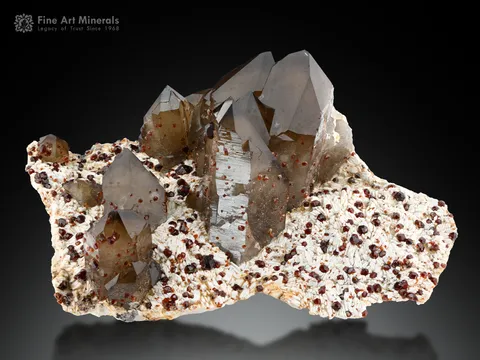
Quanzhou, China locality guide: blue-violet fluorite on quartz from Yongchun and Dehua, with saturated violet-blue crystals, glassy faces, and clear labeling n…
Key facts
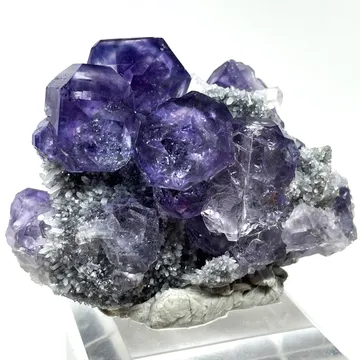
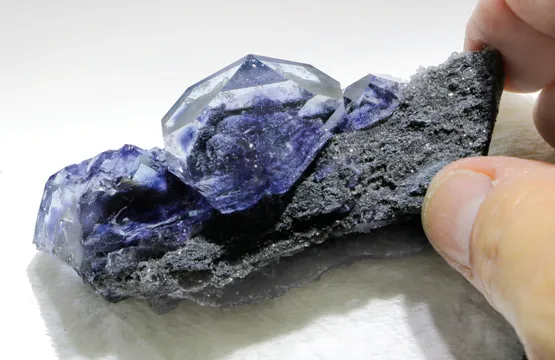
For collectors, “Quanzhou, China” is best understood not as a single classic mine in the old European sense, but as a prefecture-level collector locality in Fujian Province whose best-known specimens are the now-familiar blue-violet to purple fluorites on quartz from the inland counties of Yongchun and Dehua. The mineralogical story is tied to carbonate-hosted and hydrothermal systems on the southeastern China margin: limestone workings exploited for cement raw material, low-temperature fluorite–quartz–calcite pockets, and the broader Dehua–Youxi–Yongtai metallogenic district, where Mesozoic volcanic, subvolcanic, skarn, and epithermal systems also account for documented gold, iron, copper, zinc, and silver minerals. The pieces that made the name internationally recognizable are transparent fluorite crystals, commonly cuboctahedral to dodecahedral in aspect, perched on sparkling white or smoky drusy quartz and locally accompanied by calcite and pyrite. At their best, they have a saturated “tanzanite” violet-blue body color, glassy windows, stepped or etched faces, internal color zoning, and a sculptural contrast between jewel-like fluorite and a glittering quartz carpet.
Regional View
Country View
The locality has also become a case study in modern Chinese specimen labeling. Much material entered the trade under Xia Yang Mine or Yongchun County labels, but later locality information indicates that at least part of the famous blue-violet fluorite suite may instead have come from the Haixia Limestone Mine at Meihu Town in Dehua County, still within Quanzhou Prefecture. For the serious collector, this makes the broad Quanzhou label both useful and honest when mine-level documentation is uncertain. A specimen with a precise, reliable old dealer label deserves preservation, but the physical character of the material—fluorite on quartz from a limestone-mining district in inland Fujian—matters as much as the exact wording on a market tag.

Photo: Fabre Minerals
Search for specimens: View all specimens from Quanzhou, China
Quanzhou lies in southern Fujian on the southeastern China margin, but the collector minerals in question come from the mountainous inland part of the prefecture rather than the coastal port city. The two names most often encountered on labels are Xia Yang Mine, Xia Yang city, Yongchun County, and Haixia Limestone Mine, Meihu Town, Dehua County. Both belong to Quanzhou Prefecture, and both sit within a region where carbonate rocks, Mesozoic magmatism, faulting, and hydrothermal circulation have produced a mixed record of industrial limestone, fluorite-bearing pockets, epithermal gold deposits, and iron skarns.
The Xia Yang Mine is recorded as an active mine, with lime/cement listed as its exploited commodity and calcite, fluorite, and quartz documented as the confirmed collector minerals. The collector assemblage is simple but visually powerful: fluorite on drusy quartz, with calcite locally present and pyrite recorded in photo-based associations from the broader Yongchun fluorite suite. The crystals grew in open spaces where fluorine-bearing fluids deposited CaF2 after, with, or over silica-rich coatings. The quartz is not merely a neutral matrix; it is part of the character of the specimens, forming bright carpets of small prismatic crystals or darker “sugar” druse beneath the fluorite. Calcite appears as prismatic, columnar, dogtooth, or clear lustrous crystals on some pieces, and it can provide both aesthetic contrast and a useful paragenetic clue.
The Haixia Limestone Mine at Meihu Town, Dehua County, is especially important because later locality notes identify it as a likely source for famous “tanzanite fluorite” specimens that had often been marketed under Xia Yang/Yongchun labels. The mine is described as an underground limestone operation connected with the Haixia cement company. That setting fits the specimen style: fluorite crystals in carbonate-hosted cavities, commonly associated with quartz and calcite rather than with the sulfide-heavy assemblages of polymetallic vein districts. For collectors, this means that “Quanzhou, Fujian” can be a more defensible locality designation than a highly specific mine attribution unless the specimen carries solid provenance.
The wider prefecture is mineralogically more diverse than the specimen market suggests. In Dehua County, the Dongyang gold deposit is a low-sulfidation epithermal system hosted largely by Late Jurassic rhyolite porphyry and volcanic rocks of the Nanyuan Formation, with mineralization controlled by intersecting NE–SW and NW–SE faults. Its ore and gangue assemblage includes gold, electrum, silver minerals, pyrite, marcasite, arsenopyrite, sphalerite, chalcopyrite, quartz, sericite, illite, chalcedony, and calcite. The Yangshan Fe deposit, also in Dehua County, belongs to the Makeng–Yangshan iron skarn belt and records a very different mineralizing environment, with magnetite and skarn silicates such as garnet, hedenbergite, ilvaite, vesuvianite, and wollastonite documented from the district. These deposits are not the source of the familiar collector fluorite plates, but they explain why Quanzhou’s mineral list extends far beyond fluorite and quartz.
Specimen production appears to be a modern phenomenon in the international market. The recognizable blue-violet fluorite suite became prominent during the late 2010s and early 2020s, with fine cabinet specimens appearing through specialist dealers and auctions. The mining itself is industrial rather than specimen-driven: limestone, cement raw materials, and regional mineral exploration dominate local official records. Collecting access should therefore be assumed to be closed unless arranged through the mine or rights holder. These are active or formerly active industrial workings, not public collecting grounds, and underground limestone operations carry obvious hazards from voids, blasting, unstable ground, dust, and restricted commercial activity.
The best finds were pocket material: fluorite crystals isolated or grouped on quartz druse, occasionally in plates large enough for cabinet display and small enough to preserve bright luster and transparency. Auctioned examples include thumbnail crystals a few centimeters across, small-cabinet and cabinet plates around 8–16 cm, and larger pieces exceeding 20 cm where the matrix retained multiple intergrown fluorite crystals. The most desirable examples show intact fluorite sitting proud of the quartz, saturated violet-blue or deep purple color, sharp modification of the cube by dodecahedral and other faces, and enough transparency that backlighting reveals zoning or a glowing interior.
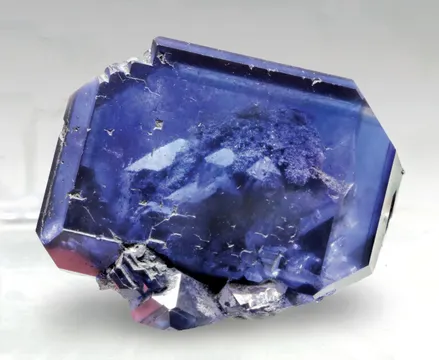
Quanzhou fluorite is prized for transparent to translucent crystals in violet, purple, blue-purple, teal-green, and locally green tones, most famously the saturated blue-violet material sold as “tanzanite fluorite.” The signature habit is modified cubic fluorite whose faces may produce cuboctahedral, dodecahedral, stepped, beveled, etched, or macromosaic surfaces; fine specimens often have clear glassy windows alternating with frosted or textured faces. Crystals commonly range from thumbnail-scale individuals to 1–3 cm crystals on cabinet plates, with larger plates displaying dozens of crystals on white, smoky, or sparkling drusy quartz. Calcite, pyrite, and additional quartz are the principal collector associations. Good Quanzhou pieces separate themselves from ordinary ones by color saturation, backlit transparency, undamaged crystal edges, aesthetic elevation above the quartz matrix, and a convincing old label or provenance that honestly handles the Xia Yang/Yongchun versus Haixia/Dehua attribution issue.
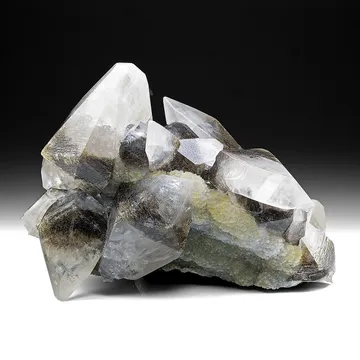
Quartz from the Quanzhou fluorite suite is usually a matrix mineral rather than the headline species, but it is central to the look of the locality. It forms fine drusy carpets, small prismatic crystals, needle-like sprays, and smoky to milky crystalline coatings that set off the fluorite color. The most attractive pieces use quartz as a visual stage: bright white druse makes the violet fluorite appear colder and more gemmy, while darker smoky or gray “sugar” quartz gives blue-green and purple crystals a stronger contrast. Quartz-only specimens are less of a market identity here than fluorite-on-quartz combinations, but quartz quality strongly affects value; clean, sparkling, undamaged druse around the fluorite is far preferable to dull, bruised, clay-coated, or sawn matrix.
Beyond the fluorite–quartz suite, Quanzhou Prefecture has a substantial documented mineral list from its gold, iron, copper, zinc, and industrial-mineral districts. Calcite is the most important associated collector mineral at the fluorite localities, while Dehua County’s ore deposits add native gold and electrum, pyrite, marcasite, arsenopyrite, sphalerite, chalcopyrite, galena, allargentum, dyscrasite, polybasite, stephanite, chlorargyrite, tellurobismuthite, tetradymite, and other ore minerals. The Yangshan iron skarn contributes magnetite, garnet-group minerals, hedenbergite, ilvaite, vesuvianite, wollastonite, molybdenite, and related skarn species. No valid type-locality mineral is documented for the Quanzhou prefecture entry in the sources used here; the locality’s collector significance rests instead on the modern fluorite production and on the broader scientific record of Fujian epithermal and skarn mineralization.
The chief authenticity issue for Quanzhou specimens is not widespread fakery but locality precision. Many blue-violet fluorites entered the market as Xia Yang Mine or Yongchun County material, while later locality notes point to the Haixia Limestone Mine in Dehua County for at least part of the famous “tanzanite fluorite” suite. Since both localities are in Quanzhou Prefecture, a broad “Quanzhou, Fujian, China” label is often safer than forcing a mine name. Be cautious with labels that use only marketing names such as “tanzanite fluorite,” “blueberry fluorite,” or “Fujian fluorite” without county or mine information; these names describe appearance, not provenance.
No well-documented treatment or artificial-coloring problem specific to Quanzhou fluorite is established in the reliable locality sources, but ordinary specimen-market cautions apply. Examine large plates for repaired fluorite crystals, glued contacts, concealed sawn bases, and matrix reconstruction. Trimming is common and not inherently deceptive when disclosed; some auctioned pieces were clearly prepared to sit well for display. The more serious concern is mislabelling among visually similar modern Chinese fluorites from different provinces and mines. A specimen with old dealer paperwork, auction history, or collection provenance is worth more than a visually similar piece carrying only a vague “China” tag.
Condition matters sharply because fluorite cleaves perfectly and the stepped crystal edges that make Quanzhou specimens desirable are also the first places to show bruising. Look for chips along beveled edges, contact marks on exposed crystal corners, broken quartz druse, and cleaved rear or underside areas. On matrix pieces, a little backside damage may be acceptable if the display face is pristine, but damage on the main fluorite edge quickly lowers desirability. Quartz druse can hide small repairs and can also shed tiny needles during handling, so avoid aggressive cleaning. Calcite associations should be kept away from acids, and any calcite-bearing specimen should be cleaned only with methods safe for carbonate minerals.
Fluorescence is not the main reason to buy Quanzhou fluorite, but associated calcite can be visually interesting. At least one documented fluorite–quartz–calcite specimen from the locality showed calcite fluorescence described as orange under shortwave ultraviolet and hot pink under longwave ultraviolet. Individual response may vary, so fluorescence should be considered a bonus rather than a guaranteed diagnostic property. Store specimens away from prolonged direct sunlight, not because Quanzhou fluorite is uniquely unstable, but because strong color, transparency, and contrast are the value drivers and are best preserved under conservative display conditions.
Market availability remains good compared with older classic fluorite localities, but truly fine Quanzhou specimens are selective. Small specimens and moderately attractive plates appear regularly through dealers and online marketplaces. Top pieces—transparent, saturated violet-blue crystals on clean quartz with minimal damage—have sold in the low four figures at auction, while lesser plates and thumbnails can be far more accessible. The best buying strategy is to compare many examples before committing: ordinary pieces can look similar at first glance, but the exceptional ones have a combination of geometry, luster, color zoning, and quartz presentation that is immediately apparent in hand.
The most revealing story from Quanzhou is a story about a label. For years, collectors learned to recognize a modern Fujian fluorite: blue-violet crystals, often dramatically modified, sitting on glittering quartz. “Xia Yang Mine” became the name attached to the look. Dealers used it, auctions used it, and collectors repeated it. Then the locality story became less tidy. A later note from a Chinese geologist stated that the famous tanzanite-blue fluorites were not from Xia Yang after all, but from the Haixia Limestone Mine at Meihu Town in Dehua County. The same note described an underground limestone mine run by the Haixia cement company and added the striking observation that the mountain beneath had been nearly emptied. For a collector, that turns an attractive specimen into a document of a working industrial landscape: not a romantic hand-dug pocket in isolation, but fluorite crystals rescued from the hidden voids of a cement-stone operation in inland Fujian.
That label problem is not just pedantry. It captures the speed and opacity of the modern Chinese mineral trade. A crystal habit appears, the market gives it a nickname, and within months or years the nickname starts doing the work that locality data should do. “Tanzanite fluorite” is memorable because the best crystals really do show a blue-violet glow that recalls gem tanzanite when backlit. But as the term spread, it began to detach from the precise occurrence. Collectors started seeing the name applied to paler, greener, or less characteristic material, while equally plausible Fujian pieces circulated with only broad province-level labels. The result is a modern classic with a modern problem: the specimens are distinctive, but the mine names require caution.
The locality’s rise can be traced in the way collectors talked about it. By 2020, fluorite-on-quartz specimens from the Xia Yang suite were already familiar enough that collectors online were identifying them from a handful of visual clues: blue centers, pale green rims, dodecahedral-looking crystals, and the alternation of smooth transparent windows with etched faces. By the mid-2020s the material was appearing in serious auction settings, with individual specimens described in increasingly precise crystallographic language—cuboctahedral crystals, dodecahedral modification, stepped growth, macromosaic texturing. A modern locality had moved quickly from internet curiosity to mainstream cabinet specimen.
There is also a quiet industrial story in the background. Yongchun County official records describe ongoing attention to strategic mineral exploration, including fluorite, and the same county reported abandoned-mine restoration planning in Xia Yang Town, with substantial ecological-repair work measured in thousands of mu. That is the landscape behind the specimens: active mines, abandoned workings, restoration campaigns, cement limestone, and small pockets that occasionally produce crystals delicate enough for display cases on the other side of the world.
Su-Ning Li, Pei Ni, Tan Bao, Chang-Ze Li, Hong-Liang Xiang, Guo-Guang Wang, Bao Huang, Zhe Chi, Bao-Zhang Dai, and Jun-Ying Ding, “Geology, fluid inclusion, and stable isotope systematics of the Dongyang epithermal gold deposit, Fujian Province, southeast China: Implications for ore genesis and mineral exploration,” Journal of Geochemical Exploration, 195, 16–30, 2018. This is the key modern paper for the Dongyang low-sulfidation epithermal gold deposit in the Dehua–Youxi–Yongtai mining camp. https://www.sciencedirect.com/science/article/pii/S037567421730482X
Wanyi Feng, Shuting Lei, Bo Xing, Jing Xu, and Haibo Yan, “Garnet Geochemistry of the Makeng-Yangshan Fe Skarn Belt, Southeast China: Implications for Contrasting Hydrothermal Systems and Metal Endowment,” Minerals, 15, 1325, 2025. This paper places the Yangshan Fe deposit in the Makeng–Yangshan iron skarn belt and is useful for Quanzhou’s skarn context. https://www.mdpi.com/2075-163X/15/12/1325
He Zhang, Yuanfeng Cai, Yang Zhang, Pei Ni, Suning Li, Junying Ding, Yuguan Pan, and Tan Bao, “Mineralogical characteristics of silver minerals from the Dongyang Gold deposit, China: implications for the evolution of epithermal metallogenesis,” abstract, 22nd IMA Meeting, Melbourne, 2018. This record is important for the silver-mineral assemblage documented from Dongyang. https://www.mindat.org/loc-156617.html
Yiming Zhao, Huijing Tan, and Jinghua Sun, “Geological characteristics and genesis of the Yangshan iron deposit in Dehua, Fujian,” Acta Petrologica et Mineralogica, 1(1), 11–22, 1982. This older Chinese study is repeatedly cited in locality records for Yangshan skarn minerals including hedenbergite, ilvaite, and molybdenite. https://www.mindat.org/loc-156617.html
Li Zongwen and Zheng Jiahao, “Mineralogy, fluid evolution, and ore-forming mechanism of the Early Cretaceous Yangshan iron skarn deposit in the Makeng-Yangshan region, SE China,” Journal of Asian Earth Sciences, 293, 106746, 2025. A recent Yangshan-specific skarn paper recorded in mineralogical references. https://www.mindat.org/reference.php?id=18832652
“calcite-xia-yang-mine-14,” SZ-Minéraux — Short specimen video of calcite from Xia Yang Mine, Yongchun County, Quanzhou, giving a useful visual reference for the calcite side of the fluorite locality. https://vimeo.com/547665414
“QR Fluorite,” Lapis — A media note illustrating typical blue fluorite on milky quartz attributed to the Xia Yang Mine in Fujian, useful for recognizing the modern collector style. https://www.lapis.de/qr-fluorite
Mindat: Quanzhou, Fujian, China — The best starting point for the prefecture-level mineral list, sublocalities, commodities, and linked references.
Mindat: Xia Yang Mine, Xia Yang city, Yongchun Co., Quanzhou, Fujian, China — Mine-level record for the classic fluorite–quartz–calcite association and the important note on Xia Yang versus Haixia attribution.
Mindat: Fluorite from Yongchun Co., Quanzhou, Fujian, China — Photo-rich occurrence page for the Yongchun fluorite suite and its quartz, calcite, and pyrite associations.
Mindat: Fluorite from Haixia Limestone Mine, Meihu Town, Dehua Co., Quanzhou, Fujian, China — Key record for the Dehua limestone-mine attribution of at least part of the famous blue-violet fluorite production.
Fabre Minerals: Fluorite with Quartz, Xia Yang Mine — Dealer reference photograph and specimen data for a 2021 fluorite-on-quartz example.
Heritage Auctions: Fluorite, Xia Yang Mine, 10.9 x 8.2 x 4.2 cm — Auction description with crystal size, quartz matrix, calcite fluorescence, condition, and a 2026 sale result.
Heritage Auctions: Fluorite, Xia Yang Mine, 16.6 x 7.4 x 6.7 cm — Useful description of stepped macromosaic texturing and purple zoning in larger Xia Yang-style fluorite.
ScienceDirect: Dongyang epithermal gold deposit paper — Detailed peer-reviewed geology, fluid-inclusion, stable-isotope, and ore-mineral study for the Dongyang gold deposit in the Quanzhou region.
MDPI Minerals: Makeng–Yangshan Fe skarn belt garnet geochemistry — Open-access scientific context for Yangshan skarn mineralization and regional iron deposits.
Fujian Provincial Natural Resources Department: Mineral Resources Plan, 2008–2015 — Official regional mining-planning document noting Fujian’s mineral-resource distribution and exploration priorities.
Yongchun County Government: Planning and Natural Resources Summary — Local government source mentioning strategic mineral exploration, fluorite, beryllium, and abandoned-mine restoration in Yongchun.