Loliondo, Tanzania — renowned for orange spessartine garnets from Nani Hill and rare orange kyanite; manganese-rich metamorphic locality with distinctive cryst…
Key facts
Loliondo entered the modern mineral-collecting vocabulary abruptly, when brilliant orange spessartine garnets from the Nani Hill–Sangulungulu Hill area began appearing on the international market in 2007–2008. The producing ground lies in the Loliondo region of Ngorongoro District, Arusha Region, northern Tanzania, near the Kenyan border and north of the better-known Ngorongoro–Serengeti volcanic and conservation landscapes. For collectors, “Loliondo” usually means the Nani Hill field: a manganese-rich metamorphic occurrence where weathered schist, massive quartz, hematite veinlets and mica-rich zones yielded sharply formed spessartine crystals, unusual orange kyanite, and a lean but distinctive supporting assemblage.
The best specimens have a look that is instantly recognizable. The spessartines are not the small, smoky-quartz-associated pegmatite garnets of Fujian, nor the classic mandarin rough of Namibia; they are robust trapezohedral to modified dodecahedral crystals, commonly loose or lightly perched on micaceous matrix, with saturated orange to orange-red body color and a glowing, almost internally lit appearance when strongly illuminated. Matrix pieces are scarcer than loose crystals, because much of the production came from weathered, friable material. When garnet, orange kyanite and muscovite remain together, the result is one of the most locality-specific combinations in the modern garnet suite.
Regional View
Country View
The geological interest of Loliondo lies in its departure from the usual pegmatite model for attractive spessartine. Published gemological work on early material described the garnets as having a significant pyrope component and very low iron, consistent with the pure orange color and with a metamorphic origin rather than a lithium-rich granitic pegmatite system. That same manganese-rich environment also produced the celebrated orange kyanite from Loliondo, a rare color variety whose color is tied to Mn3+ in the kyanite structure. In a single small field, collectors therefore get two very uncommon expressions of manganese: bright spessartine garnet and orange aluminosilicate.

Photo: Wikimedia Commons

Photo: Wikimedia Commons
Search for specimens: View all specimens from Loliondo, Tanzania
The collector locality is most accurately treated as the Nani Hill–Sangulungulu Hill occurrence in the Loliondo area, with labels also seen for Naan or Nani village, Lemesikio/Lemisikio, Ngorongoro District, Arusha Region. The field lies roughly northeast of Loliondo proper, close to the Kenya border and west-northwest of Lake Natron. Older specimen labels may simply read “Loliondo, Arusha, Tanzania,” while more recent dealer and database labels tend to include Nani Hill or Sangulungulu Hill. For serious collections, that added precision matters: “Loliondo” is the market name, but Nani Hill is the mineral locality that made the name famous.
The deposit is not a classic open-pocket granitic pegmatite locality. Field notes relayed through collector and database sources describe an approximately 100-meter-wide massive quartz body or vein system in weathered detritus, cut by hematite veinlets; the spessartine crystals are tied to those hematite-bearing veinlets. Other descriptions note a thick quartz bank of uncertain length, locally traversed by hematite and muscovite-rich seams. Early gemological reports described the host as weathered schist, and the chemistry of the garnets—dominant spessartine with a conspicuous pyrope component and little iron—also supports a metamorphic, manganese-enriched setting rather than a lithium-pegmatite one. Regional geology places the broader Loliondo–northern Tanzania basement in the high-grade metamorphic terranes of the Mozambique Belt and adjacent craton-margin crust, overprinted by the tectonic and volcanic architecture of the East African Rift region.
The “ore bodies” are better understood as specimen-bearing mineralized zones than as ore in the industrial sense. Early digging concentrated on loose weathered material, which explains why fine single-crystal floaters and detached crystals are far more common than intact matrix specimens. Work in the fresh quartz mass was reportedly limited in the early phase. Later production included vertical mineralized zones near Naan village, and a 2019 parcel of unusually bright orange rough was reported from such workings. Those later tunnels collapsed in November 2020, and published gemological notes recorded no further mining at that particular deposit after that event.
Mining has been small-scale and local rather than an operation with a long, documented corporate mine history. The first important material moved through the Tanzania-to-international dealer network: Werner Radl of Mawingu Gems, Steve Ulatowski of New Era Gems, Abe Suleman of Tuckman Mines and Minerals, Brian Cook of Nature’s Geometry, and other mineral and gem dealers were associated with early examination, acquisition or donation of specimens and study material, but they should not be read as formal mine operators. The initial rush was specimen-driven and gem-rough-driven, not a long-running industrial mine program.
The first market impact came at the 2008 Tucson shows, where large, sharply crystallized orange garnets from the new Tanzanian source attracted immediate attention. GIA studied both crystals and cut stones from that first wave, including spessartine crystals in the 2.6–4.1 cm range, an attractive mica-associated specimen measuring 4.6 x 9.9 cm, and faceted stones including a notably large 10.92 ct example. Most faceted stones, however, were much smaller because the rough was commonly included. Later dealer descriptions and collection records document matrix specimens with 1.5–2 cm garnets, larger loose crystals, and combination pieces with kyanite and muscovite. The most desirable pockets or zones were those that produced sharp, undamaged, strongly colored crystals with enough transparency to glow; matrix pieces with stable mica and attached kyanite sit at the top of the locality’s aesthetic range.
Collecting access today should not be assumed. The locality lies on Maasai lands in a remote border-region setting, and published descriptions have noted limitations on heavy traffic and practical access. Material reaching collectors today is primarily through established dealers, old stock, recycled collections, and occasional small parcels rather than routine field collecting by visiting mineral collectors. The best approach for provenance is to seek labels that specify Nani Hill, Sangulungulu Hill, Naan/Nani village or Lemesikio in the Loliondo region, and to preserve any early dealer labels because they document which phase of the locality history a specimen belongs to.
Loliondo spessartine is the locality’s defining mineral: vivid orange to orange-red Mn-rich garnet occurring as sharp trapezohedral to modified dodecahedral crystals, commonly loose from weathered schist/quartz detritus and more rarely attached to muscovite, mica-rich matrix, orange or brownish kyanite, quartz, or hematite-stained material. Early studied crystals reached several centimeters, with GIA-illustrated examples from roughly 2.6 x 3.5 cm to 4.0 x 4.1 cm, and collector-market examples include impressive 4–5 cm crystals, although the most transparent crystals are usually smaller. What separates a top Loliondo spessartine from an ordinary one is the combination of undamaged geometry, strong luster, rich pure orange color with little brown, visible internal glow under strong light, and minimal distracting inclusions or contacts; complete floaters are prized, but a fine crystal sitting naturally on mica or with associated kyanite is considerably scarcer and often more locality-expressive.
“Garnet” labels from Loliondo almost always refer to spessartine-dominant pyralspite garnet rather than to a mixed suite of visually distinct garnet species. Analyses of early material showed a dominant spessartine component with significant pyrope and minor grossular, very little iron, and gemological properties consistent with the bright orange, low-brown appearance that made the locality famous. Collectors should regard good Loliondo garnet specimens as more than simply “orange garnet”: the locality is known for large, isolated, sculptural crystals in weathered metamorphic material, for floaters with sharply developed faces, and for rare matrix pieces in which the garnet remains embedded in muscovite or mica with kyanite. Ordinary examples are included, contacted or dark; the best are sharply edged, bright, transparent to translucent, and retain enough body color to be attractive without backlighting.
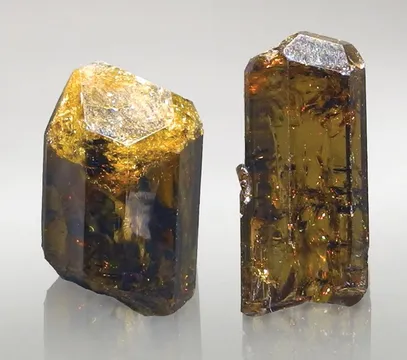
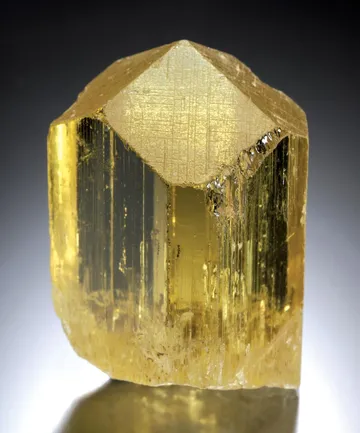
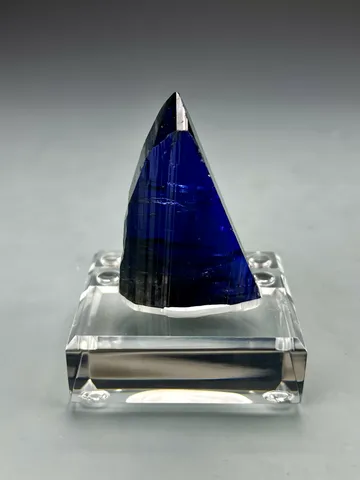
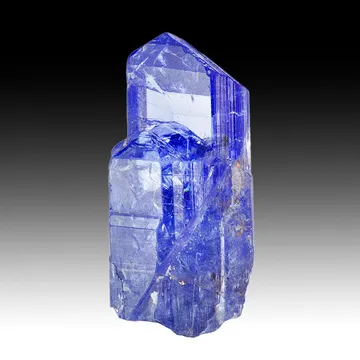
Loliondo kyanite is important because orange kyanite is genuinely unusual, and the Tanzanian material was significant enough to receive dedicated gemological and spectroscopic study soon after it appeared. Crystals are typically prismatic to bladed, golden-orange to yellow-orange, ochre, and locally other colors in the broader Loliondo suite; the best specimen crystals are transparent to translucent, sharply formed, and sometimes twinned, with documented collector examples around 5.0 x 1.7 x 0.9 cm. Kyanite may occur loose or in association with spessartine and mica, and the most desirable pieces preserve that association while showing good color saturation and minimal bruising along the prism edges or terminations. The color is linked to Mn3+ substituting in the kyanite structure, which makes these crystals a natural companion story to the manganese-rich garnet from the same field.
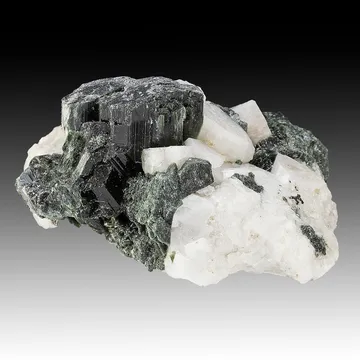
Mica at Loliondo is mostly important as matrix and as a genetic clue. The classic association is spessartine on silvery, pale, reddish-purple, brown or dark mica-rich matrix; analysis of a purple mica associated with early GIA material showed it to be muscovite rather than lepidolite, despite the color, with only very low lithium and measurable FeO, MgO and MnO. Good mica-associated specimens are valued because loose garnets are much more common than stable matrix pieces: a sharp orange crystal perched naturally on muscovite, especially with kyanite present, carries far more locality character than a detached crystal of similar size. Condition is critical, because the mica matrix can be friable, cleaved, or partly degraded from weathering, and garnets may detach from the soft matrix if poorly handled.
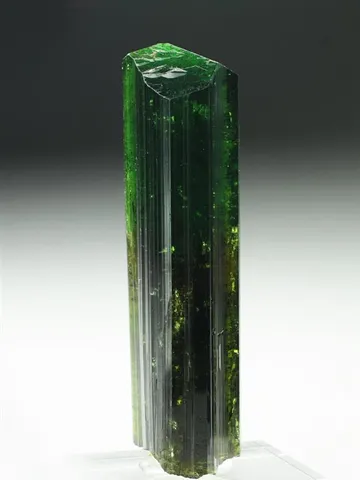
The documented supporting assemblage is compact but informative: biotite, muscovite, quartz, hematite, magnetite, rutile, dravite and staurolite are recorded from the Loliondo/Nani Hill area, and gemological microscopy has identified quartz, zircon and mica inclusions within the spessartine. Braunite was identified from black matrix associated with spessartine, while some dark inclusions in cut stones remained unidentified despite comparison with likely manganese minerals. Rutile and dravite add analytical interest, but the locality has not produced a broad specimen suite comparable to a pegmatite district. Its mineralogical importance rests on the spessartine–orange kyanite–muscovite association and on what that assemblage says about manganese behavior in a high-grade metamorphic setting.
No well-documented treatment or fake-specimen problem has become attached to Loliondo spessartine in the way that some other gem minerals have acquired treatment controversies. The more common collecting problem is locality precision. Specimens may be labelled Loliondo, Nani, Nani Hill, Sangulungulu Hill, Naan village, Lemesikio/Lemisikio, Arusha, or Ngorongoro District, and these labels can refer to the same collector field or to closely related phases of the Loliondo material. Conversely, collectors should not automatically merge Loliondo with newer Tanzanian orange spessartine localities such as Sinoniki in Longido District, nor with orange kyanite from Mautia/Matia Hill in Dodoma Region. Chemistry, associated minerals, and old labels help keep these localities distinct.
Condition is the major grading issue. Many Loliondo garnets were recovered from weathered material, so even attractive crystals may show contact faces, chips, abraded corners, healed fractures, or internal veils. Strong backlighting can make included crystals look deceptively gemmy; examine them in reflected light as well as transmitted light. Good crystals should have crisp edges, continuous luster across major faces, and an undisturbed natural surface rather than a cobbed or polished look. Matrix pieces are more fragile than their robust garnets suggest: muscovite plates can shed, kyanite can bruise or cleave, and the attachment between garnet and matrix may be shallow.
Fluorescence is not a selling point here. Published examinations of Loliondo spessartine reported inert behavior under both long-wave and short-wave ultraviolet, and examined orange kyanite showed no useful UV fluorescence or Chelsea-filter reaction. Handling is straightforward for garnet but more cautious for kyanite. Kyanite has strong directional cleavage and variable hardness by crystallographic direction, so avoid ultrasonic cleaning, steam cleaning, tight gem jars, and pressure against terminations or prism edges. A soft brush and minimal water are safer for dusty matrix pieces.
Rarity is tiered. Single loose spessartine crystals are available with some regularity, especially as older inventory circulates, but top-color, gemmy, undamaged crystals of substantial size remain selective. Matrix specimens are distinctly less common, and combination pieces with spessartine, kyanite and mica are the locality’s most characteristic high-end specimens. Fine orange kyanite crystals are scarcer than the garnets and should be judged by color saturation, translucency, termination quality and damage along cleavages. Faceted spessartine from the early material is usually small; stones above 2 ct were reported as rare in early GIA work, and later gem parcels likewise showed that clean faceting rough was only a small fraction of production.
Market availability reflects the locality’s rush-and-pulse history. The first important material appeared in 2007–2008, a later bright-orange parcel from the Naan area was mined in early 2019, and the documented collapse of the working tunnels in November 2020 appears to have ended that particular production. Today’s collector market is therefore dominated by old-stock crystals, deaccessioned collection pieces, and occasional modern offerings. Provenance-rich specimens from the 2008 debut period, especially those tied to recognized dealers or collections, deserve label preservation.
The Loliondo story begins the way many modern African gem stories do: quietly in the field, then suddenly under the lights of Tucson. In May 2007, Steve Ulatowski of New Era Gems saw a few crystals during a buying trip in Tanzania. By January 2008, he had obtained a much larger quantity, with local suppliers saying the material had been mined in late 2007 from weathered schist. At the 2008 Tucson shows, dealers were no longer showing vague rumors of orange garnet; they were putting out large, well-formed crystals from a new Tanzanian deposit, some with the kind of saturated orange color that immediately forced comparison with the best mandarin garnets then known.
The early numbers explain why collectors responded so quickly. GIA examined rough and faceted material, and dealers reported that inclusions limited good gem-quality production to roughly 3 kg per month, in pieces up to about 4 g. As of March 2008, only a few stones had been cut, faceted stones over 2 ct were rare, and a 10.92 ct stone was considered exceptional for the locality. The specimen side was more dramatic: published photos showed individual spessartine crystals several centimeters across, and a GIA specimen with reddish-purple mica measured 4.6 x 9.9 cm. Abe Suleman of Tuckman Mines and Minerals donated that mica-associated specimen to GIA, while Steve Ulatowski donated a 2.01 ct cut stone and several rough pieces for research.
At the locality, the field account has the texture of a genuine rush. German geologist Jochen O. Hintze visited the deposit and described a broad quartz mass or vein in weathered detritus, laced by hematite veinlets to which the spessartines were bound. Much of the early work was not hard-rock mining of the quartz itself but digging the loose weathered material to free crystals that had already been released or weakened by alteration. The name Nani was new enough to be described as a local Maasai assignment, and the settlement around the find was said to be growing quickly as people arrived in response to the “Garnet Rush.”
The orange kyanite arrived as a second surprise rather than as a footnote. A 1.71 g medium yellowish-orange crystal associated with the spessartine suite was identified by Raman analysis as kyanite, a result confirmed by basic gemological properties. The color was sufficiently unexpected that Karen Chadwick and George Rossman published a separate study in 2009 comparing Loliondo and Mautia Hill orange kyanite. Their work showed that the orange color came from Mn3+ absorption, transforming what might have been dismissed as a curiosity into a properly documented mineralogical rarity.
The later Loliondo chapter belongs to the material traded as “Lava garnet.” In early 2019, a small parcel of bright orange samples was recovered near Naan village in the Loliondo region, reported to be less than 1 km from the Kenyan border. Mining followed vertical mineralized zones, but the tunnels collapsed in November 2020. The studied parcel included one 3.70 ct faceted stone and rough pieces from 0.80 to 12.38 g; the fragments ranged from about 5 mm to more than 30 mm, and all were described as transparent and relatively free of inclusions. Because the rough had already been cobbed, the original crystal morphology could not be reconstructed. It was a tantalizing, short-lived echo of the first rush: excellent color, sparse production, and then silence from that particular working.
Chadwick, K. M.; Koivula, J. I.; Laurs, B. M.; Attard, J.; Simmons, W. B.; Falster, A. U. “Spessartine from Loliondo, Tanzania.” Gems & Gemology, Spring 2008, Gem News International, pp. 76–78. The key early gemological report documenting the 2007–2008 discovery, locality information, inclusions, chemistry, associated mica and orange kyanite.
Chadwick, K. M.; Rossman, G. R. “Orange kyanite from Tanzania.” Gems & Gemology, 45(2), 2009, pp. 146–147. The classic note on orange kyanite from Loliondo and Mautia Hill, identifying Mn3+ as the cause of the orange color.
Wildner, M.; Beran, A.; Koller, F. “Spectroscopic characterisation and crystal field calculations of varicoloured kyanites from Loliondo, Tanzania.” Mineralogy and Petrology, 107(2), 2013, pp. 289–310. A detailed spectroscopic study of orange, ochre, light green and dark blue kyanites from Loliondo.
Milisenda, C. C.; Lind, T.; Henn, U. “Spessartin: Von Sammlerstein zum Topseller.” Gemmologie: Zeitschrift der Deutschen Gemmologischen Gesellschaft, 59(1–2), 2010, pp. 3–18. GIA’s abstract summarizes this German-language overview of spessartine garnet sources, including the 2007 Tanzanian discovery and the pyrope-rich nature of Loliondo material.
“Gem Notes,” The Journal of Gemmology, 39(1), 2024, pp. 22–23. Includes the later Loliondo “Lava garnet” parcel, the 2019 Naan-area production, the November 2020 tunnel collapse, and gemological data for the studied samples.
Wikimedia Commons, “File:Spessartine-233435.jpg.” Documents a 4.5 x 4.4 x 4.3 cm Loliondo spessartine crystal photographed by Rob Lavinsky/iRocks.com and released under CC BY-SA 3.0.
Wikimedia Commons, “File:Kyanite-261687.jpg.” Documents a 5.0 x 1.7 x 0.9 cm golden-orange Loliondo kyanite crystal photographed by Rob Lavinsky/iRocks.com and released under CC BY-SA 3.0.
Mindat: Nani Hill, Loliondo, Ngorongoro district, Arusha Region, Tanzania — The most useful locality database page for coordinates, mineral list, alternate names, and field notes on the quartz–hematite–spessartine occurrence.
Mindat: Loliondo, Ngorongoro district, Arusha Region, Tanzania — Broader locality page useful for the regional mineral list and hierarchy.
Mindat: Spessartine from Nani Hill — Occurrence page summarizing the spessartine entry, photo-associated minerals, and reference list.
Mindat: Kyanite from Loliondo — Occurrence page for the Loliondo kyanite record and its spectroscopic publication reference.
Gemdat: Nani Hill, Loliondo — Concise gemstone-oriented locality page listing spessartine and kyanite from the locality.
Fabre Minerals: Spessartine with Kyanite and Muscovite, Sangulungulu Hill — Dealer specimen record showing the classic orange spessartine–orange kyanite–muscovite association.
Fabre Minerals: Spessartine with Kyanite and Mica, Sangulungulu Hill — Dealer record for a 2008 matrix specimen with spessartine, mica and brownish kyanite.
The Journal of Gemmology, 39(1), 2024 — Includes the 2019 “Lava garnet” note, with chemistry, inclusions, production history and the 2020 tunnel-collapse detail.
GIA: Summer 2009 Gems & Gemology PDF — Contains the orange kyanite note comparing Loliondo and Mautia Hill material.
University of Vienna record: “Spectroscopic characterisation and crystal field calculations of varicoloured kyanites from Loliondo, Tanzania” — Abstract and bibliographic record for the main mineralogical study of Loliondo kyanite color.