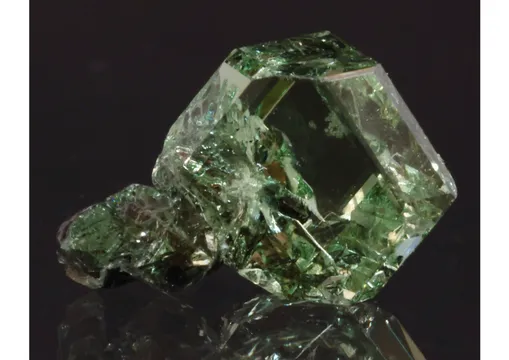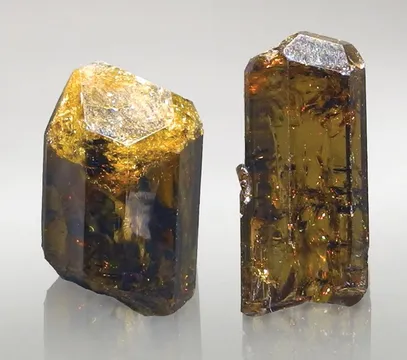
Nadonjukin, Tanzania — vanadium-bearing dravite/uvite tourmaline crystals with vivid green caps, sharp terminations, and scarce matrix pieces prized by collect…
Key facts
Nadonjukin entered the collector vocabulary abruptly in 2016, when a small hand-worked occurrence near the village produced a remarkable suite of green and brown-green tourmaline crystals now known in the trade as Commander Mine material. It is not a classic granite-pegmatite tourmaline locality. The best documented production came from pockets in the metamorphic gem country of northern Tanzania’s Simanjiro District, a region better known to collectors for vanadium-bearing green gems and for the broader East African high-grade metamorphic belt that hosts tanzanite, tsavorite, and related calc-silicate and carbonate-associated mineralization.
The locality’s fame rests on lustrous, sharply terminated dravite-to-uvite-series tourmaline crystals with intense green caps, olive to yellow-green zones, and brown to orangey brown bases. Early trade descriptions called them “chrome dravite,” but detailed gemological work showed that the vivid green is principally a vanadium effect, with chromium present only in subordinate amounts. That distinction is important: Nadonjukin specimens are among the modern benchmark collector pieces for vanadium-bearing dravite/uvite tourmaline, prized not merely as colorful gem rough but as well-formed mineral specimens.
Regional View
Country View
The finest Nadonjukin crystals have a very distinctive look: glossy trigonal prisms, commonly single and detached, with deep emerald-green terminations over darker olive, yellow-green, or brown bodies. In hand, many appear nearly black or bottle-green until strong transmitted or edge lighting wakes up the color. In the best gemmy examples the termination can flash electric green, chartreuse, amber, or even reddish tones depending on thickness and light path. Matrix pieces are genuinely scarce; published descriptions note only a few crystals retained on blocky white carbonate, probably calcite or dolomite, while most crystals were detached during mining or later sorting.
Search for specimens: View all specimens from Nadonjukin, Tanzania
The relevant specimen locality is the Commander Mine near Nadonjukin, in Simanjiro District, Manyara Region, northeastern Tanzania. Published and database locality accounts place the mine about 14 km from Nadonjukin village and roughly a two-hour drive south of Arusha by back roads. The locality lies within the northern Tanzanian gem province of the Mozambique Belt/Eastern Granulites, where high-grade metamorphic rocks, graphitic and calc-silicate units, and carbonate rocks are central to the genesis of several celebrated vanadium- and chromium-colored gems. For Nadonjukin itself, the published literature is specimen- and pocket-focused rather than a full mine-geology monograph: the important facts are the pocket setting, carbonate association, and the dravite-uvite chemistry of the crystals.
The “ore body,” in collector terms, consisted of small pockets rather than a large industrial ore zone. The 2016 production was recovered from hand-dug and blasted workings that reached approximately 12 m depth. Early pockets were in soft clayey material, which helped preserve lustrous crystals; after the miners reached harder rock, extraction became more damaging and production slowed sharply. Most recovered pieces were loose crystals or crystal fragments. A few matrix specimens were found on blocky white carbonate, described in the literature as probably calcite or dolomite and in some specimen records as calcite. These matrix pieces are important because they show the crystals in their original pocket relationship rather than as isolated gem crystals.
The mine’s earlier history appears brief. Local miners reported that the occurrence was first worked in 1997, but the initial production was poor and the diggings were soon abandoned. In late August 2016 a miner known as “Kamanda” or “Commander” reopened the old workings. This gave the occurrence its now-standard collector name, the Commander Mine. The first important pocket produced about 5 kg of mine-run material. A second pocket, recovered in September 2016, yielded about 3 kg of the best crystals plus several kilograms of lower-grade material. Later reporting on the overall find described roughly 25 kg total production as fragments and crystals up to about 10 cm long, with about 11 kg set aside as crystals or specimens and less than 600 g considered faceting quality.
Commercially, the Nadonjukin find had a remarkably fast path from pit to world stage. Crystals appeared at the October 2016 Munich show and additional material was seen at Tucson in February 2017. A significant portion of the second-pocket production was acquired by Steve Ulatowski of New Era Gems, whose material became central both to the collector market and to later gemological study. One early disappointment for mineral collectors is that some of the best first-pocket crystals were reportedly broken for facet rough before miners were advised that intact crystals could be just as valuable as gem rough.
There is no indication that Nadonjukin is a public collecting locality. It is a small artisanal mining occurrence in Tanzania, and access would require permission from landowners, mineral-rights holders, and the relevant local and national authorities. For collectors today, legitimate acquisition is through documented old-stock specimens, dealer inventory, auctions, and collections dispersed from the 2016–2017 market wave. Because production appears to have been brief and limited, reliable labels preserving “Commander Mine, Nadonjukin, Simanjiro District, Manyara Region, Tanzania” are especially valuable.
Nadonjukin dravite is best understood as vanadium-bearing dravite to dravite-uvite tourmaline: lustrous, striated trigonal crystals, commonly detached, ranging from centimeter thumbnails to crystals reported over 10 cm, with most fine collector pieces in the 2–6 cm range. The classic habit is a sharp prism with a pyramidal trigonal termination, green to yellow-green at the cap and olive, amber-brown, orangey brown, or dark bottle-green toward the base; slices studied from bicolored crystals show a brown core or basal zone overgrown by intense and pale green layers, with hollow growth tubes along the brown-green boundary. Good pieces from Nadonjukin show bright luster, undamaged terminations, visible green color without heroic lighting, gemmy upper zones, strong color contrast, and, very rarely, natural carbonate matrix; ordinary pieces tend to be too dark, chipped at the base or termination, internally fractured, or impressive only when backlit.
As “tourmaline,” Nadonjukin is significant because it helped correct a trade habit: these crystals circulated as chrome tourmaline or chrome dravite, yet later work showed the material is a dravite-uvite mixture colored chiefly by vanadium, with chromium minor. The locality’s best tourmaline specimens are green-capped brown-green crystals from the 2016 Commander Mine pockets, commonly lustrous singles but sometimes intergrown pairs, with reported examples from small 10 mm gems to stout crystals exceeding 5 cm and rare large pieces around 10 cm. Associations are sparse but important: the few matrix specimens on white carbonate are much rarer than loose crystals. Superior Nadonjukin tourmaline combines full termination, sharp prism edges, high glassy luster, clean green transparency near the tip, and honest locality-specific labeling; the name “chrome” is best treated as a historical trade description unless supported by analysis.
Other minerals are surprisingly few in the verified record. Mindat’s formal mineral list for the Commander Mine gives dravite as the only valid listed species, while published gemological descriptions and specimen records mention a blocky white carbonate matrix, probably calcite or dolomite, and some dealer or photo records identify calcite on matrix pieces. No type-locality mineral has been verified from Nadonjukin, and claims beyond dravite/tourmaline plus carbonate matrix should be treated cautiously unless supported by analysis or a strong provenance chain.
The first collecting issue is nomenclature. “Chrome dravite,” “chrome tourmaline,” “vanadium dravite,” “vanadian dravite,” “green dravite,” and “dravite-uvite” all appear in the trade for Nadonjukin material. The older “chrome” name is visually understandable but chemically imprecise for the Commander Mine material: published analyses show vanadium is the dominant green chromophore, with chromium present in smaller amounts. A precise modern label should say vanadium-bearing dravite, vanadium-bearing dravite-uvite, or dravite from the Commander Mine, Nadonjukin.
The second issue is locality precision. Nadonjukin material is sometimes grouped loosely with Landanai, Merelani-area, Simanjiro, or generic Tanzanian chrome-tourmaline material. Those labels are not equivalent. Nadonjukin/Commander Mine crystals have a specific 2016 discovery history, a characteristic green-over-brown zoning, and published analytical work tied to the Commander Mine. If an older label says “Nadonjukin,” “Nandonjuki,” “Adonjukin,” “near Simanjiro,” or “Commander Mine,” preserve the wording, but annotate it rather than replacing it with a broader Tanzanian locality.
Condition is central to value. Many crystals were detached from pocket walls, so base contacts are normal. Termination chips, edge bruises, and internal fractures are common enough that a fully terminated, glassy, undamaged crystal commands a premium. The color is also deceptive: thick crystals may look nearly black in reflected light but show excellent green along edges or under strong transmitted light. This is not automatically a defect, but specimens that show attractive green face-up under normal display lighting are more desirable than those requiring a fiber-optic torch to reveal their color.
Matrix examples are markedly rarer than loose crystals. A small, well-terminated 2 cm crystal on carbonate may be more collectible than a larger loose crystal if the matrix is original and the association is intact. Conversely, be alert for mounted, repaired, or reattached crystals. No widely documented industry of faked Nadonjukin matrix specimens has been found, but the combination of valuable loose crystals and rare matrix pieces makes repairs and reattachments a natural concern. Ask specifically about repairs, restoration, and whether a crystal has been glued to matrix or only to an acrylic display base.
The material has a few gemological quirks worth knowing. Faceted stones from the find may appear red under a Chelsea filter and may show a red glow under 405 nm laser excitation while remaining inert to standard long-wave and short-wave UV lamps. Some crystal material contains abundant growth tubes parallel to the c-axis, which can yield chatoyancy if cut as cabochons. Heat-treatment experiments on bicolored slices produced no color change, so a brown base should not be viewed as easily “fixable” rough. Lapidaries have also reported an unpleasant sulfur-compound smell during cutting, likely connected to sulfur-bearing inclusions or sulfur distributed through the crystals.
Market availability is limited but not absent. Fine pieces from the 2016 production continue to appear through dealers, auction archives, and collection turnover, but this is not a locality with steady new supply. Small gemmy thumbnails, darker detached crystals, and isolated crystal fragments are the most obtainable. Matrix pieces, fully transparent green-capped crystals, large undamaged singles, and well-documented specimens from the early New Era Gems/2016 Munich–2017 Tucson circulation are the premium end of the locality.
The Nadonjukin story has the feel of a modern pocket rush compressed into a few weeks. The diggings had been tried in 1997 and then left behind because there was so little to show for the effort. Nearly two decades later, in late August 2016, a miner known locally as Kamanda—rendered by Steve Ulatowski as “Commander”—decided to try the old ground again. Working by hand and with blasting, he pushed the previous workings down to about 12 m. There, in soft clayey material, he hit the first major pocket: about 5 kg of mixed-grade green and brown-green tourmaline.
That first pocket brought both excitement and loss. Fine crystals were present, but in the earliest rush some of the best-formed pieces were broken up for valuable facet rough. It was the familiar gemstone-field dilemma: an intact crystal may be irreplaceable to a collector, but in the heat of production a transparent green termination looks like money for cutting. The second pocket changed the handling. In September 2016 the miners found a larger, better pocket, and they were advised not to break well-formed crystals because complete specimens could equal or exceed the value of the rough. Careful extraction from that second pocket yielded about 3 kg of the best crystals from the find, plus several kilograms of lesser material.
The timing was almost theatrical. Crystals from the new find reached the October 2016 Munich show, where rich green dravite crystals with yellow zoning were one of the few truly fresh surprises. One noted 5.2 cm crystal from the New Era Gems group was described as the best miniature from a large show lot and used as a logo piece in the dealer’s show advertising. That is how quickly Nadonjukin moved from a small reopened pit south of Arusha to the high end of the international specimen market.
The scientific story followed the trade story. The crystals were beautiful enough to sell as “chrome dravite,” but the chemistry would not let the name stand. Gemological notes first established the dravite identity and the dravite-uvite component; Rossman then showed that vanadium, not chromium, was chiefly responsible for the green. Later work sliced multicolored crystals and mapped their chemistry and spectra: brown cores rich in iron and titanium, intense green zones enriched in vanadium with minor chromium, and growth tubes lining the boundary between color zones. The result is one of the better documented modern tourmaline finds—small in tonnage, but unusually well followed from pocket to show table to laboratory.