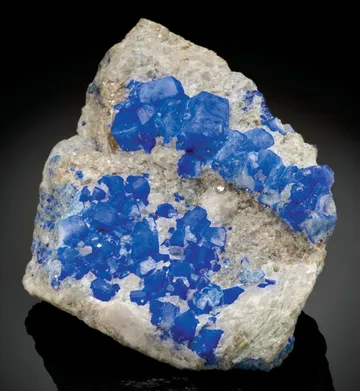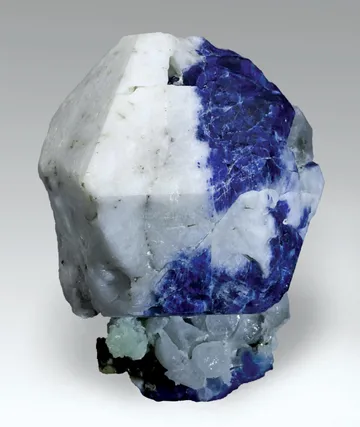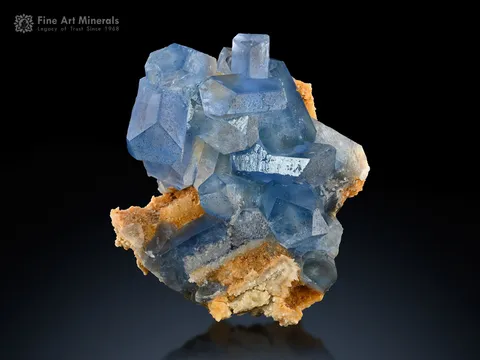
Laman celestine deposit, Afghanistan - blue, sharp, glassy Celestine crystals on Calcite druse in limestone; a new Afghan locality with collecting appeal.
Key facts
The Laman celestine deposit is one of the most unexpected specimen localities to emerge from Afghanistan in the last generation: not a granitic pegmatite, ruby marble, lapis skarn, or alpine cleft, but a small limestone-hosted strontium-sulfate occurrence in Badghis Province, far out in the western part of the country. Its collector importance rests on a simple but potent aesthetic formula: stout blue Celestine crystals, commonly sharp and glassy, set on yellow-white to buff Calcite druse over white to brownish limestone. The best examples have the scale and presence of serious cabinet minerals, yet retain the crisp, isolated “one crystal on a hill” architecture that makes a miniature unforgettable.
The locality is recorded near Lāmān, in Qala e Naw District, Badghis Province, with the historical or alternate name Dara-e-Laman / Darai Laman attached to specimens in the trade. Mindat records it as a deposit hosted in limestone, with Calcite and Celestine as the two verified mineral species. That lean species list is part of its identity: collectors do not pursue Laman for a complex paragenesis, but for the rare conjunction of color, contrast, and crystallographic sharpness in Afghan Celestine.
Regional View
Country View
Specimens began entering collector awareness around late 2022 and were being discussed and offered more prominently during 2023 and 2024. Early confusion over the precise Afghan province—and even over the species name in some sales channels—was quickly corrected as the material became better documented. By 2024, Laman Celestine had acquired a distinct market identity: short-prismatic to equant, saturated blue crystals, often singly perched or lightly grouped, on drusy Calcite-coated limestone. In a market where Celestine is often associated with Madagascar, Michigan, Ohio, Poland, or classic European sedimentary deposits, Laman gave collectors a new Afghan chapter with its own look.

Photo: MChMinerals

Photo: MChMinerals
Search for specimens: View all specimens from Laman celestine deposit, Afghanistan
The Laman celestine deposit lies in Qala e Naw District, Badghis Province, northwestern Afghanistan, close to the settlement of Lāmān and roughly southeast of the provincial capital Qala e Naw. Published locality data place the deposit at approximately 34°45'6" N, 63°5'45" E, with Lāmān village less than a kilometer away. The locality is also seen on labels as Dara-e-Laman, Darai Laman, or Dara-i-Laman, spellings that reflect transliteration from Dari/Pashto rather than distinct mineral sources.
Geologically, the essential fact is that Laman is limestone-hosted. The specimens themselves reinforce that interpretation: Celestine crystals sit in vuggy white to brownish limestone, commonly on jagged surfaces coated by drusy Calcite. The association is consistent with low-temperature strontium sulfate mineralization in cavities or fractures within carbonate rock, with Calcite forming first or alongside Celestine as a lining over the limestone substrate. The deposit is not known to collectors as a broad industrial strontium mine; its public significance is as a specimen-producing occurrence.
The “ore body,” in specimen terms, appears to have been pocketed and discontinuous rather than a massive, uniform Celestine bed. The best pieces show isolated or lightly intergrown Celestine crystals seated on small ridges, pockets, or shelves of Calcite. Many are miniatures and small cabinets, with some larger cabinet-size examples reported. The strongest pieces carry a dominant blue crystal—sometimes doubly terminated or nearly so—rather than a crowded mass. Dealers have described crystals from particular pieces reaching several centimeters, including dominant crystals around 3 cm and exceptional examples with crystals reported to more than 7 cm long.
Mining history is only lightly documented in public sources. There is no well-established published record of a named operating company, concession history, or long industrial production at Laman. The locality entered the collector record through the specimen trade: a Mindat discussion in December 2022 identified blue crystals being sold from Afghanistan as Celestine with Calcite from Darai Laman, Badghis Province, and the locality was subsequently added to Mindat. By April 2023, multiple dealers were offering the material as a new Afghan find, and by 2024–2025 the locality had become established enough for auction records, marketplace listings, and specialist commentary to treat “Laman celestine deposit” as the consensus label.
Access should be regarded as entirely non-public unless arranged through legitimate local rights holders and with serious security and logistical planning. Badghis is a remote western Afghan province, and there is no evidence that Laman is a casual collecting site. Specimens on the market have come through Afghan and Pakistani mineral trade channels rather than through ordinary collector field trips. For practical purposes, serious collectors should acquire documented specimens with precise labels, not attempt to visit.
The notable pockets that matter to collectors are the early 2022–2024 specimen lots: saturated blue Celestine crystals on butter-yellow, buff, or white Calcite, commonly over limestone matrix. One group of April 2023 dealer specimens included pieces around 2.7 to 8 cm overall, with prismatic Celestine crystals described as sharp, transparent to translucent, sky blue, and set on acute scalenohedral Calcite. Later auction descriptions emphasize three-dimensional cabinet pieces with cobalt- to steel-blue crystals, a darker blue outer rind visible down the crystal axis in at least one example, and unusually complete all-around aesthetics.
Calcite from the Laman deposit is not the headline species, but it is the stage on which the locality’s best Celestine performs: typically white, yellow-white, light yellow, buff, golden, or butter-yellow drusy coatings and small acute scalenohedral “dogtooth” crystals on limestone matrix. It may appear as microcrystalline sparkle, jagged druse, or sharper toothy growths surrounding and partly supporting the blue Celestine, and the most desirable pieces use Calcite as a clean color-contrast matrix rather than as a visual distraction. Good Laman Calcite is fresh, lustrous, and three-dimensional, forming ridges, shelves, and vug walls that display the Celestine crystal naturally; ordinary pieces tend to have duller coatings, awkward matrix, bruised contact points, or Calcite that overwhelms the blue crystal instead of framing it.
Celestine is the defining mineral of Laman: stout, sharp, vitreous crystals in pale sky blue through richer steel, cobalt, or saturated blue tones, most often as short-prismatic to equant individuals or small intergrown clusters perched on Calcite-coated limestone. Documented specimen descriptions include thumbnails through small cabinets, with crystals commonly in the 2–4 cm range and exceptional reported crystals exceeding 7 cm in length; the most admired pieces combine a dominant, well-terminated, translucent to transparent blue crystal with a contrasting golden-yellow or white Calcite base. Laman’s best Celestines are separated from ordinary examples by crystal completeness, undamaged terminations, strong face definition, glassy luster, saturated blue color, and architectural exposure above the matrix; lesser pieces may still be attractive but show bruised tips, washed-out color, cloudy interiors, or crystals half-buried in Calcite and limestone.
No type-locality minerals are documented from the Laman celestine deposit, and no rare accessory suite has been verified from the deposit itself beyond Calcite and Celestine. Nearby Qala e Naw District localities record other sedimentary minerals and materials—including gypsum at a separate Laman gypsum occurrence and apatite/clay minerals at Kotalj-i-Sebzak—but these should not be merged onto Laman Celestine labels without specimen-specific evidence. For this deposit, the disciplined collector’s label should remain simple: Celestine with Calcite on limestone, Laman celestine deposit, Qala e Naw District, Badghis, Afghanistan.
The main authenticity issue for Laman is not artificial treatment but misidentification and mislabelling. Early examples were reportedly offered by some sellers as “blue herderite” from Badakhshan, Afghanistan—a much more familiar province name in the Afghan gem-mineral trade, but the wrong species and wrong provincial attribution for this material. Correctly labelled pieces should read Badghis Province, Qala e Naw District, Laman celestine deposit, with Darai Laman / Dara-e-Laman acceptable as a historical or alternate locality name. A label saying “Badakhshan” should be treated with suspicion unless it is clearly a legacy error retained alongside corrected documentation.
There are no well-documented dyed, coated, or heated Laman Celestines in the sources consulted. The blue color is treated in the mineral trade as natural, and the more plausible problems are ordinary specimen issues: bruised terminations, chipped prism edges, missing matrix, repaired or glued matrix contacts, and confusion between Celestine and other pale blue minerals. Celestine is relatively soft at about 3 to 3.5 on the Mohs scale and has good cleavage, so sharp corners and terminations are vulnerable. Handle pieces over a padded surface, avoid ultrasonic cleaning, and do not soak friable Calcite-coated limestone bases. If cleaning is necessary, use only a soft brush, air bulb, or minimal distilled water applied carefully and dried promptly.
Condition matters greatly here because the locality’s appeal is crystallographic sharpness against a bright matrix. Minor edge rubs may be acceptable on larger pieces, but bruising at the dominant termination will sharply reduce desirability. A top Laman specimen should have a blue crystal that is exposed, upright or elegantly laid across Calcite, and not visually crowded. The best matrices are not merely “present”; they have sculptural topography and fresh Calcite that throws the blue into relief.
Market availability has been sporadic rather than abundant. Dealer pages from 2023 described small selections, many quickly sold, and later auction records show both moderate miniature prices and stronger small-cabinet results. Ordinary miniatures can appear in the low to mid hundreds of dollars, while fine, complete, saturated, small-cabinet examples have brought substantially more; elite dealer specimens have been priced in the low thousands. Because this is a recent and still relatively thinly represented Afghan locality, provenance and date-of-acquisition notes add real value.
The first memorable chapter in Laman’s collector story is a case of identity correction. In late 2022, blue Afghan crystals were circulating with an enticing but problematic label: “blue herderite” from Badakhshan. Herderite would have fit comfortably into the mental map many collectors already had of Afghanistan—pegmatites, gem crystals, familiar northeastern provinces—but the mineral did not fit the specimens. The material was Celestine with Calcite, and the locality was not Badakhshan at all. Muhammad Majid identified the source as Darai Laman, Badghis Province, Afghanistan, and the locality soon entered the Mindat database. That correction matters because it fixed the two things collectors most depend on: species and place.
The second chapter unfolded in the market. By spring 2023, Laman specimens were no longer oddities drifting under uncertain labels; they were named, compared, priced, and argued over like a serious new find. Tom Moore’s Mineralogical Record online report described miniature to large-cabinet-size Celestine specimens “trickling out” from the remote locality, and noted that an earlier speculation placing the material in Badakhshan had turned out to be wrong. Ghulam Mustafa of Fine Art Minerals was offering standout examples, including crystals described as reaching 7.3 cm long and 5 cm thick, resting in vuggy limestone coated with drusy white Calcite. The phrase that stuck was Mustafa’s own description of the best crystals as “the deepest color-saturated large fatty crystal[s] I have ever seen.”
By 2024, the tone had changed from surprise to recognition. Another Mineralogical Record report described sparse small lots appearing over several years, then singled out a handful of miniature and small-cabinet specimens as the finest seen to date. The locality-name problem had largely settled into “Dara-i-Laman, Badghis Province,” aligned with Mindat’s Laman celestine deposit in Qala e Naw District. The specimens that made people pay attention were not large for the sake of largeness: they were sharp, glassy, bright blue, short-prismatic to equant, and perched singly or in lightly intergrown clusters on yellow-white Calcite druses over white limestone. One 8 cm specimen was priced at $3,500, and the comparison being made was no longer merely “good for Afghanistan,” but competitive with respected Celestine localities in Madagascar and Michigan.