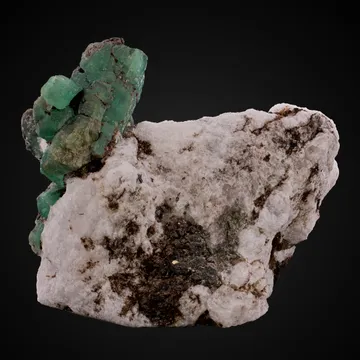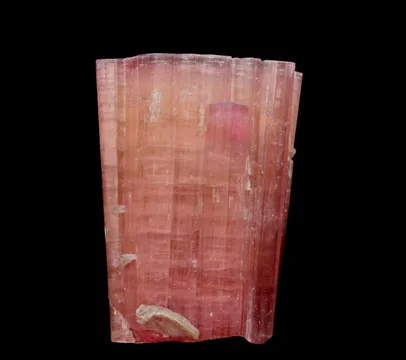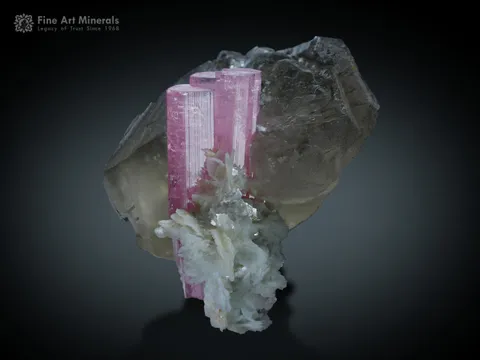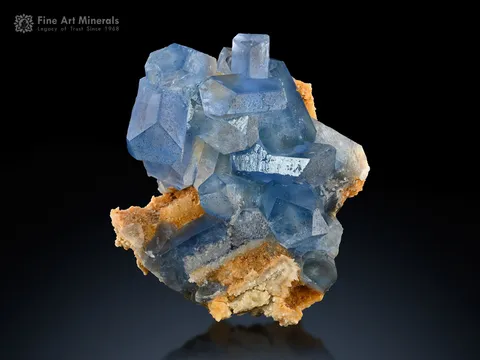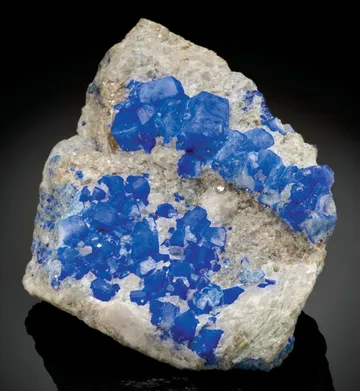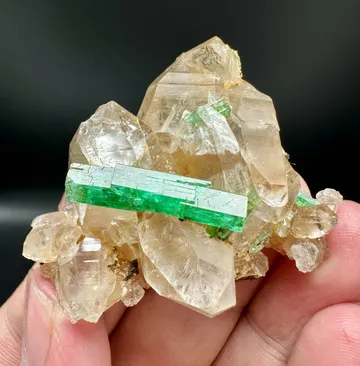
Panjshir, Afghanistan — emerald-bearing veins yield saturated green emerald prisms set in quartz and altered rock; a classic, collectible alpine locality.
Key facts
Panjshir is the great modern emerald locality of Afghanistan: a high, steep, politically storied valley in the Hindu Kush where emerald-bearing quartz-ankerite veins and silicified shear zones cut metamorphosed carbonate and clastic rocks on the eastern side of the Panjshir River. For collectors, the locality matters because its finest specimens combine a gem species of first rank with a classic cabinet-mineral aesthetic: saturated green hexagonal emerald prisms, commonly sharp and lustrous, set against pale quartz, carbonate-rich matrix, or darker altered wall rock. Good Panjshir pieces are not merely “emerald from Afghanistan”; they are instantly legible mineral specimens, with green crystals standing out in high contrast from a rugged alpine-style vein assemblage.
The district’s geological importance lies in the meeting of ingredients that normally do not coexist comfortably. Beryllium-bearing fluids interacted with chromium- and vanadium-bearing rocks along a major tectonic zone, producing emerald in a setting more properly understood as tectonic-metamorphic and hydrothermal than pegmatitic. This distinction is essential. Afghanistan is famous for pegmatite gems, but the Panjshir emerald mines are not the same geological story as the tourmaline, spodumene, aquamarine, and morganite pegmatites of Nuristan and related districts. The Panjshir emeralds formed in vein and shear-zone systems, where quartz, ankerite, calcite, albite, phlogopite, pyrite, tourmaline, and altered carbonate rocks recur as part of the specimen context.
Historically, Panjshir occupies a rare place in gem literature. Classical references to “smaragdus” from Bactria have long tempted writers to connect Afghanistan with ancient emerald trade, though the old term could mean several green stones. Modern commercial production is much clearer: emerald was recognized in the early 1970s at Buzmal, systematic Soviet-Afghan work followed, and by the late twentieth century Panjshir had become an important source of emerald rough and occasional specimen-grade crystals. The 1991 Gems & Gemology field study fixed the locality in the minds of Western gemologists and collectors, documenting large crystals, hundreds of workings, difficult access, distinctive inclusions, and a scale of production that was already substantial.
Regional View
Country View
The best Panjshir specimens have a particular visual grammar. Emerald crystals may be single upright prisms, parallel clusters, sprays, or small embedded crystals weaving through quartz. Many show the strong longitudinal striation expected of beryl, with flat basal terminations when complete. The finest color is a vivid bluish to slightly yellowish green, often concentrated toward the exterior of the crystal, while ordinary pieces may be paler, heavily fractured, etched, opaque, contacted, or damaged by blasting. Large loose crystals exist, but matrix pieces with good terminations, high color saturation, transparency, and natural balance are far scarcer in serious collections.

Photo: Wikimedia Commons

Photo: Wikimedia Commons
Search for specimens: View all specimens from Panjshir, Afghanistan
The Panjshir emerald district lies in northeastern Afghanistan, in the Hindu Kush, along the Panjshir River system north to northeast of Kabul. The emerald mines are concentrated on the eastern side of the valley, particularly in and around the Khenj district and related mining areas such as Khenj, Mikeni or Dah-Mikeni, Yaknow or Butak, Buzmal or Dahane Revat, Rivat or Rewat, Darun, and Kamar Safed. Spellings vary widely in labels and literature: Panjshir, Panjsher, Panjsheer, Khenj, Khinj, Darlhenj, Mikeni, Milzeni, Mukani, Buzmal, Buzmul, Rewat, Rivat, and Dahane Revat may all refer to the same broader district or to adjacent workings.
Geologically, Panjshir is not a pegmatite emerald locality. The emerald deposits are quartz-ankerite vein and veinlet systems, plus silicified shear zones, in metamorphosed sedimentary and intrusive rocks southeast of the Panjshir fault zone. Published descriptions place the emerald mineralization in a metasedimentary sequence that includes schist, quartzite, marble, metadolomite, and related carbonate rocks, with intrusions such as gabbro, diorite, and quartz porphyry. The Panjshir Valley itself follows a major tectonic boundary associated with the Herat-Panjshir suture system, a structural setting that helps explain why beryllium-bearing fluids could interact with chromium- and vanadium-bearing rocks to make emerald.
The productive emerald-bearing structures are narrow, discontinuous, and pockety rather than great regular ore bodies. The veins and shear zones carry quartz and ankerite as the principal gangue, with albite, calcite, dolomite, phlogopite, tourmaline, pyrite, and altered wall rock reported in association. In classic Panjshir specimen material, emerald crystals are embedded in quartz, carbonate, or altered matrix; in gem parcels they may appear as loose prismatic crystals, broken prisms, etched fragments, or long “pencil” crystals. Some blocks from the mines have contained large numbers of small emeralds, but specimen-quality recovery depends heavily on how carefully the rock is removed.
Mining has been overwhelmingly small-scale, local, and high-risk. Early modern emerald recognition dates to the 1970s, with Buzmal described as one of the earliest localities. The 1991 field account described Buzmal as a hazardous cluster of pits and tunnels on a mountain roughly 10,000 feet high, with miners “gophering” irregular tunnels into limestone using drills and dynamite. Tunnels were commonly narrow, poorly ventilated, and unsupported, and the use of excess explosive often shattered crystals that might otherwise have survived as specimens or better cutting rough. In the colder months, snow shifted work toward lower-elevation mines or to sorting older dumps from higher workings.
The older mining organization was based on partnerships rather than salaried employment. A typical team might include miners, equipment providers, and blasting-material providers who divided the proceeds by shares. Emeralds were brought down to nearby villages such as Khenj, Mikeni, or Dest-e-Rewat for valuation and sale. In the late twentieth century, production moved through local auctions and onward to Pakistan for cutting, sorting, and distribution into the international market. During the resistance period, emerald revenues were also part of Panjshir’s political economy, helping fund local power structures and armed groups.
More recent accounts show a district in transition rather than a frozen hand-mining locality. Remote-sensing work and later field reports document a move, at least in some areas, from purely traditional tunneling toward more mechanized surface excavation, trenching, and open-pit work. The de facto Ministry of Mines and Petroleum and provincial authorities have publicized surveys, licensing, and repeated emerald auctions in the 2020s, with hundreds of extraction licenses and thousands of carats offered through public bidding. These figures show continuing production, but they should not be confused with easy collecting access. Panjshir is an active mining district in a politically sensitive region; independent field collecting is not realistic for visiting collectors, and any material entering the market requires careful attention to legal export, sanctions, conflict-finance, and chain-of-custody questions.
Specimen production is only a fraction of the district’s output. Most emerald is sold as rough for cutting, especially when crystals show good color and usable clarity. The collector’s pieces are the survivors: crystals too included, too matrix-bound, too aesthetic to cut, or preserved by chance from the blasting. The most desirable pockets have yielded green prisms standing upright on white to smoky quartz, sharp emeralds partly included in quartz, crystals associated with pyrite, and larger isolated prisms with good color zoning. The Khenj and Mikeni areas are repeatedly singled out in older field reports and trade lore for higher-quality crystals, while northern areas such as Buzmal, Darun, Darik, and Aryu have been described as tending toward lighter material.
Emerald is the defining species of Panjshir, occurring as euhedral hexagonal prisms in quartz-ankerite veins and silicified shear zones, most famously from the Khenj, Mikeni, Buzmal, Rewat/Rivat, Darun, Butak/Yaknow, and Kamar Safed areas. Crystals are commonly transparent to translucent, sometimes opaque, and frequently show color zoning with paler interiors and darker green outer zones; most rough crystals described in the classic literature were in the 4–5 carat range, while crystals over 50 carats are notable and those over 100 carats are rare. The collector-grade ideal is a complete, lustrous, saturated green crystal or cluster, preferably terminated and perched on pale quartz or carbonate-rich matrix, with minimal blasting damage and no repair; ordinary pieces tend to be broken, contacted, etched, overgrown, or too included to show the luminous green that made the district famous.
Quartz is the chief visual partner to Panjshir emerald and is much more than background matrix: it forms the white, colorless, translucent, and sometimes smoky crystals and vein material that make the emeralds readable as specimens. The most collectible quartz pieces are not quartz specimens in the usual sense but emerald-on-quartz combinations, where the contrast between glassy pale quartz and green beryl is sharp enough to display from across a case; some pieces show emerald prisms bridging or penetrating quartz clusters, while others carry a single emerald crystal on a sculptural quartz pedestal. Damage, iron staining, dull quartz, and awkward contacts quickly reduce the aesthetic value, whereas clear quartz with balanced composition and a naturally exposed emerald can transform a small Panjshir piece into a memorable specimen.
Beryl from Panjshir is overwhelmingly discussed in the trade as emerald, but the broader species is worth separating because many crystals straddle the collector’s boundary between gem emerald, green beryl, pale zoned beryl, and included beryl. Panjshir beryl crystals retain the classic hexagonal prismatic habit of the species, with longitudinal striations, basal terminations when complete, and a range from colorless or very pale internal zones to darker emerald-green rims; gemologists have also documented tiny beryl or emerald inclusions inside Panjshir emeralds. For collectors, a “beryl” label on Panjshir material should prompt a closer look: top pieces deserve the emerald name by color, chromium/vanadium chemistry, and appearance, while paler, heavily zoned, bluish, yellowish, or opaque crystals may be better understood as beryl from the emerald system rather than first-quality emerald specimens.
Other minerals documented from Panjshir give the province more breadth than the emerald trade alone suggests. The emerald veins and shear zones have produced or included albite, ankerite, calcite, dolomite, phlogopite, pyrite, tourmaline, limonite-stained material, and feldspar-group minerals, all of which may appear as matrix, inclusions, or alteration products. Separate Panjshir pegmatite localities record minerals such as muscovite, schorl, spodumene, cassiterite, columbite-tantalite, garnet-group minerals, and albite, while the Panjsher Valley slag deposits connected with older silver and iron working have yielded an unusual artificial assemblage that includes fayalite, hedenbergite, leucite, magnesioferrite, monticellite, penfieldite, wüstite, galena, hematite, magnetite, quartz, feldspars, and lead alteration minerals. These slag species are archaeological-mineralogical curiosities, not emerald pocket companions.
Panjshir emerald specimens require the same scrutiny as fine emerald gems, plus the extra suspicion appropriate to matrix specimens from a heavily traded, high-value locality. The first question is locality precision. Older labels may say only “Afghanistan,” “Panjshir Valley,” “Panjshir,” “Khenj,” “Mikeni,” “Buzmal,” or “Rewat,” and spelling inconsistencies are normal. A precise mine label is valuable but not automatically reliable; the district’s rough often moves through Kabul, Peshawar, and other trading centers, and sublocality names can become trade shorthand rather than documented provenance.
The most important authenticity concerns are treatment, repair, and substitution. Emerald oiling is common worldwide and has been specifically reported for Afghan emerald parcels moving through Pakistan; oils or resins may reduce the visibility of fractures, and fresh oil can sometimes leave stains on parcel paper or reveal itself under magnification. Dye has been documented in at least one Afghan emerald crystal parcel, and synthetic emeralds have been reported mixed into cut-stone lots. On specimens, watch for glued crystals, reconstructed terminations, disguised contacts, and emerald fragments inserted into quartz or carbonate matrix. Because Panjshir emerald on quartz is valuable, a convincing specimen should be examined for natural attachment, uninterrupted matrix texture around the crystal, compatible iron staining or alteration, and the absence of suspicious adhesive films in crevices.
Condition is often the limiting factor. Many Panjshir emeralds were recovered with dynamite from hard rock, so bruised edges, broken terminations, internal fractures, and contacted backs are common. A little peripheral abrasion may be acceptable on an otherwise aesthetic matrix piece, but a broken termination, a sawn base disguised as a contact, or a heavily shattered main crystal changes the value dramatically. Etched surfaces can be natural and are part of the Panjshir story; they should not be confused automatically with damage, though dull etching is less desirable than glassy luster unless the form is exceptional.
Color assessment needs discipline. Fine Panjshir emeralds can have superb saturated green color, but some crystals are darker only in the rim and pale in the core. Others look bright under strong transmitted light but read too dark or too included in normal display lighting. The best specimens hold color in reflected light, show at least partial transparency, and do not depend entirely on backlighting. A fine cabinet piece should be judged in the light in which it will actually be displayed.
Fluorescence is not a simple locality test. The classic 1991 study reported Panjshir emeralds inert to both long-wave and short-wave ultraviolet, while later gemological work on newer “Panjshir type II” emeralds documented reddish long-wave UV fluorescence in that subset. Oils, resins, and fillers may also fluoresce differently from the host emerald, especially along fractures. UV response can therefore be useful as a clue, but never as a stand-alone locality or treatment verdict.
Market availability is uneven. Loose rough and cut stones appear regularly, but good natural matrix specimens are much less common because much of the best material is cut and because blasting has historically destroyed or damaged many crystals. Small thumbnail and miniature emerald-on-quartz pieces are obtainable; balanced small-cabinet specimens with terminated gemmy crystals are scarcer; large, undamaged, saturated crystals on matrix are genuinely rare and should command careful documentation, laboratory or expert review when warranted, and conservative assumptions until the piece has been studied.
In 1990, Gary Bowersox reached Panjshir at a moment when the valley was turning from war toward emerald. Soviet troops had withdrawn, the mines were still in a conflict-shadowed landscape, and more than 5,000 villagers were described as working under the authority of Commander Ahmad Shah Massoud, the “Lion of Panjshir.” The mountains were not a picturesque backdrop. To enter from northern Pakistan, a foreign visitor had to cross rugged country by foot, mule, and horse, travel roughly 150 miles through areas with land mines, and pass over high mountain routes, some near 14,900 feet. Bowersox needed six days just to reach the valley from the Pakistani border near Chitral.
What he found at Khenj and Mikeni had the feel of a boom town rather than an orderly mining camp. Shops sold mining tools, house timber, food, and even Sprite and Pepsi, but there was no electricity; candles and oil lamps supplied light, and military radio was the only outside communication. Because the workings lay thousands of feet above the villages, miners lived near the mines from Saturday afternoon until Thursday afternoon, then descended for two days with their families and to collect supplies. Their food was spare: rice, nan, beans, and tea.
The Buzmal mine, the oldest of the workings described in the 1991 report, was not one neat mine. It was a scatter of pits and tunnels on a mountain around 10,000 feet high. Mining groups chose spots and drove irregular tunnels into limestone, sometimes 30 to 50 yards, changing direction abruptly if another group found emerald nearby. Bowersox used the word “gophering” for this unsystematic tunneling. The blasting was unnerving. Miners did not carefully control the amount or timing of explosives, and Bowersox recorded a moment inside a tunnel when six dynamite blasts from a shaft above shook the passageway within minutes.
The danger was constant and physical. The tunnels were often only about four feet wide and four to five feet high, oval, unsupported, and poorly ventilated. Except at Khenj, there were no generators or compressors for lighting and air. Illumination came from lanterns or oil-burning cans, miners worked without hard hats, and diesel- or gas-powered drills filled the enclosed workings with smoke and carbon monoxide. Some miners became ill; a few died. The miners knew the air was bad and repeatedly left the shafts to breathe. When rock was blasted loose, it was hauled out by wheelbarrow or container and searched quickly in daylight. If there was no “green,” it went over the side of the mountain.
The business organization was just as local and distinctive as the mining. A typical team consisted of eight miners, but income might be split fourteen ways after shares were allotted to those who supplied equipment and blasting materials. Production went to a village buly, a meeting where recently mined emeralds were valued, auctioned, and taxed. In 1990, those meetings were held on Mondays and Thursdays in villages such as Khenj, Mikeni, and Dest-e-Rewat. A 15 percent tax was collected for the Jamiat-e-Islami party, officially for reconstruction in the war-damaged region, and the stones then passed into village auctions, syndicate channels, or the trade route to Pakistan.
One gem story from the early period still captures the stakes. A 36-carat Panjshir rough emerald contained cleaner “nodule” material; from it, an 8.79-carat stone was cut and later sold by Eli Livian in 1987 for US$165,000, or US$19,000 per carat. That was not a casual price for a new and remote locality. It announced that Panjshir could produce gems capable of standing in elite company.
The valley also changed how field gemologists talked about Afghanistan. In 2014, GIA’s Andy Lucas went to Panjshir with Arthur Groom of Eternity Emerald after meeting Abdullah Abdullah before the journey. They reached the town of Pawat, then climbed for four hours toward the mines, arriving at sunset. Lucas remembered the hospitality as much as the hazard, summing up Panjshir with the line: “Come as a foe and leave defeated. Come as a friend, and you will find some of the most hospitable and friendly people on the planet.”
That night, the mine camp was alive in the dark. A few hundred miners were present; one shift wound down as another began. Lucas described the evening as an “unusual serenade”: wind moving through the mountains, interrupted by dynamite blasts. Dinner was fresh lamb, rice, and Nan-e Afghani; breakfast was fresh goat milk and more bread. The work he saw the next day was hard-rock mining at its most direct: diesel drills, charges set in holes, rock removed after detonation, promising pieces broken by hand tools and washed through screens. The method had one delicate problem at its center: remove the overburden without destroying the emerald.
By 2009, Bowersox returned with a more technical purpose as part of a USAID-sponsored survey team with Derrold W. Holcomb and Lawrence W. Snee. The team recorded GPS readings for mine sites and interviewed approximately 1,400 miners at 172 emerald mines. Their work showed that the emerald-bearing area extended beyond the known workings by an additional area equal to about 30 percent of the previously recognized ground. But the survey also met the valley’s older social structure: some miners did not understand, or did not want to accept, GPS mapping, licensing, or outside formalization of land they regarded as customary, tribal, or family property.